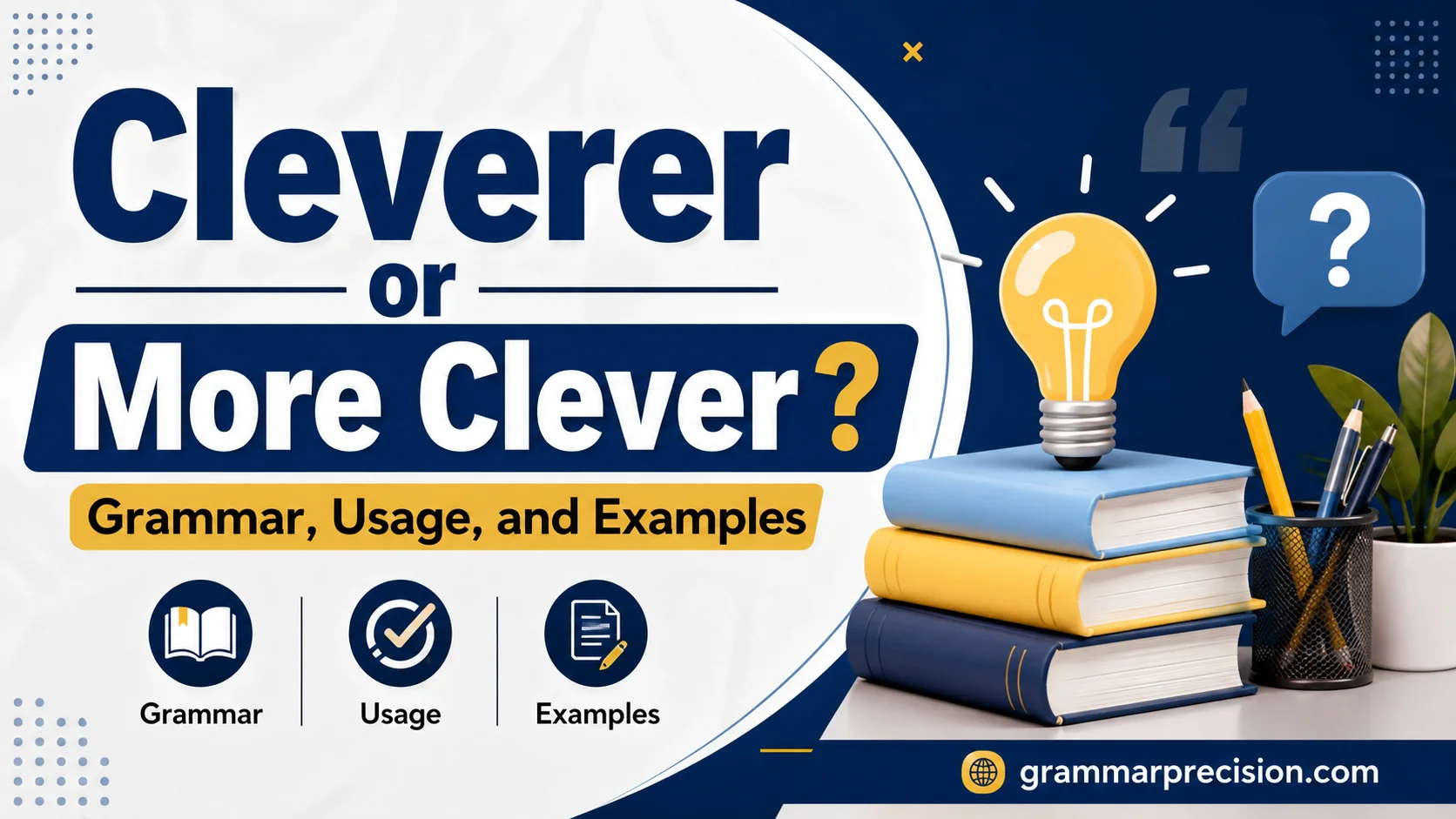
Cleverer or More Clever? Both forms are correct, but context, style, and usage can determine which comparative form sounds more natural in a sentence for you.
The adjective clever has two common comparative forms: cleverer and more clever. Both are grammatically correct, and both can compare people or things. Your choice may depend on sentence rhythm, tone, context, and natural usage. For many English learners, either form works well without changing the intended meaning.
When choosing between them, consider regional usage, style preference, and your audience. Cleverer than and more clever than can both describe greater intelligence or skill. Understanding their nuance, interchangeability, and practical usage can improve clarity and precision, helping you avoid mistakes and stop second-guessing your grammar.
Cleverer or More Clever: The Quick Answer
Both cleverer and more clever are correct comparative forms of clever.
Use them when comparing two people, ideas, actions, solutions, or things.
For example:
- Maria is cleverer than Jake.
- Maria is more clever than Jake.
- This solution is cleverer than the original.
- This solution is more clever than the original.
Neither comparative is automatically wrong.
The main difference involves style, rhythm, and preference rather than basic grammatical correctness. Cleverer follows the traditional comparative pattern of adding -er. More clever uses the analytical comparative pattern with more.
Cleverer vs. More Clever at a Glance
| Form | Correct? | Function | Example |
| clever | Yes | Base adjective | She is clever. |
| cleverer | Yes | Comparative | She is cleverer than him. |
| more clever | Yes | Comparative | She is more clever than him. |
| cleverest | Yes | Superlative | She is the cleverest student. |
| most clever | Yes | Superlative | She is the most clever student. |
So if you’re wondering whether cleverer or more clever is correct, the answer is simple: both are acceptable.
The interesting question is which one works better in your particular sentence.
What Does “Clever” Mean?
Before comparing the two forms, it helps to understand what clever actually means.
Clever usually describes someone or something that shows quick thinking, intelligence, ingenuity, or skill.
For example:
That was a clever solution to a difficult problem.
Here, clever means inventive and effective.
The word can describe people:
- She is clever.
- He’s a clever student.
- My brother is surprisingly clever.
It can also describe ideas and actions:
- That was a clever strategy.
- You found a clever way to fix it.
- The designer created a clever feature.
In some contexts, clever can also carry a slightly negative meaning. Someone might be described as too clever when their intelligence comes across as smug, manipulative, or overly calculated.
For example:
He tried to be clever, but everyone saw through the trick.
Context matters. The comparative forms keep these meanings while showing that one person or thing possesses the quality to a greater degree.
How Comparative Adjectives Work
A comparative adjective compares two people, things, places, ideas, or qualities.
English commonly creates comparatives in two ways:
- Add -er to the adjective.
- Put more before the adjective.
Consider these examples:
| Base adjective | Comparative |
| fast | faster |
| small | smaller |
| bright | brighter |
| careful | more careful |
| useful | more useful |
| interesting | more interesting |
The traditional rule says shorter adjectives often take -er, while longer adjectives generally take more.
However, English isn’t a mathematical formula. Some adjectives allow variation.
Clever is one of those adjectives.
That’s why both cleverer and more clever appear in standard English.
Why Can “Clever” Use Both Forms?
The word clever occupies an interesting position in English adjective formation.
It’s a relatively short adjective, which makes cleverer perfectly reasonable. At the same time, English speakers can use more clever because comparative constructions with more are productive and flexible.
Think of the two forms as different routes to the same destination.
Cleverer takes the shorter grammatical route:
clever → cleverer
More clever takes the analytical route:
clever → more clever
Both communicate the same basic comparison.
Cleverer Follows the “-er” Pattern
The form cleverer adds the comparative suffix -er.
Examples include:
- This plan is cleverer.
- Your idea is cleverer than mine.
- She came up with a cleverer solution.
- The second design is cleverer than the first.
This construction is compact and direct.
More Clever Uses “More”
The form more clever places more before the adjective.
Examples include:
- This plan is more clever.
- Your idea is more clever than mine.
- She came up with a more clever solution.
- The second design is more clever than the first.
The meaning remains essentially the same.
The difference is mostly one of form and style.
When Should You Use “Cleverer”?
Cleverer works especially well when you want a short, direct comparison.
It can sound crisp in everyday writing and conversation.
For example:
This approach is cleverer than the one we tried yesterday.
There’s nothing awkward about that sentence. The comparative form is clear and economical.
You can also use cleverer when describing people:
Emma is cleverer than her older brother.
Or when comparing ideas:
The second proposal is cleverer because it solves both problems at once.
Why “Cleverer” Often Sounds Natural
One advantage of cleverer is brevity.
Instead of saying:
This solution is more clever than the previous one.
you can say:
This solution is cleverer than the previous one.
The second version removes a word without changing the meaning.
That doesn’t make it universally better. Sentence rhythm still matters.
For instance, a sentence containing several consecutive words can sometimes sound smoother with more clever.
Examples of “Cleverer” in Sentences
- This is a cleverer way to organize the files.
- She found a cleverer method for solving the puzzle.
- His second argument was cleverer than his first.
- The new design is cleverer and easier to use.
- You need a cleverer strategy to beat that opponent.
Notice how naturally cleverer fits before nouns and after linking verbs.
When Should You Use “More Clever”?
More clever is equally grammatical and can sometimes sound more comfortable depending on the sentence.
Consider:
The new system is more clever than the old one.
That sentence is completely acceptable.
You might also choose more clever when the sentence already contains several comparative constructions.
For example:
The new design is more efficient and more clever than the original.
Here, repeating more creates a balanced structure:
more efficient + more clever
That parallel structure can make the sentence easier to process.
Why Speakers Choose “More Clever”
English speakers don’t choose words based solely on grammar rules. Sound, rhythm, emphasis, and context also influence word choice.
Imagine you’re explaining two competing inventions:
The first invention is clever, but the second is more clever because it solves the underlying problem.
The repeated more can emphasize the degree of improvement.
In another sentence, cleverer may feel tighter:
The second invention is cleverer.
Neither sentence breaks the rules.
Examples of “More Clever” in Sentences
- This solution is more clever than the first one.
- Her explanation was more clever than I expected.
- The new system is more clever and more efficient.
- They developed a more clever way to handle the problem.
- His latest strategy is more clever than his earlier approach.
The form works particularly well when more creates useful parallelism or emphasis.
Cleverer vs. More Clever: Side-by-Side Examples
Seeing the forms together makes the distinction easier.
| Cleverer | More clever |
| She is cleverer than me. | She is more clever than me. |
| This is a cleverer solution. | This is a more clever solution. |
| He developed a cleverer strategy. | He developed a more clever strategy. |
| The second idea is cleverer. | The second idea is more clever. |
| That was a cleverer move. | That was a more clever move. |
In every example, the basic comparison remains intact.
The choice depends largely on what sounds smoothest in context.
Also Read This: Shudder or Shutter: Meaning, Difference, Examples, and Correct Usage
Cleverer or More Clever in American English
American English accepts both cleverer and more clever.
However, clever itself has a somewhat different flavor in American English than in British English. In the United States, words such as smart, bright, and ingenious often appear where British speakers might use clever.
That doesn’t make clever unusual or incorrect in American English. It simply means context can influence how natural a sentence feels.
For example:
She’s cleverer than her classmates.
is grammatically fine.
So is:
She’s more clever than her classmates.
If the goal is concise everyday writing, cleverer is often an attractive choice. If more clever creates better rhythm or parallel structure, use it without hesitation.
Cleverer or More Clever in Formal Writing
Formal writing doesn’t require you to avoid cleverer.
Some writers mistakenly assume that more clever must be more formal because it contains more. That’s not how English grammar works.
Consider:
The revised method is cleverer because it eliminates an unnecessary step.
That’s perfectly suitable for formal prose.
You could also write:
The revised method is more clever because it eliminates an unnecessary step.
Again, both are grammatical.
When writing professionally or academically, focus on clarity, precision, and sentence rhythm rather than trying to make one comparative form sound artificially formal.
Cleverer or More Clever in Conversation
Conversation often favors shorter constructions because speakers naturally economize their words.
That’s one reason cleverer can sound especially neat in casual speech.
Imagine two friends discussing a puzzle:
“Your solution is cleverer than mine.”
Short. Clear. Done.
However, more clever doesn’t sound wrong in conversation:
“Your solution is more clever than mine.”
The listener understands the comparison immediately.
In spoken English, intonation can also influence the choice. A speaker might stress more clever when emphasizing the degree of improvement.
Cleverer or More Clever? A Real-World Case Study
Imagine a software team has two ways to solve a problem.
The first solution works but requires several manual steps. The second automates most of the process.
A developer might say:
The second solution is cleverer because it removes three unnecessary steps.
Another developer could say:
The second solution is more clever because it removes three unnecessary steps.
Both statements express the same central idea.
The first feels more compact. The second may place greater emphasis on more.
Now imagine the sentence changes:
The second solution is more efficient and more clever.
Here, more clever works nicely because it mirrors more efficient.
That’s an important lesson: grammar gives you options, but context helps you choose between them.
Cleverer or More Clever: Which One Should You Choose?
When both forms are correct, use sentence rhythm as your guide.
Choose cleverer when:
- You want a concise comparative.
- The sentence already flows naturally with -er.
- You’re writing straightforward prose.
- You want a compact comparison.
- The surrounding sentence doesn’t require parallel more constructions.
Choose more clever when:
- It creates better sentence rhythm.
- You want parallel wording with another more + adjective construction.
- You want to emphasize the comparative idea.
- The sentence sounds smoother with more clever.
- You’re comfortable with the analytical comparative pattern.
There’s no need to force one form into every sentence.
Cleverer or More Clever? Common Mistakes
Although both forms work, several mistakes regularly cause trouble.
Mistake: Using “More Cleverer”
You shouldn’t combine both comparative markers.
Incorrect:
She is more cleverer than her sister.
The sentence contains more and -er together.
Use one or the other:
She is cleverer than her sister.
Or:
She is more clever than her sister.
This rule applies broadly to comparative adjectives.
You wouldn’t normally say more faster or more smaller. The same principle applies here.
Mistake: Forgetting the Comparison
Comparatives often introduce a comparison between two things.
For example:
This method is cleverer than the old one.
The word than makes the comparison explicit.
However, you can also use a comparative without stating the second item when the context already makes it clear:
We need a cleverer approach.
The implied meaning is that the current approach isn’t clever enough.
Mistake: Assuming “More Clever” Is Wrong
Some grammar learners are taught that short adjectives must always take -er.
That’s an oversimplification.
English has patterns, but it also has variation. Cleverer and more clever are both established comparative forms.
Don’t turn a useful guideline into an absolute rule.
Cleverer, More Clever, Cleverest, or Most Clever?
Comparatives aren’t the only forms that can cause confusion.
The superlative forms are cleverest and most clever.
Use a comparative when comparing two things:
Jack is cleverer than Tom.
Use a superlative when identifying the highest degree within a group:
Jack is the cleverest student in the class.
You can also say:
Jack is the most clever student in the class.
Both superlative forms are acceptable.
| Degree | -er/-est form | More/most form |
| Positive | clever | clever |
| Comparative | cleverer | more clever |
| Superlative | cleverest | most clever |
The key distinction is simple:
Comparative = two or more items being compared.
Superlative = one item stands at the highest degree within a group.
20 Natural Examples of Cleverer or More Clever
Here are practical examples showing how both forms work.
- This is a cleverer way to solve the problem.
- This is a more clever way to solve the problem.
- Sarah is cleverer than her brother.
- Sarah is more clever than her brother.
- We need a cleverer strategy.
- We need a more clever strategy.
- His second answer was cleverer.
- His second answer was more clever.
- The new design is cleverer than the old one.
- The new design is more clever than the old one.
- She created a cleverer solution.
- She created a more clever solution.
- That was a cleverer move.
- That was a more clever move.
- The updated system is cleverer and faster.
- The updated system is more clever and more efficient.
- Your approach is cleverer than mine.
- Your approach is more clever than mine.
- They found a cleverer way around the obstacle.
- They found a more clever way around the obstacle.
These examples show why context matters more than rigid rules.
Related Comparative Adjectives
Clever isn’t the only adjective that creates questions about comparative forms.
Consider these examples:
| Adjective | Common comparative |
| smart | smarter |
| bright | brighter |
| simple | simpler |
| narrow | narrower |
| quiet | quieter |
| careful | more careful |
| useful | more useful |
| effective | more effective |
| interesting | more interesting |
| complicated | more complicated |
The pattern becomes clearer when you compare adjective length and structure.
Short adjectives frequently use -er. Longer adjectives commonly use more. Yet English allows exceptions and competing forms.
That’s why you should learn the general pattern without treating it like an ironclad formula.
A Simple Decision Guide
Still unsure whether to use cleverer or more clever?
Use this quick process.
First, ask whether you’re making a comparison.
If yes, you need a comparative form.
Next, try “cleverer.”
If the sentence sounds natural, you’re finished.
Then try “more clever.”
If that version has better rhythm or creates useful parallel structure, choose it instead.
For example:
This approach is cleverer and cheaper.
works well.
So does:
This approach is more clever and more efficient.
The surrounding words can guide your decision.
The Fast Rule
Cleverer and more clever are both correct. Choose the form that makes your sentence clearer and more natural.
That’s the practical rule worth remembering.
FAQs:
Is “cleverer” grammatically correct?
Yes, cleverer is grammatically correct. It’s the traditional comparative form of clever and is widely used in English. For example, “Sarah is cleverer than Tom” is completely correct.
Is “more clever” grammatically correct?
Yes, more clever is also grammatically correct. It can sound more natural in some sentences, depending on context, style, and sentence rhythm. It has the same basic meaning as cleverer.
Which is more common, “cleverer” or “more clever”?
Both forms are used, but cleverer is often preferred in everyday English, while more clever can sound natural in certain contexts. Your choice can depend on regional usage, personal preference, and the surrounding sentence.
Should I use “cleverer than” or “more clever than”?
You can use either cleverer than or more clever than because both are grammatically correct. If you’re unsure, choose the form that sounds more natural and fits your sentence clearly.
Do “cleverer” and “more clever” mean the same thing?
Yes, they generally have the same meaning. Both forms compare someone or something as having more intelligence, skill, or cleverness. The main difference is usually style, tone, or usage, not meaning.
Conclusion:
Both cleverer and more clever are grammatically correct comparative forms of clever. In most situations, you can choose either one without changing the meaning. Cleverer may sound more natural to many speakers, while more clever can work well depending on context and style. When writing, consider sentence rhythm, audience, and regional usage.
Most importantly, don’t second-guess yourself because both forms are acceptable.