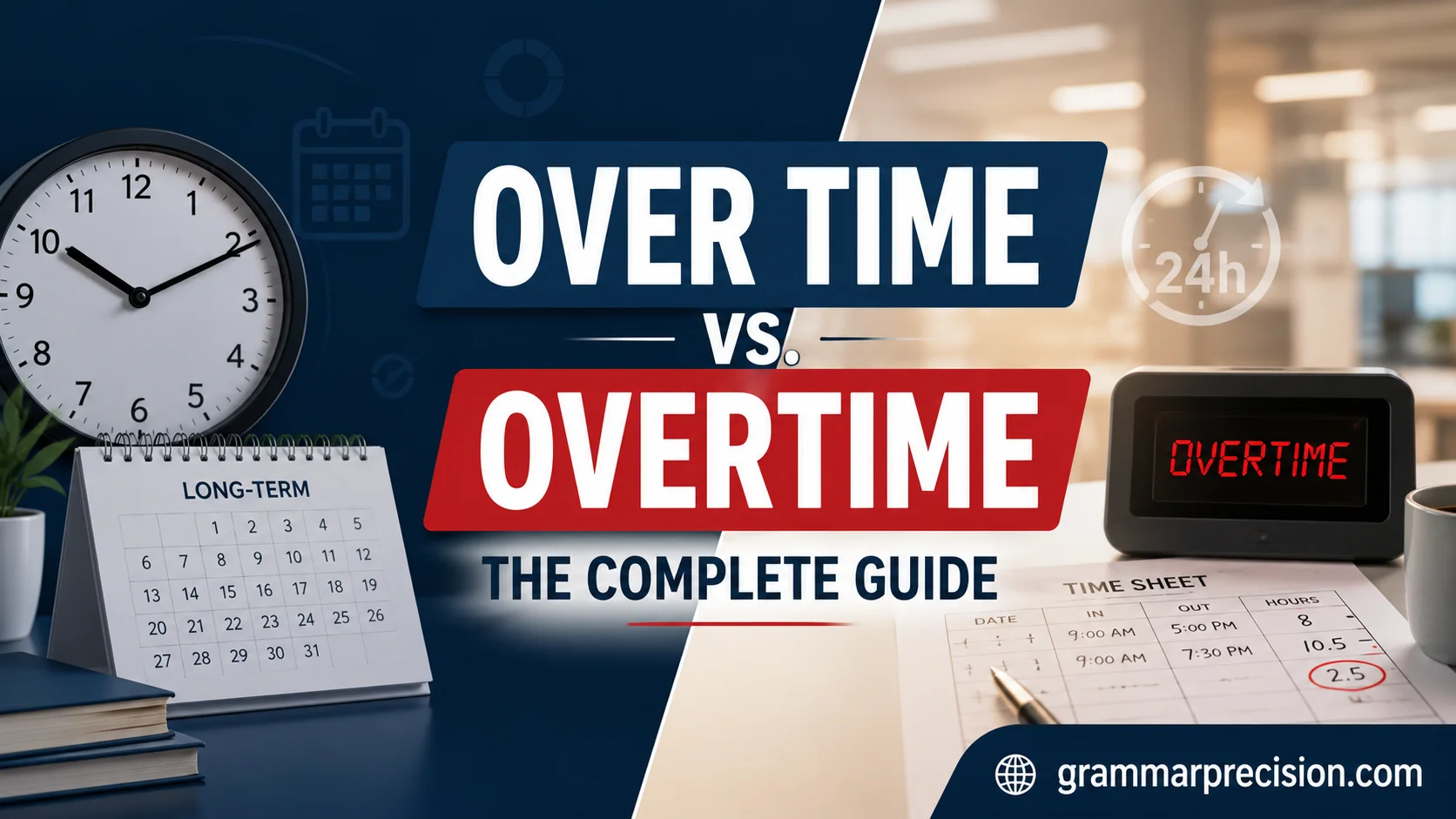
Over Time vs. Overtime helps you learn the difference between these confusing terms with simple examples and clear explanations. This guide shows how each word works in English today.
The word Overtime describes extra work hours beyond a regular schedule when employees complete additional tasks. It may include overtime pay, compensation, and special rates based on company rules or labor standards. A worker with a normal work week of 40 hours may receive extra payment after reaching the expected limit during a pay period.
The phrase over time means something happens gradually through a period of change. It shows how progress develops little by little in daily life, writing, and conversations. Remembering this difference prevents confusion because a tiny space can change meaning completely. Using these terms correctly makes your writing sound more natural and clear in professional settings.
Over Time vs. Overtime: The Quick Difference Explained
The easiest way to remember the difference is simple:
- Over time = gradually or during a period of time
- Overtime = extra time beyond what is normally expected
Here is a quick comparison:
| Word/Phrase | Meaning | Grammar Role | Example |
| Over time | Something happens gradually | Prepositional phrase | The city has changed over time. |
| Overtime | Extra working hours or additional time | Noun/adverb | He worked overtime on Friday. |
Think of it this way:
Over time shows a journey. Overtime shows extra effort.
When something develops slowly, grows, changes, or improves, you usually need over time. When someone works longer than their scheduled hours, you need overtime.
What Does “Over Time” Mean?
Over Time Meaning and Definition
Over time means gradually, little by little, or throughout a period. It describes a change or development that happens as time passes.
The phrase focuses on the process rather than a specific moment.
For example:
A small habit can create big results over time.
This sentence means the results do not appear immediately. They develop slowly through repeated actions.
You can use over time when talking about:
- Growth
- Improvement
- Changes
- Development
- Trends
- Progress
- Long-term effects
Examples of “Over Time” in Everyday Sentences
Here are common examples:
Personal Growth
Your confidence grows over time when you practice consistently.
Confidence does not appear overnight. It builds through experiences, mistakes, and learning.
Learning New Skills
You will become better at writing over time.
Nobody becomes an expert instantly. Skills develop through patience and repetition.
Technology Changes
Technology has evolved over time.
This refers to gradual changes that happened across years or decades.
Relationships
Strong friendships develop over time.
Trust usually takes months or years to build.
Common Expressions Using “Over Time”
English speakers frequently use these phrases:
| Expression | Meaning | Example |
| Improve over time | Become better gradually | Your grammar will improve over time. |
| Change over time | Become different gradually | Languages change over time. |
| Develop over time | Grow slowly | The idea developed over time. |
| Increase over time | Become larger gradually | Prices increased over time. |
| Decrease over time | Become smaller gradually | The demand decreased over time. |
These expressions appear often in business reports, research papers, and everyday conversations.
What Does “Overtime” Mean?
Overtime Meaning and Definition
Overtime means extra time spent working beyond regular working hours. It can also refer to extra periods added to a sports game when the regular time ends without a winner.
The word is commonly connected with employment.
For example:
The employees worked overtime during the busy season.
This means they worked more hours than their normal schedule required.
Overtime in the Workplace
In professional settings, overtime usually means working beyond your standard hours.
For example:
- A person normally works eight hours per day.
- The person stays three additional hours.
- Those three extra hours are overtime.
Many companies offer additional payment for overtime work.
A typical workplace example:
Maria worked overtime all week because the company had an important deadline.
The focus is not gradual change. The focus is extra working time.
Overtime Pay Explained
Overtime pay is additional money employees may receive for working beyond normal hours.
In the United States, overtime rules are often connected to the Fair Labor Standards Act (FLSA). Many eligible employees must receive at least one and a half times their regular pay rate for hours worked beyond 40 hours in a workweek.
Example:
| Regular Pay | Overtime Rate |
| $20 per hour | $30 per hour |
If an employee works overtime, their additional hours may be paid at a higher rate depending on their employment status and applicable laws.
Overtime in Sports
Overtime does not only belong to workplaces.
Sports also use the word when a game needs extra time to determine a winner.
Examples:
- The basketball game went into overtime.
- The teams played five minutes of overtime.
In this situation, overtime means extra playing time after the normal game period ends.
Over Time vs. Overtime: Side-by-Side Comparison
The difference becomes clearer when you compare their uses.
| Situation | Correct Word | Example |
| Learning a language gradually | Over time | You’ll improve over time. |
| Working extra hours | Overtime | He earned overtime pay. |
| Historical changes | Over time | Society changes over time. |
| Extra sports period | Overtime | The match went into overtime. |
| Building experience | Over time | Experience grows over time. |
| Staying late at work | Overtime | She worked overtime yesterday. |
A useful question can help:
Can you replace it with “gradually”?
If yes, use over time.
Example:
Skills improve gradually.
Skills improve over time.
Can you replace it with “extra working hours”?
If yes, use overtime.
Example:
He worked extra hours.
He worked overtime.
Also Read This: Newfound or New-Found or New Found? The Complete Guide
Why Does One Space Change the Meaning?
The difference between over time and overtime comes from how English combines words.
Many English expressions begin as separate words but later become one word when their meanings develop.
Compare:
- Every day → Everyday
- A while → Awhile
- Over time → Overtime
However, the meanings do not always stay connected.
For example:
Every day means each day.
I exercise every day.
Everyday means ordinary or common.
These are my everyday shoes.
The same idea applies to:
- Over time = gradually
- Overtime = extra time
The missing space creates a completely different meaning.
Common Mistakes With Over Time and Overtime
Many writers confuse these words because they sound similar.
Let’s look at some common errors.
Mistake: Using “Overtime” for Gradual Change
Incorrect:
Technology improves overtime.
Correct:
Technology improves over time.
Why?
Technology does not receive extra working hours. It develops gradually.
Mistake: Using “Over Time” for Extra Work
Incorrect:
She worked over time last weekend.
Correct:
She worked overtime last weekend.
Why?
The sentence refers to extra working hours.
Mistake: Confusing Long Duration With Extra Time
A long period does not always mean overtime.
Incorrect:
The company changed overtime.
Correct:
The company changed over time.
The company developed or became different gradually.
Over Time vs. Overtime Memory Tricks
Remembering grammar rules becomes easier when you connect them with images.
Memory Trick 1: Think About a Timeline
Over time = timeline
Imagine a line showing years passing.
Example:
2015 ——– 2020 ——– 2025
Growth happens slowly
That is over time.
Memory Trick 2: Think About a Clock at Work
Overtime = extra hours
Imagine an employee looking at the clock after their shift ends.
Normal shift: 9 AM – 5 PM
Extra hours: 5 PM – 8 PM
= Overtime
Real-Life Case Study: How Context Changes the Word
Consider this example:
Situation:
A small business starts with five employees. After ten years, it becomes a large company.
Correct sentence:
The company grew over time.
Why?
The growth happened gradually.
Now consider another situation:
The company receives a huge order. Employees stay late for two weeks.
Correct sentence:
Employees worked overtime to complete the order.
Why?
They worked extra hours.
The situation determines the correct word.
Over Time vs. Overtime in Professional Writing
Choosing the correct word matters in professional communication.
A small spelling mistake can make your writing appear careless.
Business Examples
Incorrect:
Sales increased overtime.
Correct:
Sales increased over time.
Incorrect:
Employees received over time payments.
Correct:
Employees received overtime payments.
Academic Writing Examples
Researchers often describe changes over periods.
Correct:
The population increased over time.
Correct:
The study examines how behavior changes over time.
Academic writing rarely uses overtime unless discussing labor or work-related topics.
FAQs:
What is the difference between Over Time and Overtime?
Over time means something happens gradually or develops slowly across a period. Overtime refers to extra working hours beyond a regular schedule, usually with additional pay. The difference is the space between the words, which changes their meanings completely.
Is overtime always related to work?
Mostly, overtime relates to extra work hours completed by employees beyond their normal schedule. However, it can also describe extra time added to a sporting event to decide a winner when a game ends in a tie.
How can I remember the difference between over time and overtime?
A simple way to remember is that overtime is connected with work and extra hours, while over time describes a gradual process or change. Think of the space in over time as representing a period of time passing.
Can over time be used in everyday sentences?
Yes, over time is commonly used in daily conversations, writing, and professional communication. For example, you can say, “My confidence improved over time,” because the change happened gradually through different stages.
Why do people confuse Over Time and Overtime?
People confuse these terms because they have similar spelling and pronunciation. They look almost identical, but their meanings are different. Understanding their correct usage helps you avoid mistakes and create clearer, more precise sentences.
Conclusion:
Understanding Over Time vs. Overtime helps improve your English writing and communication skills. Although both terms look similar, their meanings are different. Overtime focuses on extra work hours and payment, while over time describes gradual changes. Learning this simple distinction allows you to write more clearly, avoid confusion, and use both expressions correctly in everyday situations.