At first glance, annunciate vs enunciate looks like a tiny spelling puzzle. The words share several letters and sound remarkably similar, so it’s easy to assume they mean roughly the same thing. They don’t.
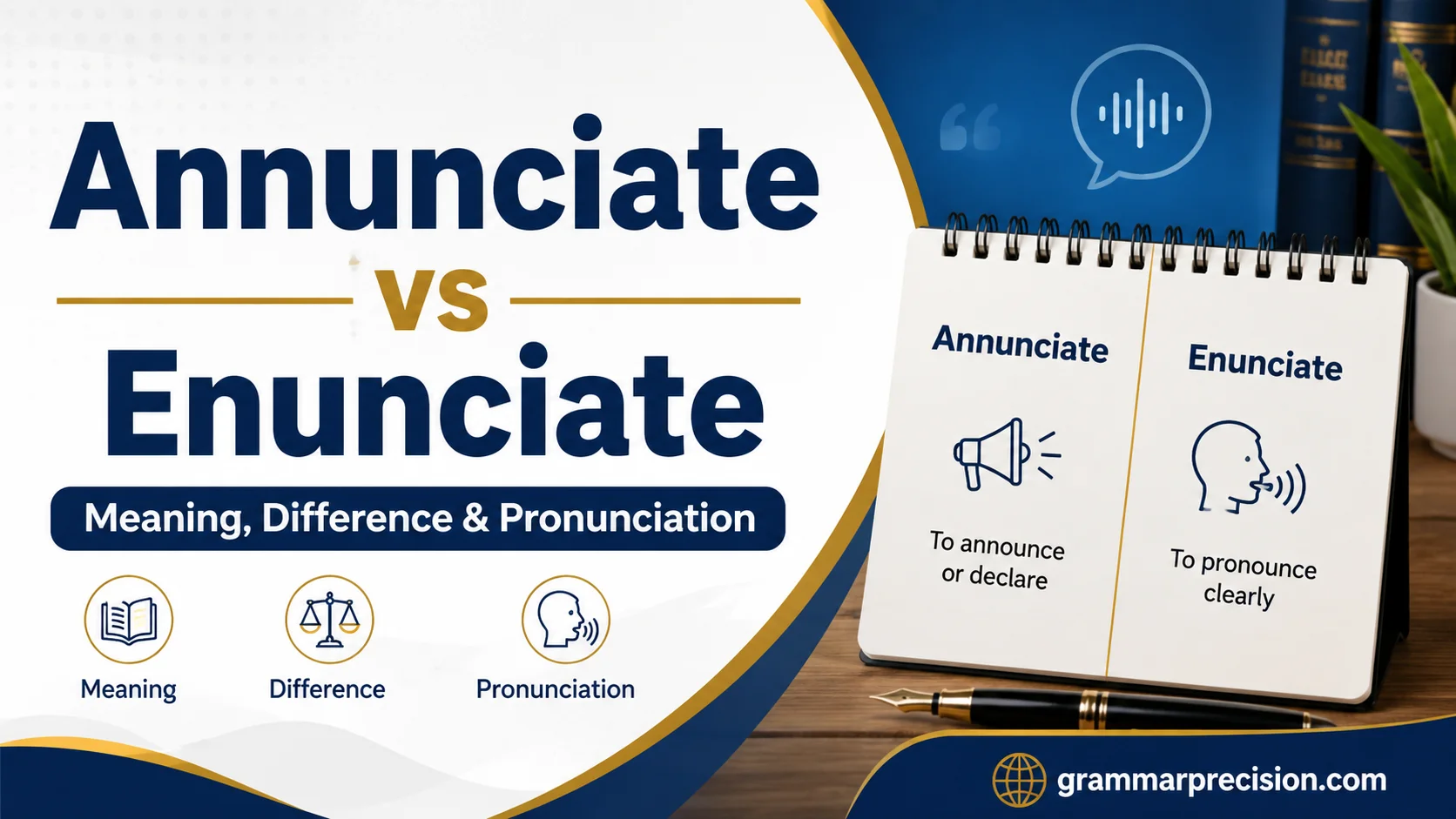
The simplest distinction is this: annunciate means to announce or proclaim something, while enunciate means to speak or pronounce something clearly. One focuses on making information known. The other focuses on making spoken words distinct and understandable.
That small difference matters. If you tell a speaker to annunciate every word, you probably chose the wrong verb. If you say someone enunciated the winner, you’ve also missed the mark.
Annunciate vs Enunciate: The Quick Difference
The easiest way to separate annunciate and enunciate is to focus on their central actions.
| Word | Basic meaning | Main focus | Simple synonym |
| Annunciate | To announce or proclaim | Making information known | Announce |
| Enunciate | To pronounce or express clearly | Making speech distinct | Articulate |
| Pronounce | To produce the sounds of a word | Correct word sounds | Say |
| Articulate | To express an idea clearly | Clear expression | Express |
Think of it this way:
Annunciate → announcement
Enunciate → clear speech
For example:
- The spokesperson annunciated the organization’s decision.
- The teacher asked the student to enunciate each word.
- The news anchor annunciated the result.
- The news anchor enunciated the report clearly.
The first pair concerns what information gets announced. The second concerns how clearly someone delivers words.
A One-Line Memory Trick
You annunciate a message, but you enunciate the words used to deliver it.
That distinction will solve most usage questions.
What Does Annunciate Mean?
Annunciate is a verb meaning to announce, proclaim, or make something known. It’s a relatively uncommon word in modern everyday English, where announce usually sounds more natural.
The word can describe formally declaring information, communicating a decision, or making something publicly known.
For example:
- The chairman annunciated the company’s new policy.
- The official annunciated the final decision.
- The ceremony annunciated a new era for the organization.
However, context matters. In ordinary conversation, most people would simply say:
“The chairman announced the new policy.”
That doesn’t make annunciate incorrect. It simply makes it less common and more formal or literary in many contexts.
Annunciate in Plain English
If announce means “tell people something officially,” annunciate can carry essentially that same idea.
Imagine a town crier standing in a crowded square centuries ago. His job is to make information known to everyone listening. That’s the conceptual territory of annunciate.
The word centers on the message or declaration.
It doesn’t primarily tell you whether the speaker articulated every syllable beautifully.
Annunciate Example Sentences
Here are several examples showing how the word works:
- The director annunciated the company’s plans during the meeting.
- The presenter annunciated the winner after a brief pause.
- The government spokesperson annunciated the new regulations.
- The ceremony annunciated the beginning of a new chapter.
- The organization formally annunciated its decision to the public.
In many of these sentences, announce would be the more familiar choice.
That’s an important usage point. A word can be grammatically valid without being the most natural option in every situation.
Annunciate Synonyms
Depending on context, alternatives include:
- announce
- declare
- proclaim
- communicate
- publish
- make known
- state
- report
The best synonym depends on the tone. Proclaim often sounds grander, while announce works in everyday English.
What Does Enunciate Mean?
Enunciate means to pronounce words clearly and distinctly. It can also mean to express or formulate something clearly, especially an idea, statement, or proposition.
This word frequently appears in discussions about:
- Public speaking
- Acting
- Broadcasting
- Teaching
- Presentations
- Speech training
- Pronunciation
- Clear communication
For example:
“Please enunciate the final sentence.”
Here, the speaker isn’t being asked to make an announcement. They’re being asked to make the sounds and words easier to understand.
Enunciate in Plain English
To enunciate is to give your words enough clarity that listeners can distinguish them easily.
Picture a presenter speaking to a large auditorium. If the presenter swallows syllables, rushes through sentences, or mumbles, the audience may struggle to follow the message.
Good enunciation gives each word a cleaner edge.
That doesn’t necessarily mean speaking slowly. Clear speech and slow speech aren’t identical. A skilled speaker can speak quickly while still enunciating well.
Enunciate Example Sentences
- Please enunciate your words during the presentation.
- The actor enunciated every line clearly.
- She enunciates particularly well when speaking to large audiences.
- The teacher reminded the class to enunciate difficult terms.
- The broadcaster enunciated the names carefully.
- He slowed down slightly to enunciate the technical vocabulary.
Notice what these sentences have in common: clarity of speech sits at the center.
Annunciate vs Enunciate: Side-by-Side Comparison
A comparison table makes the distinction easier to see.
| Feature | Annunciate | Enunciate |
| Part of speech | Verb | Verb |
| Core meaning | Announce or proclaim | Speak or express clearly |
| Main concern | The information being made known | The clarity of delivery |
| Common setting | Formal announcements | Speech and communication |
| Everyday alternative | Announce | Articulate or speak clearly |
| Related noun | Annunciation | Enunciation |
| Typical object | A decision, message, event, or declaration | Words, sounds, phrases, ideas |
| Frequency in everyday English | Relatively uncommon | Much more familiar |
| Main memory clue | Announcement | Clear articulation |
The most useful distinction remains simple:
Annunciate = make something known.
Enunciate = make something clear through speech.
The Biggest Difference: What You Say vs. How You Say It
Here’s a useful way to understand the difference without memorizing dictionary definitions.
Annunciate focuses on the message.
Enunciate focuses on delivery.
Suppose a principal stands before a school and says:
“Classes will begin at 8:00 a.m. tomorrow.”
If the principal formally announces that information, the focus is on the declaration.
If the principal speaks slowly enough for every student to understand the words, the focus is on enunciation.
The same person can do both.
For instance:
The principal annunciated the schedule change and enunciated every detail clearly.
The first verb describes the act of announcing. The second describes the clarity of the speech.
That’s the conceptual key.
Annunciate vs Enunciate Examples in Real Situations
Real-world examples make these distinctions much easier to remember.
Formal Announcements
Imagine a company CEO speaking during an annual meeting:
“Today, we’re opening a new research center.”
The CEO annunciates the company’s new development.
If the CEO speaks distinctly enough for everyone to understand, the CEO also enunciates the announcement well.
Classroom Communication
A teacher might say:
“Please enunciate the word photosynthesis.”
The teacher isn’t asking the student to announce photosynthesis to the class. The teacher wants the student to pronounce the word clearly.
That makes enunciate the appropriate choice.
Broadcasting
News anchors need both skills.
A broadcaster may annunciate an important development by formally reporting it. At the same time, the broadcaster must enunciate names, places, dates, and technical terms clearly.
A difficult name becomes especially revealing. Saying it loudly isn’t enough. The listener needs the individual sounds to remain distinguishable.
Public Speaking
Public speakers also benefit from both concepts.
A speaker can annunciate a major policy proposal while enunciating each key phrase.
The first concerns the act of presenting information. The second concerns the quality of its spoken delivery.
Also Read This: Did You Have vs Did You Had: Complete Grammar Guide
Annunciate vs Enunciate in the Same Sentence
Putting both words together provides one of the clearest demonstrations.
Consider:
The presenter annunciated the winner and enunciated the winner’s name carefully.
Here, the presenter annunciated the winner by making the result known.
The presenter enunciated the name by pronouncing it distinctly.
Another example:
The spokesperson annunciated the new policy but failed to enunciate several technical terms.
This sentence shows how the verbs perform different jobs even within the same event.
A speaker can therefore succeed at one and struggle with the other.
Enunciate vs Pronounce: Are They the Same?
Enunciate and pronounce overlap, but they aren’t perfect synonyms.
To pronounce a word means to produce its accepted sounds when saying it.
To enunciate a word means to express its sounds clearly and distinctly.
Consider someone saying the word particularly correctly but mumbling it so badly that listeners can barely understand it. The person may technically know the correct pronunciation, yet their enunciation could still be poor.
The distinction becomes clearer in these examples:
- “How do you pronounce this word?” → asks about its correct sounds.
- “Please enunciate that word.” → asks you to say it clearly.
- “She pronounced the name correctly.” → focuses on correctness.
- “She enunciated the name carefully.” → focuses on clarity.
In short, pronunciation concerns correctness, while enunciation emphasizes clarity and distinctness.
Annunciate vs Enunciate vs Articulate
Another common source of confusion is articulate.
The four words sit near one another semantically, but they aren’t interchangeable.
| Word | What it emphasizes | Example |
| Annunciate | Announcing information | He annunciated the decision. |
| Enunciate | Speaking distinctly | She enunciated every word. |
| Pronounce | Producing correct word sounds | He pronounced the name correctly. |
| Articulate | Expressing an idea clearly | She articulated her concerns. |
Articulate can describe speech, but it often reaches beyond individual sounds. Someone can articulate an argument, position, concern, or idea.
For example:
She articulated her concerns about the proposal.
You wouldn’t normally replace articulated with enunciated here because the sentence concerns the clear expression of an idea rather than simply distinct pronunciation.
How to Pronounce Annunciate and Enunciate
Although spelling can make these words look intimidating, their pronunciation becomes easier when you break them into syllables.
Annunciate: uh-NUN-see-ate
Enunciate: ih-NUN-see-ate
Both words contain a prominent “nun-see-ate” sound pattern. That similarity explains part of the confusion.
The key isn’t merely learning how they sound. You also need to connect each sound with its meaning.
Try this:
Annunciate → announce
Enunciate → clear speech
Once that association becomes automatic, the similar pronunciation becomes less troublesome.
Why Do Annunciate and Enunciate Look So Similar?
Their resemblance isn’t accidental.
Both words trace back to Latin vocabulary associated with speaking, declaring, or making something known. Their histories passed through related forms before entering English.
Annunciate is connected with Latin annuntiare, meaning to announce or report.
Enunciate comes from Latin enuntiare, associated with declaring, stating, or expressing.
Their related historical roots help explain why modern English inherited two words with such similar forms.
However, etymology shouldn’t become a maze. For practical writing, the modern distinction matters most.
Common Mistakes With Annunciate and Enunciate
These words tend to cause predictable errors.
Using Annunciate for Clear Speech
Incorrect in the intended sense:
Please annunciate your words.
If the speaker means “say your words clearly,” enunciate is the better choice:
Please enunciate your words.
Using Enunciate for an Announcement
Consider:
The mayor enunciated the new election date.
This sounds as though the mayor articulated the words clearly rather than formally announced the date.
If the intended meaning is “made the information known,” annunciated fits better, although announced sounds much more natural:
The mayor announced the new election date.
Assuming Annunciate and Announce Are Always Equally Natural
Although annunciate can mean announce, announce is usually the more familiar choice in everyday American English.
Compare:
The company announced its new product.
with:
The company annunciated its new product.
The first sentence sounds ordinary and natural. The second is much less common and may sound unusually formal.
That difference in register matters when you’re trying to write naturally.
A 10-Second Memory Trick
You don’t need a complicated mnemonic.
Just remember these two associations:
ANNUNCIATE → ANNOUNCE
ENUNCIATE → EXPRESS CLEARLY
Or use this sentence:
You annunciate the news, but you enunciate the words.
That sentence creates a clean mental boundary between the two verbs.
If you’re still uncertain, ask yourself one question:
Am I announcing information, or am I making speech clearer?
If you’re announcing information, choose annunciate when that formal word fits.
If you’re making speech clearer, choose enunciate.
Which Word Should You Use?
The right choice depends on what you want the verb to communicate.
Choose Annunciate When:
- You mean announce.
- You mean proclaim.
- Someone is formally making information known.
- The focus rests on a declaration or message.
Choose Enunciate When:
- You mean speak clearly.
- You mean pronounce distinctly.
- Someone is working on speech clarity.
- The listener needs to distinguish individual words or sounds.
A quick decision guide looks like this:
Are you making information known?
↓
ANNUNCIATE
Are you making spoken words clearer?
↓
ENUNCIATE
For everyday American English, there’s another useful consideration:
Use “announce” when you simply mean announce.
Use “enunciate” when you specifically mean speak clearly or distinctly.
That approach keeps your writing precise without making it unnecessarily ornate.
Quick Practice Quiz
Choose annunciate or enunciate in each sentence.
- The presenter was asked to ______ every technical term clearly.
- The organization will ______ its new policy tomorrow.
- The actor needs to ______ the final line more clearly.
- The spokesperson formally ______ the company’s decision.
- The teacher told the student to ______ the unfamiliar word.
- The director ______ the winners at the ceremony.
Answers
- enunciate
- annunciate
- enunciate
- annunciate
- enunciate
- annunciate
The pattern should now feel familiar. Announcements are annunciated; words are enunciated clearly.
FAQs:
Is “annunciate” the same as “announce”?
Annunciate can mean to announce, proclaim, or make something known. However, announce is far more common in everyday American English. Use annunciate when you want a more formal or literary tone.
What does “enunciate” mean?
Enunciate means to pronounce or express words clearly and distinctly. It often describes careful speech during presentations, teaching, acting, broadcasting, or public speaking.
Is “enunciate” the same as “pronounce”?
Not exactly. Pronounce focuses on saying a word correctly, while enunciate emphasizes saying it clearly enough for others to understand.
Can you use “annunciate” and “enunciate” interchangeably?
No. They have different meanings. Annunciate relates to announcing information, while enunciate relates to clear and distinct speech.
What is the easiest way to remember the difference?
Think annunciate → announce and enunciate → clear speech. You annunciate news or a decision, but you enunciate words, phrases, or sounds.
Conclusion:
Understanding annunciate vs enunciate is easier once you focus on their core meanings. Annunciate means to announce or proclaim something, while enunciate means to speak clearly and distinctly. Remember the simple distinction: annunciate = announce; enunciate = clear speech. With this rule, you can choose the right word confidently in both writing and conversation.