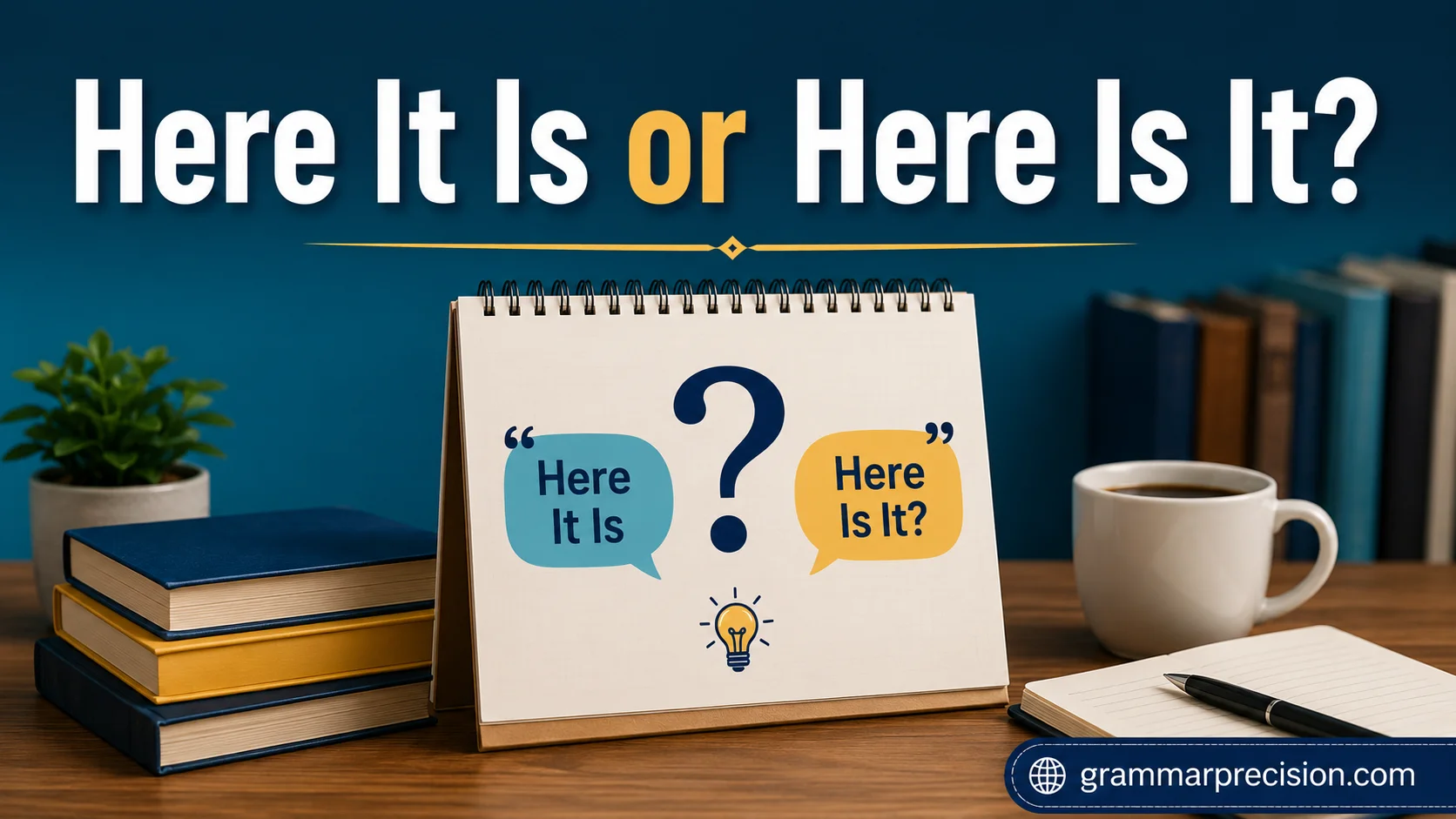
Here It Is or Here Is It? often confuses English learners because both phrases look similar, yet only one sounds natural and grammatically correct in everyday communication.
Many people wonder why “Here It Is or Here Is It?” creates so much confusion. The answer lies in English word order, subject-verb placement, and how native speakers naturally form sentences. Understanding this simple grammar rule will help you communicate with greater accuracy and confidence in both speaking and writing.
If you’ve ever hesitated before using these phrases, you’re not alone. This guide explains the correct usage, highlights common mistakes, provides real-world examples, and shares practical tips to help you remember the right expression. By the end, you’ll confidently choose the grammatically correct phrase every time.
The Short Answer
If you’re looking for the quick answer, here it is:
| Phrase | Correct? | Natural in Modern English? |
| Here it is | ✅ Yes | Yes |
| Here is it | ❌ Almost never | No |
In nearly every conversation, “Here it is” is the correct choice.
Examples
- Here it is! I finally found your keys.
- Here it is. This is the report you requested.
- Here it is! Your coffee is ready.
Compare those with the incorrect versions:
- ❌ Here is it.
- ❌ Here is it, your phone.
- ❌ Here is it that you wanted.
The second group feels unnatural because English doesn’t normally place the verb before the pronoun “it” in this type of expression.
Quick Tip: Whenever you’re handing someone something or pointing something out, say “Here it is.”
What Does “Here It Is” Mean?
The phrase “Here it is” simply means “This is the thing you were looking for” or “I have found it” or “I’m presenting it now.”
Native speakers use this expression every day because it’s short, friendly, and natural.
You might hear it in homes, offices, classrooms, restaurants, airports, and almost anywhere people communicate.
For example:
- Someone asks for a pen.
- You search your desk.
- You find it.
- You say:
“Here it is!”
The phrase instantly tells the listener that the object has been found or is now available.
Everyday Situations Where You Use “Here It Is”
You’ll hear this phrase in many different settings.
Handing Someone an Object
Perhaps the most common use happens when giving someone something.
Examples
- Here it is. Your passport.
- Here it is. I found your wallet.
- Here it is. The charger was under the couch.
These short responses sound completely natural because English favors this word order.
Finding Something
After searching for an item, people often announce their success with “Here it is!”
Imagine looking for your glasses for fifteen minutes.
Then suddenly you notice them sitting on the kitchen counter.
You smile and say,
“Here it is!”
The sentence expresses both discovery and relief.
Responding to a Request
Suppose your coworker says,
“Can you send me yesterday’s report?”
A few seconds later, you email the file and reply,
“Here it is.”
Simple.
Professional.
Natural.
Showing Information
You can also use the phrase when introducing information rather than a physical object.
Examples include:
- Here it is. The answer to your question.
- Here it is. Today’s weather forecast.
- Here it is. The final schedule.
Although you’re presenting information instead of an object, the grammar stays exactly the same.
Why Do People Get Confused?
If “Here it is” is correct, why do so many learners say “Here is it”?
Several reasons explain the confusion.
Direct Translation From Other Languages
Many languages place words in a different order.
A learner may translate directly into English instead of following English grammar rules.
For example, another language might naturally arrange the sentence as:
Here + is + it
Unfortunately, English doesn’t usually work that way.
Memorizing Words Instead of Patterns
Some learners memorize vocabulary without learning sentence structure.
They know:
- here
- is
- it
Since all three words are correct individually, they assume any order should also be correct.
English isn’t that flexible.
Word order changes meaning and naturalness.
Overthinking Grammar
Ironically, advanced learners sometimes make this mistake because they try too hard.
They know that “is” comes before nouns in sentences like:
- Here is the book.
- Here is your phone.
- Here is my backpack.
Then they replace the noun with “it.”
That seems logical.
Yet English follows a different rule when the subject becomes a pronoun.
The Grammar Behind “Here It Is”
Understanding one grammar rule clears up nearly all confusion.
English normally follows this sentence pattern:
Subject + Verb + Object
For example:
- Sarah found the keys.
- They opened the door.
- You finished the project.
However, expressions beginning with here and there sometimes change the normal word order.
This change is called inversion.
What Is Inversion?
Inversion happens when the verb appears before the subject.
For example:
- Here comes the bus.
- There goes the train.
- Here comes my brother.
Notice the pattern.
Instead of saying,
“My brother comes here,”
English often says,
“Here comes my brother.”
This sounds perfectly natural.
But Pronouns Follow a Different Rule
Things change when the subject is a pronoun like:
- it
- he
- she
- they
- we
- you
Instead of saying,
❌ Here comes it.
Native speakers say,
✅ Here it comes.
Similarly,
❌ Here is it.
becomes
✅ Here it is.
This rule applies across many common expressions.
| Incorrect | Correct |
| Here comes it. | Here it comes. |
| Here is he. | Here he is. |
| Here are they. | Here they are. |
| There goes she. | There she goes. |
| Here is it. | Here it is. |
This pattern appears constantly in spoken English.
Breaking Down “Here It Is” Word by Word
Let’s examine each word separately.
Here
Here tells someone about a location.
It often introduces something that is nearby.
Examples include:
- Here is my office.
- Here are your tickets.
- Here comes the bus.
It immediately directs the listener’s attention.
It
The word “it” replaces a noun you’ve already mentioned.
Instead of repeating the same noun again and again, English uses pronouns.
Example:
Instead of saying,
“I found your phone. Here is your phone.”
Native speakers usually say,
“I found your phone. Here it is.”
The sentence becomes smoother and less repetitive.
Is
The verb “is” links the subject with the rest of the sentence.
In this expression, it simply connects “it” with the idea that something is now present.
Together, the words create one of the most common expressions in English:
Here it is.
Why “Here Is It” Sounds Awkward
The phrase “Here is it” isn’t technically impossible in every historical or literary context, but in modern everyday English, it almost always sounds unnatural.
Why?
Because native speakers instinctively place the pronoun before the verb in this construction.
Think of language as music.
The notes might all be correct.
But if they’re in the wrong order, the melody feels strange.
English works the same way.
The words themselves aren’t wrong.
Their arrangement is.
A Simple Memory Trick
Whenever you replace a noun with it, remember this easy formula:
With a noun
- Here is the book.
- Here is your bag.
- Here is the answer.
With a pronoun
- Here it is.
- Here he is.
- Here she is.
- Here they are.
The pronoun comes before the verb.
That’s the pattern native speakers naturally follow.
Common Examples You’ll Hear Every Day
Below are some realistic conversations that show how “Here it is” fits naturally into everyday English.
| Situation | Natural Response |
| Looking for your keys | Here they are! |
| Finding your phone | Here it is! |
| Sending a file | Here it is. |
| Giving someone a receipt | Here it is. |
| Showing directions | Here it is on the map. |
| Finding the correct page | Here it is. Page 42. |
| Delivering an order | Here it is. Enjoy your meal! |
Notice how effortlessly the phrase works across different situations.
It sounds natural because it follows the rhythm and grammar of spoken English.
Real-Life Conversation Examples
At Home
Emma: Have you seen the TV remote?
Daniel: I was looking for it too.
(Daniel checks under the couch cushions.)
Daniel: Here it is!
Emma: Finally! Thanks.
At Work
Manager: Did you finish the quarterly report?
Employee: Yes. Here it is. I’ve also included the latest sales figures and recommendations.
In a Classroom
Student: I can’t find question number six.
Teacher: Here it is. It’s at the bottom of the next page.
At a Coffee Shop
Customer: I ordered a large latte.
Barista: Here it is! Have a great day.
These conversations show that “Here it is” feels natural in both casual and professional settings.
Why Native Speakers Prefer “Here It Is”
If you’ve spent time listening to native English speakers, you’ve probably noticed something interesting. They rarely stop to think about this phrase. They simply say “Here it is.”
That’s because the expression has become a fixed pattern in English. Native speakers learn it from childhood, and they repeat it thousands of times throughout their lives.
You’ll hear it:
- At home
- In schools
- At work
- In stores
- On television
- In movies
- During phone calls
- In emails and text messages
The phrase feels automatic because it follows the natural rhythm of English.
Think about these common situations:
“Here it is! I found your glasses.”
“Here it is. The document you requested.”
“Here it is. I finally solved the problem.”
Each sentence sounds smooth because English places the pronoun before the verb in this construction.
Understanding English Word Order
One of the biggest challenges for English learners isn’t vocabulary. It’s word order.
You can know every word in a sentence and still produce something that sounds unnatural if those words appear in the wrong order.
English relies heavily on predictable sentence patterns.
Consider these examples.
| Correct | Incorrect |
| Here it is. | Here is it. |
| There she goes. | There goes she. |
| Here he comes. | Here comes he. |
| Here they are. | Here are they. |
Notice the pattern?
Whenever the subject is a pronoun, English usually places it before the verb.
This rule appears again and again throughout the language.
Subject-Verb Inversion Explained Simply
The term subject-verb inversion sounds technical, but the idea is surprisingly easy.
Normally, English follows this pattern:
Subject + Verb
Example:
- The train arrived.
- My friend called.
- The package is here.
Sometimes English changes that order.
Instead of saying:
The bus comes here.
English often says:
Here comes the bus.
The subject moves after the verb.
That’s inversion.
However, pronouns behave differently.
Instead of saying:
❌ Here comes it.
English says:
✅ Here it comes.
This small adjustment keeps the sentence sounding natural.
When Inversion Happens
You’ll often see inversion with words like:
- Here
- There
- Now
- Then
Examples include:
- Here comes the rain.
- There goes the airplane.
- Here comes my brother.
- There goes our chance.
Notice that all these subjects are nouns, not pronouns.
When Inversion Does Not Happen
Now look at the same idea using pronouns.
| With a Noun | With a Pronoun |
| Here comes the train. | Here it comes. |
| There goes Sarah. | There she goes. |
| Here comes my dad. | Here he comes. |
| There go the children. | There they go. |
This distinction explains why “Here it is” sounds right while “Here is it” doesn’t.
Also Read This: Role vs. Roll: The Complete Guide to Understanding the Difference
Here It Is vs. Here You Go
These two expressions often appear in the same situations, yet they aren’t identical.
Let’s compare them.
| Phrase | Meaning | Common Use |
| Here it is. | This is the thing you wanted. | Showing or finding something |
| Here you go. | I’m giving this to you. | Handing something to someone |
Example
Imagine someone orders coffee.
The barista might say:
“Here you go.”
Now imagine someone loses their wallet.
A friend finds it and says:
“Here it is!”
Both expressions work naturally, but they emphasize different actions.
When to Use “Here You Go”
Use “Here you go” when you’re physically giving someone something.
Examples:
- Here you go. Your change.
- Here you go. One large pizza.
- Here you go. I printed your tickets.
The focus is on giving.
When to Use “Here It Is”
Use “Here it is” when you’re identifying, finding, or presenting something.
Examples:
- Here it is. The email you’ve been waiting for.
- Here it is. I finally found the missing file.
- Here it is. That’s the answer.
The focus is on showing or revealing.
Here It Is vs. There It Is
These expressions are also closely related.
Although they look similar, they point to different locations.
| Phrase | Meaning |
| Here it is. | The object is near the speaker. |
| There it is. | The object is farther away. |
Example
You’re holding your friend’s phone.
You say:
“Here it is.”
Now imagine the phone is across the room.
You point toward it and say:
“There it is.”
The grammar stays the same.
Only the location changes.
Here It Is vs. Here They Are
The only difference between these expressions is the number of objects.
| Singular | Plural |
| Here it is. | Here they are. |
Examples
One key:
Here it is.
Several keys:
Here they are.
One report:
Here it is.
Three reports:
Here they are.
Always match the pronoun with the number of things you’re talking about.
Common Situations Where You’ll Hear “Here It Is”
Native speakers use this phrase constantly.
Here are some of the most common situations.
Finding Lost Items
Everyone has experienced this.
You search for ten minutes.
Nothing.
Then suddenly…
“Here it is!”
Examples include:
- Wallet
- Passport
- Glasses
- Phone
- Car keys
- Notebook
Sending Digital Files
Modern communication has expanded how we use the phrase.
Instead of handing someone a paper document, you might send a file online.
Examples:
- Here it is. I attached the PDF.
- Here it is. Check your inbox.
- Here it is. Let me know if you have questions.
Customer Service
Employees use this expression every day.
Examples:
- Here it is. Your receipt.
- Here it is. Your boarding pass.
- Here it is. Your reservation details.
The phrase sounds polite without being overly formal.
Family Conversations
Parents say it constantly.
Examples:
- Here it is. Your lunch.
- Here it is. Your backpack.
- Here it is. The TV remote.
Children quickly learn the expression because they hear it so often.
Classroom English
Teachers frequently use this phrase while helping students.
Examples:
- Here it is. The correct answer.
- Here it is. Look on page thirty-two.
- Here it is. That’s the formula.
Students also use it.
For example:
“Here it is, teacher. I finished my homework.”
American vs. British English
Many grammar questions have different answers depending on whether you’re using American or British English.
This isn’t one of them.
Both varieties overwhelmingly prefer:
✅ Here it is.
You’ll hear it throughout:
- The United States
- Canada
- England
- Scotland
- Wales
- Ireland
- Australia
- New Zealand
The wording stays the same.
Only pronunciation and accent change.
Does “Here Is It” Ever Appear?
This question deserves a careful answer.
In modern conversational English, the answer is almost always no.
However, language has a long history.
Occasionally, you’ll encounter “Here is it” in:
- Older literature
- Poetry
- Religious writing
- Highly dramatic dialogue
- Historical texts
Writers sometimes rearrange words for rhythm, emphasis, or artistic effect.
That doesn’t mean the expression belongs in everyday conversation.
If your goal is to sound natural, confident, and fluent, always choose:
“Here it is.”
A Practical Case Study
Imagine two international employees giving presentations during a meeting.
Speaker A
“Here is it, the updated marketing report.”
Everyone understands the meaning, but the sentence sounds unusual. Native speakers immediately recognize that something feels off.
Speaker B
“Here it is—the updated marketing report.”
The sentence flows naturally and sounds professional.
Lesson Learned
Both speakers communicated the same idea. However, correct word order made Speaker B sound more fluent and confident.
Small grammar choices often create a big difference in how natural your English sounds.
Common Mistakes to Avoid When Using “Here It Is”
Learning the correct phrase is only half the battle. The next step is recognizing the mistakes that many English learners make and understanding how to fix them.
Some of these errors come from translating directly from another language. Others happen because learners apply grammar rules too broadly. Fortunately, once you know what to watch for, these mistakes become much easier to avoid.
Mistake #1: Saying “Here Is It”
This is the most common error.
❌ Here is it.
✅ Here it is.
Remember that when the subject is a pronoun like it, he, she, they, or we, the pronoun comes before the verb in these expressions.
Correct Examples
- Here it is.
- Here he is.
- Here she is.
- Here they are.
- Here we go.
Mistake #2: Using the Wrong Pronoun
Sometimes learners choose it even when they’re talking about multiple objects.
Incorrect
❌ Here it is. (while holding three books)
Correct
✅ Here they are.
The pronoun should always match the noun.
| Object | Correct Phrase |
| One document | Here it is. |
| One phone | Here it is. |
| Two phones | Here they are. |
| Five books | Here they are. |
Mistake #3: Mixing Up Here and There
These words describe different locations.
Here
Means close to the speaker.
Here it is.
There
Means farther away.
There it is.
Example
Your friend asks where the restaurant is.
If you’re standing in front of it:
✅ Here it is.
If it’s across the street:
✅ There it is.
Mistake #4: Overusing the Phrase
Although “Here it is” is common, repeating it too often can make your writing feel repetitive.
Instead, vary your language when appropriate.
Alternatives
- This is it.
- I’ve found it.
- Here’s the file.
- This is the document you requested.
- I found it.
- This should help.
- Take a look at this.
Using different expressions makes your writing smoother and more engaging.
Similar Expressions You Should Know
Once you understand “Here it is,” you’ll recognize many similar patterns.
These expressions follow the same grammar principles.
| Expression | Meaning | Example |
| Here he is. | Someone has arrived. | Here he is at last! |
| Here she is. | Someone appears. | Here she is now. |
| Here they are. | Multiple people or things are present. | Here they are. |
| There it is. | Something is over there. | There it is on the shelf. |
| Here we go. | We’re starting. | Here we go! |
| There you go. | You did it or here’s what you wanted. | There you go. Great job! |
| Here you are. | Giving something politely. | Here you are, sir. |
Learning these expressions together helps you sound much more natural.
Common Expressions Built Around “Here”
English contains dozens of everyday phrases that begin with here.
Below are some you’ll hear regularly.
Here we go
Used when something is about to begin.
Example
“Everyone is ready.”
“Great. Here we go!“
Here you are
Usually spoken while handing someone an object.
Example
“Can I have the menu?”
“Here you are.“
Here’s why
Common in articles, presentations, and conversations.
Example
“You should back up your files.”
“Here’s why.“
Here’s what happened
Frequently used when explaining a story.
Example
“You asked why the meeting was canceled.”
“Here’s what happened.“
Here’s the thing
A conversational phrase used before making an important point.
Example
“Here’s the thing. We need more time.”
Although informal, native speakers use it every day.
Practice Exercises
The best way to remember grammar is to use it.
Try these exercises before checking the answers.
Exercise 1: Choose the Correct Phrase
1.
I finally found your passport.
A. Here is it.
B. Here it is.
2.
The children were hiding behind the tree.
A. Here they are.
B. Here are they.
3.
Someone arrives at the party.
A. Here comes he.
B. Here he comes.
4.
You’re handing your friend a notebook.
A. Here you are.
B. Here are you.
Answers
- ✅ Here it is.
- ✅ Here they are.
- ✅ Here he comes.
- ✅ Here you are.
Exercise 2: Correct the Mistake
Rewrite these sentences correctly.
Sentence 1
❌ Here is it.
✅ ___________________
Sentence 2
❌ Here are they.
✅ ___________________
Sentence 3
❌ There goes she.
✅ ___________________
Sentence 4
❌ Here comes it.
✅ ___________________
Answers
- Here it is.
- Here they are.
- There she goes.
- Here it comes.
Quick Cheat Sheet
Save this table for future reference.
| Situation | Correct Expression |
| Finding one object | Here it is. |
| Finding several objects | Here they are. |
| Someone arrives | Here he is. |
| Someone leaves | There she goes. |
| Giving someone something | Here you are. |
| Starting an activity | Here we go. |
| Pointing to something nearby | Here it is. |
| Pointing to something farther away | There it is. |
Memory Tricks You’ll Actually Remember
Grammar rules stick better when you connect them to simple patterns.
Here are a few easy tricks.
Trick #1: Pronouns Come First
If the sentence contains:
- it
- he
- she
- they
- we
- you
Put the pronoun before the verb.
Think:
Here + Pronoun + Verb
Examples:
- Here it is.
- Here he comes.
- Here they are.
Trick #2: Imagine Handing Someone an Object
Whenever you give someone something, picture yourself extending your hand and saying:
“Here it is.”
The mental image reinforces the correct word order.
Trick #3: Listen to Native Speakers
Movies, podcasts, news broadcasts, and TV shows provide thousands of real examples.
You’ll hear:
- Here it is.
- Here you go.
- Here we are.
- There it is.
You probably won’t hear “Here is it.”
That repetition naturally trains your ear.
Expert Tips for Sounding Like a Native Speaker
Small adjustments can make a big difference in how fluent your English sounds.
Here are a few practical tips.
Learn complete expressions.
Instead of memorizing single words, memorize entire phrases.
For example:
- Here it is.
- There it is.
- Here we go.
- Here you are.
Your brain recalls chunks of language faster than isolated vocabulary.
Practice aloud.
Reading grammar explanations helps, but speaking builds confidence.
Repeat each phrase until it feels automatic.
Pay attention to conversations.
Watch how native speakers naturally respond in everyday situations.
Notice how often they use short expressions instead of long explanations.
Focus on rhythm.
English has a natural flow.
“Here it is” rolls off the tongue smoothly.
“Here is it” interrupts that rhythm.
Your ear will begin to notice the difference with practice.
Key Takeaways
Before moving on to the FAQs, let’s summarize the most important points.
- Here it is is the correct phrase in modern English.
- Here is it sounds unnatural in almost every everyday situation.
- English places pronouns before the verb in these expressions.
- The rule applies to many similar phrases, including Here he is, Here they are, and There she goes.
- Learning complete expressions helps you sound more fluent than memorizing individual grammar rules.
- Practice with real conversations, not just grammar exercises.
Once you understand this pattern, you’ll recognize it everywhere—and you’ll use it confidently in both speech and writing.
FAQs:
Is “Here It Is” grammatically correct?
Yes, “Here It Is” is the grammatically correct and natural expression in modern English. Native speakers commonly use it when presenting, finding, or showing something. It follows standard English word order, making it the preferred choice in both spoken and written communication.
Can I ever use “Here Is It”?
In everyday English, “Here Is It” is considered unnatural and should generally be avoided. While it may appear in older literature or for stylistic emphasis, native speakers rarely use it in modern conversations or professional writing.
Why do English learners confuse “Here It Is” and “Here Is It”?
Many learners become confused because they translate directly from their native language or assume the words can be arranged freely. However, English relies on a specific word order, especially when pronouns like it are used, which is why “Here It Is” is the correct form.
What’s the difference between “Here It Is” and “Here You Are”?
Both expressions are correct, but they have different purposes. “Here It Is” is used to identify or show something, while “Here You Are” is commonly used when handing something to another person. Choosing the right phrase depends on the situation.
How can I remember the correct phrase?
A simple way to remember is to think of the pattern “Here + pronoun + verb.” Whenever you use a pronoun such as it, he, or they, place it before the verb. Practicing common expressions like “Here It Is”, “Here They Are”, and “Here He Comes” will help the pattern become natural.
Conclusion:
Understanding the difference between “Here It Is” and “Here Is It” is easier once you know the basic English grammar rule. In modern English, “Here It Is” is the correct, natural, and widely accepted expression for presenting or finding something. By learning the correct word order, practicing real-life examples, and avoiding common mistakes, you can improve both your speaking and writing skills. Remember this simple rule, and you’ll use the correct phrase with confidence every time.