If you’re confused about Truly vs Truely, you’re not alone. These spellings look almost identical, but only one is correct in standard English. This guide explains the correct spelling, meaning, usage, and common mistakes clearly.
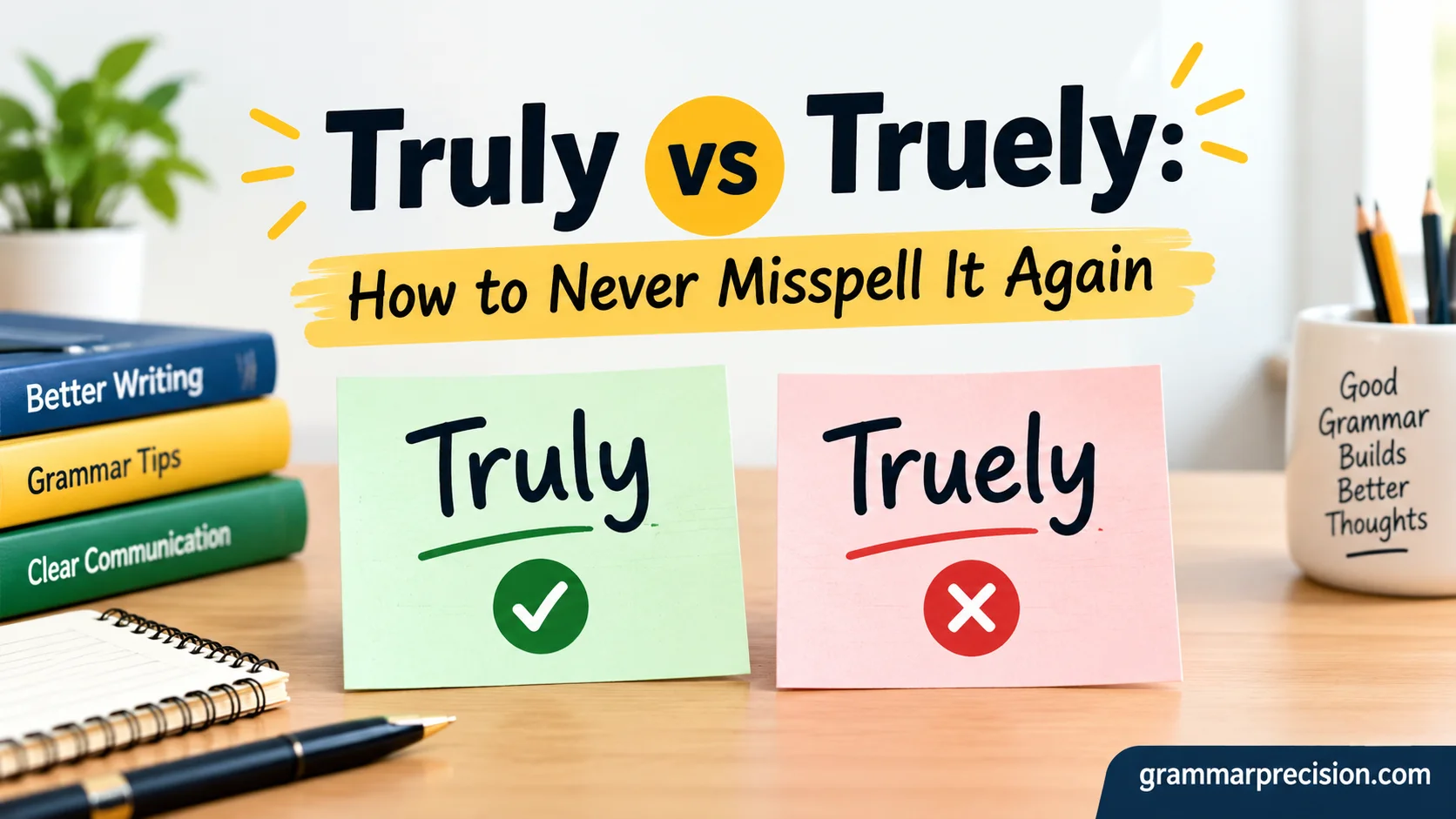
The correct spelling is truly, while truely is a common misspelling. Truly is an adverb that means really, genuinely, or sincerely. You’ll often see it used to describe feelings, opinions, or actions. Understanding this small spelling rule can help you write clear, accurate, and professional English in everyday and formal communication.
Many people write truely because they expect the word to follow the usual spelling pattern for words ending in “-ly.” However, true + ly becomes truly, not truely. The final e is dropped before adding “-ly.” Learning this simple spelling rule makes it easier to remember the correct form and avoid this common English grammar mistake.
In this article, you’ll learn why truly is correct, why truely is incorrect, and how to use truly naturally in sentences. We’ll also cover its meaning, pronunciation, spelling rule, synonyms, examples, and common usage. By the end, you’ll have a clear understanding of the difference and feel more confident using truly in your writing.
The 5-Second Answer: Truly or Truely?
If you only need the answer, remember this:
Truly is correct. Truely is incorrect in standard English.
The word truly is an adverb. It can mean genuinely, sincerely, really, or in an actual or sincere way, depending on the context.
For example:
- I truly appreciate your help.
- She is truly talented.
- He truly believes what he said.
- That was a truly remarkable experience.
The incorrect spelling truely often appears because writers naturally want to keep the e from true. However, standard English drops that final e when forming truly.
| Spelling | Status | Meaning |
| truly | Correct | Genuinely, sincerely, really |
| truely | Incorrect | Common spelling error |
| true | Correct | Accurate, genuine, faithful |
So, when you’re writing an email, essay, article, application, or professional message, choose truly.
Why Your Brain Wants to Write “Truely”
The spelling truely looks logical. That’s exactly why the mistake is so common.
Start with the adjective true. Then add the familiar adverb-forming suffix -ly:
true + ly = ?
At first glance, truely seems like the obvious answer. English learners often learn that adjectives can become adverbs by adding -ly:
- quick → quickly
- careful → carefully
- honest → honestly
- beautiful → beautifully
That pattern encourages you to preserve the original spelling. Yet English spelling isn’t a perfectly tidy machine. Some words change slightly when a suffix is added.
The word true belongs to one of those spelling patterns.
Instead of:
true + ly → truely
standard English uses:
true + ly → truly
The final e disappears.
Think of the silent e as a suitcase that doesn’t need to travel with the word. When true changes into the adverb truly, that letter gets left behind.
True + Ly = Truly? Let’s Break It Down
Understanding the transformation is more useful than memorizing a single spelling.
Start With “True”
True is an adjective. It describes a person, thing, statement, feeling, or situation.
Consider these examples:
- The story is true.
- Her answer is true.
- He remained true to his promise.
- That information isn’t true.
Because true is an adjective, it commonly describes a noun or follows a linking verb.
Add “-ly”
The suffix -ly frequently helps create adverbs from adjectives.
For example:
- slow → slowly
- quiet → quietly
- clear → clearly
- honest → honestly
Adverbs often tell us how, when, where, or to what degree something happens.
The same basic idea applies to true. But the spelling changes when the suffix attaches.
Apply the Spelling Change
The correct transformation is:
true → truly
The final e disappears before the -ly ending.
This gives us a clean spelling:
She truly understands the problem.
Here, truly modifies the verb understands.
Get the Correct Word
The easiest pattern to memorize is simply:
true → truly
Don’t try to construct the spelling from scratch every time. Treat truly as a complete word.
That approach becomes especially useful when you’re writing quickly. Your goal isn’t to pause and debate every letter. You want the correct form to feel automatic.
Truly Meaning: More Than Just “Really”
The word truly has several closely related meanings. Context determines which shade of meaning feels strongest.
Truly Means “Genuinely”
In many sentences, truly means genuinely or in a sincere way.
She truly cares about her students.
This suggests that her concern is real rather than fake or superficial.
Another example:
He truly wanted to help.
The sentence emphasizes the person’s genuine intention.
Truly Can Mean “Really”
In everyday English, truly can also work much like really.
It was truly an amazing performance.
Here, truly adds emphasis. The speaker isn’t simply saying the performance was amazing. The word strengthens the statement.
Truly Can Express Sincerity
When someone says:
I truly apologize.
the word can communicate genuine feeling.
Compare that with:
I apologize.
The second sentence is perfectly grammatical. Adding truly makes the emotional commitment more noticeable.
Truly Can Add Strong Emphasis
Writers sometimes use truly to highlight an especially important quality.
This is a truly extraordinary achievement.
The word doesn’t merely provide information. It signals that the speaker considers the quality especially genuine or remarkable.
How to Use Truly Like a Native Speaker
Once the spelling is clear, the next step is learning where truly sounds natural.
Truly Before Adjectives
One common pattern is:
truly + adjective
Examples include:
- truly remarkable
- truly beautiful
- truly important
- truly difficult
- truly impressive
- truly unusual
- truly valuable
For example:
The discovery was truly remarkable.
Here, truly modifies the adjective remarkable and strengthens its meaning.
Truly Before Verbs
You can also place truly before many verbs.
Examples:
- truly understand
- truly believe
- truly appreciate
- truly deserve
- truly care
- truly enjoy
Consider:
You won’t truly understand the issue until you see both sides.
The adverb adds the idea of genuine or complete understanding.
Truly in Emotional Statements
Truly works especially well when a sentence expresses gratitude, regret, admiration, or affection.
For example:
I truly appreciate everything you’ve done.
We are truly grateful for your support.
She truly regrets her decision.
These sentences sound sincere because truly emphasizes the speaker’s genuine feelings.
Truly in Formal Expressions
The word also appears in traditional formal phrases.
One familiar example is:
Yours truly
Historically, this expression has been used as a complimentary closing in letters. Today, it can sound formal, old-fashioned, playful, or deliberately traditional depending on the setting.
In everyday email, you’ll usually see other closings such as Best, Regards, or Sincerely. Still, Yours truly remains a recognized English expression.
Truly vs True: The Grammar Test
A major source of confusion is the relationship between true and truly.
They belong to different parts of speech.
| Word | Part of Speech | Main Function | Example |
| true | Adjective | Describes something | The statement is true. |
| truly | Adverb | Modifies a verb, adjective, or another adverb | I truly believe you. |
Here’s a simple test.
If you’re describing a noun, true may be the right choice:
It is a true story.
If you’re describing how someone feels, believes, understands, or does something, truly may be appropriate:
She truly believes the story.
Look at another pair:
His friendship is true.
He truly values your friendship.
The words come from the same family, but they perform different grammatical jobs.
Also Read This: Beef vs Beaf: The Complete Guide to Correct Spelling and Usage
Truly vs Truely vs Other Common Misspellings
Truely isn’t the only spelling error people make. Because the pronunciation doesn’t clearly reveal the spelling, several incorrect versions can appear.
Common mistakes include:
- ❌ truely
- ❌ truley
- ❌ trueley
- ❌ truelyy
The standard form is:
- ✅ truly
The most common error is truely, probably because writers try to preserve the spelling of true.
A Useful Word-Family Check
Learning related words can make spelling easier:
true → truly → truth → truthful → truthfully
Notice that these words don’t all form by applying one simple spelling rule. English vocabulary often develops through several historical and morphological paths.
That’s why it’s better to recognize common word families than to assume every spelling can be predicted perfectly.
Truly vs Really vs Actually: The Nuance Nobody Explains
At first, truly, really, and actually can seem interchangeable. Sometimes they are. Their meanings aren’t identical, though.
| Word | Common Meaning | Typical Effect |
| truly | Genuinely, sincerely | Adds sincerity or emphasis |
| really | Actually, very much | Common and conversational |
| actually | In fact, in reality | Corrects or clarifies information |
Compare these sentences:
I really like this restaurant.
This sounds natural and conversational.
I truly like this restaurant.
This can sound more sincere or emotionally emphatic.
Now consider:
I actually like this restaurant.
This can imply that the statement contrasts with an expectation. Perhaps the speaker usually dislikes similar restaurants.
The words overlap, but they aren’t interchangeable in every context.
A Quick Context Comparison
Imagine someone asks whether you appreciated a friend’s help.
I really appreciate it.
Warm and natural.
I truly appreciate it.
Sincere and slightly more emphatic.
I actually appreciate it.
Potentially surprising or corrective.
The choice depends on the message you want to send, not merely grammar.
“Yours Truly” Explained
The phrase Yours truly deserves special attention because it uses truly in a fixed expression.
Traditionally, a writer might end a letter with:
Yours truly,
Alex
The phrase essentially conveys a respectful or sincere relationship between the writer and recipient.
Today, Yours truly isn’t the most common professional email closing. In some contexts, it may sound old-fashioned. However, it remains familiar and grammatically established.
It’s also useful to distinguish it from Yours sincerely.
| Expression | General Tone | Common Context |
| Yours truly | Formal, traditional | Letters and stylized writing |
| Yours sincerely | Formal | Professional correspondence |
| Best regards | Professional, neutral | Modern emails |
| Best | Friendly, concise | Casual-professional emails |
The important point is that truly remains correctly spelled in the expression.
Pronunciation: Does the Spelling Match the Sound?
Pronunciation won’t necessarily help you distinguish truly from truely because both spellings might seem to represent the same sound.
In standard American English, truly is generally pronounced with two syllables, roughly like:
TROO-lee
The first syllable contains the long oo sound heard in true. The second sounds like lee.
Because the pronunciation doesn’t announce the missing e, spelling becomes a memory issue.
That leads to an important learning tip:
Don’t rely on pronunciation to spell truly. Remember the word visually: truly.
Writing the correct form several times can help build recognition.
Why Does True Become Truly?
The spelling change is connected to the way English forms words with suffixes. The final e in true isn’t retained in truly.
This may seem unusual because many familiar adjectives simply add -ly:
- slow → slowly
- quiet → quietly
- careful → carefully
- useful → usefully
But English contains many spelling patterns that developed over centuries. Modern spelling doesn’t always behave like a perfectly mathematical formula.
Consider a few other familiar forms:
| Base Word | Adverb |
| true | truly |
| due | duly |
| whole | wholly |
| full | fully |
| gentle | gently |
These examples show why memorizing individual word forms can sometimes be more reliable than trying to force every word into one rule.
Does Every Word Ending in E Drop the E?
No.
That’s an important point. You shouldn’t assume that every adjective ending in e will automatically lose the letter before -ly.
English spelling contains patterns, exceptions, and historical forms. For that reason, it’s safer to learn common transformations individually.
For true, the form you need is simple:
true → truly
Not:
❌ true → truely
Common Mistakes With Truly
Even advanced English users sometimes make spelling errors when typing quickly.
Mistake: Writing “Truely”
❌ I truely appreciate your support.
Correct:
✅ I truly appreciate your support.
Mistake: Writing “Truley”
❌ She is truley remarkable.
Correct:
✅ She is truly remarkable.
Mistake: Using “True” as an Adverb
❌ I true believe you.
Correct:
✅ I truly believe you.
The adjective true can’t simply replace the adverb truly in this sentence.
Mistake: Assuming the Base Word Must Stay Unchanged
This is the root of the problem for many writers.
The fact that the adjective is true doesn’t mean every related form must preserve its final e. English word families often change spelling when suffixes are added.
A Mini Case Study: Why Context Matters
Consider a student writing this sentence:
“I truely believe that practice improves writing.”
The intended meaning is clear. The reader understands the sentence immediately. Yet the spelling mistake can make the writer appear less careful, particularly in an academic or professional setting.
Correcting it gives:
“I truly believe that practice improves writing.”
The difference is only one letter. The impact, however, can be noticeable.
This illustrates a broader writing lesson: small spelling details can influence how polished your writing appears.
When a word looks unfamiliar, don’t invent its spelling from pronunciation or from the base word. Check the established form or learn the word family.
The Ultimate Memory Trick
Here’s the simplest way to remember the difference:
True loses its final E when it becomes truly.
Write this pattern several times:
TRUE → TRULY
Then connect it with a sentence:
I truly mean what I say.
The visual pattern is more useful than trying to remember a complicated rule.
Another helpful trick is to mentally cross out the final e:
tru[e] + ly → truly
Once the spelling becomes familiar, the temptation to write truely usually fades.
Practice: Can You Spot the Mistake?
Try correcting these sentences before checking the answers.
Sentence A
I truely appreciate your kindness.
Sentence B
She is truly talented.
Sentence C
He truley believes that the plan will work.
Sentence D
The information is true.
Sentence E
We truly enjoyed the concert.
The correct answers are:
- A: I truly appreciate your kindness.
- B: Correct.
- C: He truly believes that the plan will work.
- D: Correct.
- E: Correct.
Notice how true and truly serve different grammatical purposes. That’s an important distinction beyond spelling.
FAQs:
Is “truly” the correct spelling?
Yes, truly is the correct spelling in standard English. It means really, genuinely, or sincerely. For example, “I truly appreciate your help.” The spelling truely is incorrect and should be avoided in formal, academic, and professional writing.
Is “truely” a correct English word?
No, truely is not the standard English spelling. It is a common misspelling of “truly.” Many people make this mistake because they add “-ly” directly to “true.” However, the correct form removes the final e before adding the suffix.
Why is “truly” spelled without an “e”?
The word truly comes from the adjective “true” combined with the suffix “-ly.” In this case, the final e is dropped, giving us “truly.” Therefore, the correct spelling is true + ly = truly, not “truely.” This spelling rule helps prevent a common English spelling error.
What does “truly” mean?
Truly is an adverb that means really, genuinely, sincerely, or honestly. It can emphasize that something is true or strongly felt. For example, “She truly cares about her students” means that she genuinely cares. The word is common in both everyday English and formal writing.
How can I remember the spelling of “truly”?
You can remember truly by using the simple pattern true + ly = truly. Think of the final “e” as being removed before “-ly” is added. If you remember that “truely” contains an extra e, you’ll be less likely to make this common spelling mistake.
Conclusion:
When comparing Truly vs Truely, remember that truly is the correct spelling, while “truely” is a common misspelling. Truly means really, genuinely, or sincerely, and it’s widely used in everyday and formal English.
The spelling becomes easier when you remember the simple rule behind it. The adjective true changes to truly when “-ly” is added because the final “e” is removed. Therefore, always write truly, not “truely,” in standard English.
Using truly correctly can make your writing more accurate, polished, and professional. Whether you’re writing an essay, email, article, or casual message, choosing the correct spelling helps you communicate your meaning clearly and avoid unnecessary spelling errors.