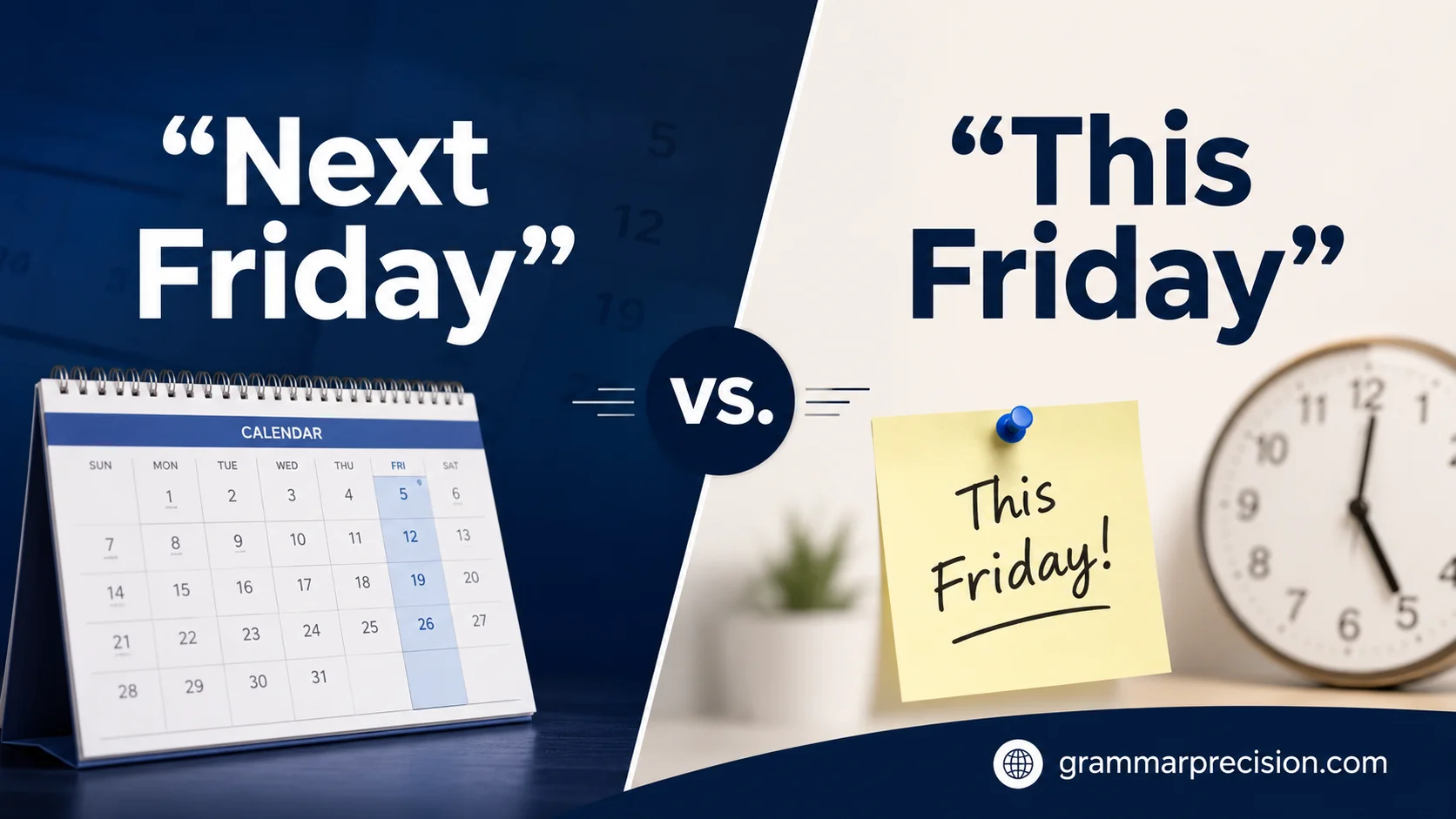
“Next Friday” vs. “This Friday”: The real difference often creates confusion when people discuss plans, dates, and timing during weekly conversations, meetings, and social events regularly.
Many native English speakers still misunderstand Next Friday and This Friday because the meaning changes with context, current week, and following week discussions. In plain English, This Friday usually means the closest Friday, while Next Friday often points to the following Friday. Using clear dates, calendar notes, and communication skills helps avoid miscommunication, missed meetings, and unnecessary confusion.
In professional settings and personal settings, small mistakes in communication, scheduling, and interpretation can create awkward social situations and ruined plans. Strong clarification skills, communication tools, and proper weekly planning improve understanding and support clear communication. Adding an exact date during appointments, business meetings, or social plans prevents scheduling conflicts, booking mistakes, and future timing issues effectively.
The Quick Answer: “Next Friday” vs. “This Friday”
In modern American English, most people use the phrases like this:
| Phrase | Most Common Meaning | Example |
| This Friday | The nearest upcoming Friday | Today is Tuesday → means 3 days away |
| Next Friday | The Friday after this coming Friday | Today is Tuesday → means 10 days away |
So if today is Monday:
- This Friday = the Friday happening this week
- Next Friday = the Friday happening next week
Simple enough. Until humans enter the equation.
Because language behaves more like jazz than math.
Why These Phrases Confuse So Many People
The confusion exists because English speakers use two different mental systems when thinking about time.
Some people think in terms of proximity.
Others think in terms of calendar sequence.
That small difference changes everything.
The Two Competing Interpretations
| Thinking Style | Interpretation of “Next Friday” |
| Proximity logic | The next Friday coming up |
| Sequence logic | The Friday after this Friday |
Most workplaces and professional communication follow sequence logic.
That means:
- “This Friday” = upcoming Friday
- “Next Friday” = the following Friday
However, casual speech often breaks the rules.
And that’s where chaos begins.
What “This Friday” Actually Means
“This Friday” usually refers to the closest upcoming Friday.
If today is:
| Today | “This Friday” Usually Means |
| Monday | Friday in 4 days |
| Tuesday | Friday in 3 days |
| Wednesday | Friday in 2 days |
| Thursday | Tomorrow |
| Friday morning | Today |
| Saturday | Upcoming Friday |
Most native speakers interpret “this Friday” as the Friday connected to the current week.
Examples of “This Friday” in Real Conversations
Workplace Example
“The report is due this Friday.”
Employees usually understand this as the nearest Friday deadline.
Not next week.
Text Message Example
“Dinner this Friday?”
That almost always means the upcoming Friday night.
Family Example
“We’re visiting grandma this Friday.”
Again, most people hear “the closest Friday coming up.”
When “This Friday” Becomes Confusing
Things get messy when today is already Friday.
Imagine it’s Friday afternoon and someone says:
“Let’s do it this Friday.”
Now you have two possibilities:
- Later today
- Next week’s Friday
Context becomes king.
That’s why smart communicators avoid vague phrasing near the end of the week.
What “Next Friday” Actually Means
“Next Friday” usually means the Friday after this coming Friday.
Think of Fridays like stepping stones.
- The closest one = this Friday
- The one after that = next Friday
Many grammar experts and native speakers follow this interpretation.
Timeline Examples That Make It Crystal Clear
If Today Is Tuesday
| Phrase | Meaning |
| This Friday | 3 days away |
| Next Friday | 10 days away |
If Today Is Thursday
| Phrase | Meaning |
| This Friday | Tomorrow |
| Next Friday | 8 days away |
If Today Is Saturday
| Phrase | Meaning |
| This Friday | Upcoming Friday |
| Next Friday | Friday after that |
Why Native Speakers Still Disagree
Here’s the fascinating part:
English itself doesn’t completely settle the debate.
Cambridge Grammar explains that “next” refers to the thing immediately after the present one.
That sounds simple.
But humans rarely speak with dictionary precision.
Instead, people rely on:
- Habit
- Region
- Family language patterns
- Workplace culture
- Context
- Tone
That’s why two intelligent native speakers can hear the same sentence and imagine completely different Fridays.
The Psychology Behind the Confusion
Language researchers call this a relative time reference problem.
Your brain interprets time phrases using context clues rather than strict definitions.
For example:
When someone says:
“See you next Friday.”
Your brain instantly tries to calculate:
- Which week are we mentally inside?
- Has this week “ended” emotionally?
- Is the speaker thinking short-term or long-term?
Humans don’t process time like calendars.
We process time like stories.
That subtle psychological shortcut creates ambiguity.
British English vs. American English Usage
Both American and British English use these phrases similarly.
However, regional habits still differ.
Some speakers in the UK use expressions like:
- “Friday week”
- “Friday next week”
Those phrases reduce ambiguity.
American English speakers often prefer:
- “This coming Friday”
- “The Friday after next”
Both versions sound clearer than plain “next Friday.”
The Hidden Workplace Problem Nobody Talks About
Ambiguous dates cost businesses real money.
A missed meeting can derail:
- Interviews
- Flights
- Deadlines
- Team presentations
- Client calls
In professional settings, vague scheduling language becomes dangerous.
That’s why experienced managers rarely rely on phrases like:
- “Next Friday”
- “This Friday”
- “Next week sometime”
Instead, they use exact dates.
Case Study: How One Phrase Caused a Project Delay
A marketing agency scheduled a client presentation for “next Friday.”
Half the team assumed:
- Friday the 10th
The other half planned for:
- Friday the 17th
Nobody clarified.
The presentation deck wasn’t finished on time. The client became frustrated. The agency lost trust instantly.
All because of two tiny words.
Communication can behave like a loose shoelace. Ignore it long enough and somebody trips.
The Safest Alternatives to Use Instead
If clarity matters, skip ambiguous phrases entirely.
Use these instead:
| Confusing Phrase | Better Alternative |
| Next Friday | Friday, May 22 |
| This Friday | This coming Friday |
| Next Friday | Friday next week |
| This Friday | The upcoming Friday |
Best Phrases for Professional Communication
Best for Emails
- “Friday, May 22”
- “May 22 at 2 PM”
- “This coming Friday”
Best for Meetings
- “The Friday after next”
- “Next week’s Friday meeting”
Best for Text Messages
- “This Friday night”
- “Friday the 22nd”
What Native Speakers on Reddit Say
Online discussions reveal something important:
Even native speakers constantly debate this topic.
One Reddit user explained:
“This Friday is the upcoming one. Next Friday is next week.”
Another said:
“Native speakers will have different opinions.”
A third user admitted:
“This always confuses me.”
That inconsistency proves a key point:
Clarity matters more than technical correctness.
Why ESL Learners Struggle With “Next Friday”
English learners often expect logical consistency.
Unfortunately, English behaves like a cat.
Sometimes it follows rules. Sometimes it knocks grammar off the table for fun.
Many languages interpret “next Friday” differently.
German speakers, for example, often use the equivalent phrase to mean the closest upcoming Friday.
That creates confusion when speaking English.
The “Nearest Date” Effect
Humans naturally prioritize the closest possible event.
That’s why some people hear “next Friday” and immediately think:
“The next Friday coming up.”
Their brain focuses on proximity.
Others think in calendar blocks:
- This week
- Next week
Both interpretations feel logical.
That’s why assumptions become dangerous.
The Easiest Rule to Remember
If you only remember one thing from this article, remember this:
| Phrase | Safest Interpretation |
| This Friday | Upcoming Friday |
| Next Friday | Friday after that |
That rule works most of the time.
However, if the situation matters, always confirm the exact date.
Real-Life Scenarios Explained
Scenario: Today Is Wednesday
Your coworker says:
“Let’s finalize the budget next Friday.”
Most professionals interpret this as:
- Friday of next week
Scenario: Today Is Monday
Your friend texts:
“Party this Friday?”
That almost always means:
- The nearest Friday
Scenario: Today Is Friday Night
Someone says:
“See you this Friday.”
Now ambiguity explodes.
That phrase could mean:
- Tonight
- One week away
Context decides everything.
Why “This Coming Friday” Works Better
“This coming Friday” removes uncertainty because it emphasizes proximity.
It clearly points to the nearest Friday ahead.
That phrase works especially well in:
- Business emails
- Event planning
- Scheduling
- Travel coordination
“Friday After Next” Explained
English also uses another phrase:
“The Friday after next.”
This means:
- Skip one Friday
- Go to the following one
Example:
If today is Monday the 1st:
- This Friday = 5th
- Next Friday = 12th
- Friday after next = 19th
Common Mistakes People Make
Assuming Everyone Thinks the Same Way
Bad assumption.
Language interpretation differs widely.
Using “Next Friday” in High-Stakes Situations
Never use vague phrasing for:
- Flights
- Interviews
- Deadlines
- Legal appointments
- Medical visits
Use exact dates instead.
Forgetting Context Changes Meaning
Friday afternoon changes interpretation dramatically.
Timing matters.
The Smartest Communication Strategy
Professional communicators follow a simple rule:
If misunderstanding would create problems, use the actual date.
That single habit prevents endless confusion.
Instead of:
“Next Friday.”
Say:
“Friday, May 22.”
Problem solved instantly.
Calendar Visualization That Helps Instantly
Imagine today is Tuesday:
| Tue | Wed | Thu | Fri | Fri (Next Week) |
| Today | THIS FRIDAY | NEXT FRIDAY |
That visual framework helps most people understand the distinction immediately.
Why Context Always Wins
Grammar rules matter.
But context matters more.
Consider this sentence:
“Not this Friday. Next Friday.”
Now the meaning becomes obvious.
The speaker contrasts:
- Upcoming Friday
- Following Friday
Context removes ambiguity like sunlight removing fog.
How Movies, TV, and Texting Changed Usage
Modern texting culture increased ambiguity because people write quickly.
Messages became shorter:
- “next fri?”
- “this fri works”
- “see u friday”
Speed replaced precision.
That casual communication style made misunderstandings more common.
The Linguistic Reason English Feels Weird Here
English uses flexible temporal markers.
Words like:
- this
- next
- upcoming
- following
depend heavily on speaker perspective.
Unlike math equations, language bends around human interpretation.
That flexibility makes English expressive.
It also makes it wonderfully annoying.
The Best Rule for Teams and Businesses
If you manage teams, create a scheduling rule.
For example:
| Phrase | Team Definition |
| This Friday | Closest Friday |
| Next Friday | Friday of next week |
Consistency reduces mistakes dramatically.
How to Politely Clarify Without Sounding Awkward
Use simple confirmation questions.
Examples:
- “Do you mean this coming Friday?”
- “Just to confirm, May 22?”
- “The Friday next week?”
Nobody gets offended by clarity.
People appreciate it.
Clear Communication Beats Grammar Debates
Some people argue endlessly about which interpretation is “correct.”
That debate misses the point.
Language exists to communicate clearly.
If the listener misunderstands you, technical correctness doesn’t help much.
The smartest communicators prioritize understanding over ego.
FAQs:
Can “Next Friday” and “This Friday” mean the same day?
Yes, sometimes both phrases can point to the same Friday depending on the context and the speaker’s intention. This is why many people experience confusion during conversations, meetings, and social planning.
Why do native English speakers confuse these phrases?
Even native English speakers misunderstand these terms because the meaning changes based on the current week, timing, and daily communication habits. Different regions and speaking styles also affect the interpretation.
How can I avoid misunderstandings about Friday dates?
The best way to avoid miscommunication is to use clear dates instead of only saying Next Friday or This Friday. Mentioning the exact day and date improves clear communication and prevents missed meetings.
Does “This Friday” always mean the closest Friday?
Usually, This Friday refers to the closest Friday in the current week, but the meaning can still shift in some conversations. Paying attention to context clues helps reduce common confusion.
Why is context important when talking about dates?
Context helps listeners understand the speaker’s real intention. Without proper clarification, simple phrases can create scheduling conflicts, booking mistakes, and problems in both professional settings and personal settings.
Conclusion:
Understanding the difference between Next Friday and This Friday is important for better communication, smarter weekly planning, and fewer scheduling mistakes. Small wording changes can completely shift the meaning of a conversation, especially in business meetings, appointments, and social plans. Using exact dates, strong communication skills, and proper clarification helps create clear communication, prevents unnecessary confusion, and supports a more organized life.