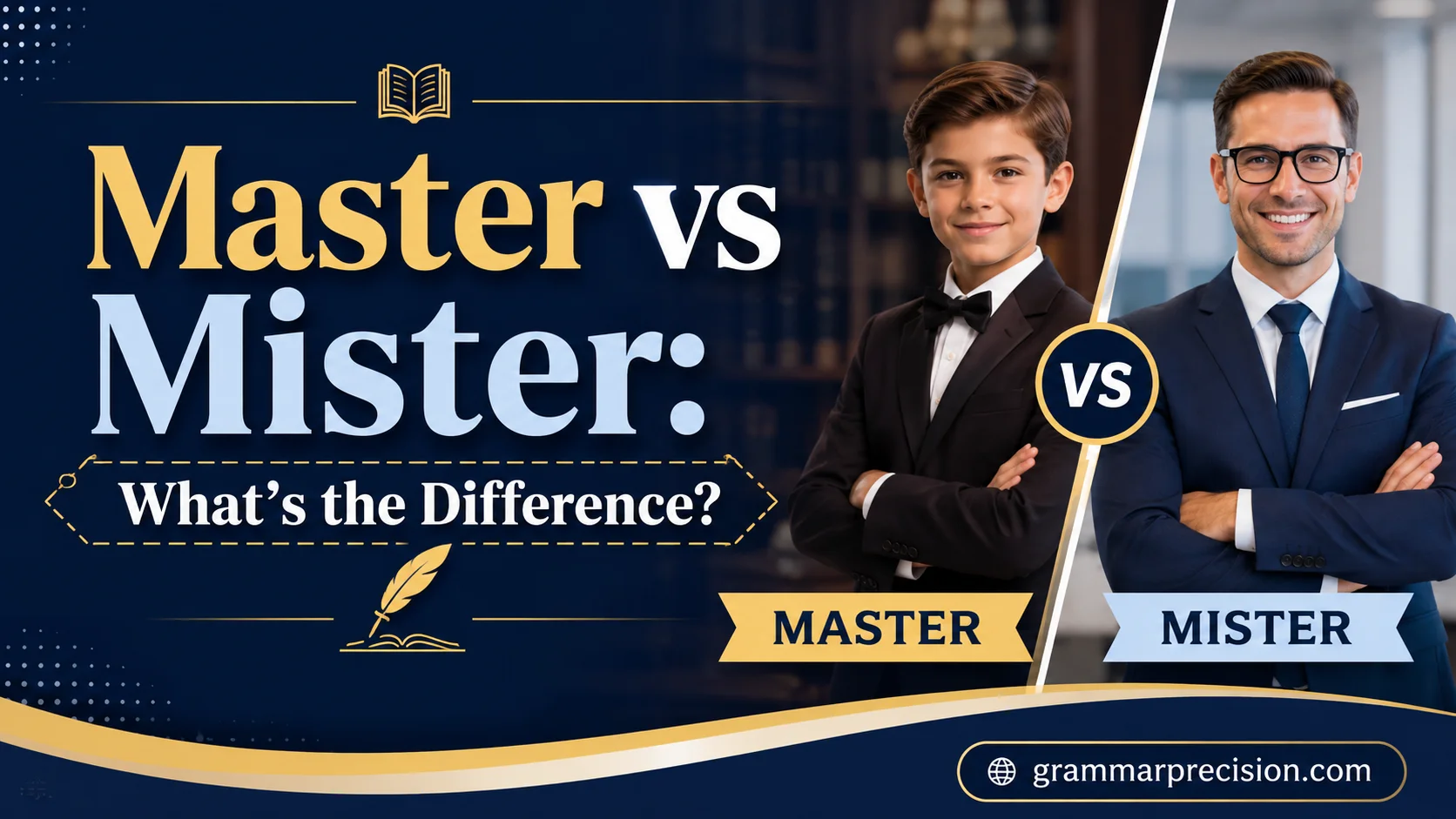
Master vs Mister can seem confusing because both are male titles, but they serve purposes. Master usually refers to a boy, while Mister and Mr. normally refer to an adult man.
Understanding the difference becomes easier when you consider age, usage, and social situations. Master is traditionally used for a young boy, while Mister is commonly used for an adult man. These titles can appear in formal communication, letters, invitations, and official documents, depending on the context and the purpose of the message you are writing.
Modern English has changed the way these titles are used. The older meaning of Master for an adult male now sounds old-fashioned in many situations. Knowing the history, etiquette, and regional variations helps you choose the correct title and avoid awkward or outdated writing in formal and everyday communication with greater confidence and accuracy.
Master vs Mister at a Glance
Here’s the simplest way to remember the difference:
- Master usually relates to skill, control, authority, or something principal.
- Mister refers to a man as a title or form of address.
- Mr. is the standard abbreviation of mister.
- Master can work as a noun, verb, and adjective.
- Mister is primarily a noun and form of address.
Merriam-Webster gives master a wide range of meanings, including a highly skilled person, someone with authority, a person licensed to command a merchant ship, an original used to make copies, and a person who becomes skilled at something. It also records master as a verb meaning to become skilled at or overcome something.
By contrast, dictionaries define mister mainly as a title for a man, the full form of Mr., or an informal way to address a man whose name is unknown.
| Word | Main meaning | Grammar | Typical example |
| master | Skill, control, authority, or principal version | Noun, verb, adjective | She mastered the technique. |
| mister | A title or form of address for a man | Noun | Mister Brown is here. |
| Mr. | Abbreviation of mister | Honorific/title | Mr. Brown is here. |
What Does “Master” Mean?
Master as a Noun
As a noun, master can mean a person with exceptional skill. You might say:
- She is a master of watercolor painting.
- He became a master chess player.
- The chef is a master of French cuisine.
- That violinist is a true master.
In these sentences, master suggests a very high level of ability. It doesn’t simply mean “good.” Calling someone a master usually implies deep knowledge, practiced technique, and impressive command of a field.
The word can also refer to someone with authority or control. Older English uses included masters of households, servants, ships, and other domains. Modern usage still preserves some of these meanings, although the social contexts have changed considerably.
For example:
The captain remained master of the ship.
Here, master doesn’t mean an expert at a hobby. It identifies a person with recognized command.
Another important meaning appears in technology and production. A master can be an original from which copies are produced. A master recording, for instance, serves as the source from which other versions can be created.
Master as a Verb
The verb master means to become highly skilled at something or gain control over it.
Consider these examples:
- She mastered Spanish after years of study.
- He finally mastered the guitar solo.
- The students are learning to master difficult equations.
- You’ll need practice to master this technique.
Notice the difference between learn and master. Learning can begin with basic familiarity. Mastering suggests a much deeper level of competence.
Master as an Adjective
Master can also work as an adjective meaning principal, guiding, highly skilled, or controlling.
Common combinations include:
- master plan
- master key
- master copy
- master recording
- master craftsman
- master control
A master key, for example, can open multiple locks within a system. A master plan serves as the main plan that guides related actions.
This use explains why the word appears far beyond conversations about people. Its core idea often involves command, centrality, or superior skill.
What Does “Mister” Mean?
Mister has a narrower modern role. It usually functions as a courtesy title for a man.
For example:
- Mister Johnson will arrive shortly.
- Please speak with Mister Adams.
- Mr. Davis sent the letter.
In normal formal writing, Mr. is much more common than the fully spelled-out mister. Oxford notes that mister is the full form of Mr. and is not often used in writing.
Mister as a Formal Title
The standard pattern is:
Mr. + surname
Examples:
- Mr. Wilson
- Mr. Carter
- Mr. Thompson
- Mr. Anderson
You can technically write Mister Wilson, but Mr. Wilson is usually the more natural choice in contemporary American English.
The title doesn’t describe the man’s profession, personality, or skill. It simply functions as a respectful form of address.
That’s why these sentences mean different things:
- Mr. Lee is a doctor.
- Dr. Lee is a master of surgery.
The first sentence uses a title. The second describes exceptional skill.
Mister as Direct Address
You can also use mister without a name:
“Hey, mister, you dropped your wallet.”
This use is usually informal. Depending on the speaker’s tone, it can sound friendly, playful, annoyed, or confrontational. Cambridge specifically notes that mister can be an informal and sometimes rude form of address for a man whose name the speaker doesn’t know.
Compare:
- “Excuse me, sir.”
- “Excuse me, mister.”
The first sounds more conventionally polite. The second can sound more casual or pointed.
Why Are Master and Mister Related?
Here’s the fascinating part: master and mister are historically connected.
Mister developed from master. Merriam-Webster dates the first known use of mister in its title sense to 1551 and identifies it as an alteration of master. Oxford similarly describes mister as a weakened form of master that arose in unstressed use before a name.
The relationship becomes clearer when you look at the older title system. Master itself goes back to Middle English and ultimately to Latin magister, a word associated with a master, teacher, or person holding authority. Merriam-Webster records master in English before the 12th century.
Over centuries, pronunciation shifted in ordinary speech. The shorter, weaker form eventually developed into mister. The written abbreviation Mr. also preserves part of this history.
Interestingly, master once had a title-related meaning close to Mr. Merriam-Webster still records an archaic sense of master meaning Mr. and another traditional use for a boy too young to be called mister.
So the words are not random look-alikes. They are linguistic relatives that took different paths.
Master vs Mister: A Historical Twist
Merriam-Webster explains that Mr. developed from Middle English forms related to maister, meaning “master.” Historically, master was associated with younger unmarried males, while mister became associated with married men before eventually becoming the ordinary title for adult men generally.
That old distinction no longer controls modern American English. Today, Mr. can be used for adult men regardless of marital status.
Master vs Mister in Real-Life Contexts
Context makes the choice straightforward once you know what each word contributes.
In a Person’s Name
Use Mr. when placing the title before an adult man’s name.
Correct:
- Mr. Parker called this morning.
- Mr. Evans will lead the meeting.
Usually unnecessary:
- Master Parker called this morning.
Master can appear as a traditional title for a boy in certain contexts, but it isn’t the ordinary modern substitute for Mr.
When Talking About Skill
Use master when describing exceptional ability.
- She is a master painter.
- He became a master carpenter.
- The coach is a master strategist.
You could also use the verb:
- She mastered the technique.
- He mastered the language.
Mister would make no sense in these sentences.
When Talking About Control
Again, master is the right word.
- The engineer mastered the complex system.
- She became master of the situation.
- The master key opens every door in the building.
The underlying idea is control or command.
In Formal Correspondence
When addressing a man in a letter, email, or formal document, Mr. is normally the appropriate title.
For example:
Dear Mr. Carter,
Not:
Dear Master Carter,
The second version could be appropriate only in a special historical, traditional, or age-specific context.
Also Read This: Anyone or Any One: Which One Should You Use?
Master vs Mister in American English
For American English readers, the practical rule is simple. Mr. is the normal written title for an adult man. Mister appears more often in speech, direct address, literary dialogue, or when someone deliberately spells out the title.
For example:
“Mister, your car lights are still on.”
This sounds natural in dialogue because the speaker doesn’t know the man’s name.
In a business letter, however:
Mr. Robinson,
is the standard choice.
Pronunciation: Master vs Mister
The pronunciation difference is subtle enough to confuse learners.
Master is generally pronounced approximately MAS-ter, with the first syllable carrying the main stress.
Mister is generally pronounced approximately MIS-ter, also with stress on the first syllable.
The opening vowel provides the clearest distinction:
- master → /ˈmæstər/
- mister → /ˈmɪstər/
Merriam-Webster lists the American pronunciation of mister as /ˈmi-stər/ and gives master as /ˈma-stər/.
The middle consonants can also sound slightly different. Master contains the /æ/ sound associated with words such as cat, while mister begins with the short /ɪ/ sound found in sit.
A quick pronunciation trick helps:
master → “mass-ter”
mister → “miss-ter”
That isn’t a perfect phonetic transcription, but it gives English learners a useful listening cue.
Common Master vs Mister Mistakes
The biggest mistakes happen when writers choose the word based on appearance rather than meaning.
Mistake: Using “Mister” for Expertise
Incorrect:
She is a mister of classical music.
Correct:
She is a master of classical music.
Why? Because the sentence describes exceptional skill.
Mistake: Using “Master” for an Adult Male Title
Incorrect in ordinary modern usage:
Master Williams will attend the meeting.
Correct:
Mr. Williams will attend the meeting.
Unless the context specifically calls for a traditional title, Mr. is the natural choice.
Mistake: Treating “Mr.” as an Abbreviation of “Master”
Modern readers should treat Mr. as the abbreviation of mister, even though the history of the abbreviation reaches back to older forms of master. That historical connection explains the spelling, but it doesn’t mean you can freely substitute master and mister today.
Master vs Mister: A Practical Comparison
| Situation | Best choice | Example |
| Title before an adult man’s surname | Mr. / Mister | Mr. Harris arrived. |
| Exceptional skill | master | She is a master pianist. |
| Learning something thoroughly | master | He mastered French. |
| Main or controlling version | master | Keep the master copy. |
| Main guiding plan | master | Follow the master plan. |
| Informal direct address | mister | Hey, mister, wait! |
| Traditional title for a boy | Master | Master James was called to dinner. |
The table reveals the central principle: choose according to meaning, not spelling.
Case Study: Choosing the Right Word
Imagine a workplace sentence:
“___ Davis is a ___ of project management.”
Which words belong in the blanks?
The answer is:
Mr. Davis is a master of project management.
Why does this work?
Mr. identifies Davis as a man by courtesy title. Master describes his exceptional expertise.
Now change the sentence:
“___ Davis called to discuss the project.”
Here, the correct choice is:
Mr. Davis called to discuss the project.
There is no claim about expertise, so master doesn’t belong.
This tiny exercise shows how context does most of the work.
A Simple Memory Trick for Master vs Mister
When you’re unsure, ask one question:
Am I talking about a title for a man or about skill and control?
If you’re talking about a man’s title, choose mister/Mr.
If you’re talking about skill, control, authority, or a principal version, choose master.
Think of it this way:
Mister names the address. Master describes the command.
That short contrast captures the modern difference surprisingly well.
Master vs Mister Mini Quiz
Choose master or mister in each sentence.
- ___ Thompson will speak at the conference.
- She wants to ___ the software before Friday.
- He is a ___ of classical guitar.
- “Excuse me, ___, you dropped this.”
- Please save the ___ recording.
- ___ Brown sent the invoice.
- They hired a ___ craftsman for the restoration.
Answer Key
- Mr. / Mister
- master
- master
- mister
- master
- Mr. / Mister
- master
The pattern should now feel clear. Mister points toward a man as an addressee or title. Master points toward ability, control, authority, or a principal version.
FAQs:
Is Master used for boys or adult men?
Master is traditionally used as a title for boys, especially young boys. In modern English, it isn’t commonly used for adult men because that usage can sound old-fashioned.
Is Mister the same as Mr.?
Yes. Mister is the full form of Mr., and both are generally used as a title for adult men. Mr. is more common in formal writing, while Mister may appear in speech or when the full word is preferred.
What is the main difference between Master and Mister?
The main difference is usually related to age. Master generally refers to a young boy, while Mister or Mr. normally refers to an adult man.
Can Master be used in formal documents?
Yes, Master can still appear in formal documents, forms, invitations, or other records when referring to a boy. However, the appropriate title can depend on the context, regional usage, and the conventions of the organization.
Why does Master sound old-fashioned sometimes?
The word Master once had broader uses, including referring to an adult male. That older usage has largely declined in modern English, so using Master for an adult man may sound old-fashioned, unusual, or less natural today.
Conclusion:
Understanding Master vs Mister becomes simple when you focus on age and usage.
Use Master mainly for a young boy, while Mister or Mr. generally refers to an adult man.
Knowing this difference can help you avoid common grammar and etiquette mistakes.
With regular practice, choosing the correct title becomes natural and easy.