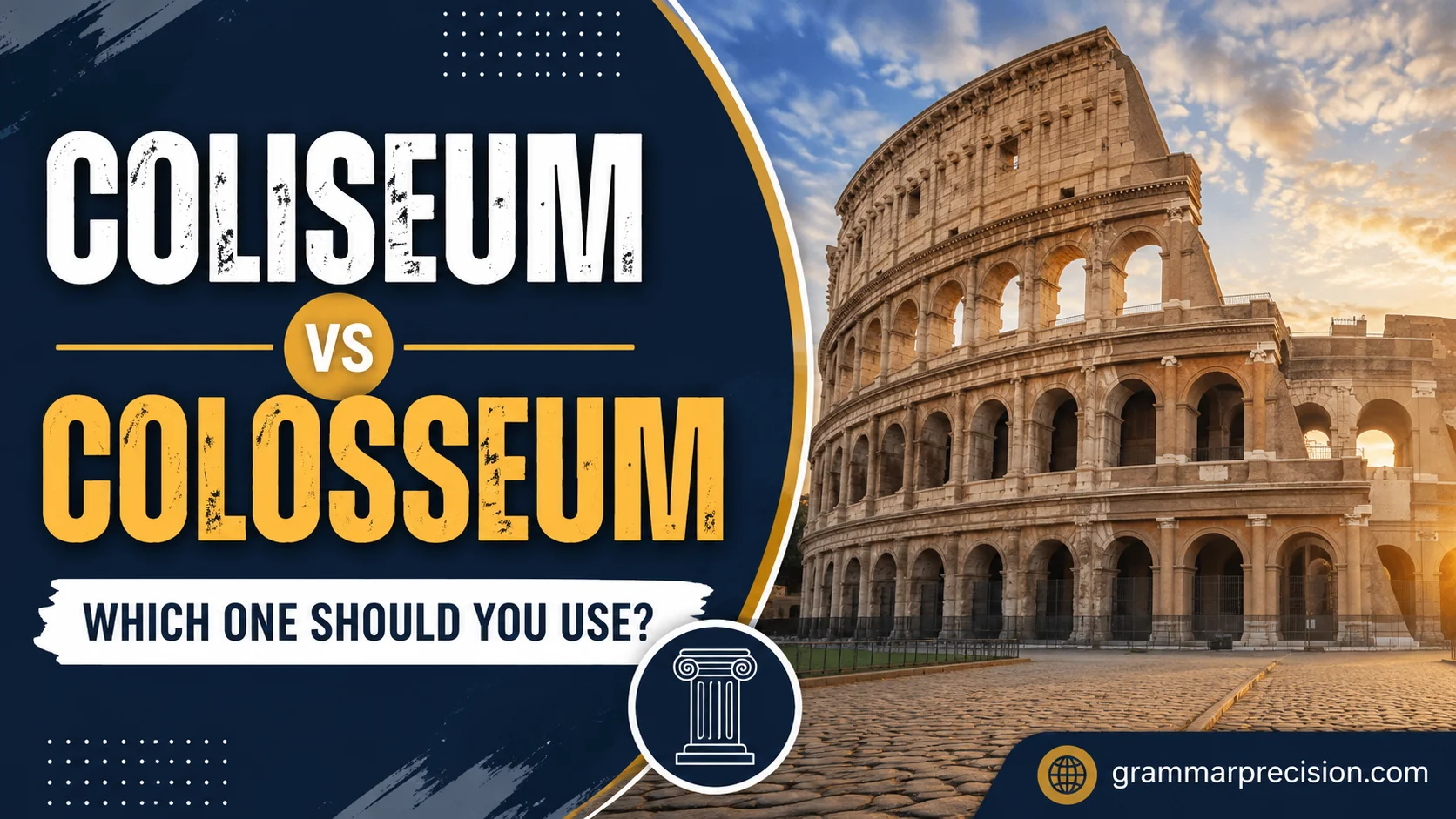
Coliseum vs Colosseum can be confusing because both words look similar, but they have different meanings, spelling, and usage in historical, architectural, and entertainment contexts.
A Coliseum usually describes a large or very large venue where a sports fan may attend an event. Many cities have such places, while the Colosseum refers to the famous ancient Roman structure. Understanding these distinct entities helps readers avoid common spelling mistakes and choose the correct term.
For astute readers, the easiest clarification is to consider the context. Coliseum commonly appears in sports-related or entertainment contexts, while Colosseum belongs to historical and architectural contexts. Although the words look seemingly similar, their correct spelling and correct usage differ, making accuracy important when writing or answering a spelling query.
Coliseum or Colosseum? The Answer in 30 Seconds
Here’s the easiest way to remember the distinction:
- Colosseum usually refers to the famous ancient amphitheater in Rome.
- coliseum can refer to a large public building used for sports, entertainment, meetings, or similar events.
- Coliseum can also appear as part of an official venue name.
- The two words can overlap because coliseum has developed into a broader English term.
- When writing about Rome’s ancient monument, Colosseum is the safest and clearest choice.
For example:
We visited the Colosseum during our trip to Rome.
But:
The basketball tournament filled the local coliseum.
The distinction becomes even clearer when you think about proper names. Rome has one specific ancient monument. A modern city can have a building called a Coliseum.
Quick comparison
| Word | Main use | Example |
| Colosseum | Ancient Roman amphitheater | The Colosseum is in Rome. |
| coliseum | Large public venue or arena | The concert was held at the coliseum. |
| Coliseum | Official name of a venue | The team played at the city’s Coliseum. |
So, if you’re wondering which spelling to use in a grammar article, school assignment, travel piece, or general sentence, start with the context rather than assuming one spelling is always correct.
What Is the Colosseum?
The Colosseum is the enormous ancient amphitheater in the center of Rome, Italy. Its ancient name was the Flavian Amphitheatre, reflecting the Flavian dynasty that commissioned it.
Construction began during the reign of Emperor Vespasian in the first century CE and continued under his successors. The amphitheater became a major venue for public spectacles, including gladiatorial contests and animal hunts. The official archaeological park describes it as the largest amphitheater in the world and notes that it featured sophisticated stage machinery for its time.
The building also has an interesting naming history.
The name Colosseum became associated with a colossal statue that once stood nearby. The statue was linked to Emperor Nero and later altered by subsequent rulers. According to the archaeological park, the amphitheater eventually became known as the Colosseum because of this enormous statue.
That history matters because it explains why the word has a double identity today. One spelling points strongly toward Rome and its ancient amphitheater, while the other developed a broader sense in English.
A few remarkable Colosseum facts
- It was built in first-century CE Rome.
- It was commissioned by members of the Flavian dynasty.
- Its ancient name was the Flavian Amphitheatre.
- It hosted public spectacles, including gladiatorial games and animal hunts.
- Its underground spaces supported complicated systems used to stage spectacles.
- The monument remained important long after its original entertainment function ended.
- In 2024, the archaeological park reported approximately 14 million visitors to the Colosseum.
That last point shows just how far the building has traveled through history. What began as an imperial entertainment venue has become one of the world’s most recognizable archaeological monuments.
What Is a Coliseum?
A coliseum is a broader English noun. It can describe a large public building used for sports, entertainment, meetings, performances, or other major events.
Cambridge Dictionary labels coliseum as mainly American English and defines it as a large public building used for entertainment, meetings, sports events, and similar activities.
That broader meaning explains why the word appears in the names of modern venues.
For instance, imagine a city builds a huge indoor arena for basketball, concerts, trade shows, and exhibitions. Calling the building a coliseum makes sense because the word can describe a large gathering place.
The key point is simple: a coliseum doesn’t have to be the Roman Colosseum.
Examples of general usage
- The championship game attracted thousands of fans to the coliseum.
- The city plans to renovate its aging coliseum.
- Several concerts will take place at the Coliseum this summer.
- The new coliseum can host sporting events and exhibitions.
Notice how context changes the meaning.
In the first two examples, coliseum works as a common noun. In the third, Coliseum functions as part of a proper name.
The Biggest Difference Between Coliseum and Colosseum
The easiest distinction is this:
Colosseum = the famous ancient Roman monument.
coliseum = a broader word for a large public venue or arena.
However, English isn’t always that tidy. Dictionaries recognize overlap between the terms. Cambridge lists colosseum as a noun for a large amphitheater, especially one associated with ancient Rome, while it separately defines coliseum as a large public building for entertainment, meetings, sports events, and related purposes.
That means you shouldn’t treat coliseum as a simple spelling mistake.
Instead, think of the words as having different centers of meaning.
| Question | Best choice |
| Are you writing about Rome’s ancient monument? | Colosseum |
| Are you describing a large modern arena generally? | coliseum |
| Is “Coliseum” part of an official venue name? | Coliseum |
| Are you discussing ancient Roman amphitheaters generally? | colosseum may fit |
| Are you unsure about a building’s official name? | Check its established name |
This approach prevents a common mistake: trying to force one spelling into every situation.
Where Did the Word “Colosseum” Come From?
The story behind Colosseum is more interesting than the spelling suggests.
The monument was originally known as the Flavian Amphitheatre. Its later name relates to a colossal statue that stood near the structure. The official archaeological park specifically connects the name to this huge statue.
Over centuries, the name developed through historical and linguistic changes. English eventually settled on Colosseum as the conventional spelling for the Roman monument.
That spelling preserves a strong connection to the landmark itself.
The broader English word coliseum, meanwhile, developed as a term that could describe other large amphitheaters and public venues. As English speakers used the word outside the specific Roman context, the spelling and meaning became more flexible.
Think of it like a brand name becoming a general description. Once a famous thing becomes culturally familiar, its name can sometimes develop a life of its own.
Why the extra “o” matters
Compare the words visually:
Coliseum
Colosseum
The second spelling contains an extra o after the “l.”
That tiny difference can help you identify the historical Roman reference at a glance.
A useful memory trick is:
Rome has the extra “o”: Colosseum.
It isn’t a universal spelling rule. It’s simply a practical way to remember the standard English name of Rome’s monument.
Why Is “Coliseum” So Common?
There’s a straightforward reason: English uses the word beyond Rome.
Modern English speakers need a word for huge public venues. Coliseum fills that role naturally. Cambridge specifically describes it as a mainly U.S. term for large public buildings used for entertainment, meetings, and sports.
American English also has a long tradition of using Coliseum in venue names.
That creates an important distinction between dictionary meaning and official naming.
Suppose a sports organization officially names its building “Central Coliseum.” You shouldn’t change it to “Central Colosseum” merely because you’re thinking about ancient Rome. Proper names have their own spelling.
Official names should stay official
Consider these two situations:
The ancient Colosseum attracts visitors in Rome.
The concert will take place at the Central Coliseum.
Both can be correct.
The first identifies the Roman monument. The second uses the spelling chosen for a modern venue.
That distinction is especially important for journalists, editors, students, travel writers, and anyone writing about organizations or locations.
Coliseum or Colosseum in a Sentence?
Seeing the words inside complete sentences makes the difference much easier to understand.
Historical context
The Colosseum remains one of Rome’s most famous ancient monuments.
Here, Colosseum is the natural choice because the sentence refers to the specific Roman landmark.
Modern sports context
Thousands of fans gathered inside the coliseum for the championship.
Here, coliseum works as a general noun.
Official venue name
The band announced a concert at the City Coliseum.
Here, capitalization and spelling depend on the venue’s established name.
Academic writing
Roman colosseums served as major venues for public spectacles.
Here, lowercase colosseums can describe amphitheaters generally rather than the specific monument in Rome.
Travel writing
No trip to Rome feels complete without seeing the Colosseum.
Again, the capitalized spelling identifies the specific monument.
The lesson is simple: context does most of the heavy lifting.
Also Read This: Master vs Mister: What’s the Difference?
Do You Capitalize Coliseum and Colosseum?
Capitalization depends on whether you’re using the word as a proper name or a common noun.
When you mean Rome’s famous monument, write:
the Colosseum
When you use coliseum as a general noun, lowercase it:
a coliseum
When Coliseum appears in an official venue name, capitalize it:
Madison Coliseum
This follows a basic English principle: proper names receive capital letters, while general nouns usually don’t.
Compare these examples
| Correct form | Why? |
| We toured the Colosseum. | Specific Roman monument |
| The city built a new coliseum. | General noun |
| The event is at the Downtown Coliseum. | Official venue name |
| Ancient colosseums attracted huge crowds. | General plural reference |
Capitalization therefore gives readers another clue about your intended meaning.
How Do You Pronounce Coliseum and Colosseum?
Here’s where things become easier: the pronunciation is very similar.
Cambridge gives U.S. pronunciations for coliseum and colosseum that are essentially alike, with the main difference occurring in spelling rather than everyday spoken form.
A simple approximation is:
coliseum: kol-uh-SEE-um
colosseum: kol-uh-SEE-um
The exact sound can vary slightly depending on accent.
This similarity explains why people often know the word perfectly well when speaking but hesitate when writing it. You hear the same basic sound and then have to choose between two spellings.
That’s a classic spelling trap.
English contains plenty of words where sound doesn’t give you enough information to determine spelling. Coliseum and Colosseum fit neatly into that category.
Is “Coliseum” Wrong?
No.
Calling coliseum wrong in every situation oversimplifies the language.
A dictionary recognizes coliseum as a legitimate English noun. It can describe a large public building used for sports, entertainment, meetings, and related activities.
The problem arises when someone uses Coliseum while specifically referring to the ancient monument in Rome.
In that context, Colosseum is the standard spelling and the clearer choice.
So instead of asking:
“Which spelling is correct?”
A better question is:
“Which spelling fits this context?”
That question leads you to the right answer much more reliably.
Coliseum vs. Colosseum: A Practical Decision Guide
When you’re writing quickly, use this mini decision tree.
Are you talking about Rome’s ancient amphitheater?
→ Use Colosseum.
Are you talking about a large public arena in general?
→ Use coliseum.
Is the word part of an official building or organization name?
→ Use the organization’s established spelling.
Are you discussing ancient amphitheaters as a category?
→ colosseum can work as a general term, depending on your sentence and style guide.
Are you writing about a specific venue called a Coliseum?
→ Keep Coliseum capitalized and spelled according to its official name.
This method is much safer than memorizing a single rigid rule.
Common Mistakes With Coliseum and Colosseum
A few errors appear again and again.
Using “Coliseum” for the Roman landmark
This isn’t the clearest choice when you’re referring specifically to Rome’s ancient amphitheater.
Better: The Colosseum stands in the heart of Rome.
Assuming “Coliseum” is always incorrect
That’s also a mistake.
Coliseum is an established English word and can refer to a large public venue.
Changing an official venue name
If an arena’s official name uses Coliseum, don’t “correct” it to Colosseum.
Proper names don’t follow your assumptions. They follow the established name.
Forgetting capitalization
Compare:
- We visited the Colosseum.
- The city built a new coliseum.
- The concert is at Riverfront Coliseum.
The capital letters tell the reader how you’re using the word.
A Case Study: One Spelling, Three Contexts
Imagine a travel writer covering a sports event in Rome.
The writer could correctly produce three different sentences:
The tourists spent the morning exploring the Colosseum.
This identifies the ancient Roman monument.
The city later hosted a boxing event in a modern coliseum.
This uses the word as a general noun.
The performers returned to the Rome Coliseum for another show.
If that is the venue’s established name, its official spelling controls.
Notice what happened. The writer didn’t need three different grammar rules. The meaning and naming context determined the spelling.
That’s the real secret behind Coliseum vs. Colosseum.
A Quick Reference Table
| Feature | Coliseum | Colosseum |
| Standard Roman landmark spelling | No | Yes |
| Can mean a large public venue | Yes | Sometimes |
| Mainly associated with modern U.S. usage | Yes | Less strongly |
| Can be a proper name | Yes | Yes |
| Can be a common noun | Yes | Yes |
| Pronunciation | Similar | Similar |
| Capitalization | Depends on context | Usually capitalized for Rome |
| Best choice for Rome’s monument | No | Yes |
FAQs:
What is the difference between Coliseum and Colosseum?
Coliseum is a general term for a large venue, especially one used for sports or entertainment events. Colosseum specifically refers to the famous ancient Roman amphitheater in Rome.
Is Coliseum the correct spelling for the Roman structure?
No. The standard spelling for the famous ancient Roman landmark is Colosseum. Coliseum is commonly used as a general noun for certain large arenas or venues.
Can Coliseum and Colosseum be used interchangeably?
Not always. Although the words look similar, they have different uses. Colosseum identifies the ancient Roman structure, while Coliseum can describe a modern venue or arena.
Why do people confuse Coliseum and Colosseum?
People often confuse them because their spelling and pronunciation are very similar. However, remembering the historical context of the Colosseum can make the distinction much easier.
Which word should I use in formal writing?
Use Colosseum when you mean the ancient Roman landmark. Use Coliseum when referring to a general arena, especially in a sports or entertainment context. Choosing the correct word improves accuracy and clarity.
Conclusion:
Understanding Coliseum vs Colosseum becomes easier when you focus on their meaning and context. Colosseum refers to the famous ancient Roman structure, while Coliseum commonly describes a large venue or arena.
Their similar appearance can cause confusion, but their correct usage is different. Remembering this simple distinction will help you use both words with greater accuracy.