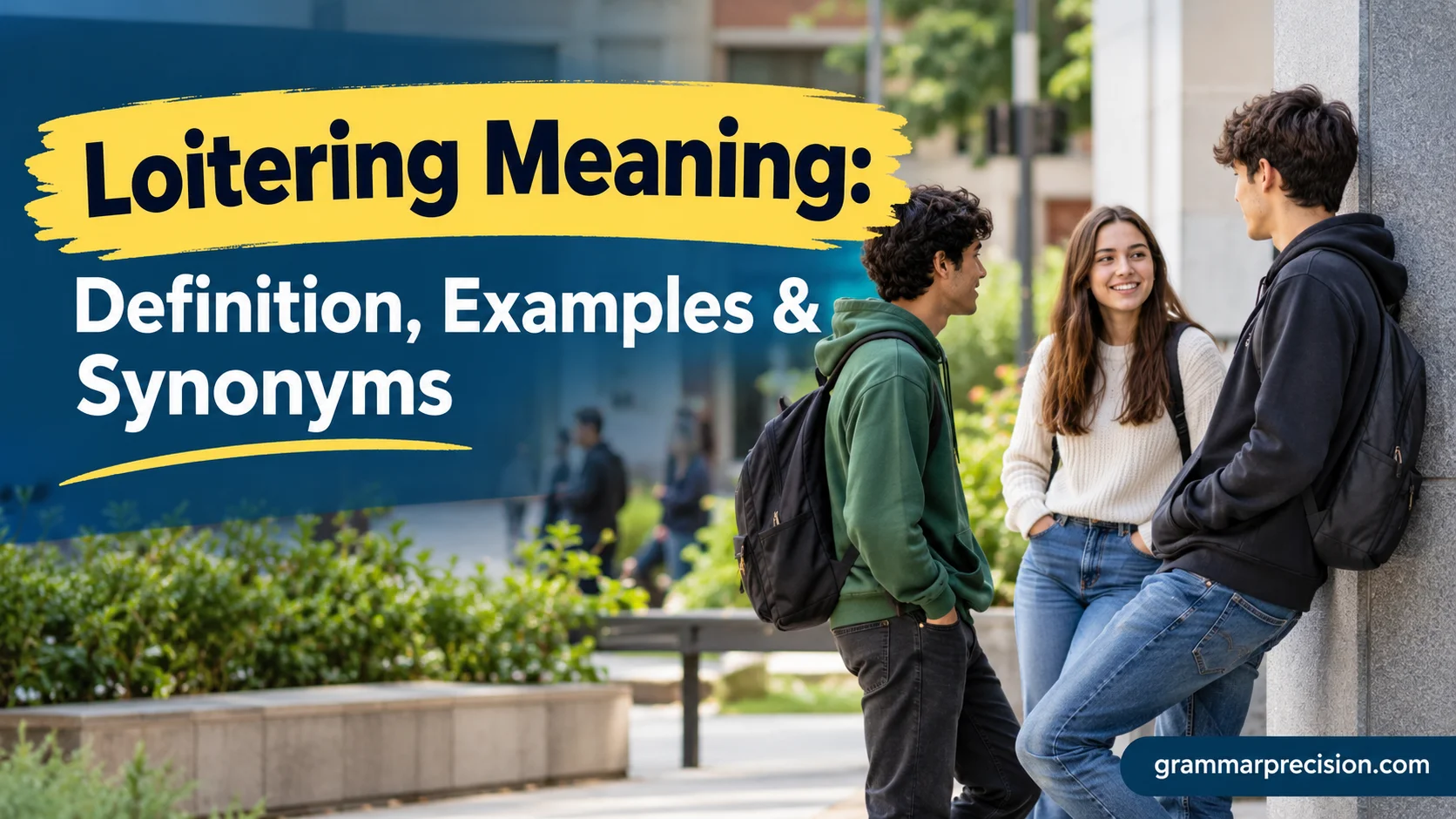
Have you ever waited somewhere without a specific purpose and wondered whether your behavior counts as loitering? The Loitering Meaning refers to remaining in a public or private place without an apparent reason, although the exact meaning can depend on context and local laws. Understanding this term helps you recognize its use in everyday conversations, workplace policies, and legal discussions. This guide explores its definition, common examples, synonyms, and differences in English usage to help you use the word correctly.
Whether you’re reading a notice, discussing public safety, or improving your formal writing, context matters. You’ll learn how loitering appears in business communication, scheduling, meetings, and everyday situations, along with its relevance to time management and project management. Although terms such as online booking, broadcasting, and calendar management relate to different activities, clear language and consistency help prevent misunderstandings. We’ll also consider US and UK English preferences, grammar rules, and practical examples so you can understand when and how to use loitering naturally and accurately.
What Does Loitering Mean?
Loitering means spending time in a place without an apparent immediate purpose or remaining there longer than expected. The word often suggests that someone is lingering instead of moving toward a particular destination or activity.
People use it in everyday conversations, public notices, workplace rules, and news reports. Its tone can range from neutral to disapproving, depending on the context.
For example, consider these situations:
- A teenager hangs around a shopping mall after meeting friends.
- Someone remains outside a closed office building for an extended period.
- A person lingers near a store entrance without shopping.
- A group stays in a parking lot long after an event ends.
Someone might describe these behaviors as loitering. However, the description doesn’t automatically establish that anyone has done something wrong.
Loitering Meaning in Simple English
In simple English, loitering means hanging around somewhere without a clear reason to stay.
Imagine that your friend finishes work at 5 p.m. You meet them outside the office, but they need another 20 minutes to finish a call. You wait nearby. That’s ordinary waiting.
Now imagine that you remain outside the building for hours after your friend leaves, with no particular destination or activity in mind. Someone might call that loitering.
The distinction isn’t always clear. People can have perfectly reasonable reasons for staying somewhere, even when those reasons aren’t obvious to others.
How to Pronounce Loitering
The word loitering is pronounced LOY-ter-ing. Its first syllable sounds like “boy” with an L.
Here is a simple breakdown:
| Word | Pronunciation | Meaning |
| Loiter | LOY-ter | To linger in a place |
| Loitering | LOY-ter-ing | The act of lingering |
| Loitered | LOY-terd | Stayed around in the past |
| Loiterer | LOY-ter-er | Someone who loiters |
You can use these forms in different sentences. For example, “They were loitering near the entrance” describes an ongoing action, while “They loitered near the entrance” describes a past action.
What Does Loitering Look Like in Real Life?
The meaning becomes easier to understand when you connect it to familiar situations. Loitering often describes behavior that appears unnecessary, prolonged, or unrelated to the place where someone is standing.
However, appearances don’t always reveal a person’s actual purpose.
Loitering Outside a Store
Imagine that someone stands outside a convenience store for 45 minutes without entering or meeting anyone. A store employee might wonder why the person is there and describe the behavior as loitering.
Now consider someone waiting outside the same store for a friend who is buying groceries. Although both people stand in the same place, their circumstances differ.
The location alone doesn’t determine the meaning. The duration, purpose, surrounding circumstances, and applicable rules may all matter.
Loitering in a School or Parking Lot
Schools sometimes use rules to discourage students from lingering in hallways, entrances, or parking areas after classes end. These rules may help manage traffic, maintain supervision, and keep particular areas accessible.
Similarly, a business might ask visitors to leave its parking lot after closing. Someone remaining there without permission could attract attention.
Still, a student waiting for a parent or a driver checking directions isn’t automatically doing anything wrong. A fair interpretation considers the person’s purpose and the rules that apply.
Waiting for Someone vs. Loitering
Waiting and loitering can look similar, but they emphasize different things.
Waiting usually means staying somewhere until an expected event occurs. Loitering emphasizes lingering without an apparent immediate purpose or staying longer than expected.
For example:
- “I’m waiting outside the restaurant for my sister.” This explains a specific purpose.
- “Several people were loitering outside the restaurant.” This describes lingering without explaining why.
- “We waited at the station for 30 minutes.” This describes a planned delay.
- “He kept loitering around the entrance.” This suggests prolonged lingering.
These differences matter because the word loitering can carry a negative implication even when the underlying behavior seems harmless.
Loitering Examples in Sentences
Sentence examples show how people use loitering in everyday English. Notice how the word often describes a person’s location, behavior, or length of stay.
Examples of Loitering in Casual Conversations
Here are examples you might hear in ordinary conversations:
- “Stop loitering around the kitchen and help me cook.”
- “The security guard asked the group to stop loitering near the entrance.”
- “We were loitering outside the theater while waiting for our friends.”
- “Why are those people loitering near the parking garage?”
- “The kids kept loitering around the playground after sunset.”
- “He spent the afternoon loitering around the mall.”
- “The manager doesn’t want employees loitering in the stockroom.”
- “They were accused of loitering, although they were waiting for a ride.”
These sentences demonstrate how the word can describe ordinary behavior or suggest that someone has overstayed their welcome.
Examples of Loitering in Formal Writing
In formal writing, loitering often appears in reports, workplace policies, and descriptions of public behavior.
Consider these examples:
- “Visitors must avoid loitering near emergency exits.”
- “The report described several individuals loitering outside the building.”
- “Employees should return to their assigned work areas rather than loitering in corridors.”
- “The property manager introduced a policy addressing unauthorized lingering in restricted areas.”
- “Security personnel observed a group loitering near the facility’s main entrance.”
When you write formally, describe the behavior objectively. Avoid assuming that someone has committed an offense merely because they remained in one place.
Examples of Loitering in News Reports
News reports may use the word when describing activity near businesses, transportation facilities, or public buildings.
For example:
- “Police investigated reports of people loitering near the closed facility.”
- “The city reviewed complaints about prolonged loitering in a commercial district.”
- “Witnesses reported seeing several individuals lingering outside the building.”
- “Officials reminded visitors not to loiter in areas reserved for emergency access.”
These are illustrative sentences, not reports of specific incidents. In actual news writing, distinguish eyewitness observations, allegations, and verified findings.
Synonyms and Antonyms of Loitering
Choosing the right synonym makes your writing more precise. Although several words describe lingering, each carries a slightly different meaning or tone.
Common Synonyms for Loitering
| Synonym | Meaning | Example |
| Lingering | Staying longer than expected | She lingered outside the café. |
| Dawdling | Moving or acting too slowly | He kept dawdling on the way home. |
| Hanging around | Staying somewhere informally | They were hanging around the entrance. |
| Lollygagging | Spending time idly | Stop lollygagging and get ready. |
| Milling around | Moving about without a clear direction | Visitors were milling around the lobby. |
| Idling | Remaining inactive | The workers were idling near the gate. |
| Loafing | Spending time without working | He was loafing instead of completing his tasks. |
Lingering is often the closest neutral alternative. Loafing usually emphasizes inactivity, while dawdling suggests unnecessary slowness.
Choose your word based on the behavior you want to describe. Someone can linger thoughtfully, dawdle while getting ready, or loaf instead of working.
Antonyms of Loitering
Antonyms express the opposite idea. Depending on the context, useful opposites include:
- Departing: Leaving a place.
- Proceeding: Continuing toward a destination or next step.
- Moving along: Leaving an area or continuing onward.
- Hurrying: Moving quickly.
- Advancing: Moving forward.
- Working: Engaging in a productive activity.
For example, “The visitors stopped loitering and proceeded toward the exit” contrasts lingering with purposeful movement.
Remember that an antonym doesn’t need to describe the exact opposite in every situation. The best choice depends on the sentence.
Loiter, Loitering, and Loitered: What’s the Difference?
These words belong to the same verb family, but their grammatical roles differ.
- Loiter: The base form of the verb.
- Loitering: The present participle or gerund form.
- Loitered: The simple past form and past participle.
- Loiterer: A noun describing someone who loiters.
Here are examples that show how to use each form correctly:
| Word form | Example sentence |
| Loiter | Please don’t loiter near the entrance. |
| Loitering | The group is loitering outside. |
| Loitered | We loitered near the shops yesterday. |
| Loiterer | The sign warns loiterers to move along. |
You can also use loitering as a noun: “Loitering near emergency exits can create safety concerns.”
As a verb form, it describes an action. As a gerund, it functions as a noun within the sentence. For example, “Loitering is prohibited in this restricted area.”
How to Use Loitering in Different Tenses
The verb loiter follows a regular pattern, so its past forms are easy to remember.
- Present: “They loiter near the entrance.”
- Present continuous: “They are loitering near the entrance.”
- Simple past: “They loitered near the entrance.”
- Present perfect: “They have loitered near the entrance before.”
- Future: “They will loiter near the entrance if nobody redirects them.”
One small grammar detail matters: use loitering after forms of be when describing an ongoing action. Use loitered when the action happened in the past.
For example, “She was loitering outside” is correct. “She was loitered outside” is not correct for this intended meaning.
Is Loitering Always a Negative Word?
No. Loitering often sounds disapproving, but its tone depends on the speaker and situation.
In a store notice, the word may communicate a restriction. In a novel, it might simply describe someone spending time in a particular place. In a casual conversation, it could even sound playful.
Consider these examples:
- Negative: “The manager complained about customers loitering after closing.”
- Neutral description: “A few people were loitering near the fountain.”
- Playful: “We spent the afternoon loitering around the bookstore.”
The final example uses the word humorously to describe a relaxed afternoon. It doesn’t necessarily suggest misconduct.
Why Loitering Can Sound Accusatory
Words influence how readers interpret behavior. Calling someone a loiterer may suggest that the person has no legitimate reason to remain somewhere.
However, the observer might not know the full circumstances. A person standing outside a building could be waiting for transportation, taking a break, meeting a friend, or seeking assistance.
For that reason, neutral wording often works better when the purpose remains unclear.
Instead of writing, “Suspicious people were loitering outside,” consider “Several people were standing outside the building.” The second sentence reports observable behavior without assigning motives.
This distinction is especially useful in journalism, professional communication, and formal incident reports.
What Does Loitering Mean Legally?
In legal contexts, loitering can refer to remaining in a particular place under circumstances covered by a specific law or regulation. However, the exact definition and legal consequences vary by jurisdiction.
The everyday meaning doesn’t automatically establish a legal violation. Someone may linger outside a building without breaking any law.
Legal rules can depend on factors such as location, conduct, applicable restrictions, and the circumstances surrounding an incident. Some jurisdictions also have constitutional or statutory limits on how authorities may enforce loitering laws.
Loitering vs. Trespassing
Loitering and trespassing are different concepts, although certain situations can involve both.
| Feature | Loitering | Trespassing |
| Basic meaning | Lingering in a place without an apparent immediate purpose | Entering or remaining somewhere without the required permission or legal authority |
| Main concern | The circumstances surrounding someone’s presence | Unauthorized presence on property |
| Can it happen in public? | Yes, depending on the circumstances | Certain forms can, depending on the law and location |
| Is it automatically illegal? | No | Not every situation labeled trespassing establishes a legal violation |
| Example | Someone remains outside a business for an extended period | Someone enters a restricted area without authorization |
For example, standing on a public sidewalk for an extended period doesn’t automatically constitute trespassing. Entering a locked, restricted area without permission raises a different issue.
The key distinction is that loitering concerns lingering, while trespassing concerns unauthorized presence. Their precise legal definitions depend on the applicable law.
Can You Get in Trouble for Loitering?
Possibly, but simply standing or waiting somewhere doesn’t automatically make your behavior illegal.
The answer depends on local laws, property rules, and the specific circumstances. For example, a person who refuses to leave a restricted area after receiving a lawful direction may face different consequences from someone waiting peacefully for a bus.
If you encounter a no-loitering sign, check what area it covers and what restrictions apply. A sign alone doesn’t establish that every person standing nearby has committed an offense.
Common Mistakes to Avoid When Using Loitering
Even fluent English speakers sometimes use loitering too broadly. Avoid these common mistakes to make your writing clearer and more accurate.
Assuming Loitering Always Means Criminal Behavior
One common mistake is treating loitering as another word for criminal activity. The word describes behavior, not proof of wrongdoing.
Better approach: Describe what happened before drawing conclusions about a person’s intentions or legal status.
Confusing Loitering With Waiting
Waiting usually involves an expected event or purpose. Loitering emphasizes lingering without an apparent immediate purpose.
However, the two can overlap in everyday descriptions. Someone waiting for a friend might appear to be loitering to an observer who doesn’t know the circumstances.
Using Loitering When You Mean Trespassing
These words aren’t interchangeable. Someone may linger in a public place without trespassing, while someone may trespass without lingering.
Choose the term that accurately describes the situation rather than using the words as synonyms.
Forgetting the Word’s Grammatical Form
Use the correct form according to your sentence structure:
- Correct: “The visitors were loitering outside.”
- Correct: “The visitors loitered outside yesterday.”
- Incorrect: “The visitors were loitered outside.”
A quick grammar check can prevent this mistake.
Real-Life Scenarios: Is It Waiting or Loitering?
Consider these situations to see how context changes the interpretation.
| Situation | Possible description | Why it matters |
| Someone waits ten minutes for a bus | Waiting | The person has an identifiable purpose. |
| A shopper browses inside a bookstore | Shopping or browsing | The activity fits the location. |
| A person remains outside a closed office for hours | Possibly loitering | The extended stay may prompt questions, but the person’s purpose still matters. |
| A student waits for a parent after school | Waiting | The person has a clear reason to stay. |
| Someone remains inside a restricted area without authorization | Potentially unauthorized presence | Property rules and applicable laws become relevant. |
These scenarios illustrate ordinary language rather than legal conclusions. The same behavior may have different explanations depending on the circumstances.
The main lesson is simple: don’t confuse an observer’s impression with established facts.
FAQs About Loitering Meaning
Does Loitering Mean Wasting Time?
Not necessarily. Loitering means lingering in a place without an apparent immediate purpose or remaining longer than expected. Although people sometimes associate it with wasting time, the words don’t have identical meanings.
Is Loitering the Same as Hanging Around?
They’re similar, but hanging around sounds more casual and conversational. Loitering can sound more formal or disapproving, especially in signs, workplace policies, and public discussions.
Can You Use Loitering in a Sentence?
Yes. For example, “The students were loitering near the school entrance after classes ended.” The sentence describes where the students stayed without automatically suggesting that they did anything wrong.
Is Loitering Illegal?
Not necessarily. Whether particular conduct violates a law depends on the jurisdiction, applicable rules, and specific circumstances. Merely standing or waiting in a public place isn’t automatically illegal.
What Is the Difference Between Loitering and Lingering?
Both words describe staying somewhere longer than expected. Lingering is generally more neutral, while loitering often suggests that someone remains without an apparent purpose.
What Is a No-Loitering Sign?
A no-loitering sign tells people not to linger in a designated area under the stated restrictions. The sign’s legal effect depends on the location, property rules, and applicable law.
What Is a Loiterer?
A loiterer is someone who loiters. For example, “The security guard asked the loiterers to move away from the restricted entrance.” The word can sound judgmental, so use it carefully when someone’s intentions remain unknown.
Conclusion:
Understanding the Loitering Meaning helps you recognize how people use this term in everyday conversations, public settings, and legal discussions. By learning its definition, examples, and context, you can improve your vocabulary and communicate more clearly in English.
Remember that loitering can carry different meanings depending on the situation and local laws. Use the word carefully in formal writing, workplace communication, and daily conversations. Understanding its synonyms, grammar, and practical examples will strengthen your English usage and help you express your ideas with greater accuracy and confidence.