Have you ever come across ABV on a beverage label, in a business message, or during an online search? Understanding ABV meaning helps you interpret abbreviations accurately across different contexts. While ABV commonly stands for Alcohol by Volume, its interpretation can vary depending on the subject and industry. Recognizing the intended meaning improves English usage, supports clear communication, and prevents misunderstandings in everyday conversations.
In this article, we’ll explore the definition of ABV, its common uses, and how context influences its interpretation. We’ll also examine its relevance to business communication, broadcasting, and professional terminology, alongside practical examples. Whether you’re reading product labels, managing a calendar, handling scheduling, or working with project management tools, understanding abbreviations promotes consistency and clarity. We’ll also consider how grammar, formal writing conventions, and regional preferences in US and UK English can influence abbreviation usage.
What Does ABV Mean?
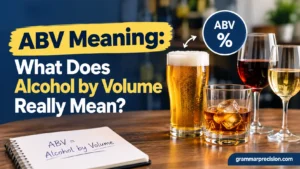
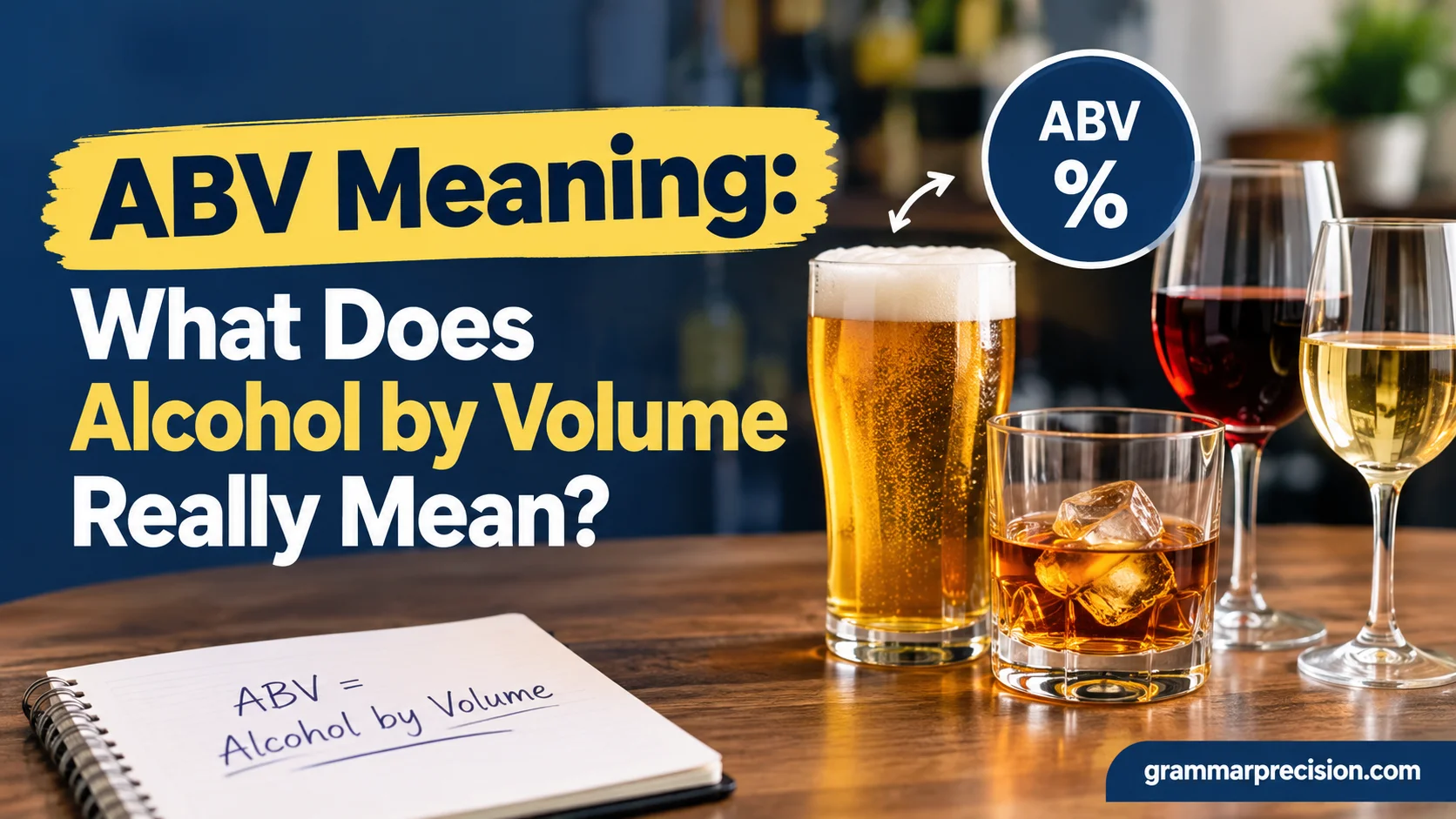
ABV stands for Alcohol by Volume. It expresses the volume of ethanol in an alcoholic beverage as a percentage of the drink’s total volume. Ethanol is the type of alcohol found in beer, wine, whiskey, vodka, and other alcoholic beverages.
For example, a beverage labeled 5% ABV contains approximately 5 milliliters of pure ethanol per 100 milliliters of beverage under the applicable measurement conditions. A 12% ABV wine contains approximately 12 milliliters per 100 milliliters.
The percentage describes alcohol concentration rather than the total amount of alcohol in the container. That’s an important distinction.
What Does ABV Stand For in Simple English?
Imagine dividing a drink into 100 equal parts. If the beverage contains 5% ABV, approximately five parts represent pure ethanol by volume. The remaining portion consists primarily of water and other ingredients, including sugars, acids, flavor compounds, and dissolved substances.
This example simplifies the concept because alcohol and water behave differently when mixed. Their combined volume isn’t always equal to the sum of their separate volumes. Nevertheless, the example makes the basic idea easy to understand.
What Does 5% ABV Actually Mean?
A 5% ABV beer contains approximately 5% alcohol by volume. However, the total amount of alcohol depends on how much beer you have.
Consider these examples:
- 100 mL of beer at 5% ABV: approximately 5 mL of ethanol.
- 330 mL of beer at 5% ABV: approximately 16.5 mL of ethanol.
- 500 mL of beer at 5% ABV: approximately 25 mL of ethanol.
The beer’s alcohol concentration stays the same in all three examples. The larger serving simply contains more total alcohol.
Why Do Alcoholic Drinks Display ABV?
ABV helps consumers compare beverages and understand their alcohol concentration. Manufacturers also use alcohol measurements for production quality, product consistency, and regulatory compliance.
A bottle labeled 40% ABV contains a much higher concentration of ethanol than a bottle labeled 5% ABV. However, you must consider the serving size before comparing the total alcohol in two drinks.
ABV is therefore useful when reading labels, choosing products, and understanding how much alcohol a beverage contains.
How Does ABV Work in Alcoholic Beverages?
The ABV percentage describes the concentration of alcohol within a beverage. It doesn’t measure sweetness, bitterness, flavor intensity, or overall quality.
Two beers can have the same ABV but taste completely different. One might taste light and crisp, while another feels rich and bitter. Ingredients, brewing methods, carbonation, and residual sugars all influence the drinking experience.
Understanding Alcohol Percentage Through Examples
Suppose you have two beverages:
- Drink A: 330 mL at 5% ABV.
- Drink B: 330 mL at 8% ABV.
Drink B contains more ethanol because both drinks have the same volume, but Drink B has a higher alcohol concentration.
Now imagine comparing a 330 mL beer at 5% ABV with a 150 mL wine at 12% ABV. The beer contains approximately 16.5 mL of ethanol, while the wine contains approximately 18 mL.
Although the wine serving is less than half the size of the beer serving, it contains slightly more pure alcohol.
How to Calculate Pure Alcohol Using ABV
You can estimate the volume of pure ethanol in a drink with a simple formula:
Pure alcohol (mL) = Beverage volume (mL) × ABV (%) ÷ 100
For example, a 250 mL beverage containing 6% ABV has approximately 15 mL of ethanol.
Calculation:
250 × 6 ÷ 100 = 15 mL
This calculation works for any beverage when you know its volume and ABV. It estimates the ethanol content by volume rather than its weight.
What Is a Typical ABV for Different Drinks?
Different alcoholic beverages have different ABV ranges because manufacturers use different ingredients and production methods. Beer usually contains less alcohol by volume than wine or distilled spirits. However, exceptions exist, especially with high-strength craft beers and fortified wines.
The following table shows common examples. Actual percentages vary by brand, recipe, and product style.
| Beverage | Typical ABV range | Example |
| Light beer | 3%–4% | A light lager |
| Regular beer | 4%–6% | A standard pale lager |
| Strong beer | 7%–12% or higher | An imperial stout |
| Wine | 11%–15% | A red or white table wine |
| Champagne | 11%–13% | A traditional sparkling wine |
| Hard cider | 4%–8% | An apple cider |
| Hard seltzer | 4%–6% | A flavored alcoholic seltzer |
| Vodka | 35%–50% | A typical 40% vodka |
| Whiskey | 40%–50% | A standard bottled whiskey |
| Rum | 35%–50% | A standard white rum |
| Gin | 37.5%–47% | A typical London dry gin |
These ranges are general examples, not fixed limits. Some beers exceed 12% ABV, and certain spirits reach much higher concentrations. Always check the individual product label rather than assuming every beverage in a category has the same strength.
Beer and Lager ABV
Most regular beers contain around 4%–6% ABV. Light beers often contain less alcohol, while some specialty beers have substantially higher concentrations.
A 355 mL beer at 5% ABV contains approximately 17.75 mL of ethanol. If the same serving contains 8% ABV, it provides approximately 28.4 mL of ethanol.
That difference matters. A beer’s familiar taste or casual presentation doesn’t necessarily indicate how much alcohol it contains.
Wine and Champagne ABV
Most table wines fall somewhere around 11%–15% ABV. Champagne and other sparkling wines often fall within a similar range, although individual products differ.
Wine’s alcohol concentration depends partly on the amount of sugar available for fermentation and how far fermentation proceeds. Grape variety, growing conditions, and winemaking decisions can also influence the final percentage.
Fortified wines, such as port and sherry, may have higher ABV because producers add distilled alcohol or use production methods that retain more natural sugar.
Vodka, Whiskey, Rum, and Gin ABV
Many standard bottled spirits contain approximately 40% ABV, although the exact percentage varies by product and market.
Distillation concentrates ethanol after fermentation. That’s why spirits generally have a higher ABV than beer or wine.
Some bottles display terms such as cask strength or overproof. These labels often indicate higher alcohol concentrations than standard bottlings. Read the stated percentage carefully because the product name alone doesn’t establish its strength.
Hard Seltzer, Cider, and Ready-to-Drink Cocktails
Hard seltzers and alcoholic ciders often contain around 4%–8% ABV. Ready-to-drink cocktails vary much more widely because their recipes may include spirits, mixers, and other ingredients.
A canned cocktail can look similar to a regular soft drink while containing considerably more alcohol than expected. Check both the ABV and container size before comparing it with beer or cider.
ABV Chart: Compare Alcohol Content at a Glance
An ABV chart makes it easier to compare alcohol concentrations, but concentration alone doesn’t show how much ethanol you’ll consume. You also need to consider the amount of beverage.
| Beverage example | Serving size | ABV | Approximate pure ethanol |
| Beer | 355 mL | 5% | 17.75 mL |
| Beer | 355 mL | 8% | 28.4 mL |
| Wine | 150 mL | 12% | 18 mL |
| Spirits | 45 mL | 40% | 18 mL |
| Hard seltzer | 355 mL | 5% | 17.75 mL |
These figures are illustrative calculations. Actual servings and product strengths vary.
Notice that 150 mL of wine at 12% ABV and 45 mL of spirits at 40% ABV each contain approximately 18 mL of ethanol. Their volumes differ considerably, but their estimated ethanol quantities are similar.
This is why comparing drinks by ABV alone can be misleading. A smaller serving of a concentrated beverage may contain as much alcohol as a larger serving of a lower-strength drink.
ABV vs. Proof: What’s the Difference?
ABV and proof both describe alcohol strength, but they use different numerical scales in the United States.
ABV expresses alcohol as a percentage by volume. U.S. proof is generally twice the ABV percentage.
The basic conversion is:
- Proof = ABV × 2
- ABV = Proof ÷ 2
For example, a spirit labeled 40% ABV is 80 proof. A spirit labeled 50% ABV is 100 proof.
| ABV | U.S. proof |
| 5% | 10 proof |
| 12% | 24 proof |
| 20% | 40 proof |
| 35% | 70 proof |
| 40% | 80 proof |
| 50% | 100 proof |
| 60% | 120 proof |
The conversion is straightforward under the U.S. system. However, historical proof systems and terminology in other countries can differ. When comparing international products, use the stated ABV rather than assuming every country uses the same proof convention.
ABV vs. ABW: Alcohol by Volume vs. Alcohol by Weight
Another term you might encounter is ABW, which means Alcohol by Weight. Unlike ABV, ABW expresses alcohol as a percentage of the beverage’s total weight.
Ethanol is less dense than water, so its percentage by weight is generally lower than its percentage by volume for the same mixture.
This distinction matters when reading technical documents, brewing information, or regulations. If a source reports ABW, don’t treat its number as though it were ABV.
For everyday label reading, ABV is the more familiar measurement in many markets.
Does Higher ABV Mean a Stronger Drink?
Yes, a higher ABV means a beverage contains a greater proportion of alcohol by volume. However, it doesn’t automatically mean that every serving contains more alcohol than every lower-ABV drink.
A 250 mL beer at 8% ABV contains 20 mL of ethanol. A 500 mL beer at 4% ABV also contains 20 mL. The first beer has a higher alcohol concentration, but both servings contain approximately the same volume of ethanol.
This distinction helps explain three related ideas:
- Alcohol concentration: The percentage of ethanol in a beverage.
- Total alcohol content: The amount of ethanol in a particular serving or container.
- Alcohol effects: The effects alcohol produces, which depend on consumption and individual circumstances.
Why Serving Size Matters
Consider a simple case study involving two hypothetical drinks.
Case study: Comparing two beverages
| Detail | Drink A | Drink B |
| Beverage volume | 330 mL | 150 mL |
| ABV | 5% | 12% |
| Pure ethanol | 16.5 mL | 18 mL |
Drink B has a smaller serving size but contains slightly more ethanol. Its higher ABV makes the difference.
This example demonstrates why the percentage on a label shouldn’t be the only number you consider when comparing beverages. Container size and serving volume also matter.
Does Higher ABV Mean Faster Intoxication?
Not necessarily in every situation, although consuming more alcohol over a shorter period generally increases the risk of intoxication. A high-ABV beverage can make it easier to consume substantial amounts of alcohol in a small volume.
Alcohol absorption and its effects depend on several factors, including:
- How much alcohol you consume.
- How quickly you drink it.
- Whether you’ve eaten.
- Your body composition and individual metabolism.
- Medications and other substances.
ABV alone cannot predict your blood alcohol concentration or determine whether you’re safe to drive. Never rely on a beverage’s percentage to judge whether you can perform activities that require alertness and coordination.
How to Read ABV on a Bottle or Can
Reading an alcohol label becomes easier when you know which details to look for. The ABV figure may appear near the product description, on the front label, or elsewhere on the packaging, depending on the product and local labeling rules.
Follow these steps when comparing beverages:
- Find the ABV percentage. Look for wording such as “5% Alc./Vol.” or “40% ABV.”
- Check the container size. A 500 mL can contains more liquid than a 330 mL can.
- Calculate the ethanol content if needed. Multiply the beverage volume by the ABV percentage and divide by 100.
- Compare equivalent serving sizes. This helps you understand how much alcohol different drinks contain.
- Read additional product information. Serving recommendations and ingredient lists can offer useful context.
For example, suppose a canned cocktail contains 200 mL of liquid at 10% ABV. The calculation gives approximately 20 mL of ethanol. A 500 mL beer at 4% ABV also contains approximately 20 mL of ethanol.
Despite their different sizes and appearances, these servings contain similar amounts of pure alcohol.
Common Mistakes When Interpreting ABV
Several misconceptions can make alcohol labels confusing.
Mistake: Assuming a lower ABV always means less alcohol.
A large serving of a lower-strength drink can contain more total ethanol than a small serving of a stronger beverage.
Mistake: Confusing ABV with proof.
A spirit labeled 40% ABV is generally 80 proof in the United States. The two numbers aren’t interchangeable.
Mistake: Assuming every drink in a category has the same strength.
Beer, wine, cider, and spirits vary by product. Always check the actual label.
Mistake: Treating ABV as a measure of taste.
Alcohol concentration can influence flavor and mouthfeel, but it doesn’t determine sweetness, bitterness, aroma, or overall quality by itself.
Mistake: Using ABV to estimate whether driving is safe.
ABV describes a beverage, not your level of impairment. Alcohol can affect judgment and coordination even when you don’t feel intoxicated.
How Is ABV Measured?
ABV measurement involves determining how much ethanol a beverage contains relative to its volume. Manufacturers and laboratories use suitable measurement methods to check alcohol concentration and maintain product consistency.
For fermented drinks, the process is more complicated than simply measuring the liquid’s density because sugar and other dissolved substances also affect density.
The Role of Fermentation
Fermentation occurs when yeast converts fermentable sugars into ethanol and carbon dioxide. The amount of alcohol produced depends on factors such as the available sugar, yeast strain, temperature, and fermentation conditions.
For example, a brewer can produce beers with different ABV levels by changing the recipe and fermentation process. However, fermentation doesn’t continue indefinitely under every condition. Yeast activity can slow or stop depending on alcohol concentration, temperature, and available nutrients.
How Hydrometers Help Measure Alcohol
A hydrometer measures a liquid’s density relative to a reference scale. Brewers often record the liquid’s original gravity before fermentation and its final gravity afterward.
Because fermentation converts sugar into ethanol and carbon dioxide, the liquid’s density changes. Brewers can use these readings with suitable calculations to estimate alcohol content.
However, a hydrometer reading taken from a finished sugary beverage won’t automatically provide an accurate ABV measurement. Sugar and other ingredients can affect the result, so the measurement method must suit the beverage.
What ABV Doesn’t Tell You
ABV provides valuable information, but it has limits. Understanding those limits helps you interpret labels without drawing conclusions that the percentage cannot support.
- It doesn’t predict your exact blood alcohol concentration. Individual physiology, drinking speed, and other factors influence alcohol levels in the body.
- It doesn’t measure beverage quality. A higher percentage doesn’t automatically indicate better ingredients or flavor.
- It doesn’t reveal the complete ingredient list. Two drinks with identical ABV may contain very different ingredients.
- It doesn’t show the total alcohol in a container by itself. You must also know the beverage volume.
- It doesn’t guarantee a particular effect. People respond differently to alcohol, and subjective feelings aren’t reliable measures of impairment.
The key distinction is simple: ABV describes alcohol concentration in the beverage. It doesn’t tell you everything about the drink or how your body will respond to it.
FAQs About ABV Meaning
What does ABV mean in simple terms?
ABV means Alcohol by Volume. It tells you what percentage of a beverage’s volume consists of ethanol. For example, a drink labeled 5% ABV contains approximately 5 mL of ethanol per 100 mL of beverage.
Is 5% ABV considered high?
A 5% ABV beverage is common for regular beer and some hard seltzers. Whether it contains a large amount of alcohol depends on the serving size. A large container can deliver considerably more ethanol than a small one at the same percentage.
What does 40% ABV mean?
A 40% ABV beverage contains approximately 40 mL of ethanol per 100 mL of beverage. Many standard bottled spirits, including vodka and whiskey, use this concentration. The total ethanol in a serving depends on how much liquid you pour.
Is ABV the same as alcohol percentage?
Yes. On most alcoholic beverage labels, ABV is the alcohol percentage expressed by volume. However, alcohol by weight uses a different measurement, so you should check which unit a label or technical source reports.
Does higher ABV mean better quality?
No. ABV measures alcohol concentration, not quality. Flavor, aroma, ingredients, production methods, and personal preferences all contribute to how a beverage tastes. A drink with a higher percentage isn’t automatically better than one with a lower percentage.
Can two drinks with different ABV contain the same amount of alcohol?
Yes. A 500 mL beverage at 4% ABV contains approximately 20 mL of ethanol. A 250 mL beverage at 8% ABV also contains approximately 20 mL. Their concentrations differ, but their estimated ethanol quantities match.
Conclusion:
Understanding ABV meaning helps you recognize abbreviations accurately and interpret information confidently. Whether reading beverage labels or encountering industry-specific terminology, knowing the correct definition improves English comprehension, prevents confusion, and supports clear communication across different everyday and professional contexts.
Ultimately, understanding ABV depends on the context in which it appears. Although it commonly means Alcohol by Volume, other interpretations may apply in specific industries. Paying attention to surrounding information, English usage, and regional writing conventions helps ensure accuracy. By recognizing these differences, you can communicate more effectively and avoid common misunderstandings in everyday conversations and professional writing.