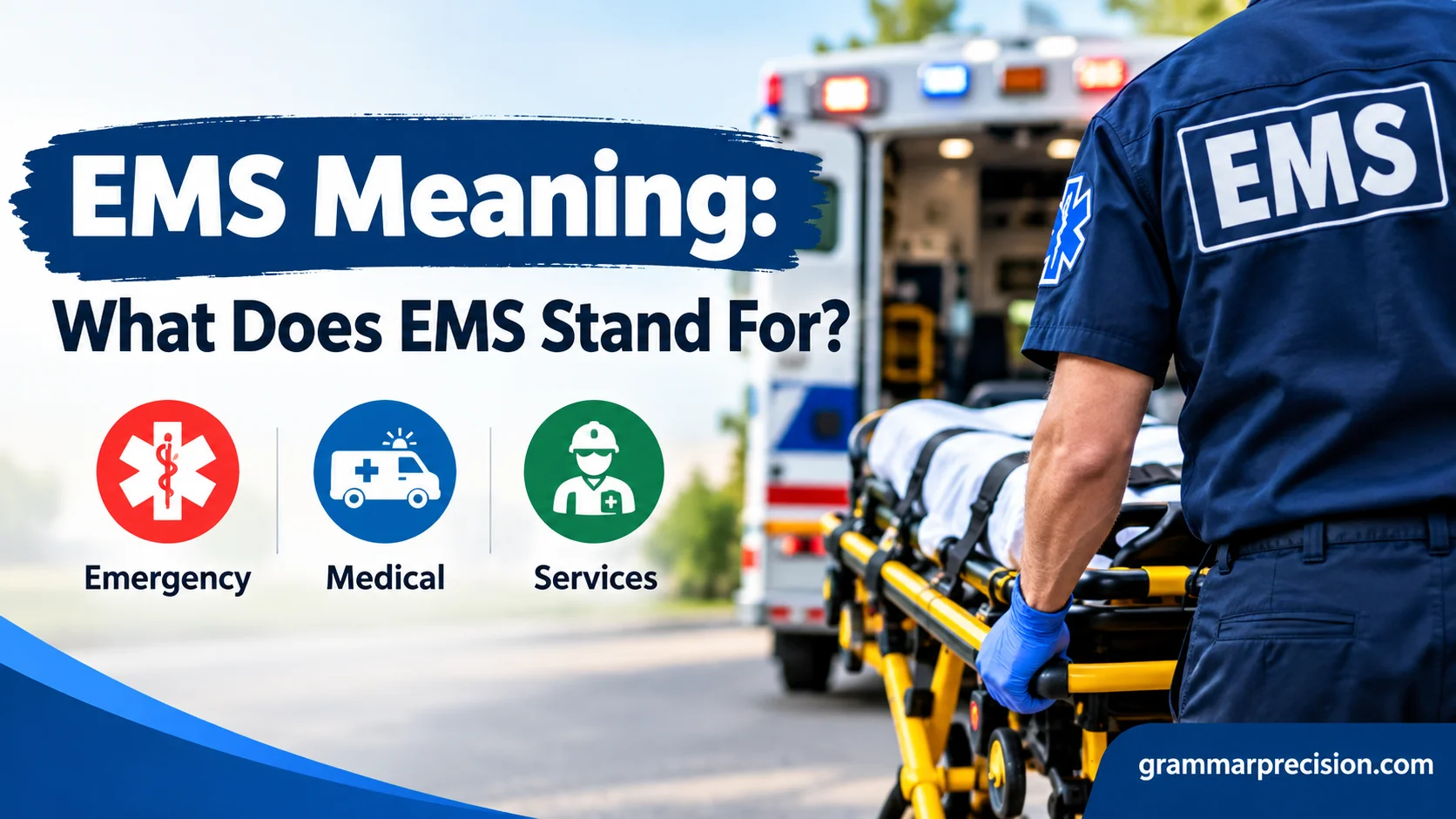
Have you ever encountered the abbreviation EMS in a text message, business document, calendar invitation, or online platform? Understanding the EMS meaning can help you interpret its intended message accurately. Depending on the context, EMS may refer to Emergency Medical Services, electronic messaging systems, or other specialized terms. Recognizing these differences is essential for clear business communication, effective scheduling, and professional English usage.
In this article, we’ll explore the different meanings of EMS, explain how context influences its interpretation, and distinguish it from similar abbreviations. You’ll also learn how EMS may appear in meetings, project management, online booking, and broadcasting, alongside practical guidance on grammar, formal writing, and consistency. Whether you follow US or UK English preferences, understanding these distinctions can improve time management and help you communicate more confidently.
What Does EMS Mean?
EMS stands for different terms in different industries. Its meaning depends on the subject, conversation, or document where it appears. Although Emergency Medical Services is one of its best-known meanings, it’s not the only correct interpretation.
In everyday use, EMS commonly appears in healthcare, shipping, fitness, business, and environmental management. Each field uses the abbreviation for a different purpose.
Here’s a quick overview of the most common meanings.
| EMS Full Form | Industry | What It Means |
| Emergency Medical Services | Healthcare | Emergency medical assistance and transportation |
| Express Mail Service | Postal services | An international express postal delivery service |
| Electrical Muscle Stimulation | Fitness and therapy | Electrical impulses that cause muscles to contract |
| Environmental Management System | Environmental management | A framework for managing environmental responsibilities |
| Enhanced Messaging Service | Telecommunications | An older messaging format with features beyond basic SMS |
| Electronics Manufacturing Services | Electronics | Manufacturing and technical services for electronic products |
| European Monetary System | Economics and history | A historical framework for European monetary cooperation |
These definitions aren’t interchangeable. The correct one depends on what you’re reading or discussing.
For instance, EMS on a hospital report means something different from EMS on a parcel label. Looking at the surrounding words usually provides the clearest answer.
What Is the Most Common Full Form of EMS?
In emergency healthcare, EMS means Emergency Medical Services. These services provide urgent medical assessment, treatment, and transportation when someone experiences a serious injury or sudden illness.
Emergency medical professionals may respond to road accidents, breathing difficulties, cardiac emergencies, severe bleeding, and other dangerous situations. Depending on the location and available resources, the response may involve emergency medical technicians, paramedics, ambulances, dispatchers, and specialized rescue teams.
However, the most familiar meaning can vary by audience. A person tracking an international package may recognize EMS as Express Mail Service instead. Someone researching a muscle stimulation device may associate it with Electrical Muscle Stimulation.
Therefore, it’s best to avoid assuming that one full form applies everywhere.
What Does EMS Mean in Simple English?
In simple English, EMS refers to a service, system, or technology identified by those three letters.
The easiest way to understand it is to consider the situation:
- An ambulance arrives after an emergency: EMS means Emergency Medical Services.
- A tracking page shows an international parcel service: EMS may mean Express Mail Service.
- A fitness device sends electrical impulses to muscles: EMS means Electrical Muscle Stimulation.
- A company manages waste, pollution, and environmental risks: EMS may mean Environmental Management System.
Think of EMS as a label with several possible meanings. The words around it tell you which definition makes sense.
EMS Meaning in Emergency Healthcare
Emergency Medical Services (EMS) provide immediate medical assistance to people experiencing urgent health problems or serious injuries. These services connect the scene of an emergency with appropriate medical care, often beginning treatment before a patient reaches the hospital.
EMS systems play a vital role in public safety. They respond to emergencies at homes, workplaces, roads, schools, and public events.
What Do Emergency Medical Services Do?
Emergency Medical Services handle much more than ambulance transportation. Trained professionals assess patients, provide immediate treatment, and help arrange the next stage of care.
Their responsibilities may include:
- Responding to emergencies: Reaching people who experience sudden illness, injury, or other medical crises.
- Assessing patients: Checking breathing, circulation, consciousness, and other signs of medical distress.
- Providing immediate treatment: Delivering appropriate first aid, CPR, oxygen, or other interventions within their training and authority.
- Transporting patients: Taking people to suitable medical facilities when transportation is necessary.
- Coordinating with hospitals: Sharing important patient information with emergency department staff.
- Supporting rescue operations: Working with firefighters, police officers, and other emergency responders when necessary.
For example, after a serious traffic collision, EMS personnel may assess injured passengers, control bleeding, stabilize patients, and transport them for further treatment.
Who Works in EMS?
An EMS system involves several professionals, and each plays a different role.
| Professional | Main Responsibility |
| Emergency medical dispatcher | Receives emergency calls and coordinates responses |
| Emergency medical technician (EMT) | Provides emergency assessment and treatment within their training |
| Paramedic | Provides advanced prehospital care within their authorized scope |
| Ambulance operator | Supports safe and timely transportation |
| EMS supervisor | Oversees teams, operations, or response quality |
Training, professional titles, and responsibilities vary by country and region. Not every ambulance crew has the same qualifications or equipment.
When Should You Contact EMS?
Contact local emergency services when someone faces a potentially life-threatening situation. Examples include severe breathing difficulties, suspected heart attack or stroke, uncontrolled bleeding, unconsciousness, or serious traumatic injuries.
If someone is unresponsive and isn’t breathing normally, call the local emergency number and follow the dispatcher’s instructions. Begin CPR if appropriate and you’re able to do so.
Example: Imagine a person suddenly develops facial drooping, difficulty speaking, and weakness in one arm. These symptoms can indicate a stroke. Calling EMS promptly allows trained responders to assess the person and coordinate urgent hospital care.
The important lesson is that EMS helps bring medical care to the patient. It isn’t simply another name for an ambulance.
EMS Meaning in Shipping and International Delivery
In international shipping, EMS stands for Express Mail Service. It refers to an international express postal service offered through participating postal operators. Customers use it to send documents and parcels across borders, often with tracking and priority handling.
For someone waiting for an online order, EMS may appear in a seller’s shipping confirmation, parcel label, or tracking information.
What Is Express Mail Service?
Express Mail Service is designed to move eligible mail and parcels through participating postal networks. National postal operators manage the service in their respective countries and handle the relevant stages of delivery.
The exact delivery process depends on the origin, destination, customs requirements, and local postal arrangements.
Typical features may include:
- Tracking updates as the parcel moves through the network.
- Priority handling compared with certain standard postal services.
- International delivery through participating postal operators.
- Delivery confirmation where the service supports it.
- Customs processing for international shipments.
Delivery times, compensation policies, size limits, and available features vary by route and postal operator. EMS doesn’t guarantee that every parcel will arrive on the same schedule.
How Does EMS Shipping Work?
An international EMS shipment usually follows several stages:
- Acceptance: The postal operator receives the parcel and records the shipment.
- Processing: Staff sort the parcel and prepare it for transportation.
- International dispatch: The shipment travels toward the destination country.
- Customs clearance: Authorities may inspect the parcel and assess duties or taxes.
- Local processing: The destination postal operator receives and sorts the shipment.
- Final delivery: The parcel moves toward the recipient’s address or designated collection point.
Tracking information helps customers understand which stage their shipment has reached. However, updates may not appear continuously, especially while a parcel travels between countries.
EMS Shipping vs. Standard Postal Delivery
| Feature | EMS | Standard Postal Service |
| Main purpose | Express international delivery | Routine mail and parcel delivery |
| Priority | Often receives priority handling | Depends on the service selected |
| Tracking | Commonly available | Varies by service |
| Delivery speed | Often faster than basic international mail | Depends on route and service |
| Cost | Usually higher than basic postal options | Often more economical |
These are general comparisons, not universal guarantees. Always check the actual service terms before choosing a shipping option.
Example: Suppose you order a product from another country and the seller sends it through EMS. A tracking update might show that the parcel has left the exporting country. That status doesn’t necessarily mean it has reached your city. It may still need to pass through customs and local sorting.
EMS Meaning in Fitness and Physical Therapy
In fitness and rehabilitation, EMS means Electrical Muscle Stimulation. This technology uses electrical impulses delivered through electrodes to trigger muscle contractions.
A device may attach electrodes to the skin using adhesive pads or specialized garments. The electrical signals stimulate nearby nerves, causing targeted muscles to contract.
Healthcare professionals may use electrical stimulation for specific rehabilitation goals. Fitness facilities also offer EMS workouts, although their methods, purposes, and evidence may differ from clinical treatments.
How Does Electrical Muscle Stimulation Work?
Your nervous system normally sends electrical signals that tell muscles when to contract. EMS devices use externally generated electrical impulses to stimulate nerves and produce contractions.
The result depends on the device, electrode placement, intensity, pulse settings, and treatment purpose.
Some systems target individual muscle groups, while others stimulate multiple areas simultaneously. A trained professional may adjust the settings according to the person’s needs and tolerance.
What Are the Uses of EMS in Fitness and Therapy?
Electrical muscle stimulation may support several goals when used appropriately.
- Rehabilitation: Certain devices help address muscle weakness or support recovery after injury.
- Muscle reeducation: Electrical stimulation can help activate muscles when normal voluntary control is impaired.
- Strength training: Some supervised programs combine stimulation with physical exercise.
- Pain management: Specific forms of electrical stimulation may help manage certain types of pain, depending on the device and condition.
It’s important to distinguish EMS from TENS, which stands for Transcutaneous Electrical Nerve Stimulation. TENS primarily targets nerves for pain relief, although the effects of different electrical stimulation methods can overlap.
Is EMS Training Safe?
EMS can be useful in suitable circumstances, but it isn’t automatically safe for everyone. High-intensity whole-body EMS sessions can place substantial demands on muscles, especially for beginners.
Excessive intensity or inadequate recovery may cause severe muscle damage, including rare cases of rhabdomyolysis. This condition involves muscle breakdown that can damage the kidneys.
People with implanted electrical devices, certain heart conditions, pregnancy, or other relevant medical concerns should seek professional guidance before using EMS. Precautions depend on the device and the person’s health.
Remember: EMS doesn’t replace balanced exercise, appropriate nutrition, or qualified medical care. Claims that a device melts fat or guarantees rapid muscle growth should be treated cautiously.
EMS Meaning in Business and Environmental Management
In business settings, EMS may refer to an Environmental Management System or Electronics Manufacturing Services. Both meanings appear in professional documents, but they describe very different activities.
The surrounding subject usually reveals which definition applies.
What Is an Environmental Management System?
An Environmental Management System is a structured approach that helps an organization manage its environmental responsibilities. Businesses use an EMS to monitor environmental impacts, meet applicable requirements, reduce waste, and improve their environmental performance.
For example, a manufacturing company might use an environmental management system to track energy consumption, manage wastewater, reduce packaging waste, and monitor emissions.
A typical system includes:
- Environmental planning: Identifying activities that affect the environment.
- Legal compliance: Understanding and meeting relevant environmental obligations.
- Operational controls: Establishing procedures for managing environmental risks.
- Performance monitoring: Measuring indicators such as waste generation and resource use.
- Continuous improvement: Reviewing results and adjusting processes when necessary.
Organizations may align their systems with ISO 14001, an international standard for environmental management systems.
Example: A food processing plant discovers that its production process wastes large amounts of water. Its EMS helps managers measure consumption, introduce water-saving procedures, and review the results over time.
In this context, EMS describes a management framework rather than a piece of equipment or an emergency response team.
What Does EMS Mean in Electronics Manufacturing?
In electronics, EMS stands for Electronics Manufacturing Services. These services involve producing electronic products or components on behalf of other companies.
An electronics brand might design a circuit board and develop the product concept while outsourcing manufacturing to an EMS provider. Depending on the agreement, the provider may also handle assembly, testing, supply chain management, and repairs.
Common services include:
- Printed circuit board assembly.
- Electronic component sourcing.
- Product testing and quality control.
- Manufacturing and assembly support.
- Inventory and supply chain coordination.
- Product lifecycle and repair services.
Example: A startup develops a smart home sensor but doesn’t own a factory. It contracts an EMS provider to source components, assemble circuit boards, test finished units, and prepare products for shipment.
The startup can then focus more heavily on product design, software development, marketing, and customer support.
What Does EMS Mean in Professional Documents?
The abbreviation can appear in company reports, technical specifications, contracts, and job advertisements.
Use the surrounding terminology to identify its intended meaning.
| Context | Likely EMS Meaning | Clues to Look For |
| Environmental compliance | Environmental Management System | Waste, emissions, audits, sustainability |
| Electronics production | Electronics Manufacturing Services | Circuit boards, components, assembly |
| Emergency planning | Emergency Medical Services | Ambulances, patient care, dispatch |
| Postal operations | Express Mail Service | Parcels, tracking, customs |
When a document uses EMS repeatedly without defining it, check the abbreviation list or glossary near the beginning. Technical documents often define specialized terms before using them throughout the text.
EMS Meaning in Technology and Messaging
In telecommunications, EMS can stand for Enhanced Messaging Service. This term describes an older messaging format that expanded on the basic capabilities of SMS, or Short Message Service.
Traditional SMS focuses on text messages. Enhanced messaging formats introduced support for certain additional features, such as text formatting and simple multimedia elements, depending on device compatibility and network support.
What Is Enhanced Messaging Service?
Enhanced Messaging Service was designed to provide more expressive messages than basic SMS while retaining compatibility with existing mobile messaging systems.
Depending on the implementation, it could support features such as:
- Formatted text.
- Simple pictures or icons.
- Basic animations.
- Certain sounds or other enhanced content.
EMS shouldn’t be confused with modern messaging applications that support high-resolution images, video, group conversations, and internet-based communication.
Today’s phones commonly rely on richer messaging platforms, including internet messaging services and newer carrier messaging standards. As a result, EMS is more likely to appear in older telecommunications material than in everyday conversations.
EMS vs. SMS: What’s the Difference?
| Feature | EMS | SMS |
| Full form | Enhanced Messaging Service | Short Message Service |
| Primary purpose | Add basic enhancements to mobile messages | Send text messages |
| Formatting | Supports certain enhanced formatting | Primarily plain text |
| Multimedia features | Limited enhancements, depending on implementation | Traditionally limited |
| Modern relevance | Mostly historical or specialized | Still widely used |
The key distinction is that EMS extended basic messaging capabilities. It didn’t become the universal standard for modern multimedia communication.
Does EMS Mean Anything Different in Text Messages?
Sometimes. A person might use EMS as shorthand for Emergency Medical Services, especially when discussing an accident or urgent medical situation. Someone else might use it while discussing shipping, technology, or a professional topic.
However, EMS isn’t a universally recognized slang expression with one fixed meaning. Don’t assume a message uses the abbreviation as internet slang unless the surrounding conversation supports that interpretation.
For example:
- “EMS arrived within minutes.” This probably refers to emergency medical responders.
- “My EMS package is delayed.” This likely refers to Express Mail Service.
- “The therapist recommended EMS.” This probably refers to Electrical Muscle Stimulation.
Context matters more than the abbreviation alone.
Other EMS Meanings You May Encounter
Although healthcare, shipping, fitness, and business account for several common uses, EMS has additional meanings in specialized fields.
European Monetary System
The European Monetary System was a framework established in 1979 to encourage monetary cooperation among participating European countries. It aimed to reduce exchange-rate instability and support greater economic coordination.
One of its central features was the Exchange Rate Mechanism, which linked participating currencies through agreed exchange-rate arrangements. The system formed part of the historical development that eventually led to the euro.
If you encounter EMS in a history textbook, economics lecture, or discussion about European integration, this may be the intended meaning.
Other Industry-Specific EMS Definitions
The abbreviation can also appear in specialized settings.
- Energy Management System: Software and control systems that monitor and optimize energy use in buildings, industrial facilities, or power networks.
- Event Management System: A platform used to organize registrations, schedules, attendees, and event logistics.
- Enterprise Management System: A broad term for software that helps organizations coordinate business operations.
- Emergency Management System: In some organizations, a framework for coordinating preparedness, response, and recovery activities.
These meanings aren’t interchangeable with the more established definitions discussed earlier. Some are industry-specific labels rather than universally standardized expansions.
When accuracy matters, check how the organization defines EMS in its documentation.
How to Identify the Correct EMS Meaning
The easiest way to identify the right definition is to examine the words, activities, and circumstances surrounding the abbreviation.
Rather than memorizing every possible full form, focus on a few practical clues.
Check the Subject of the Conversation
Start by identifying the topic. If someone discusses ambulances, emergency calls, or paramedics, Emergency Medical Services is the likely meaning. If the conversation concerns parcel delivery, shipping is the stronger possibility.
Here are a few examples:
| Where You See EMS | Most Likely Meaning |
| Hospital or ambulance report | Emergency Medical Services |
| International parcel tracking | Express Mail Service |
| Fitness studio or rehabilitation clinic | Electrical Muscle Stimulation |
| Environmental audit | Environmental Management System |
| Electronics factory | Electronics Manufacturing Services |
| Older mobile technology documentation | Enhanced Messaging Service |
Look for Supporting Words
Specific words can help you narrow down the possibilities.
- Medical terms: Ambulance, paramedic, emergency response, patient.
- Shipping terms: Parcel, customs, tracking number, delivery.
- Fitness terms: Electrodes, muscle contraction, workout, rehabilitation.
- Environmental terms: Sustainability, emissions, waste, compliance.
- Electronics terms: Assembly, circuit boards, components, manufacturing.
If the abbreviation appears in an unfamiliar document, read the entire sentence before choosing a definition. A single surrounding word may resolve the confusion.
Consider Who Is Using the Abbreviation
The speaker’s profession can also provide useful context. A paramedic discussing EMS probably means emergency medical care. A logistics employee may be referring to international mail, while an electronics engineer might be discussing manufacturing services.
Still, context is a guide rather than proof. When a document has legal, technical, or medical significance, confirm the intended meaning instead of relying on assumptions.
EMS vs. EMT vs. ER: Understanding the Differences
People sometimes confuse EMS with EMT or ER because all three abbreviations appear in emergency healthcare. However, each term refers to something different.
| Abbreviation | Full Form | Meaning |
| EMS | Emergency Medical Services | The broader system providing emergency medical care |
| EMT | Emergency Medical Technician | A trained professional who provides emergency medical assistance |
| ER | Emergency Room | A hospital department that evaluates and treats urgent medical conditions |
EMS describes a system. EMT describes a professional role. ER describes a hospital department.
For example, after a serious accident, an EMS team may respond to the scene. An EMT may assess the injured person and provide treatment. If transportation is necessary, the patient may then receive further care in a hospital emergency department.
The exact terminology and professional responsibilities vary by country, but these distinctions remain useful for understanding general medical discussions.
FAQs About EMS Meaning
What Is the Full Form of EMS?
EMS has several full forms. Common examples include Emergency Medical Services in healthcare, Express Mail Service in shipping, and Electrical Muscle Stimulation in fitness and rehabilitation. The intended meaning depends on the context.
What Does EMS Mean in Texting?
In text messages, EMS may refer to Emergency Medical Services, especially when someone discusses an accident or medical emergency. It can also refer to shipping or another subject. It isn’t universally recognized as slang with one fixed definition.
What Does EMS Mean in Shipping?
In shipping, EMS usually stands for Express Mail Service. It refers to an international express postal service that participating postal operators use to deliver documents and parcels.
What Does EMS Mean in Fitness?
In fitness, EMS means Electrical Muscle Stimulation. Devices deliver electrical impulses through electrodes to trigger muscle contractions. Certain applications support training or rehabilitation, but results and safety depend on the device and how it’s used.
What Does EMS Mean in Healthcare?
In healthcare, EMS stands for Emergency Medical Services. These services provide emergency assessment, treatment, and transportation for people experiencing serious injuries or sudden illnesses.
Is EMS the Same as an Ambulance?
No. An ambulance is a vehicle used to transport patients and, depending on its equipment and crew, provide medical care. EMS refers to the broader emergency medical service system, which may include dispatchers, EMTs, paramedics, ambulances, and other resources.
What Does EMS Mean in Business?
In business, EMS may refer to an Environmental Management System or Electronics Manufacturing Services. The first helps organizations manage environmental impacts, while the second involves manufacturing electronic products or components for other companies.
Does EMS Have More Than One Meaning?
Yes. EMS is a multi-meaning abbreviation used in healthcare, postal services, fitness, telecommunications, manufacturing, environmental management, and other fields. Reading the surrounding text is usually the quickest way to identify the correct full form.
Conclusion:
Understanding the EMS meaning helps you interpret abbreviations accurately in different situations. Whether used in emergency services, business communication, or technology, its intended meaning depends on context. Recognizing these differences improves clarity, English usage, and everyday communication while helping readers understand information correctly.
By considering the surrounding words and purpose, you can avoid misunderstandings and choose the correct interpretation. Always focus on context, maintain consistent writing, and use abbreviations appropriately. These simple practices strengthen professional communication, improve accuracy, and make your messages clearer, more effective, and easier for readers to understand.