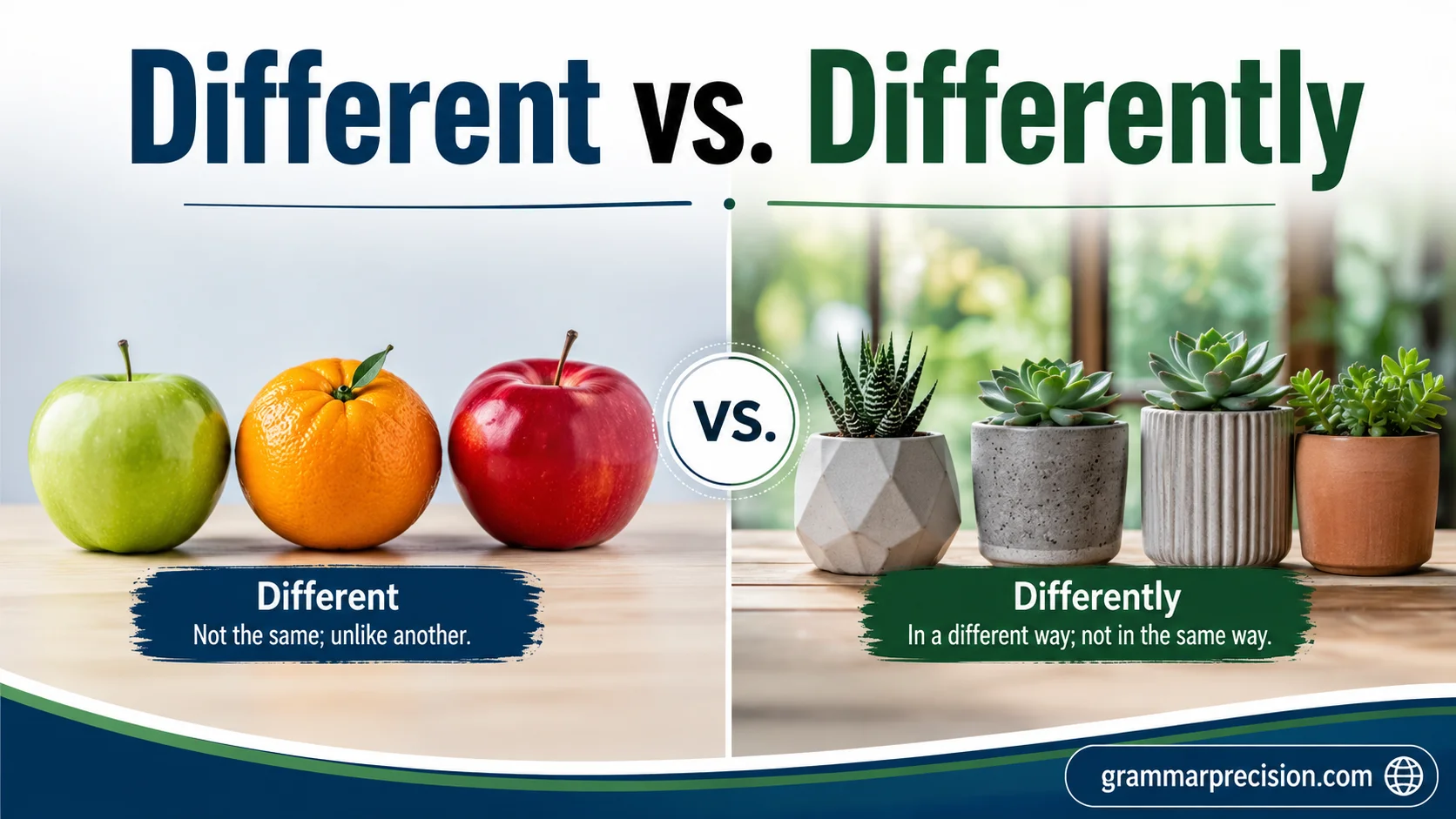
Different vs. Differently is a common grammar question. Understanding the correct usage helps you write clear, accurate, and natural English in both everyday conversations and professional communication.
Learning Different vs. Differently can instantly improve your grammar and make your writing more confident and precise. Although these words share the same root, they perform different grammatical roles. Knowing when to use each one helps you avoid common mistakes and communicate your ideas with greater clarity and accuracy.
If you’ve ever paused before writing different or differently, you’re not alone. Many English learners and native speakers confuse these words because they look similar but function differently in sentences. This guide explains the key differences, provides practical examples, and shares easy grammar tips so you can choose the correct word with confidence every time.
Quick Answer
Here’s the short version if you’re in a hurry.
| Word | Part of Speech | Purpose | Example |
| Different | Adjective | Describes a noun or pronoun | We chose a different route. |
| Differently | Adverb | Describes a verb, adjective, or another adverb | She solved the problem differently. |
Simple rule: If you’re describing a person, place, thing, or idea, use different. If you’re describing how an action happens, use differently.
Why People Confuse Different and Differently
Many English learners—and even native speakers—mix up these two words because they share the same root word, differ. They look similar, sound similar, and relate to the same general idea of being not the same.
However, grammar isn’t just about meaning. It’s also about function.
Think of it this way:
- Different answers “What kind?”
- Differently answers “How?”
That single distinction solves most grammar questions involving these words.
For example:
✅ This restaurant serves different dishes.
Here, different describes the noun dishes.
Now compare it with:
✅ This restaurant cooks food differently.
This time, differently explains how the restaurant cooks.
The meaning changes because each word has a different grammatical job.
Grammar Tip: Adjectives describe things. Adverbs describe actions.
Remembering this one sentence makes the choice much easier.
What Does “Different” Mean?
The word different is an adjective. It describes a noun or pronoun by showing that it is not the same as another person, object, place, or idea.
Whenever you modify a noun, different is usually the correct choice.
Different as an Adjective
Adjectives give more information about nouns.
Examples include words like:
- large
- small
- beautiful
- happy
- different
Notice how each adjective tells you something about the noun.
Examples
- I bought a different laptop.
- She has a different opinion.
- We need a different solution.
- They visited a different country.
- The manager suggested a different strategy.
Each sentence answers the question:
“What kind of laptop, opinion, solution, country, or strategy?”
The answer is different.
Common Sentence Patterns with Different
You’ll often see different used in these structures.
Pattern 1
Different + Noun
Examples:
- a different answer
- a different teacher
- a different city
- a different approach
Pattern 2
Be + Different
Examples:
- Your idea is different.
- This movie feels different.
- Their plan was completely different.
- My experience was very different.
Pattern 3
Different from
This is the most common and widely accepted structure in American English.
Examples:
- Cats are different from dogs.
- My results were different from yours.
- Today’s weather is different from yesterday’s.
Everyday Examples of Different
Let’s look at practical situations.
At School
- Every student has a different learning style.
- The science project required a different method.
- Our teacher assigned different topics.
At Work
- We need a different marketing plan.
- The client requested a different design.
- Each department follows a different process.
At Home
- Let’s try a different recipe tonight.
- I bought a different brand of coffee.
- My brother has a different schedule.
Notice how different always modifies a noun.
What Does “Differently” Mean?
Unlike different, differently is an adverb.
Instead of describing nouns, it describes actions.
It explains how something happens.
Whenever you can ask “How?”, there’s a good chance an adverb belongs there.
Differently as an Adverb
Most English adverbs end in -ly.
Examples include:
- slowly
- quickly
- carefully
- quietly
- differently
Each one explains how someone performs an action.
Examples
- She thinks differently.
- They reacted differently.
- He answered the question differently.
- We approached the problem differently.
- The company operates differently today.
The adverb tells readers how the action happened.
Common Sentence Patterns with Differently
Verb + Differently
Examples:
- Learn differently.
- Work differently.
- Speak differently.
- Think differently.
- Drive differently.
Do Things Differently
One of the most common English expressions.
Examples:
- Successful companies do things differently.
- Great leaders think differently.
- Children sometimes learn differently.
Treat Someone Differently
Examples:
- Teachers shouldn’t treat students differently.
- Parents often raise siblings differently.
- Managers may evaluate employees differently.
Different vs. Differently: Side-by-Side Comparison
The fastest way to master this grammar point is by comparing both words together.
| Feature | Different | Differently |
| Part of Speech | Adjective | Adverb |
| Describes | Nouns | Verbs |
| Answers | What kind? | How? |
| Common Position | Before or after nouns | After verbs |
| Function | Shows something isn’t the same | Explains how an action happens |
| Example | A different answer | Answer differently |
Different vs. Differently in Real-Life Situations
Seeing both words side by side makes the distinction much clearer.
| Situation | Correct Sentence |
| School | Every student has a different learning style. |
| School | Every student learns differently. |
| Office | We need a different strategy. |
| Office | We solved the issue differently. |
| Sports | The team used a different formation. |
| Sports | The team played differently after halftime. |
| Family | Every child has a different personality. |
| Family | Every child behaves differently. |
Notice that the first sentence in each pair describes a thing, while the second describes an action.
How to Choose the Correct Word Every Time
Instead of memorizing dozens of grammar rules, use this simple three-step method.
Step One: Find the Word Being Described
Ask yourself:
What is this word describing?
If it’s describing a noun, choose different.
Example:
A different computer.
Computer is a noun.
If it’s describing an action, choose differently.
Example:
She typed differently.
Typed is a verb.
Step Two: Ask a Question
This trick works almost every time.
If the sentence answers:
What kind?
Use different.
Example:
What kind of solution?
A different solution.
If the sentence answers:
How?
Use differently.
Example:
How did she solve it?
She solved it differently.
Step Three: Look for the Verb
If the word appears next to an action, there’s a strong chance differently belongs there.
Compare these examples.
✅ He has a different opinion.
Opinion is a noun.
✅ He thinks differently.
Thinks is a verb.
One tiny grammar clue changes everything.
Common Grammar Mistakes and How to Fix Them
Many writing errors happen because people choose the right meaning but the wrong part of speech.
Here are some of the most common mistakes.
| ❌ Incorrect | ✅ Correct | Why |
| She sings different. | She sings differently. | Describes the verb. |
| We need differently ideas. | We need different ideas. | Describes the noun. |
| They acted different. | They acted differently. (Formal English) | Describes action. |
| Think different. | Think differently. (Grammatically) | Adverb modifies the verb. |
A Note About “Think Different”
You’ve probably seen Apple’s famous slogan:
“Think Different.”
Interestingly, this phrase intentionally breaks standard grammar rules for branding. In formal English, “Think Differently” is grammatically correct because think is a verb that should be modified by an adverb.
Apple chose “Think Different” because it sounded shorter, more memorable, and more powerful as a marketing slogan. Creative advertising often bends grammar rules for style, but that doesn’t change the standard rule for everyday writing.
When writing essays, emails, reports, or professional documents, stick with the grammatically correct form unless you’re quoting the slogan itself.
Different vs. Differently in Professional Writing
Clear communication matters in every workplace. Whether you’re writing reports, emails, presentations, or proposals, using different and differently correctly makes your writing more polished and easier to understand.
Let’s compare a few examples.
| Less Effective | Better Choice |
| We approached the project different. | We approached the project differently. |
| We need differently marketing ideas. | We need different marketing ideas. |
| The new policy is different from the old one. | ✅ Correct |
| Our team now works differently. | ✅ Correct |
A small grammar mistake can distract readers from your message. Taking a moment to identify whether you’re describing a thing or an action helps you choose the correct word every time.
Email Example
Incorrect
We handled this client different from our usual process.
Correct
We handled this client differently from our usual process.
Another example:
We need a different pricing strategy to stay competitive.
Here, different describes the noun strategy, so it’s the right choice.
Different vs. Differently in Academic Writing
Academic writing values precision. Professors, editors, and examiners expect grammar that follows standard English conventions.
Imagine you’re writing a research paper.
Instead of writing:
The participants responded different.
Write:
The participants responded differently.
Or instead of:
Researchers used differently methods.
Write:
Researchers used different methods.
These changes may seem small, yet they improve clarity and strengthen your credibility.
Academic Examples
- Students solved the equation differently.
- Scientists reached different conclusions.
- The second experiment produced different results.
- Each participant reacted differently.
- The researchers proposed a different hypothesis.
Notice the consistent pattern:
- Different modifies results, conclusions, and hypothesis.
- Differently modifies solved and reacted.
Also Read This: Situation vs. Circumstance: Understanding the Difference
Different From, Different Than, or Different To?
Many learners know when to use different, but they aren’t sure which preposition should follow it.
The answer depends partly on the variety of English you’re using.
| Expression | Common In | Example |
| Different from | Standard American & British English | This answer is different from mine. |
| Different than | Common in American English | Life is different than I expected. |
| Different to | Common in British English | Your experience is different to mine. |
Which One Should You Use?
For most situations, different from is the safest choice.
It appears in:
- academic writing
- business documents
- newspapers
- books
- formal communication
Examples
- Today’s lesson is different from yesterday’s.
- Your opinion is different from mine.
- This software is different from the previous version.
When Is “Different Than” Acceptable?
American English often uses different than, especially before a clause.
Example:
- Things turned out different than we expected.
Many grammar experts still prefer different from, but different than is widely accepted in modern American English.
Common Learner Mistakes
Even advanced English speakers occasionally confuse these words. Here are the mistakes that appear most often.
Using an Adjective Instead of an Adverb
❌ She dances different.
✅ She dances differently.
Why?
Because dances is the verb.
Using an Adverb Before a Noun
❌ We need differently solutions.
✅ We need different solutions.
Why?
Because solutions is the noun.
Forgetting the Part of Speech
Many learners focus only on meaning.
Instead, focus on grammar first.
Ask yourself:
- Am I describing a thing?
- Or am I describing an action?
That single question eliminates most mistakes.
Copying Informal Speech
In casual conversation, native speakers sometimes say:
He acts different.
Although common in everyday speech, formal writing prefers:
He acts differently.
Understanding this distinction helps you adapt your writing to different situations.
Different vs. Differently in Everyday Conversations
You hear these words every day, often without noticing them.
At Home
Parent:
Let’s try a different restaurant tonight.
Child:
Can we cook dinner differently this time?
At Work
Manager:
We need a different approach.
Employee:
I’ll handle the project differently next week.
At School
Teacher:
Every student has a different learning style.
Student:
I learn differently when I study alone.
These examples show how naturally both words fit into daily English.
Case Study: One Grammar Change That Improved a Report
A marketing agency reviewed a client’s annual report before publication.
The report repeatedly used sentences like:
Customers responded different after the redesign.
The editor corrected every instance to:
Customers responded differently after the redesign.
The report also included phrases such as:
We introduced differently pricing models.
These became:
We introduced different pricing models.
Although the edits were small, they improved readability and reflected a stronger command of English. The client later adopted the revised style guide for all future reports, helping maintain consistency across presentations, emails, and published content.
Lesson: Correct grammar isn’t just about rules. It also builds trust with your readers.
Similar Grammar Pairs You Should Know
Once you understand Different vs. Differently, several other grammar pairs become much easier.
| Adjective | Adverb |
| Quick | Quickly |
| Slow | Slowly |
| Easy | Easily |
| Careful | Carefully |
| Happy | Happily |
| Loud | Loudly |
| Quiet | Quietly |
| Different | Differently |
The pattern is remarkably consistent.
Example
Quick
- She’s a quick learner.
- She learns quickly.
Careful
- He’s a careful driver.
- He drives carefully.
Different
- That’s a different opinion.
- She thinks differently.
Learning these pairs together strengthens your grammar naturally.
A Simple Memory Trick You’ll Never Forget
Here’s an easy trick.
Think “Thing” vs. “Action”
If you’re talking about a thing, choose different.
If you’re talking about an action, choose differently.
For example:
Thing
- different idea
- different plan
- different answer
- different teacher
Action
- speak differently
- think differently
- behave differently
- work differently
Another helpful clue is the ending.
Most English adverbs end in -ly.
When you see -ly, ask yourself whether you’re describing how someone does something.
If the answer is yes, you’ve probably chosen the correct word.
Quick Practice Quiz
Test your understanding before moving on.
Choose the correct answer.
Question 1
We need a ______ solution.
- Different
- Differently
✅ Answer: Different
Question 2
The children behaved ______ during the field trip.
- Different
- Differently
✅ Answer: Differently
Question 3
This year’s budget looks ______ from last year’s.
- Different
- Differently
✅ Answer: Different
Question 4
Everyone solved the puzzle ______.
- Different
- Differently
✅ Answer: Differently
Question 5
The manager suggested a ______ strategy.
- Different
- Differently
✅ Answer: Different
If you answered all five correctly, you’ve mastered the basic rule.
Key Takeaways
Here’s a quick summary you can remember.
| Use Different When… | Use Differently When… |
| Describing a noun | Describing a verb |
| Talking about people, places, things, or ideas | Talking about actions |
| Asking “What kind?” | Asking “How?” |
| Before or after a noun | Usually after a verb |
The Golden Rule
- Different = adjective = describes a noun.
- Differently = adverb = describes a verb.
Whenever you’re unsure, identify the word being modified. That simple habit will guide you to the correct choice.
FAQs:
Is different an adjective or an adverb?
Different is an adjective because it describes a noun or pronoun. For example, in the sentence “She chose a different book,” the word different describes the noun book.
When should I use differently in a sentence?
Use differently when you need to describe how an action is performed. Since it is an adverb, it modifies a verb, adjective, or another adverb. For example, “They solved the problem differently.”
Is “think different” grammatically correct?
In standard English, “think differently” is the grammatically correct expression because differently modifies the verb think. However, “Think Different” became famous as Apple’s advertising slogan, where creative branding intentionally ignored the usual grammar rule.
What is the easiest way to remember Different vs. Differently?
A simple trick is to remember that different describes a thing, while differently describes an action. If you’re talking about a noun, choose different. If you’re explaining how something happens, choose differently.
Can different and differently be used interchangeably?
No. Although both words come from the same root, they have different grammatical functions. Replacing one with the other often creates a grammar mistake because different is an adjective and differently is an adverb.
Conclusion:
Understanding Different vs. Differently is essential for writing clear, natural, and grammatically correct English. The easiest way to choose the right word is to identify what you’re describing. Use different to modify a noun and differently to describe how an action happens. With regular practice and the examples in this guide, you’ll avoid common mistakes and write with greater confidence, accuracy, and clarity in every situation.