Discover the truth about To Discuss or Discuss About? and learn the correct grammar rule. This simple guide helps you avoid common mistakes and communicate with confidence in both writing and speaking.
Many English learners struggle with “To Discuss or Discuss About?” because both expressions may sound natural at first. However, only one follows standard English grammar. Understanding this simple rule will improve your writing, strengthen your speaking skills, and help you communicate with greater accuracy in every situation.
Using the correct form isn’t just about grammar. It also makes your communication sound more professional, natural, and credible. Whether you’re writing an email, preparing an academic assignment, or speaking in a meeting, mastering To Discuss or Discuss About? will help you avoid common errors and express your ideas with confidence.
To Discuss or Discuss About? Quick Answer
If you’re looking for the short answer, here it is:
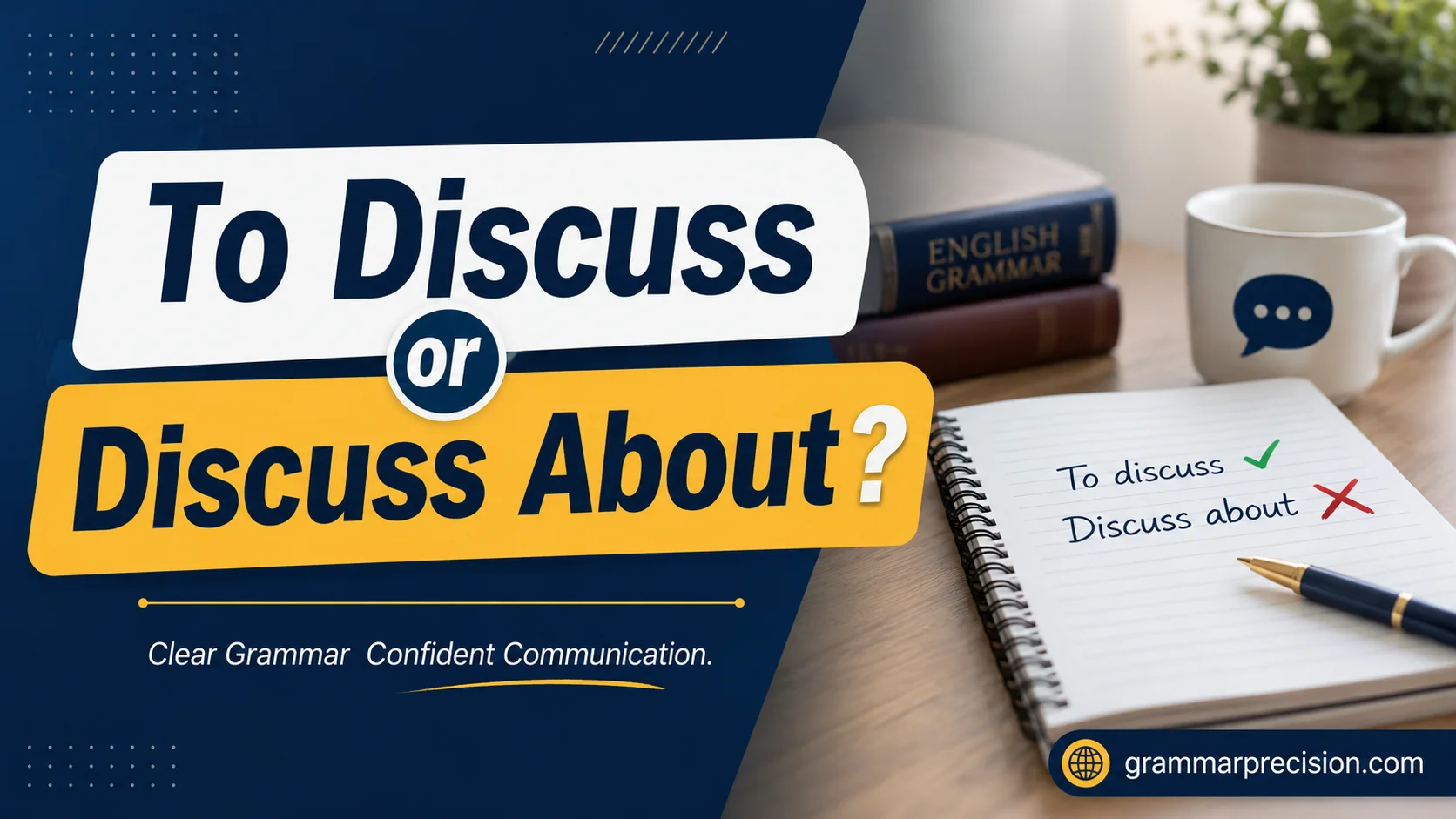
| Expression | Correct? | Example |
| Discuss | ✅ Yes | Let’s discuss the proposal. |
| Discuss about | ❌ No | Let’s discuss about the proposal. |
The verb discuss already means to talk about something. Because the meaning of about is already built into the verb, adding about creates unnecessary repetition.
Correct:
- We need to discuss the project tomorrow.
- They discussed the new policy during the meeting.
- Let’s discuss your ideas after lunch.
Incorrect:
- We need to discuss about the project.
- They discussed about the new policy.
- Let’s discuss about your ideas.
Simple Rule: Use discuss + object. Never add about after discuss.
What Does “Discuss” Mean?
The verb discuss means to talk about a topic in detail, usually to exchange ideas, solve a problem, or reach a decision.
Unlike verbs such as talk, speak, or chat, discuss is a transitive verb. That means it takes a direct object without needing a preposition.
For example:
- We discussed the budget.
- She discussed her concerns.
- The committee discussed several proposals.
- Students discussed the novel in class.
In each sentence, the noun comes directly after discuss.
Dictionary Meaning
Most major dictionaries define discuss in similar ways:
- To talk about something carefully.
- To examine a topic through conversation.
- To exchange opinions about an issue.
- To consider a subject in detail.
No standard dictionary includes about after discuss in normal usage.
Why “Discuss About” Is Incorrect
This mistake happens because people mix discuss with verbs that require about.
Look at these examples.
| Verb | Correct Form |
| Talk | Talk about the issue |
| Speak | Speak about the issue |
| Learn | Learn about the issue |
| Read | Read about the issue |
| Discuss | Discuss the issue |
Notice how discuss is different.
The word about is unnecessary because discuss already carries that meaning.
Think of it this way.
Imagine someone says:
“Advance forward.”
The word advance already means move forward.
Adding forward repeats the same idea.
The same thing happens with discuss about.
Why This Grammar Rule Exists
English verbs don’t all follow the same pattern.
Some verbs need prepositions.
Examples include:
- Listen to
- Depend on
- Believe in
- Think about
- Wait for
Others don’t.
Examples include:
- Discuss
- Enter
- Mention
- Approach
- Resemble
Since discuss belongs to the second group, adding about makes the sentence grammatically incorrect.
Understanding this pattern helps you avoid similar mistakes throughout English.
The Origin of the Word “Discuss”
The word discuss comes from the Latin word discutere, meaning to examine, to investigate, or to break apart for careful consideration.
Over time, English adopted the word with the meaning of examining ideas through conversation.
Because the original meaning already included examining a subject, English never required an additional preposition after the verb.
That’s why native speakers naturally say:
- Discuss the plan.
- Discuss your options.
- Discuss the results.
Instead of:
- Discuss about the plan.
- Discuss about your options.
- Discuss about the results.
Is “Discuss About” Ever Correct?
In standard American English and British English, discuss about is considered incorrect.
Whether you’re writing an essay, sending an email, giving a presentation, or speaking in a meeting, you should simply use discuss followed by the topic.
Correct Examples
- Let’s discuss the contract.
- We discussed our travel plans.
- The doctor discussed treatment options.
- Teachers discussed classroom strategies.
- Scientists discussed their findings.
Incorrect Examples
- Let’s discuss about the contract.
- We discussed about our travel plans.
- The doctor discussed about treatment options.
- Teachers discussed about classroom strategies.
- Scientists discussed about their findings.
If your goal is clear, professional English, always leave out about after discuss.
Discuss vs. Talk About vs. Speak About
Many learners confuse these expressions because they all involve conversation.
However, they follow different grammar rules.
| Expression | Correct? | Typical Use |
| Discuss the problem | ✅ | Formal and informal |
| Talk about the problem | ✅ | Everyday conversation |
| Speak about the problem | ✅ | Formal speech and presentations |
| Chat about the problem | ✅ | Casual conversation |
| Discuss about the problem | ❌ | Incorrect |
Although these expressions have similar meanings, their grammar is different.
For example:
Discuss
- We discussed the new software yesterday.
Talk about
- We talked about the new software yesterday.
Both are correct.
However:
- We discussed about the new software yesterday.
This sentence is incorrect.
When Should You Use “Discuss”?
The verb discuss works well whenever you want to describe a detailed conversation.
Common situations include:
Academic Writing
- Students discussed Shakespeare’s plays.
- The researchers discussed their findings.
- The professor discussed climate change.
Business Meetings
- Managers discussed next year’s budget.
- The team discussed customer feedback.
- Executives discussed company goals.
Everyday Conversation
- We discussed our vacation plans.
- They discussed the movie after dinner.
- My parents discussed the renovation.
Professional Emails
Instead of writing:
Let’s discuss about your proposal.
Write:
Let’s discuss your proposal during tomorrow’s meeting.
The second version sounds natural, professional, and grammatically correct.
Also Read This: Per Cent or Percent: Which Spelling Is Correct?
Why Do So Many People Say “Discuss About”?
This mistake is incredibly common around the world.
There are several reasons why.
Influence from Other Verbs
People already know these phrases:
- Talk about
- Speak about
- Learn about
- Think about
Because these expressions use about, learners assume discuss follows the same pattern.
It doesn’t.
Translation from Other Languages
Many languages include a preposition after their equivalent of discuss.
When speakers translate directly into English, they naturally add about.
This process is called language transfer.
It’s one of the biggest reasons English learners make this mistake.
Everyday Speech
People often hear incorrect English online, in casual conversations, or on social media.
Repeated exposure can make an incorrect phrase sound normal.
However, grammar guides, dictionaries, and style manuals consistently recommend using discuss without about.
Correct Examples in Different Contexts
Seeing examples in context makes the rule much easier to remember.
School
✅ The students discussed the assignment.
✅ We discussed the exam schedule.
✅ Our teacher discussed grammar rules.
Workplace
✅ The manager discussed the marketing strategy.
✅ We discussed customer complaints.
✅ The team discussed new ideas.
Healthcare
✅ The doctor discussed treatment options.
✅ We discussed the test results.
✅ The nurse discussed medication safety.
Everyday Life
✅ We discussed our weekend plans.
✅ They discussed their favorite books.
✅ My friends discussed the latest movie.
Formal Writing
✅ This article discusses the impact of renewable energy.
✅ The report discusses economic growth.
✅ The paper discusses recent research findings.
These examples all follow the same simple structure:
Discuss + noun (or noun phrase).
Common Mistakes People Make with “Discuss”
Many English learners understand that discuss is the correct verb, yet they still make mistakes because several expressions sound similar. Learning these common errors will help you write and speak more confidently.
Using “Discuss About”
This is the most frequent mistake.
❌ We discussed about the new policy.
✅ We discussed the new policy.
The word about is unnecessary because discuss already means to talk about something.
Using “Discuss On”
Some learners replace about with on, but this is also incorrect.
❌ We discussed on climate change.
✅ We discussed climate change.
You may see phrases like a discussion on climate change, but that rule applies to the noun discussion, not the verb discuss.
Compare these examples:
- We discussed climate change. ✅
- We had a discussion on climate change. ✅
Notice how the grammar changes depending on whether you’re using a verb or a noun.
Using “Discuss Regarding”
Another common mistake is adding unnecessary prepositions.
❌ We discussed regarding the proposal.
✅ We discussed the proposal.
Simply remove regarding.
Adding Too Many Words
Some people make sentences longer than necessary.
❌ We discussed about regarding the budget.
✅ We discussed the budget.
Clear writing is usually shorter and easier to understand.
Incorrect vs. Correct Sentences
The following table shows common mistakes alongside their corrected versions.
| Incorrect | Correct |
| Discuss about the issue. | Discuss the issue. |
| Discuss on the project. | Discuss the project. |
| Discuss regarding the report. | Discuss the report. |
| Discuss about your concerns. | Discuss your concerns. |
| Discuss about this topic. | Discuss this topic. |
| Discuss about our plans. | Discuss our plans. |
| Discuss on education. | Discuss education. |
| Discuss regarding safety. | Discuss safety. |
If you remember just one rule, remember this:
Discuss + direct object.
Nothing else is needed.
Discuss vs. Talk About vs. Speak About vs. Debate
Although these expressions seem similar, they have different meanings and levels of formality.
| Expression | Meaning | Formality | Example |
| Discuss | Examine a topic carefully | Medium to High | We discussed the proposal. |
| Talk about | Have a conversation | Informal | We talked about sports. |
| Speak about | Present information or express thoughts | Formal | She spoke about leadership. |
| Debate | Argue different viewpoints | Formal | They debated the new law. |
Discuss
Use discuss when people exchange ideas or consider a topic in detail.
Example:
- We discussed several possible solutions.
Talk About
Use talk about in everyday conversations.
Examples:
- We talked about our childhood.
- Let’s talk about your plans.
This expression sounds relaxed and conversational.
Speak About
Use speak about more often in presentations, speeches, interviews, or formal settings.
Examples:
- The guest speaker spoke about innovation.
- She spoke about her experience abroad.
Debate
A debate usually involves opposing opinions.
Examples:
- Students debated school uniforms.
- Experts debated climate policy.
Not every discussion is a debate, but every debate includes discussion.
Why Native Speakers Don’t Say “Discuss About”
Native speakers learn discuss as a complete verb from childhood.
They naturally say:
- Discuss the problem.
- Discuss your options.
- Discuss the details.
Because this structure becomes automatic, adding about sounds awkward to their ears.
If you listen carefully to news interviews, university lectures, business meetings, or documentaries, you’ll notice professional speakers consistently use discuss without about.
The Secret Grammar Rule Behind “Discuss”
Here’s an easy way to understand the rule.
English verbs fall into two categories.
Verbs That Need Prepositions
Examples include:
- Talk about
- Listen to
- Believe in
- Wait for
- Depend on
- Think about
- Laugh at
Without their prepositions, these verbs sound incomplete.
Verbs That Don’t Need Prepositions
Examples include:
- Discuss
- Mention
- Approach
- Enter
- Resemble
- Answer
- Reach
These verbs connect directly to the object.
Examples:
- Discuss the report.
- Mention the issue.
- Enter the room.
- Approach the manager.
Once you recognize this pattern, many grammar mistakes disappear.
Real-Life Examples Across Different Situations
Learning grammar becomes much easier when you see it in action.
Business Meeting
Manager:
Let’s discuss the sales report before Friday.
Employee:
We should also discuss next quarter’s goals.
University Classroom
Professor:
Today we’ll discuss Shakespeare’s influence on modern literature.
Student:
Can we discuss the final project requirements?
Job Interview
Interviewer:
I’d like to discuss your previous experience.
Candidate:
I’d be happy to discuss my leadership skills.
Family Conversation
Dad:
Let’s discuss our vacation plans tonight.
Mom:
We should discuss the budget first.
Medical Appointment
Doctor:
I’d like to discuss your test results.
Patient:
Can we discuss treatment options?
Every example follows the same structure.
Discuss + object
Sentence Transformations
One of the fastest ways to improve your grammar is by correcting incorrect sentences.
| Incorrect Sentence | Correct Sentence |
| Let’s discuss about it. | Let’s discuss it. |
| We discussed about money. | We discussed money. |
| They discussed about school. | They discussed school. |
| Can we discuss about this later? | Can we discuss this later? |
| She discussed about the problem yesterday. | She discussed the problem yesterday. |
| We discussed on the issue. | We discussed the issue. |
| They discussed regarding taxes. | They discussed taxes. |
| The committee discussed about several ideas. | The committee discussed several ideas. |
Notice how every corrected sentence becomes shorter and stronger.
Easy Memory Tricks
Grammar rules become much easier when you connect them with simple reminders.
Memory Trick One
Think of this sentence:
Discuss already includes “about.”
If you remember that idea, you’ll never add about again.
Memory Trick Two
Imagine these phrases.
- Advance forward ❌
- Repeat again ❌
- Return back ❌
- Discuss about ❌
Each phrase repeats the same meaning twice.
Removing the extra word makes the sentence correct.
Memory Trick Three
Remember this simple formula.
Discuss + Topic
Examples:
- Discuss the movie.
- Discuss the report.
- Discuss your ideas.
- Discuss our future.
Nothing comes between discuss and the topic.
Similar Grammar Mistakes to Avoid
The mistake with discuss about belongs to a larger group of redundant expressions.
Here are several examples.
| Incorrect | Correct |
| Mention about | Mention |
| Return back | Return |
| Repeat again | Repeat |
| Enter into the room | Enter the room |
| Join together | Join |
| Cooperate together | Cooperate |
| Blend together | Blend |
| Combine together | Combine |
Each incorrect phrase repeats information that is already included in the verb.
Good writing removes unnecessary words.
A Practical Editing Tip
When proofreading your writing, search for the word about.
Ask yourself one question.
Does this verb actually need “about”?
If the verb is discuss, the answer is almost always no.
This simple habit can eliminate dozens of grammar mistakes in emails, essays, reports, and presentations.
Case Study: A Student Improves Their Writing
Maria, an international university student, frequently wrote sentences like:
We discussed about renewable energy in class.
Her professor marked the sentence every time.
After learning the rule Discuss + Object, Maria rewrote her assignments.
Instead of writing:
The researchers discussed about the experiment.
She wrote:
The researchers discussed the experiment.
Over one semester, her grammar became more natural, and she made noticeably fewer language errors. The improvement didn’t come from memorizing hundreds of rules. It came from mastering one important pattern and applying it consistently.
“Small grammar improvements often create the biggest gains in writing quality.”
This principle applies whether you’re writing an academic essay, a business proposal, or a casual email.
When Is “About” Correct?
After learning that “discuss about” is incorrect, you might wonder when about should actually be used.
The answer is simple: about is perfectly correct with many other English verbs. The key is knowing which verbs require it.
Here are some of the most common examples.
| Verb | Correct Example |
| Talk about | We talked about the project. |
| Speak about | She spoke about her experience. |
| Think about | Think about your decision carefully. |
| Learn about | Children learn about history in school. |
| Read about | I read about the new discovery. |
| Write about | She writes about technology. |
| Dream about | He dreams about traveling the world. |
| Care about | They care about the environment. |
| Worry about | Don’t worry about the exam. |
| Know about | Do you know about the event? |
Notice that every verb in the table naturally takes about. Unlike discuss, these verbs need the preposition to complete their meaning.
How to Choose the Right Expression
Sometimes several expressions are grammatically correct, but one sounds more natural than another depending on the situation.
Use this guide to choose the best option.
| Situation | Best Choice | Example |
| Business meeting | Discuss | Let’s discuss the proposal. |
| Casual conversation | Talk about | Let’s talk about your weekend. |
| Speech or presentation | Speak about | She spoke about leadership. |
| Friendly chat | Chat about | We chatted about movies. |
| Formal argument | Debate | Experts debated the policy. |
Choosing the right verb makes your writing more precise and helps you sound like a confident English speaker.
Tips to Remember the Rule Forever
If you only remember a few points from this guide, make them these.
- Discuss is a transitive verb.
- It takes a direct object.
- It does not need about.
- If you’re unsure, remove about and read the sentence again.
- Shorter sentences are often stronger and clearer.
For example:
❌ Let’s discuss about your idea.
✅ Let’s discuss your idea.
The corrected version sounds cleaner and follows standard English grammar.
Mini Grammar Quiz
Test your understanding before moving on.
Question 1
Which sentence is correct?
A. We discussed about the budget.
B. We discussed the budget.
Answer: B
Question 2
Choose the correct sentence.
A. They discussed on climate change.
B. They discussed climate change.
Answer: B
Question 3
Which expression is correct?
A. Let’s talk the project.
B. Let’s talk about the project.
Answer: B
Question 4
Fill in the blank.
The manager wants to ________ the new marketing strategy.
A. discuss
B. discuss about
Answer: A
Question 5
Which sentence is grammatically correct?
A. We spoke about the results.
B. We spoke the results.
Answer: A
Practice Exercise
Rewrite these incorrect sentences.
- We discussed about our vacation.
- They discussed on the proposal.
- Can we discuss about this tomorrow?
- The professor discussed about grammar.
- She discussed regarding the budget.
Answers
- We discussed our vacation.
- They discussed the proposal.
- Can we discuss this tomorrow?
- The professor discussed grammar.
- She discussed the budget.
Completing exercises like these helps reinforce the rule until it becomes second nature.
Quick Cheat Sheet
Keep this table handy whenever you write.
| Correct | Incorrect |
| Discuss the issue | Discuss about the issue |
| Discuss the report | Discuss on the report |
| Discuss the plan | Discuss regarding the plan |
| Talk about the issue | Talk the issue |
| Speak about the topic | Speak the topic |
| Debate the proposal | Debate about the proposal |
This quick reference can save you from one of the most common English grammar mistakes.
Key Takeaways
Here are the most important points from this guide.
- Discuss is the correct verb to use when talking about a topic in detail.
- Never say discuss about in standard English.
- Use the pattern discuss + object.
- About belongs with verbs like talk, speak, learn, read, and think.
- Removing unnecessary words makes your writing stronger and more professional.
- Learning verb patterns is more effective than memorizing isolated rules.
- Practice with real sentences to build confidence and improve fluency.
FAQs:
Is “discuss about” ever correct?
No, “discuss about” is not correct in standard English. The verb discuss already means “to talk about”, so adding about is unnecessary. The correct form is discuss + object, such as “Let’s discuss the project.”
Why do people say “discuss about”?
Many learners confuse discuss with phrases like talk about or speak about. Others translate directly from their native language, where a preposition may be required. Learning the correct verb pattern helps you avoid this common grammar mistake.
What is the difference between “discuss” and “talk about”?
Both expressions refer to talking about a topic, but discuss is generally more formal and often suggests a detailed conversation. Talk about is more common in everyday English and always requires the preposition about.
How can I remember the correct usage of “discuss”?
A simple trick is to remember that discuss already includes the meaning of “about.” Whenever you use discuss, place the topic directly after it. For example, say “discuss the plan” instead of “discuss about the plan.”
Is “discuss” used in formal and informal English?
Yes, discuss is appropriate in both formal and informal situations. You can use it in business meetings, academic writing, professional emails, and everyday conversations whenever you want to talk about a topic in detail.
Conclusion:
Using To Discuss or Discuss About? correctly is easier once you understand the grammar rule. Always remember that discuss does not need the preposition about because its meaning already includes it. Applying this simple rule will make your writing, speaking, and overall English communication more accurate, natural, and professional.