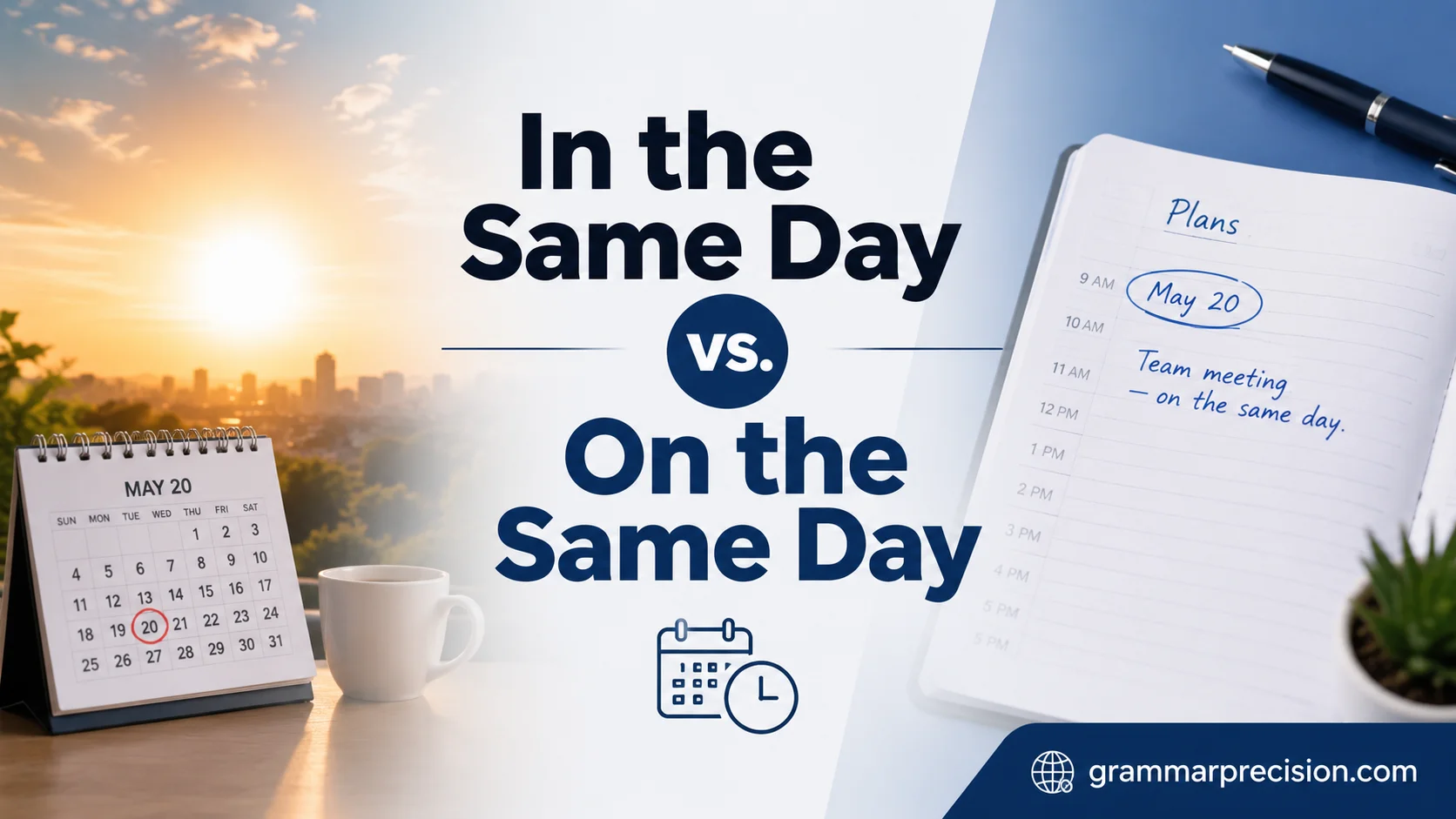
In the Same Day vs. On the Same Day explains confusing English time expressions and helps learners improve grammar, sentence clarity, natural speaking, and correct communication in everyday writing and conversations.
Many English learners, native speakers, and writers confuse these phrases because both refer to similar events and time periods. Usually, on the same day describes a specific calendar day, while in the same day highlights actions completed within a 24-hour period or short span. Understanding these subtle differences improves grammar, clarity, and overall communication naturally.
Learning correct usage through practical examples, grammar tips, and sentence examples helps people avoid common grammar mistakes and write without awkward sentences. Regular practice, observing native speakers, and using proper prepositions improve fluency in English, strengthen confidence, support strong writing, and make everyday communication feel more natural and professional.
Quick Answer: Which Phrase Is Usually Correct?
In most situations, “on the same day” is the natural and preferred expression.
Example:
- We arrived on the same day.
- The meetings happened on the same day.
- They announced both products on the same day.
Meanwhile, “in the same day” usually refers to completing something within a single day.
Example:
- She wrote the entire report in the same day.
- They repaired the road in the same day.
That tiny distinction changes everything.
What Does “On the Same Day” Mean?
The phrase “on the same day” refers to events happening on an identical calendar date.
Think of it this way:
The focus is the shared day itself.
Native speakers commonly use this phrase when discussing:
- Events
- Appointments
- Announcements
- Meetings
- Birthdays
- Travel schedules
- Historical moments
It sounds smooth because English naturally uses “on” with specific days and dates.
Examples:
- We were born on the same day.
- The packages arrived on the same day.
- Both teams played on the same day.
- She submitted the application and received approval on the same day.
Notice how each sentence focuses on a shared point in time rather than duration.
Why “On the Same Day” Sounds More Natural
English treats days like surfaces or points on a calendar.
That’s why people say:
- On Monday
- On Friday
- On my birthday
- On July 4th
So when speakers say “on the same day,” the brain instantly recognizes the familiar time pattern.
It feels natural.
It flows easily.
And it matches how English organizes time expressions.
What Does “In the Same Day” Mean?
Now things get interesting.
The phrase “in the same day” shifts attention away from the calendar date and toward completion within a timeframe.
Instead of emphasizing which day, it emphasizes what happened during that day.
Examples:
- He finished the entire project on the same day.
- They interviewed ten candidates on the same day.
- The system crashed twice in the same day.
Here, the speaker stresses that multiple actions occurred within one day’s duration.
That nuance matters more than most grammar websites explain.
The Hidden Difference Between the Two Phrases
Here’s the easiest way to understand it.
| Phrase | Main Focus | Sounds Most Natural For |
| On the same day | Shared calendar date | Events, schedules, timing |
| In the same day | Completion within a timeframe | Productivity, duration, repeated actions |
This distinction explains why certain sentences sound awkward.
For example:
❌ I met him in the same day.
✅ I met him on the same day.
Why?
Because meeting someone relates to a specific day or event.
Now compare this:
✅ We completed both projects in the same day.
That sentence works because the focus is completion within one day.
Why English Learners Get Confused
Prepositions are notoriously tricky because languages organize time differently.
Many learners translate directly from their native language. That creates unnatural phrasing.
For instance, some languages use a single preposition for:
- Dates
- Months
- Durations
- Timeframes
English doesn’t.
Instead, English divides time into categories.
| Time Expression | Common Preposition |
| Specific days | On |
| Months/years | In |
| Exact times | At |
Examples:
- On Tuesday
- In January
- At 5 PM
So native speakers instinctively expect “on” with days.
That expectation shapes what sounds fluent.
The Psychology Behind Why One Phrase Sounds Wrong
Language has rhythm.
Even when grammar is technically understandable, certain combinations feel unnatural because they violate expected patterns.
That’s exactly what happens with:
❌ In the same day we met.
Native speakers mentally expect “on.”
The sentence interrupts the rhythm their brains anticipate.
This phenomenon is called collocational expectation.
Certain words naturally pair together because people hear them repeatedly over time.
Common English collocations:
- On time
- On schedule
- On Monday
- On that day
As a result, “on the same day” appears vastly more often in natural speech.
Real-Life Examples of “On the Same Day”
Understanding theory helps.
Seeing real-world examples helps even more.
Everyday Conversation
- We landed on the same day.
- Both weddings happened on the same day.
- I started my new job on the same day my brother graduated.
Workplace English
- The contracts were signed on the same day.
- Management announced both policy changes on the same day.
- The client approved the proposal and released payment on the same day.
News Headlines
- Two storms hit the region on the same day.
- The company launched three products on the same day.
- Both candidates appeared on television on the same day.
Storytelling
- She lost her wallet and found a new opportunity on the same day.
- He received terrible news and incredible news on the same day.
Notice how natural every sentence sounds.
Real-Life Examples of “In the Same Day”
Now compare the second phrase.
Productivity Contexts
- She answered 200 emails on the same day.
- The team fixed the software bug on the same day.
- We completed the renovation on the same day.
High-Speed Achievement
- He traveled to three cities on the same day.
- They closed five sales deals on the same day.
Repeated Events
- The website crashed twice in the same day.
- I spilled coffee on myself two times in the same day.
These examples emphasize volume, repetition, or completion within one day.
Also Read This: Conform To or Conform With?
Sentences That Change Meaning Depending on the Phrase
This is where nuance becomes fascinating.
Example 1
On the same day
We submitted the applications on the same day.
Meaning:
Both submissions happened on an identical date.
In the same day
We submitted the applications on the same day.
Meaning:
The applications were completed within one day.
The second version sounds less natural because “submit” usually connects to scheduling rather than duration.
Example 2
On the same day
They arrived on the same day.
Focus:
Shared arrival date.
In the same day
They arrived on the same day.
This sounds awkward because arrival isn’t usually measured as a duration-based accomplishment.
Example 3
On the same day
She announced the news on the same day.
Focus:
Specific date.
In the same day
She solved three major problems on the same day.
Focus:
Achievement within a limited time.
The Fastest Trick to Choose the Correct Phrase
Here’s a simple memory shortcut.
Ask yourself this question:
Are you talking about:
- A specific date or event?
→ Use on the same day
OR
- Something completed within one day?
→ Use in the same day
That’s it.
Simple rules often work best.
Native-Sounding Alternatives Most Articles Ignore
One major problem with grammar blogs is that they focus too heavily on only two options.
Native speakers actually use several alternatives far more often.
These sound smoother and more modern in conversation.
“That Same Day”
This phrase sounds highly natural in storytelling.
Examples:
- She called me later that same day.
- The doctor reviewed the results that same day.
- We received confirmation that same day.
It feels concise and conversational.
“Within the Same Day”
This option emphasizes the time frame more clearly than “on the same day.”
Examples:
- The repairs were completed within the same day.
- Customers received responses within the same day.
This phrase sounds more polished in professional writing.
“Later That Day”
Perfect for narratives.
Examples:
- Later that day, everything changed.
- He apologized later that day.
It creates smooth transitions in storytelling.
“By the End of the Day”
Excellent for workplace English.
Examples:
- Please submit the report by the end of the day.
- We resolved the issue by the end of the day.
Common Mistakes English Learners Make
Using “In” for Every Time Expression
Many learners overuse “in” because they memorize:
- In January
- In 2025
- In the morning
Then they incorrectly apply it to days.
Translating Directly
Direct translation causes countless grammar problems.
Natural English depends heavily on collocations rather than strict logic.
Copying Incorrect Social Media English
Online writing often contains mistakes.
Just because a phrase appears frequently online doesn’t mean native speakers prefer it.
Ignoring Context
Grammar changes depending on meaning.
There’s rarely a one-size-fits-all rule.
British vs. American Usage
Both American and British English strongly prefer:
✅ On the same day
There’s no major regional disagreement here.
However, formal British writing sometimes uses alternatives like:
- Within the same day
- During the same day
American English tends to favor direct simplicity.
Formal vs Casual Usage
Casual Conversation
Most people naturally say:
- On the same day
- That same day
Professional Writing
Business writing often prefers:
- Within the same day
- By the end of the day
because these phrases sound precise.
Academic Writing
Academic English depends heavily on context.
Examples:
- Two experiments occurred on the same day.
- Researchers processed all samples within the same day.
The SEO Problem With Many Grammar Articles
Many grammar websites oversimplify language because they want fast answers.
Unfortunately, real English isn’t always binary.
You’ll often see misleading claims like:
- “Only this phrase is correct.”
- “Never use that phrase.”
That approach creates confusion instead of fluency.
Natural English depends on:
- Context
- Intention
- Rhythm
- Collocation
- Usage frequency
Language behaves more like music than mathematics.
Usage Frequency: What Native Speakers Actually Say
In modern English, “on the same day” appears far more frequently than “in the same day.”
Why?
Because people commonly discuss:
- Dates
- Shared events
- Scheduling
- Timelines
Meanwhile, duration-focused situations occur less often.
This frequency gap matters because repeated exposure shapes fluency.
The more often native speakers hear a phrase, the more natural it feels.
Mini Case Study: Workplace Communication
Imagine two employees writing emails.
Employee A
We completed both audits on the same day.
This sounds slightly unclear because audits are tasks.
Employee B
We completed both audits on the same day.
This works better because the focus is completion within a timeframe.
Now compare:
The audits were scheduled on the same day.
Perfect.
Why?
Because scheduling connects to dates rather than duration.
Tiny shifts create huge differences.
Mini Case Study: Storytelling
Consider this sentence:
She lost her job and got engaged on the same day.
The phrase creates emotional contrast because two major events share one date.
Now compare:
She handled six interviews in the same day.
The emphasis shifts toward effort and accomplishment.
Commonly Confused Similar Phrases
English learners often mix these expressions together.
At the Same Day
❌ Incorrect in standard English.
Use:
✅ On the same day
During the Same Day
Correct but less common.
Example:
- Several issues appeared during the same day.
Within the Same Day
Very natural in professional contexts.
Example:
- Customer support responded within the same day.
That Same Day
Excellent for storytelling.
Example:
- That same day, the storm arrived.
Practice Section: Which Phrase Sounds Better?
Sentence 1
We met for the first time ___ the same day.
✅ On the same day
Sentence 2
She completed the project ___ the same day.
✅ In the same day
Sentence 3
Both announcements happened ___ the same day.
✅ On the same day
Sentence 4
They traveled across three states ___ the same day.
✅ In the same day
Quick Cheat Sheet
| If You Mean… | Use This Phrase |
| Same calendar date | On the same day |
| Completion within one day | In the same day |
| Smooth storytelling | That same day |
| Professional timeframe | Within the same day |
The Simplest Way to Sound Natural
If you’re ever unsure, choose:
✅ On the same day
Why?
Because it works in most situations and sounds highly natural to native speakers.
Use “in the same day” only when emphasizing:
- Completion
- Volume
- Duration
- Repeated actions within one day
That distinction instantly improves fluency.
Final Verdict: In the Same Day or On the Same Day?
Here’s the short answer.
Use “on the same day” for:
- Shared dates
- Events
- Scheduling
- Appointments
- Announcements
- Stories
Use “in the same day” for:
- Completion within one day
- Productivity
- Repeated actions
- Time-limited achievements
Most importantly, remember this:
Fluent English isn’t just about grammar rules.
It’s about choosing phrases that sound natural in context.
And in modern English, “on the same day” overwhelmingly sounds more natural for everyday communication.
Once you recognize that pattern, these expressions stop feeling confusing entirely.
FAQs:
What is the difference between in the same day and on the same day?
On the same day is used for events happening on one specific calendar date, while in the same day focuses on actions completed within a 24-hour period or short time span.
Which phrase is more common in everyday English?
Native speakers usually use on the same day more often in daily conversation, formal communication, and writing because it sounds more natural in most situations.
Can both phrases be correct in one sentence?
Yes, both expressions can be correct depending on the context, meaning, and the type of events you are describing in the sentence.
Why do English learners confuse these phrases?
Many English learners confuse them because both phrases relate to time expressions in English and appear similar in meaning, even though their usage is different.
How can I remember the correct usage easily?
The best way is through practice, reading sentence examples, observing native speakers, and learning simple grammar rules with real-life examples.
Conclusion:
Understanding the difference between in the same day and on the same day can improve grammar, clarity, and communication in both speaking and writing. Small changes in prepositions often affect the overall meaning and tone of a sentence. By using practical examples, following English grammar rules, and practicing regularly, learners can avoid common grammar mistakes and communicate more confidently in everyday English.