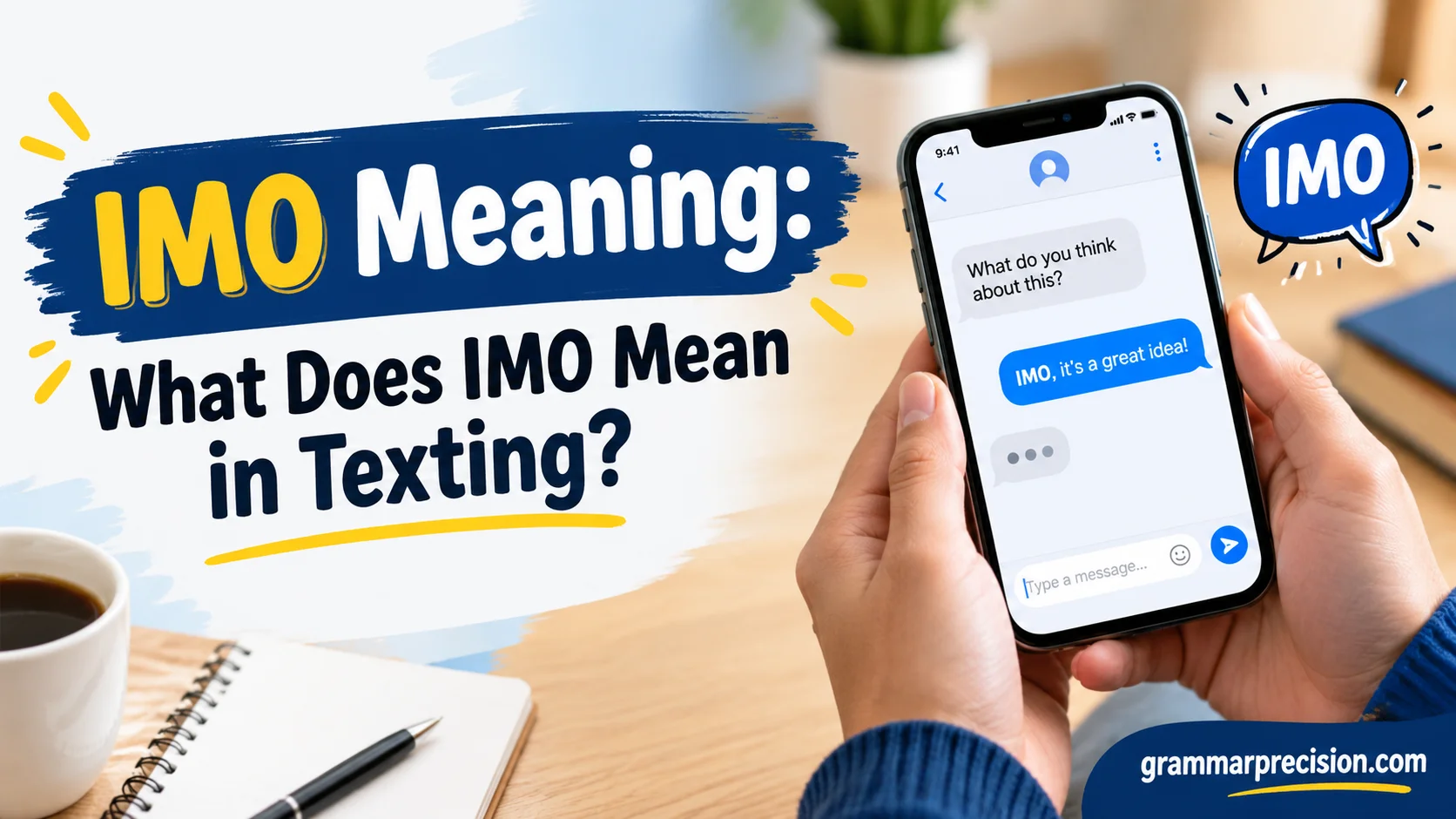
Have you ever seen “IMO” in a text message, social media post, or online discussion and wondered what it means? IMO meaning is commonly understood as “In My Opinion,” an abbreviation people use to share personal views in digital conversations. From casual texting and online broadcasting to business communication, understanding this acronym helps improve English usage, clarity, and consistency across different contexts.
In this article, we’ll explore the meaning of IMO, its origin, common texting examples, and the difference between IMO and similar abbreviations. You’ll also learn when to use it in formal writing versus informal chats, along with its relevance to meetings, scheduling, time management, online booking, calendar updates, and project management. Finally, we’ll consider US and UK style preferences to help you communicate naturally and follow appropriate grammar conventions.
What Does IMO Mean?
IMO stands for “In My Opinion.” People use this abbreviation before or after a statement to show that they’re sharing their personal perspective rather than stating an established fact.
For example, consider this message:
“IMO, Italian food is better than Mexican food.”
The sender isn’t claiming that everyone must agree. They’re simply expressing a preference. Another person might prefer Mexican food, and both opinions can be valid.
IMO Meaning in Texting
In texting, IMO makes conversations faster and more casual. Instead of typing the complete phrase “in my opinion,” you can use three letters to communicate the same idea.
Here are a few common examples:
- “IMO, we should leave early.” — The sender recommends leaving early.
- “That was the best episode, IMO.” — The sender shares a personal judgment.
- “IMO, you’re overthinking this.” — The sender offers their perspective on a situation.
- “IMO, the blue one looks better.” — The sender expresses a preference.
The meaning stays essentially the same across these examples. However, the tone depends on the subject, the relationship between the people chatting, and the surrounding conversation.
What Does IMO Stand For in Online Conversations?
Online, IMO serves the same purpose as it does in text messages. You’ll find it in discussion threads, product reviews, gaming chats, comment sections, and community forums.
Someone reviewing a video game might write, “IMO, the new update makes combat much smoother.” A person discussing a popular song might say, “IMO, the original version sounds better.”
In both cases, IMO signals that the statement reflects the writer’s judgment. It doesn’t automatically make the opinion correct, polite, or well-supported. It simply tells readers how to interpret the statement.
Is IMO Different From Saying “I Think”?
Not really. IMO and “I think” often communicate the same basic message. The main difference involves style and context.
“I think we should order pizza” sounds natural in almost any conversation. “IMO, we should order pizza” feels slightly more like online shorthand. Both express a suggestion without insisting that everyone agree.
Use whichever version fits your conversation. In formal writing, spelling out your thoughts usually sounds more natural than relying on abbreviations.
How People Use IMO in Text Messages
Although IMO has one main definition, people use it for several conversational purposes. Sometimes it introduces a recommendation. Other times, it helps someone disagree without sounding too forceful.
Sharing Personal Opinions
The most common use of IMO is expressing a personal preference or judgment. People often use it when discussing entertainment, food, fashion, relationships, hobbies, or everyday decisions.
Examples include:
- “IMO, that restaurant has the best burgers.”
- “IMO, this song deserves more attention.”
- “The second outfit looks better, IMO.”
- “IMO, studying in the morning is more productive.”
Notice how each sentence communicates a viewpoint rather than an objective fact. This distinction matters because preferences don’t require everyone to reach the same conclusion.
Disagreeing Politely
Disagreements can become uncomfortable when people state their opinions as if nobody could reasonably challenge them. IMO sometimes softens that effect by presenting a statement as one person’s perspective.
For example:
Without IMO: “You’re wrong. That movie was terrible.”
With IMO: “IMO, the movie wasn’t that great.”
The second message sounds less confrontational because it frames the judgment as a personal opinion. Still, IMO isn’t a magic word that makes every statement polite. “IMO, you’re clueless” remains insulting.
When you want to disagree respectfully, combine IMO with considerate language. You might say, “IMO, the first option makes more sense, but I understand why you prefer the second.”
Making Suggestions and Recommendations
People also use IMO to recommend something without sounding overly authoritative. It works particularly well when friends are deciding what to watch, where to eat, or which product to buy.
For instance:
- “IMO, you should try the new café downtown.”
- “IMO, the cheaper laptop is enough for your needs.”
- “IMO, we should book the tickets today.”
These statements communicate advice rather than commands. The recipient can consider the suggestion without feeling obligated to follow it.
Adding Humor to Casual Conversations
IMO can also introduce playful opinions, exaggerated preferences, or lighthearted complaints.
Imagine two friends debating which superhero would win a fictional battle. One texts, “IMO, Batman wins if he gets enough preparation time.”
Another friend might reply, “IMO, you’re giving him way too much credit.”
The abbreviation adds a casual, conversational feel. However, humor still depends on shared context, so avoid assuming every reader will recognize sarcasm in a short message.
IMO Meaning on Snapchat, Instagram, TikTok, and WhatsApp
One reason people search for IMO meaning on social media is that abbreviations sometimes change across platforms. In this case, IMO generally retains its familiar meaning: “In My Opinion.” The setting changes, but the basic definition doesn’t.
IMO on Snapchat
On Snapchat, IMO can appear in direct messages, group conversations, or replies to a friend’s story.
Example:
“IMO, that picture looks better without the filter.”
The sender is expressing a preference about the picture. They aren’t using a special Snapchat-only definition.
IMO on Instagram
Instagram users may include IMO in comments, captions, direct messages, and conversations about Reels.
Example:
“IMO, this is the most underrated outfit in the collection.”
Here, the abbreviation signals that the comment reflects the user’s personal judgment. It can also appear in discussions about creators, products, trends, and entertainment.
IMO on TikTok
On TikTok, IMO often appears in comments responding to videos or debating trending topics.
For example:
“IMO, the original recipe tastes better than the viral version.”
Because comment sections move quickly, abbreviations help users communicate their thoughts with fewer characters. Nevertheless, IMO doesn’t mean that a claim has been verified or that the creator agrees with it.
IMO on WhatsApp and in Group Chats
WhatsApp conversations often involve practical decisions, personal advice, and discussions among friends or family members.
Someone might write, “IMO, let’s leave at 8 a.m. to avoid traffic.”
In a group chat, IMO can clarify that a suggestion comes from one participant rather than representing the group’s final decision. That small distinction can make collaborative conversations easier to follow.
IMO vs. IMHO vs. TBH vs. NGL
IMO is part of a larger family of texting abbreviations that express opinions, honesty, or personal experience. Although these terms overlap, they don’t always communicate the same thing.
| Abbreviation | Full form | Main purpose | Example |
| IMO | In My Opinion | Shares a personal viewpoint | “IMO, this book is excellent.” |
| IMHO | In My Humble Opinion | Presents a viewpoint, sometimes modestly | “IMHO, the sequel is better.” |
| TBH | To Be Honest | Introduces candidness or sincerity | “TBH, I didn’t enjoy the concert.” |
| NGL | Not Gonna Lie | Signals a candid or frank statement | “NGL, that ending surprised me.” |
| FWIW | For What It’s Worth | Offers a thought or detail for consideration | “FWIW, the reviews are positive.” |
| AFAIK | As Far As I Know | Signals the limits of someone’s knowledge | “AFAIK, the store closes at nine.” |
| IME | In My Experience | Shares a conclusion based on experience | “IME, this method works well.” |
IMO vs. IMHO
IMO means “In My Opinion,” while IMHO traditionally means “In My Humble Opinion.” Some people also interpret the H in IMHO as “Honest.”
Both abbreviations introduce personal viewpoints. However, IMHO can sound more self-effacing, although many people use it casually without thinking about the word “humble.”
Example:
- IMO: “IMO, this is the better solution.”
- IMHO: “IMHO, we might want to reconsider the first option.”
Neither abbreviation guarantees that the following statement will sound modest. Tone and wording still matter.
IMO vs. TBH
TBH means “To Be Honest.” It emphasizes candor rather than simply identifying a statement as an opinion.
For example, “TBH, I didn’t like the restaurant” suggests the speaker is being frank about their experience. “IMO, that restaurant is overrated” presents a judgment about its reputation or quality.
The distinction isn’t absolute. People frequently use both abbreviations when sharing subjective thoughts.
IMO vs. NGL
NGL stands for “Not Gonna Lie.” It often introduces a candid admission, reaction, or confession.
Compare these messages:
- “IMO, the new album is better.” — A personal evaluation.
- “NGL, I listened to the album five times.” — A candid admission.
Both can express personal feelings, but NGL often adds a conversational sense of honesty or surprise.
IMO vs. FWIW, AFAIK, and IME
These three abbreviations serve slightly different purposes.
FWIW introduces information that someone thinks may be useful. AFAIK indicates that a statement reflects the person’s current knowledge. IME identifies a conclusion based on personal experience.
For example, “AFAIK, the application closes Friday” communicates limited knowledge. It doesn’t necessarily express an opinion. By contrast, “IMO, Friday is the best day to submit it” expresses a preference.
Quick tip: Use IMO for opinions, AFAIK for what you know, and IME for what you’ve personally experienced.
15 IMO Texting Examples With Meanings
The easiest way to understand IMO is to see how it works in everyday conversations. The following examples cover different situations, from casual recommendations to disagreements.
| Text message example | What it means |
| “IMO, pizza is the best comfort food.” | The sender expresses a food preference. |
| “IMO, you should call her first.” | The sender recommends taking the initiative. |
| “That was the best match, IMO.” | The sender shares a personal judgment. |
| “IMO, the first design looks cleaner.” | The sender prefers one design. |
| “IMO, we need more time to prepare.” | The sender believes the group needs extra time. |
| “IMO, that joke went too far.” | The sender thinks the joke was inappropriate. |
| “IMO, this phone is worth the price.” | The sender considers the phone a good value. |
| “IMO, the book is better than the movie.” | The sender prefers the book adaptation. |
| “IMO, we should take the train.” | The sender suggests a travel option. |
| “IMO, you handled that situation well.” | The sender praises someone’s actions. |
| “IMO, the update fixed most of the problems.” | The sender evaluates a software update positively. |
| “IMO, that team needs a stronger defense.” | The sender offers a sports-related assessment. |
| “IMO, this color suits you.” | The sender expresses a personal style preference. |
| “IMO, the ending made perfect sense.” | The sender explains their interpretation of a story. |
| “I wouldn’t buy it again, IMO.” | The sender gives a negative personal review. |
A Mini Case Study: Understanding IMO in a Group Chat
Imagine a group of friends planning a weekend trip. One person suggests visiting a crowded beach, while another prefers a quieter destination.
The conversation might look like this:
Alex: “Let’s go to the popular beach on Saturday.”
Jordan: “IMO, the smaller beach would be more relaxing.”
Taylor: “That’s fair, but the popular one has better restaurants.”
Jordan: “True. IMO, we should choose the smaller beach and eat somewhere nearby.”
In this exchange, IMO helps Jordan introduce a preference without treating it as the only reasonable choice. The other participants can weigh the suggestion against their own priorities.
The lesson is simple: IMO signals a personal viewpoint, not a final decision. People still need to consider evidence, preferences, and practical details before reaching an agreement.
How to Reply When Someone Says IMO
When someone uses IMO in a message, you don’t need a special response. Reply to the idea they’re expressing. Your answer might agree, disagree, ask a question, or add another perspective.
Agreeing With Their Opinion
If you share the same view, a short response works well.
Try these examples:
- “I agree with you.”
- “Honestly, I think so too.”
- “That’s exactly how I see it.”
- “Good point!”
- “Same here.”
- “Yeah, that makes sense.”
For a casual conversation, you can keep your reply brief. If your friend says, “IMO, that was the best episode,” responding with “Definitely!” feels natural.
Disagreeing Respectfully
You can disagree without turning the conversation into an argument. Acknowledge the person’s viewpoint before explaining yours.
Useful replies include:
- “I see your point, but I feel differently.”
- “Fair enough. I actually preferred the other one.”
- “Interesting take! What makes you think that?”
- “I get where you’re coming from.”
- “IMO, the opposite is true.”
The final example uses IMO to introduce your own position. That’s perfectly natural when the discussion involves competing opinions.
Keeping the Conversation Funny
When you’re chatting with close friends, a playful response can keep things light.
Consider these options:
- “IMO, you’re officially banned from choosing movies.”
- “That’s a bold take!”
- “Okay, let’s agree to disagree.”
- “Respectfully, absolutely not.”
- “Your opinion has been noted!”
Use humor according to your relationship with the other person. A joke that works between close friends might sound dismissive when sent to a coworker or someone you barely know.
Asking for More Information
Sometimes the best reply is a question. If someone’s opinion interests you, invite them to explain their reasoning.
For example:
Friend: “IMO, the older version was much better.”
You: “Interesting! What did you like more about it?”
This response encourages a meaningful discussion instead of simply agreeing or disagreeing. It works especially well when you’re comparing products, entertainment, ideas, or experiences.
How to Use IMO Correctly in a Sentence
IMO is easy to use once you understand its purpose. It generally fits at the beginning or end of a sentence, although people sometimes place it within a longer message.
Using IMO at the Beginning of a Sentence
Starting with IMO makes it clear from the outset that you’re expressing a personal view.
Examples:
- “IMO, the earlier flight is a better choice.”
- “IMO, this recipe needs less sugar.”
- “IMO, the second explanation is easier to understand.”
In standard written English, a comma after the introductory abbreviation is a common choice.
Using IMO at the End of a Sentence
You can also place IMO at the end of a statement. This position often feels casual and conversational.
Examples:
- “The first version looks better, IMO.”
- “That was a smart decision, IMO.”
- “The restaurant is a little overrated, IMO.”
Both placements communicate essentially the same meaning. Choose the one that makes your sentence flow naturally.
Capitalization and Punctuation
IMO is commonly written in capital letters, but lowercase imo is also widely understood in informal digital conversations.
You might see:
- “IMO, this is the better option.”
- “imo this is the better option”
- “This is the better option imo.”
The first example follows conventional punctuation more closely. The others reflect casual texting habits.
For professional writing, academic work, or formal correspondence, write “in my opinion” instead. It looks more polished and avoids relying on internet shorthand.
Is IMO Formal or Informal?
Although IMO is common online, it doesn’t fit every situation. Knowing when to use it helps you communicate clearly without sounding too casual or overly stiff.
When IMO Works Best
IMO is a natural choice when you’re talking with friends, participating in online discussions, or sharing personal preferences.
Use it when you’re:
- Chatting with friends or family.
- Commenting on social media posts.
- Discussing movies, games, music, or sports.
- Giving informal advice.
- Comparing products or sharing personal recommendations.
- Participating in casual online debates.
For example, “IMO, the second laptop offers better value” works well in a conversation between friends comparing devices.
When to Avoid IMO in Professional Writing
In formal communication, abbreviations can make your message seem too casual. Writing out the complete phrase often creates a clearer, more professional impression.
Compare these examples:
Casual message: “IMO, we should move the meeting to Thursday.”
Professional message: “In my opinion, moving the meeting to Thursday would give the team more time to prepare.”
The second version provides more context and suits a workplace discussion. You can also remove the phrase entirely when your reasoning already makes it clear that you’re offering a recommendation.
Remember that formal communication isn’t only about avoiding abbreviations. Your audience, purpose, and tone matter just as much.
Other Meanings of IMO Outside Texting
Although “In My Opinion” is the most common meaning in casual messaging, IMO can refer to something entirely different in other contexts.
IMO Meaning in Maritime and International Affairs
IMO can stand for the International Maritime Organization, a specialized agency of the United Nations that addresses international shipping safety, maritime security, and pollution from ships.
Unlike the texting abbreviation, this meaning appears in discussions about shipping regulations, maritime transport, environmental protection, and international standards.
For example:
“The IMO adopted measures to improve environmental performance in international shipping.”
In this sentence, IMO refers to the organization rather than someone’s personal opinion.
How to Identify the Correct Meaning
Context usually makes the intended meaning clear. Look at the subject, surrounding words, and type of conversation.
| Context | Likely meaning | Example |
| Texting with friends | In My Opinion | “IMO, we should leave early.” |
| Social media comments | In My Opinion | “IMO, this trend is overrated.” |
| Maritime regulations | International Maritime Organization | “The IMO develops international shipping standards.” |
| Shipping industry news | International Maritime Organization | “The report discusses IMO regulations.” |
If someone writes “IMO, that restaurant is fantastic,” they almost certainly mean “In My Opinion.” If an article discusses international shipping rules, the organizational meaning is more likely.
The key is context. Don’t assume every abbreviation has the same meaning in every setting.
Common Mistakes to Avoid When Using IMO
Even a simple abbreviation can cause confusion when people use it carelessly. A few small adjustments can make your messages clearer and more considerate.
- Treating opinions as facts: IMO introduces a personal viewpoint. It doesn’t prove that the statement is accurate.
- Using IMO to excuse rudeness: Adding the abbreviation doesn’t make an insult respectful.
- Overusing the abbreviation: Starting every sentence with IMO can make your writing repetitive. Use it when it adds meaning.
- Confusing IMO with IMHO: The two expressions are similar, but IMHO traditionally includes the idea of humility.
- Using it in every professional email: Spell out “in my opinion” when a more formal tone is appropriate.
- Ignoring context: IMO can have different meanings in texting and maritime discussions.
- Assuming everyone understands slang: When writing for a broad audience, explain unfamiliar abbreviations before using them repeatedly.
A good rule is to use IMO when it clarifies that you’re sharing a perspective. If it doesn’t improve the sentence, you probably don’t need it.
FAQs About IMO Meaning
What does IMO mean in texting?
IMO means “In My Opinion.” People use it in text messages and online conversations to introduce a personal viewpoint, preference, suggestion, or judgment.
What does IMO mean from a guy or girl?
The abbreviation has the same basic meaning regardless of who sends it. If someone texts, “IMO, you look great,” they’re expressing their opinion. The message alone doesn’t establish romantic interest; the broader conversation provides more context.
Is IMO rude or disrespectful?
No. IMO is generally neutral and often helps people express opinions without sounding too forceful. However, the words that follow it can still sound rude, sarcastic, or dismissive.
Does IMO mean the same as IMHO?
They’re similar but not identical. IMO means “In My Opinion,” while IMHO traditionally means “In My Humble Opinion.” Both introduce personal viewpoints, and people often use them interchangeably in casual conversations.
What does IMO mean on Snapchat?
On Snapchat, IMO generally means “In My Opinion.” You might see it in direct messages, group chats, or replies to stories. It doesn’t have a separate, standard Snapchat-specific meaning.
What does IMO mean on Instagram and TikTok?
On both platforms, IMO usually introduces a personal opinion in a comment, caption, or direct message. People commonly use it when discussing videos, trends, creators, entertainment, and other topics.
How do you reply to IMO?
Respond to the person’s actual message. You can agree by saying “I think so too,” disagree politely with “I see it differently,” or ask a question such as “What makes you think that?”
Is IMO an internet slang term?
Yes. IMO is a widely recognized internet and texting abbreviation. People use it to shorten “In My Opinion” in digital conversations and informal writing.
Can I use IMO in a professional email?
You can, but it’s usually better to write “in my opinion” in formal workplace communication. The complete phrase often sounds more polished and makes your meaning clear to readers unfamiliar with texting abbreviations.
What does IMO mean in business or shipping?
In maritime and international shipping contexts, IMO often refers to the International Maritime Organization, a United Nations agency responsible for important aspects of international shipping safety and environmental protection. The surrounding context determines which meaning applies.
Conclusion:
IMO meaning is “In My Opinion,” a popular abbreviation used in texting, social media, and online conversations to express personal thoughts. Understanding its meaning, usage, and examples helps you communicate clearly and confidently in everyday digital interactions.
Whether you’re chatting with friends or participating in professional discussions, using IMO appropriately makes your message sound natural. Remember that IMO suits informal communication better than formal writing. By understanding its context, you can improve your English usage, grammar, and communication skills while avoiding misunderstandings.