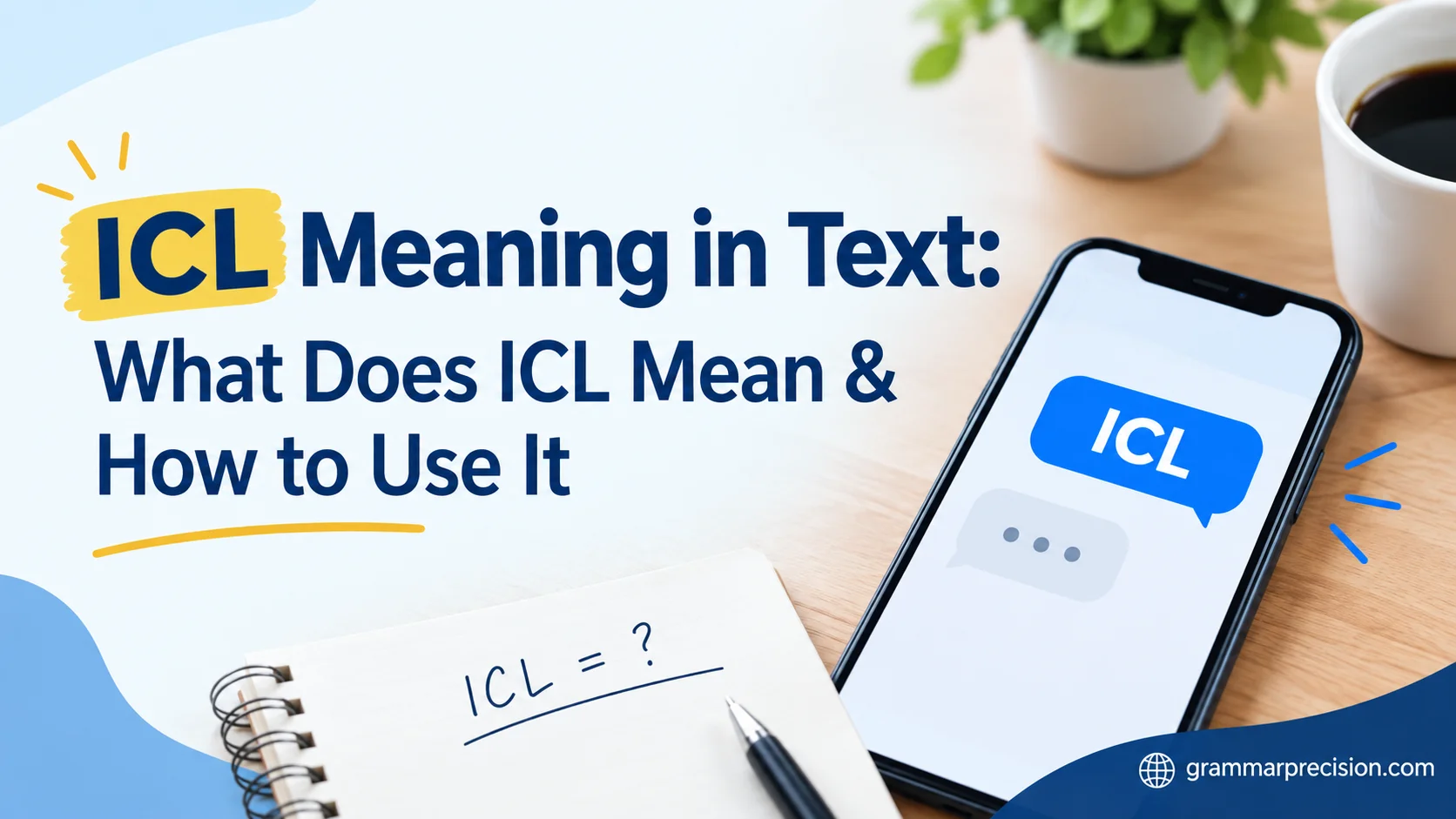
Have you ever received “ICL” in a text and wondered what those three letters actually mean? The ICL meaning in text is usually “I Can’t Lie,” an informal expression people use before sharing an honest opinion, reaction, or confession. Although the phrase looks simple, its tone can change with context, punctuation, and the relationship between speakers. This guide explains how ICL works across texting, social media, casual conversations, and modern English usage, while also showing how it differs from expressions such as NGL and TBH.
Understanding internet abbreviations also connects to broader grammar, communication style, and consistency. While ICL fits naturally into casual messages, it usually doesn’t belong in formal writing, business communication, professional meetings, or workplace documents involving scheduling, time management, online booking, broadcasting, calendar management, or project management. Regional preferences matter, too: US and UK style guides may differ in punctuation and usage conventions, although informal internet slang often crosses those boundaries. In this article, you’ll discover the meaning, tone, origins, examples, common uses, and practical differences that make ICL easier to understand and use naturally.
What Does ICL Mean in Text?
ICL means “I Can’t Lie.” It’s an informal internet initialism that introduces something the writer considers honest, genuine, or difficult to deny.
For example:
“ICL, that was the best episode.”
The writer isn’t claiming that lying is literally impossible. They’re emphasizing that their opinion is sincere.
You could rewrite the same sentence as:
“Honestly, that was the best episode.”
That’s why understanding ICL meaning in text is fairly simple once you recognize its conversational role.
ICL Definition at a Glance
| Feature | Meaning |
| Full form | I Can’t Lie |
| Type | Internet slang / initialism |
| Main purpose | Signal honesty or sincerity |
| Tone | Casual, direct, conversational |
| Common settings | Texts, DMs, comments, group chats |
| Formal writing | Generally inappropriate |
| Similar expressions | NGL, TBH, honestly |
ICL can introduce a compliment, criticism, confession, surprise, or strong opinion. The statement after it determines the exact emotional flavor.
What Does ICL Stand For?
ICL stands for “I Can’t Lie.”
The phrase itself is an informal idiom meaning something close to “to be honest” or “frankly.” English speakers have used “I can’t lie” as an honesty marker long before its shortened internet form became common.
Online communication simply compresses that phrase into three letters.
Instead of typing:
“I can’t lie, I really enjoyed that.”
Someone can write:
“ICL, I really enjoyed that.”
That saves typing while preserving the conversational effect.
Interestingly, ICL doesn’t always introduce a dramatic confession. Sometimes the statement is completely ordinary:
“ICL, I’m tired today.”
Here, the writer simply emphasizes that they’re being genuine.
What Does ICL Mean on Social Media?
On social platforms, ICL usually carries the same “I Can’t Lie” meaning. The difference comes from the environment around it.
A TikTok comment may use ICL before a hot take. A Snapchat message might introduce a personal opinion. An Instagram reply may use it before a compliment or criticism.
The surrounding words provide the real clue.
ICL Meaning on TikTok
TikTok’s fast-moving comment culture favors short expressions that communicate tone quickly. ICL fits that environment because three letters can frame an entire opinion.
For example:
“ICL, this version is better.”
The commenter is essentially saying, “Honestly, I think this version is better.”
ICL can also introduce criticism:
“ICL, the old design looked better.”
That makes the phrase useful when someone wants to soften a blunt statement slightly while still sounding direct.
ICL Meaning on Snapchat
Snapchat conversations tend to be informal and fast. In that setting, ICL can appear at the beginning of a message when someone wants to emphasize a genuine reaction.
“ICL, you looked great yesterday.”
That sounds like a sincere compliment.
Likewise:
“ICL, I don’t think we should go.”
Here, the abbreviation signals an honest disagreement.
ICL Meaning on Instagram
On Instagram, ICL can appear in DMs, comments, and replies. Users may place it before an opinion about a photo, outfit, video, relationship, or trend.
For example:
“ICL, this outfit goes hard.”
The phrase makes the compliment feel more candid and conversational.
ICL in Group Chats and DMs
Group chats create another useful setting for ICL. People often use it when they want to jump into a debate without sounding overly formal.
“ICL, you’re both wrong on this one.”
The phrase doesn’t automatically make the statement polite. It simply frames the following opinion as honest.
That’s an important distinction.
How People Use ICL in Conversations
Although ICL meaning remains consistent, people use the abbreviation for several conversational purposes.
ICL to Give an Honest Opinion
This is probably the most straightforward use.
“ICL, that restaurant wasn’t worth the price.”
The writer wants to make clear that they’re giving their genuine assessment.
ICL to Admit Something
ICL can introduce an admission that someone might normally hesitate to make.
“ICL, I was nervous before the interview.”
The abbreviation adds a small sense of openness.
ICL to Give a Compliment
Not every ICL statement delivers criticism. It can introduce praise just as easily.
“ICL, your new haircut looks great.”
In this context, ICL can make the compliment feel spontaneous rather than rehearsed.
ICL to Make a Blunt Statement
Sometimes people use ICL before saying something that could sound harsh.
“ICL, you need to practice more.”
The writer is essentially saying, “I’m going to be honest with you.”
However, ICL doesn’t magically make criticism kind. The rest of the sentence still matters.
ICL to Express Surprise
You might also see it before an unexpected reaction:
“ICL, I didn’t think I’d like this song.”
The abbreviation emphasizes the speaker’s genuine surprise.
What Tone Does ICL Create?
Here’s where ICL meaning in texting becomes more interesting.
The abbreviation doesn’t carry one fixed emotional tone. Context changes its effect. It can sound warm, funny, blunt, surprised, or even confrontational.
| Context | Example | Likely Tone |
| Compliment | “ICL, you look amazing.” | Sincere |
| Criticism | “ICL, this isn’t working.” | Blunt |
| Confession | “ICL, I was nervous.” | Open |
| Agreement | “ICL, you’re right.” | Supportive |
| Surprise | “ICL, that was actually good.” | Surprised |
| Humor | “ICL, that cat runs the whole house.” | Playful |
Punctuation and emojis can change the feeling even further.
Compare:
“ICL, you’re right.”
with:
“ICL 😭 you’re right.”
The second version feels much more playful and emotionally expressive.
That’s why internet slang can’t always be understood through dictionary definitions alone. Digital context acts like body language.
ICL Examples in Real Conversations
Seeing ICL inside realistic sentences makes its meaning much easier to understand.
Friendly Conversation Examples
- “ICL, that was a really good idea.”
- “ICL, I needed that laugh today.”
- “ICL, you were right about the movie.”
- “ICL, this place is better than I expected.”
Each sentence uses ICL to emphasize sincerity.
Dating and Relationship Examples
- “ICL, I actually miss talking to you.”
- “ICL, you looked amazing tonight.”
- “ICL, I wasn’t expecting to catch feelings.”
- “ICL, we should probably talk about what happened.”
Here, ICL can make emotional statements feel more candid.
Funny Examples
- “ICL, my dog has more social skills than I do.”
- “ICL, I opened the fridge three times hoping new food appeared.”
- “ICL, that meeting could’ve been an email.”
The abbreviation creates a mock-serious setup before the punchline.
Argument Examples
- “ICL, you didn’t explain your side very well.”
- “ICL, I understand why you’re upset.”
- “ICL, that wasn’t fair.”
In disagreements, ICL can signal honesty, but it can also make a statement feel more forceful.
ICL vs. NGL vs. TBH: What’s the Difference?
ICL often gets confused with NGL and TBH because all three can introduce honest statements.
| Expression | Full Form | Main Function | Typical Feel |
| ICL | I Can’t Lie | Emphasizes candidness | Direct, casual |
| NGL | Not Gonna Lie | Introduces an honest admission | Casual, conversational |
| TBH | To Be Honest | Marks an honest opinion | Broad and familiar |
| IMO | In My Opinion | Identifies a personal viewpoint | Neutral |
| FR | For Real | Emphasizes agreement or seriousness | Casual, emphatic |
These expressions overlap, but they’re not always perfect substitutes.
Consider:
“ICL, this is my favorite.”
The focus is on candid admission.
Now consider:
“IMO, this is my favorite.”
That sentence simply identifies the statement as a personal opinion.
The distinction is subtle, yet it matters when you want your message to sound natural.
ICL vs. “Honestly”: Are They the Same?
ICL and “honestly” often perform the same conversational job.
For example:
“ICL, I don’t like it.”
and:
“Honestly, I don’t like it.”
Both communicate sincerity.
However, ICL belongs strongly to informal digital communication. “Honestly” works comfortably in speech and writing across many settings.
That’s why ICL is better suited to a casual text than a professional email.
Is ICL Always Positive?
Not at all.
ICL itself is emotionally neutral. The statement following it determines whether the message feels positive or negative.
Consider these examples:
“ICL, you’re doing great.”
Positive.
“ICL, that wasn’t your best work.”
Negative.
“ICL, I don’t know what to think.”
Neutral or uncertain.
The phrase simply tells the reader, “I’m being honest about what comes next.”
That makes ICL surprisingly flexible.
Can ICL Sound Rude?
Yes, depending on the sentence.
The abbreviation can sometimes act like a verbal drumroll before criticism.
“ICL, your idea makes no sense.”
The writer may intend honesty rather than hostility. Still, the recipient could perceive the statement as harsh.
If you want to soften your message, pair honesty with respectful language:
“ICL, I see what you’re trying to do, but I think we could improve this part.”
That version preserves the candid tone without turning the message into a verbal brick.
When Should You Use ICL?
Use ICL in casual situations where internet slang feels natural.
Good settings include:
- Text messages
- Group chats
- Social media comments
- TikTok conversations
- Snapchat messages
- Instagram DMs
- Casual Discord chats
- Conversations with friends
The abbreviation works particularly well when you want to emphasize a genuine reaction.
When Should You Avoid ICL?
ICL doesn’t belong in every form of communication.
Avoid it in:
- Academic essays
- Job applications
- Formal business emails
- Legal documents
- Professional reports
- Official announcements
- Customer-service communication
For those settings, use clearer alternatives such as “honestly,” “in my opinion,” “I believe,” or “to be candid.”
For example, instead of:
“ICL, I think the proposal needs work.”
A professional version might say:
“I believe the proposal would benefit from further revision.”
The second sentence communicates the same basic idea without relying on internet slang.
How to Reply When Someone Says “ICL”
Your response depends on what follows the abbreviation.
If someone says:
“ICL, that was actually fun.”
You could reply:
- “Honestly, same.”
- “Right? I had a great time.”
- “Glad you enjoyed it.”
- “I knew you’d like it.”
If someone says:
“ICL, I don’t agree.”
You could respond:
- “Fair enough.”
- “I see your point.”
- “Why do you feel that way?”
- “That’s fair, but here’s how I see it.”
The best response focuses on the actual statement, not the abbreviation itself.
Common Mistakes With ICL
Even simple slang can sound awkward when used incorrectly.
Using ICL in Formal Writing
ICL belongs to casual communication. Dropping it into a research paper or business report will usually look out of place.
Treating ICL as a Complete Sentence
ICL normally works as an introductory phrase.
“ICL, that was funny.”
sounds natural.
“ICL.”
can work in a reply, but its meaning depends heavily on context.
Assuming ICL Always Means Something Positive
It doesn’t. The following statement can express praise, criticism, surprise, or frustration.
Overusing It
If every message begins with ICL, the expression loses its punch.
“ICL, I’m hungry. ICL, I’m tired. ICL, that’s funny.”
That starts sounding less like natural conversation and more like a broken slang generator.
Where Did ICL Come From?
The exact origin of the internet initialism isn’t tied to one clearly documented inventor or launch date. However, “I can’t lie” has long existed as an informal English expression, while the abbreviated form developed within online communication. Wiktionary records ICL as an internet-slang initialism and gives an example dating to December 2019, showing that the shortened form was already in online use by then.
The expression later became more visible across social media and texting communities. Contemporary slang references consistently identify “I Can’t Lie” as the dominant internet meaning.
That history also explains why ICL feels so natural beside abbreviations such as NGL and TBH. Digital language tends to compress familiar spoken phrases into fast, recognizable shorthand.
Why Do People Use ICL Instead of “I Can’t Lie”?
The answer is simple: speed, tone, and identity.
Typing three letters takes less effort than writing the complete phrase. More importantly, ICL instantly signals an informal digital setting.
Compare:
“I can’t lie, that was hilarious.”
with:
“ICL, that was hilarious.”
The second version feels shorter, lighter, and more native to texting culture.
Internet slang also helps people communicate social identity. A particular abbreviation can make a message feel current, casual, or connected to a specific online community.
ICL Meaning: A Quick Cheat Sheet
| Question | Answer |
| What does ICL mean? | I Can’t Lie |
| What does ICL mean in text? | An informal way to introduce an honest statement |
| Is ICL slang? | Yes |
| Is ICL formal English? | No |
| Is ICL similar to NGL? | Yes, they often serve similar purposes |
| Can ICL introduce criticism? | Yes |
| Can ICL introduce a compliment? | Yes |
| Can ICL show surprise? | Yes |
| Where is ICL common? | Texting and social media |
| Is “I can’t lie” always literal? | No, it’s often an idiomatic honesty marker |
FAQs About ICL Meaning
What does ICL mean in texting?
ICL means “I Can’t Lie.” People use it before an honest opinion, confession, reaction, or candid statement. It usually has a casual and conversational tone.
What does ICL mean on Snapchat?
On Snapchat, ICL generally means “I Can’t Lie.” Someone may use it before a compliment, criticism, confession, or personal reaction.
What does ICL mean on TikTok?
On TikTok, ICL commonly means “I Can’t Lie.” Commenters use it to introduce genuine opinions or reactions, particularly when they want to emphasize that they’re being candid.
Is ICL the same as NGL?
They’re very similar, but they’re not identical. ICL means “I Can’t Lie,” while NGL means “Not Gonna Lie.” Both commonly introduce honest opinions or admissions.
Is ICL rude?
ICL isn’t inherently rude. Its tone depends on the sentence, context, relationship between the speakers, and sometimes punctuation or emojis. A compliment can sound warm, while criticism can sound blunt.
Conclusion:
Understanding the ICL meaning in text helps you recognize when someone expresses honesty, opinions, or reactions in casual digital conversations without confusing it with other popular internet abbreviations.
Whether you see ICL in texts, social media comments, or DMs, its meaning usually remains consistent. Use it for casual communication, but choose clearer language for formal writing, professional messages, and business communication.