Imply vs Infer can confuse even strong English learners because both words deal with unstated meaning. The key is understanding who communicates the idea and who interprets it.
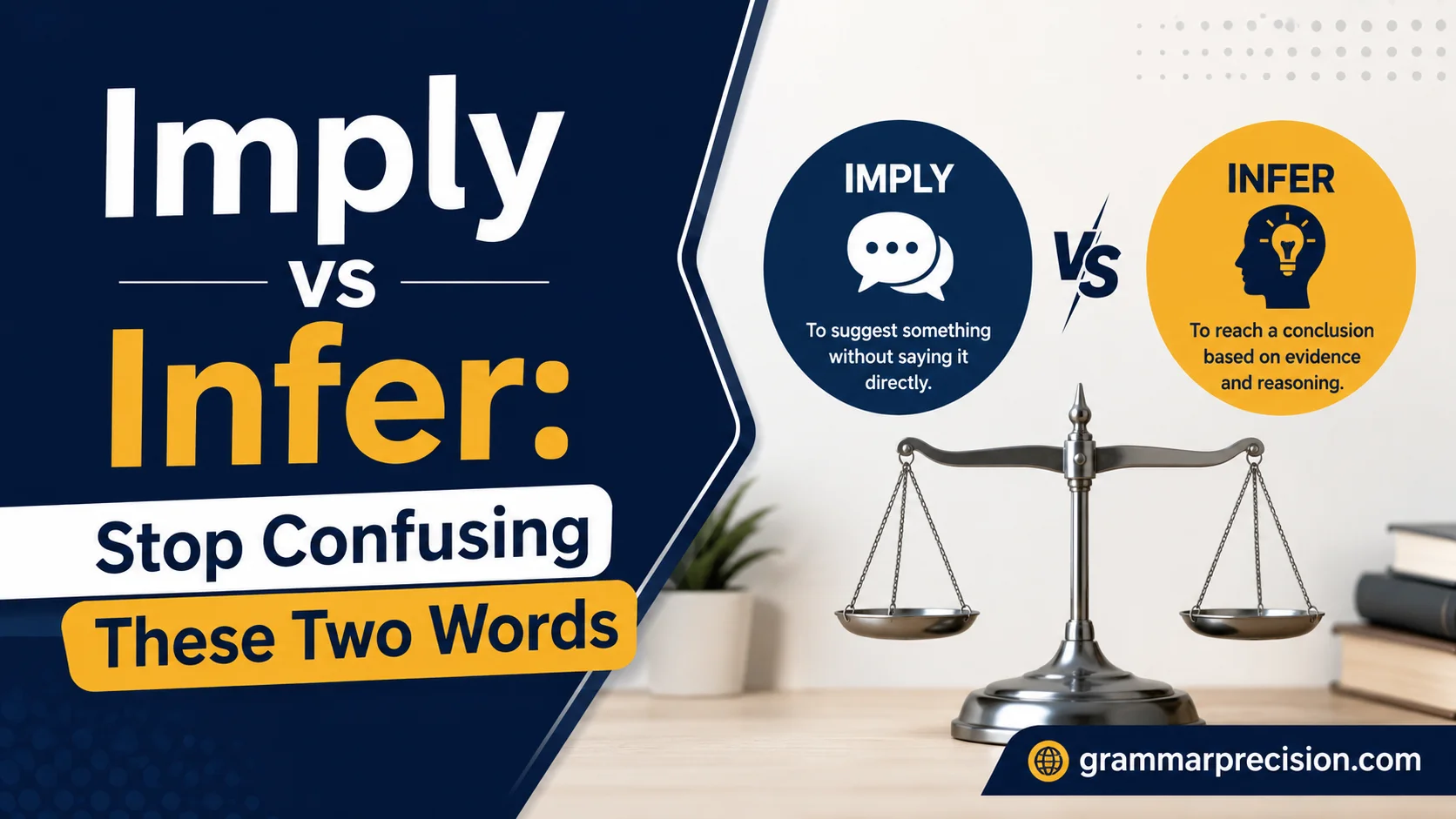
When someone implies something, they suggest an idea without saying it directly. When someone infers something, they reach a conclusion from words, clues, or evidence. Understanding this simple difference helps you choose the right word in everyday and formal writing.
In this guide, you’ll learn the clear difference between imply and infer, their meanings, correct usage, sentence examples, common mistakes, and easy ways to remember them. By the end, you’ll know exactly when to use imply and when to use infer with confidence.
Imply vs Infer at a Glance
Here’s the quickest way to separate the two:
| Word | Basic Meaning | Who Usually Does It? | Direction |
| Imply | Suggest something without saying it directly | Speaker or writer | Meaning goes into the message |
| Infer | Reach a conclusion from information or clues | Listener or reader | Meaning comes out of the message |
Consider this example:
“You haven’t finished the report yet.”
Depending on the situation, the speaker might imply that the report should have been finished already.
The listener might infer that the speaker is disappointed.
Notice the two different actions. The speaker puts an unstated suggestion into the conversation. The listener draws a meaning from it.
That’s the heart of imply vs infer.
The Golden Rule
You imply something. Someone else infers something.
This isn’t merely a memory trick. It reflects the normal relationship between the two verbs.
What Does Imply Mean?
Imply means to communicate an idea, feeling, criticism, or suggestion without stating it directly. It can also mean that something naturally involves or requires something else.
For example:
“The manager asked whether I was planning to stay late.”
The manager didn’t necessarily say, “I want you to stay late.”
However, the question might imply that staying late is expected.
The important point is that the speaker or writer creates the indirect message.
How to Use Imply in a Sentence
The verb imply commonly appears with a noun, pronoun, or that-clause.
Examples:
- Her comment implied that something had gone wrong.
- Are you implying that I made the mistake?
- His silence implied disappointment.
- The evidence implies that the theory needs revision.
- She didn’t mean to imply that everyone was responsible.
The construction imply that is especially common in formal and academic writing.
For example:
The results imply that the treatment may require further testing.
Here, the results don’t literally speak. Instead, the information in those results points toward a conclusion.
Imply From the Speaker’s Perspective
Imagine a friend looks outside at dark clouds and says:
“I don’t think those shoes are a good choice today.”
They haven’t directly said, “It’s going to rain.”
Still, the comment may imply that the weather could become wet.
The speaker has supplied the suggestion. The listener interprets it.
That’s why imply often works with:
- statements
- comments
- questions
- expressions
- behavior
- evidence
- reports
- wording
- tone
However, context matters. A sentence doesn’t always carry one fixed implied meaning. Different listeners may understand the same words differently.
Imply Can Also Mean “Involve”
There’s another important meaning that learners sometimes overlook.
Imply can mean that something logically or necessarily involves another condition. Cambridge gives examples such as a principle implying a particular consequence.
For example:
Democracy implies free elections.
Here, imply doesn’t mean that democracy is secretly hinting at elections. Instead, free elections are presented as something that follows from the concept of democracy.
Another example:
Accepting the offer implies agreeing to its terms.
In this use, imply means something like entail, involve, or make necessary.
That distinction is useful because not every use of imply involves a person dropping a hint.
What Does Infer Mean?
Infer means to form an opinion, conclusion, or understanding from information, evidence, clues, or what someone has said.
For example:
The roads were wet, so we inferred that it had rained.
Nobody directly told us that it had rained. Instead, we looked at the available evidence and reached a conclusion.
That’s infer.
How to Use Infer in a Sentence
The most useful pattern is:
infer + something + from + evidence
Examples:
- We inferred the meaning from the context.
- She inferred from his expression that he was upset.
- Researchers inferred that the results were significant.
- I inferred from her silence that she disagreed.
- Readers can infer the character’s feelings from the description.
The word from is especially helpful because it highlights where the conclusion comes from.
Infer From the Listener’s or Reader’s Perspective
Suppose someone says:
“It’s getting pretty late, and I have an early meeting tomorrow.”
They haven’t said:
“Please leave.”
Still, you might infer that they want the conversation to end.
You take the information they provided and interpret its likely meaning.
That makes infer an act of interpretation.
It can involve:
- spoken words
- written text
- facial expressions
- behavior
- circumstances
- statistics
- observations
- physical evidence
- context
Inference can therefore happen far beyond ordinary conversation.
A reader can infer a character’s feelings. A scientist can infer a pattern from data. A detective can infer what happened from evidence.
Imply vs Infer: The Key Difference
The simplest distinction is this:
The speaker implies. The listener infers.
Imagine someone says:
“Wow, this room is really cold.”
The speaker might imply that someone should close the window.
You might infer that they want you to close it.
The same conversation contains both actions.
Imply vs Infer Communication Flow
SPEAKER
↓
Says something indirectly
↓
IMPLIES a meaning
↓
Message reaches listener
↓
Listener interprets clues
↓
INFERS a meaning
This relationship explains why swapping the two verbs can completely change your sentence.
Compare:
Are you implying that I lied?
This asks whether the other person is suggesting that you lied.
Now compare:
I inferred from your comment that you were angry.
This says that you reached a conclusion based on the other person’s comment.
Both sentences involve indirect meaning. Their grammatical roles are different.
Imply vs Infer Examples
Seeing the words in realistic situations makes the distinction much clearer.
| Situation | Imply | Infer |
| A boss says, “Some people arrived early today.” | The boss may imply that others should arrive earlier. | An employee may infer that the boss is unhappy about lateness. |
| A friend says, “I haven’t eaten all day.” | The friend may imply that they’re hungry. | You may infer that they want food. |
| A teacher says, “Only two students submitted the assignment.” | The teacher may imply that others failed to submit it. | Students may infer that the teacher is concerned. |
| Someone carries an umbrella. | Their choice may imply that rain is expected. | You may infer that they expect bad weather. |
| A report shows falling sales. | The data may imply a business problem. | Analysts may infer that demand has weakened. |
Everyday Conversation
Imagine this exchange:
Alex: “Are you still working on that presentation?”
Jordan: “It’s almost midnight.”
Jordan doesn’t explicitly say, “Yes, I’m still working on it.”
However, the response implies that the presentation is taking a long time.
Alex might infer that Jordan is tired or frustrated.
The beauty of these words is that they describe different stages of the same interaction.
Also Read This: Have Been Having vs Have Had: Meaning, Differences, & Rules
Imply vs Infer in Professional Communication
The distinction becomes especially important at work because indirect language can create misunderstandings.
Consider this email:
“It would be helpful if the figures were available before tomorrow’s meeting.”
The writer may imply that the recipient needs to provide the figures quickly.
The recipient may infer that the figures are expected before the meeting.
Neither person used the words “You must send the figures tonight.” Yet the intended meaning can still be understood.
In professional writing, however, indirect language can sometimes create ambiguity. If a deadline is critical, direct wording may work better:
“Please send the figures by 9 a.m. tomorrow.”
That’s clearer than relying on implication.
A Useful Rule for Workplace Writing
Use implied meaning when tact and diplomacy matter.
Use direct language when precision matters more than subtlety.
For example:
Diplomatic:
“There may be an opportunity to improve the formatting.”
Direct:
“Please revise the formatting before publication.”
Neither approach is automatically better. The right choice depends on the situation.
Imply vs Infer in Academic Writing
Academic writing uses both words frequently, although their roles differ.
Researchers often write that evidence implies something:
The findings imply that additional research is necessary.
Readers, meanwhile, infer conclusions from evidence:
From these findings, readers can infer that the treatment had limited effects.
This distinction becomes particularly useful when discussing evidence.
Implication describes what information points toward.
Inference describes the conclusion drawn from that information.
That difference matters because evidence doesn’t always prove a conclusion beyond doubt.
For example:
The survey showed a sharp increase in online purchases.
A researcher might infer that consumer preferences are changing.
That inference could be reasonable without being absolutely certain.
The Difference Between Imply and Infer in Formal Grammar
Both imply and infer are transitive verbs. They can take an object or a clause.
Common patterns include:
Patterns With Imply
- imply + noun
- His words implied anger.
- imply + that-clause
- Her response implied that she disagreed.
- imply + gerund
- The decision implied accepting additional risks.
Patterns With Infer
- infer + noun
- We inferred the meaning.
- infer + that-clause
- They inferred that the plan had failed.
- infer + from + noun
- We inferred the conclusion from the evidence.
One particularly useful pattern is:
infer X from Y
For example:
We inferred his intention from his actions.
Here, his intention is the conclusion, while his actions provide the evidence.
Common Mistakes With Imply and Infer
These words cause several predictable errors.
Mistake: Using Infer When You Mean Imply
Incorrect in standard usage:
“Are you inferring that I cheated?”
If you’re asking whether someone suggested that you cheated, use imply:
“Are you implying that I cheated?”
Cambridge specifically identifies this confusion as a common error.
Mistake: Using Imply When You Mean Infer
Consider:
“From her silence, I implied that she was angry.”
That’s usually the wrong verb.
You didn’t put the suggestion into her silence. You interpreted it.
Better:
“From her silence, I inferred that she was angry.”
Mistake: Treating Inference as Certainty
To infer something doesn’t necessarily mean you’ve proved it.
Suppose you see someone carrying an umbrella.
You might infer that it’s raining.
But perhaps they’re simply preparing for possible rain.
An inference is a conclusion based on available information. Its strength depends on the quality of that information.
That’s why careful writing often uses phrases such as:
- we can infer
- it can be inferred
- the evidence suggests
- this may imply
- the results imply
These expressions leave appropriate room for uncertainty.
Imply vs Infer vs Assume vs Conclude
These four words overlap, but they aren’t interchangeable.
| Word | Meaning | Example |
| Imply | Suggest something indirectly | Her comment implied that she was unhappy. |
| Infer | Reach a conclusion from information | I inferred that she was unhappy from her comment. |
| Assume | Accept something as true without complete proof | I assumed she was unhappy. |
| Conclude | Reach a judgment after considering information | We concluded that the plan wasn’t practical. |
The biggest trap is confusing infer with assume.
If you infer something, you normally have some basis for your conclusion.
If you assume something, you may accept it without enough evidence.
For example:
The lights are off, so I inferred that nobody was home.
That’s an evidence-based conclusion.
But:
I assumed nobody was home.
This may simply describe an expectation.
The difference isn’t always dramatic in casual conversation, yet it matters in careful writing.
Imply vs Infer: A Simple Memory Trick
Here’s an easy trick:
IMPLY = put the idea IN the message.
INFER = take the idea FROM the message.
Another way to remember it:
Speakers imply. Listeners infer.
Think of a person hiding a gift inside a box.
The speaker puts the hidden meaning into the message.
The listener pulls the meaning out.
That’s essentially how implication and inference work.
One-Line Test
Whenever you’re unsure, ask:
“Am I sending the unstated meaning or receiving it?”
- Sending it indirectly? → Imply
- Figuring it out? → Infer
That question solves most cases in seconds.
How Context Helps You Infer Meaning
Words don’t exist in a vacuum. Context can dramatically change what someone implies and what another person infers.
Consider:
“That’s an interesting choice.”
Depending on tone and circumstances, this could be sincere praise.
It could also imply criticism.
The listener might infer criticism because of the speaker’s facial expression, previous conversation, or sarcastic tone.
Context can include:
- Tone of voice
- Facial expression
- Word choice
- Previous statements
- Cultural expectations
- Situation
- Relationship between speakers
- Available evidence
This is why two people can hear the same sentence and reach different inferences.
The speaker may intend one implication. The listener may infer another.
That’s one reason indirect communication can be powerful but risky.
Imply vs Infer: A Quick Practice Test
Choose imply or infer in each sentence.
“What are you ___ by that comment?”
Answer: implying
You’re asking what the speaker is suggesting.
“From the empty chairs, we ___ that most guests had left.”
Answer: inferred
You’re drawing a conclusion from evidence.
“Her expression ___ that she wasn’t pleased.”
Answer: implied
Her expression communicated an indirect message.
“I ___ from his silence that he disagreed.”
Answer: inferred
You interpreted his silence and reached a conclusion.
“The evidence ___ that the original explanation was incomplete.”
Answer: implied
The evidence points toward a particular conclusion.
The Fastest Check
If the subject is communicating a hidden suggestion, imply usually fits.
If the subject is drawing a conclusion, infer usually fits.
FAQs:
What is the main difference between imply and infer?
Imply means to suggest something indirectly, while infer means to understand or conclude something from clues or information. The speaker or writer usually implies a meaning, while the listener or reader infers it.
Is it correct to say “Are you implying that”?
Yes, “Are you implying that?” is correct when you want to ask whether someone is suggesting something without saying it directly. For example, “Are you implying that I made a mistake?” asks about the other person’s intended meaning.
Can I use infer and imply as synonyms?
No, they aren’t exact synonyms. Although both words relate to indirect meaning, they describe different actions. Imply focuses on communicating a suggestion, while infer focuses on reaching a conclusion from available information.
What is an easy way to remember imply vs infer?
Use this simple rule: the speaker implies, and the listener infers. You can also remember that imply puts an idea into a message, while infer takes an idea from a message, clue, or evidence.
What is an example of imply and infer in one sentence?
Consider this example: “She said the office was unusually quiet.” She may imply that something is wrong. From her comment and the quiet office, you may infer that an unusual situation has occurred.
Conclusion:
Understanding imply vs infer becomes easy when you focus on their different roles. Imply means to communicate an unstated idea, while infer means to draw a conclusion from information.
Remember that speakers imply and listeners infer. With this simple rule and regular practice, you can use both words accurately and confidently.