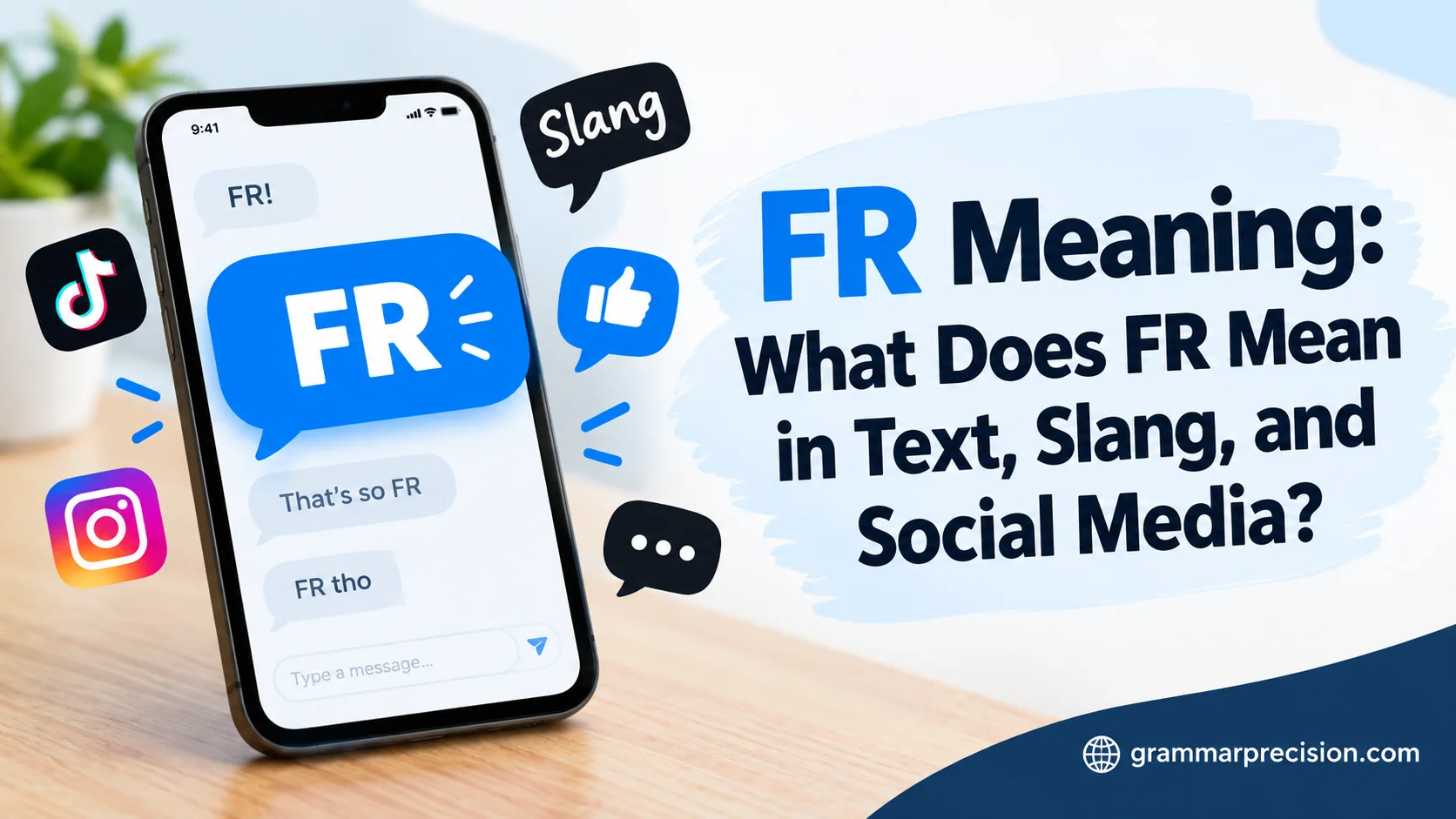
Have you ever received “FR” in a text and wondered what the sender really meant? The FR meaning usually connects to “for real,” yet its tone can shift with context, punctuation, and conversation. This guide explores its slang meaning, common texting uses, social media context, examples, and related expressions such as FRFR. It also explains how English usage, grammar, and audience affect informal digital language.
Understanding abbreviations matters beyond casual texting. Clear business communication, formal writing, and professional meetings require consistency and context. Even everyday digital language can intersect with scheduling, time management, online booking, broadcasting, calendar updates, and project management conversations. While US English commonly favors certain informal expressions, UK English and major style guides may follow different preferences for tone and formality. This article helps you recognize those differences and use FR naturally without sacrificing clarity.
What Does FR Mean in Text?
In texting slang, FR means “for real.” People use it as a compact way to say “seriously,” “honestly,” “I agree,” or “that’s true.”
The meaning changes slightly depending on how someone uses it. A standalone “FR” often signals strong agreement. When it appears at the end of a sentence, it usually adds emphasis. With a question mark, it can express surprise or ask for confirmation.
For example:
- “That class was exhausting.” — “FR.”
The reply means, “Seriously. I agree.” - “I need a vacation fr.”
Here, FR emphasizes that the speaker genuinely needs one. - “You met her yesterday? FR?”
The question suggests surprise: “Really?”
So, FR meaning in text isn’t limited to one dictionary-style definition. It works more like a small conversational signal that tells you how seriously to take the surrounding message.
What Does FR Stand For?
FR stands for “for real.” The abbreviation simply compresses the first letters of the two words.
The full expression, “for real,” has long been used in informal English to emphasize truth, seriousness, or authenticity. Online communication shortened it further because digital conversations favor speed, brevity, and expressive shorthand.
Historical references to the phrase predate modern texting culture. The abbreviation itself appeared in early online slang records in the 2000s, while “FRFR” became increasingly visible in social-media language later.
That history matters because FR didn’t suddenly appear with one app. It grew from an existing spoken expression and then fit neatly into fast-moving digital communication.
FR Meaning in Slang and Online Conversation
As slang, FR usually carries a sense of sincerity or strong agreement. Think of it as a digital nod.
When someone writes:
“That ending was wild fr.”
They aren’t simply stating that the ending was wild. The FR reinforces the feeling. It says, in effect, “I genuinely mean that.”
Similarly:
“FR, I needed that advice.”
Here, FR works as an opening emphasis marker. It signals that the speaker isn’t exaggerating their appreciation.
This is why FR often feels more emotional than a plain statement. Two letters can add conviction without requiring another full sentence.
The Main Meanings of FR
| Use | What FR communicates | Example |
| Agreement | “I agree” or “Exactly” | “That test was brutal.” — “FR.” |
| Sincerity | “I genuinely mean this” | “I appreciate you fr.” |
| Emphasis | “Really” or “Seriously” | “That was difficult fr.” |
| Confirmation | “Is that really true?” | “FR?” |
| Surprise | “Seriously?” | “You won? FR?” |
The surrounding message determines which meaning makes the most sense.
How Context Changes the FR Meaning
Context acts like the missing punctuation in many digital conversations. Without it, FR can look vague. With it, the intended tone usually becomes obvious.
FR as Agreement
This is one of the most common uses.
Alex: “Mondays should be four hours shorter.”
Sam: “FR.”
Sam isn’t asking a question. Sam is agreeing strongly.
In this position, FR behaves almost like “exactly,” “facts,” or “I know, right?”
FR as Emphasis
People also place FR after their own statement.
“That restaurant was expensive fr.”
The speaker isn’t asking for confirmation. They are strengthening their own claim.
You could replace FR with “seriously” or “honestly” without changing the basic message.
FR as Surprise
Add a question mark and the tone can shift dramatically.
“You finished the whole project tonight?”
“FR?”
Now FR means something closer to “Really?”, “Seriously?”, or “Are you being honest?”
The punctuation does important work here.
FR as Genuine Emotion
FR can also make an emotional statement sound more sincere.
“I’m really proud of you fr.”
The abbreviation reassures the reader that the sentiment is genuine rather than casual politeness.
FR Meaning by Capitalization and Punctuation
Digital slang doesn’t follow every traditional writing rule. Still, capitalization and punctuation can influence how a message feels.
| Form | Typical interpretation |
| fr | Casual, relaxed, everyday slang |
| FR | Stronger visual emphasis or standard abbreviation styling |
| fr. | Less common in casual slang and may look like an abbreviation |
| FR! | Strong agreement, excitement, or emphasis |
| FR? | Surprise, doubt, or a request for confirmation |
| frfr | Stronger version of “for real” |
Lowercase fr often feels especially conversational. However, users don’t always follow a consistent pattern. Someone may type FR simply because they prefer uppercase abbreviations.
Therefore, capitalization alone shouldn’t determine the meaning. Read the whole message.
FR Meaning on Social Media
FR has become common across many forms of online conversation because it is short and emotionally flexible. Current slang references describe it across TikTok, Instagram, Snapchat, Discord, group texts, and comment sections.
FR on TikTok
On TikTok, FR often appears in comments when someone strongly relates to a video.
For example:
“This is exactly what my Mondays look like fr.”
The commenter is emphasizing recognition and agreement.
You may also see FR attached to a humorous observation:
“Bro really thought that would work fr.”
Depending on the video, that can sound amused, skeptical, or sarcastic.
FR on Instagram
On Instagram, FR can appear in DMs, comments, captions, and replies.
A friend might respond:
“FR, that picture turned out great.”
Here, the abbreviation reinforces genuine agreement.
FR on Snapchat
Snapchat conversations tend to be fast and informal, making short expressions like FR especially convenient.
A single “fr” can keep a conversation moving without adding unnecessary words.
FR on Discord and Gaming Chats
Gaming communities use compressed language constantly. FR fits naturally because players often communicate quickly between matches or during live gameplay.
For example:
“That boss fight was ridiculous fr.”
The speaker is adding emphasis to the complaint.
FR Meaning in Different Sentence Positions
Where FR appears can provide a useful clue.
FR at the Beginning
“FR, that was the funniest part.”
This usually introduces agreement or emphasis.
It can feel similar to saying, “Seriously, that was the funniest part.”
FR at the End
“That was the funniest part fr.”
The statement comes first. FR acts like an emphasis stamp afterward.
FR Alone
“FR.”
A standalone FR generally means strong agreement.
It can be equivalent to:
- “Exactly.”
- “Seriously.”
- “I know.”
- “For real.”
- “Facts.”
FR as a Question
“FR?”
This usually asks for confirmation.
The speaker may be surprised, skeptical, or genuinely curious.
FR vs FRFR: What’s the Difference?
FRFR means “for real, for real.” It repeats the phrase to increase emphasis.
If FR is a nod, FRFR is a double nod.
| Expression | Meaning | Strength |
| FR | For real | Normal emphasis |
| FRFR | For real, for real | Stronger emphasis |
| “for real” | Full phrase | Natural spoken form |
Consider these examples:
“You should watch that movie fr.”
This sounds like a genuine recommendation.
“You should watch that movie frfr.”
The second version pushes the recommendation harder. The writer really wants you to believe them.
FRFR can also carry a playful or slightly exaggerated internet tone. Its meaning remains straightforward, but repetition gives it extra emotional weight.
FR vs Other Texting Abbreviations
FR belongs to a wider family of internet shorthand. However, similar expressions don’t always do the same job.
| Slang | Meaning | Main purpose |
| FR | For real | Agreement or emphasis |
| FRFR | For real, for real | Stronger sincerity |
| TBH | To be honest | Introducing an honest opinion |
| NGL | Not gonna lie | Introducing a candid statement |
| IMO | In my opinion | Marking an opinion |
| ONG | On God | Strong oath or emphasis |
| ISTG | I swear to God | Strong emotional emphasis |
For example, TBH usually introduces honesty:
“TBH, I didn’t like the ending.”
FR more often confirms or emphasizes something:
“That ending was confusing fr.”
The difference is subtle but useful.
How to Use FR Naturally
Using slang well isn’t about inserting it into every sentence. Timing matters more than frequency.
Use FR With Friends
FR works naturally in casual conversations with people who already understand internet slang.
“You were right fr.”
“That was hilarious fr.”
“FR, we need to do that again.”
Use FR in Casual Comments
It fits naturally when reacting to relatable posts, jokes, opinions, or everyday observations.
“This is me every morning fr.”
“FR, nobody talks about this.”
Don’t Force It
If every sentence ends with FR, the expression loses its punch.
Compare:
“That movie was good fr. The actors were great fr. The ending was wild fr.”
It sounds repetitive.
A more natural version varies the language:
“That movie was good fr. The acting was great, and that ending was wild.”
The strongest slang usually works because you don’t overuse it.
How to Reply When Someone Says FR
Your response depends on what the other person means.
If They Agree With You
You can respond naturally with:
- “Exactly.”
- “I know, right?”
- “Facts.”
- “Seriously.”
- “Right?”
If They Ask “FR?”
They’re probably asking you to confirm something.
You could say:
- “Yeah, seriously.”
- “Yep, I’m not joking.”
- “Absolutely.”
- “No joke.”
If They Use FR as Emphasis
You don’t necessarily need to address the FR itself. Just continue the conversation.
Friend: “I’m exhausted fr.”
Reply: “Same. This week has been brutal.”
That keeps the conversation natural.
When You Shouldn’t Use FR
FR is informal internet slang, so it doesn’t belong everywhere.
Avoid it in:
- Job applications
- Academic essays
- Formal reports
- Business proposals
- Professional emails
- Legal documents
- Official announcements
Instead, use clearer alternatives such as:
- Seriously
- Genuinely
- Indeed
- I agree
- Absolutely
- Honestly
- In fact
For example, instead of:
“I agree with this fr.”
A professional message could say:
“I completely agree with this point.”
The second version communicates the same idea without informal slang.
Other Meanings of FR
Although “for real” is the dominant meaning in texting, FR isn’t limited to slang.
Context can give the same two letters completely different meanings.
One notable example is FR as the country code associated with France in technical and internet contexts. The distinction is usually obvious from the surrounding information.
FR can also appear as an abbreviation in specialized fields, organizations, names, and platform features. Therefore, don’t automatically translate every instance of FR as “for real.”
A useful rule is simple:
If you’re reading a casual text or social-media comment, “for real” is usually the best interpretation. If you’re reading a technical, geographic, or professional document, check the context first.
Common Examples of FR in Real Conversations
Here are several examples showing how the meaning changes naturally.
Example: Strong Agreement
Person A: “This weather is way too hot.”
Person B: “FR.”
Meaning: “I completely agree.”
Example: Sincere Feeling
“I really appreciate your help fr.”
Meaning: “I genuinely appreciate your help.”
Example: Surprise
“You got the tickets for free?”
“FR?”
Meaning: “Really? Is that true?”
Example: Emphasis
“That was the best burger I’ve had fr.”
Meaning: “I genuinely thought it was excellent.”
Example: Social Media Reaction
“Nobody talks about how hard Mondays are.”
“FR 😭”
Meaning: “Exactly. I relate to this.”
A Quick Case Study: Why Context Matters
Imagine someone sends this message:
“You actually quit your job? FR?”
If you only know that FR means “for real,” you understand the words. Yet you might miss the emotional tone.
The question mark suggests surprise. The sender probably wants confirmation.
Now change the message:
“That job was exhausting fr.”
The meaning shifts. Here, FR reinforces the speaker’s statement.
Finally:
“That job was exhausting.”
“FR.”
Now FR signals agreement.
Same abbreviation. Three conversational functions.
That’s the real key to understanding FR. Don’t translate the letters in isolation. Read them alongside the sentence, punctuation, and conversation.
Is FR Appropriate for Everyone?
FR is widely understood in casual digital spaces, but slang always depends on audience.
A close friend may find it completely natural. A professor, manager, client, or older relative may interpret it differently or simply find it unclear.
That doesn’t make FR bad language. It makes it context-specific language.
Think of FR like casual clothing. A T-shirt works perfectly at a weekend gathering. It probably isn’t your best choice for a formal interview.
FAQs About FR Meaning
Does FR Mean “For Real”?
Yes. In texting and internet slang, FR usually means “for real.” It can express agreement, sincerity, emphasis, surprise, or a request for confirmation depending on context.
What Does FR Mean From a Girl?
The basic FR meaning doesn’t change based on gender. If someone sends “FR,” she is usually expressing agreement, sincerity, emphasis, or surprise. The surrounding conversation determines the exact tone.
What Does FR Mean From a Guy?
The meaning is generally the same. A guy using FR may mean “I agree,” “seriously,” “honestly,” or “really?” depending on punctuation and placement.
What Does FRFR Mean?
FRFR means “for real, for real.” It intensifies the original expression and signals stronger sincerity, agreement, or seriousness.
Is FR a Bad Word?
No. FR isn’t inherently offensive. It’s simply an informal abbreviation for “for real.” However, like other slang, it may sound inappropriate in formal or professional writing.
What Does “FR?” Mean in a Text?
“FR?” usually means “Really?”, “Seriously?”, or “Is that true?” The question mark makes it different from a standalone “FR,” which commonly expresses agreement.
Conclusion:
Understanding FR Meaning makes texting slang easier to interpret, especially when context, punctuation, and tone change the intended message.
Whether FR shows agreement, sincerity, emphasis, or surprise, context always matters. Use it naturally in casual conversations, while choosing clearer language for professional communication, formal writing, and business settings when greater consistency matters.