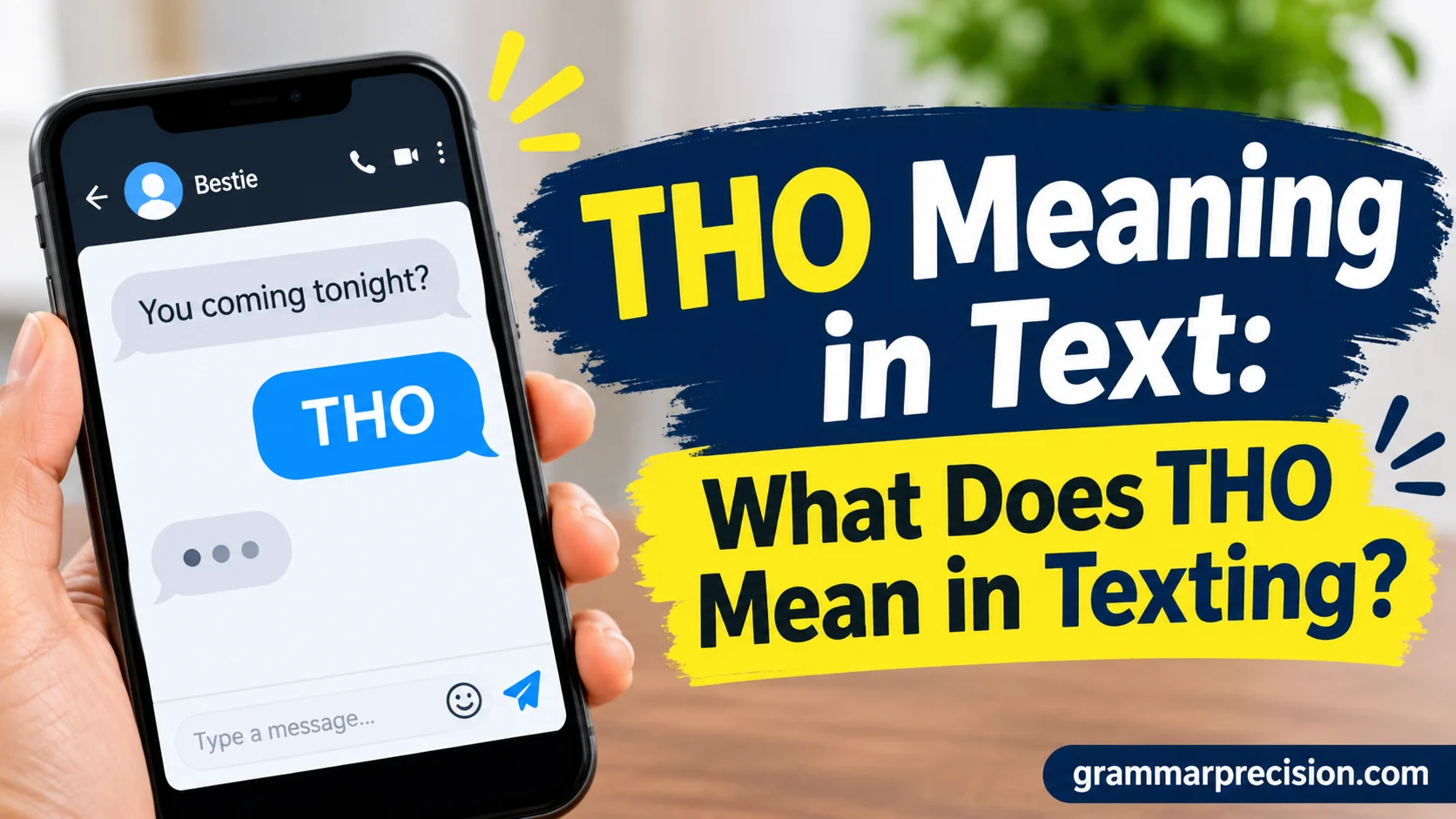
Have you ever received a message ending with “tho” and wondered what it means? THO meaning in text is simple, yet its tone can change depending on the conversation.
From casual texting to social media comments, THO helps express contrast, emphasis, opinions, and emotions naturally. This guide explores its meaning, common examples, platform-specific uses, and differences from standard English grammar.
You’ll also learn how THO fits into everyday business communication, why people prefer informal expressions, and when formal writing requires alternatives. Understanding its usage can improve your English communication skills, helping you recognize tone and maintain consistency across different conversations.
Quick Answer: What Does THO Mean in Text?
THO means “though” in texting, online conversations, and social media. It’s a shortened, informal spelling that people use to express contrast, add emphasis, or introduce an additional thought.
Here are a few examples:
- “I don’t like coffee, tho.” — Shows a personal preference or contrast.
- “You’re looking good tho!” — Adds emphasis to a compliment.
- “It was raining, but we had fun tho.” — Highlights a positive point despite an inconvenience.
- “That’s expensive tho.” — Emphasizes the cost of something.
The expression doesn’t have a completely different meaning on different platforms. Whether someone uses it on Snapchat, Instagram, TikTok, or WhatsApp, it generally means though.
What Does THO Stand For?
THO is a shortened spelling of though, an English word used to introduce contrast or acknowledge something that differs from an earlier statement.
People often remove the letters “ugh” from the end of though when writing casually. This creates a shorter version that’s quick to type and easy to recognize.
For example:
- Standard: “I enjoyed the party, though.”
- Casual: “I enjoyed the party, tho.”
Both sentences communicate the same basic idea. However, the second version feels more relaxed and conversational.
Unlike many texting abbreviations, such as LOL (Laughing Out Loud) or BRB (Be Right Back), THO doesn’t represent a phrase made from several words. It’s simply a shortened spelling of an existing English word.
Why Do People Use THO Instead of Though?
The biggest reason is convenience. Texting encourages quick communication, and shorter expressions help people send messages without typing unnecessary letters.
However, convenience isn’t the only reason. THO also creates a casual tone that fits naturally into online conversations.
People commonly use it because:
- It’s shorter: Typing “tho” takes less effort than typing “though.”
- It sounds casual: The spelling feels natural in friendly conversations.
- It adds emphasis: It can make an opinion or observation stand out.
- It fits internet culture: Social media users often prefer short, expressive language.
- It creates a relaxed tone: It makes messages feel less formal and more personal.
For instance, “You’re funny though” sounds perfectly natural. However, “You’re funny tho” feels more like something you’d send in a quick message to a friend.
Is THO a Word, Abbreviation, or Slang?
THO is best described as an informal spelling or shortened form of though.
People sometimes call it slang because it’s popular in texting and internet conversations. However, it isn’t an acronym or an entirely separate slang expression.
Consider these distinctions:
| Term | Meaning | Type |
| THO | Though | Informal spelling |
| LOL | Laughing Out Loud | Acronym |
| TBH | To Be Honest | Acronym |
| IDK | I Don’t Know | Acronym |
| IMO | In My Opinion | Acronym |
Understanding this difference helps you avoid confusing THO with abbreviations that have entirely different expansions.
How People Use THO in Everyday Conversations
Although THO has one basic meaning, its placement can change how a sentence feels. The surrounding words provide important clues about the sender’s intention.
Let’s examine its most common positions.
THO at the Beginning of a Sentence
When THO appears at the beginning, it usually introduces a contrasting thought. The sender acknowledges something before presenting another perspective.
For example:
- “Tho I was tired, I still went shopping.”
- “Tho it’s expensive, I might buy it.”
- “Tho I disagree, I understand your point.”
In these examples, THO works like “though” or “although.” It’s a casual way to introduce an idea that contrasts with something else.
However, starting a sentence with THO is more common in informal digital writing than formal documents.
THO at the End of a Sentence
This is probably the most recognizable way people use THO in texting.
At the end of a sentence, it often adds emphasis or introduces a small contrast without requiring another complete explanation.
Examples include:
- “That restaurant was amazing tho.”
- “You look different tho.”
- “I wasn’t expecting that tho.”
- “This song is addictive tho.”
Notice how THO adds a little extra weight to each statement. It can make an observation sound playful, surprised, or slightly argumentative.
For example, “You look different” sounds neutral. Meanwhile, “You look different tho” suggests the sender wants you to notice something specific.
THO in the Middle of a Message
People also place THO between two ideas to connect them naturally.
Examples:
- “I wanted to come, tho I had too much work.”
- “She’s quiet, tho she’s actually very funny.”
- “The phone looks expensive, tho it has impressive features.”
Here, THO introduces a contrasting detail. It connects two thoughts without making the sentence sound overly formal.
Different Meanings and Tones of THO
Here’s where things become interesting. THO doesn’t always communicate the same emotion.
Its basic definition stays consistent, but the sender’s tone changes with context, punctuation, and surrounding words.
THO to Show Contrast
Contrast is one of its most common functions.
People use THO when they want to acknowledge one fact while highlighting another.
Examples:
- “The weather is cold, but the view is beautiful tho.”
- “I don’t usually watch horror movies, but this one was good tho.”
- “He talks a lot, but he’s helpful tho.”
In each example, THO draws attention to a contrasting detail.
THO to Emphasize an Opinion
Sometimes, people add THO to make their opinions sound stronger.
For example:
- “That outfit looks amazing tho!”
- “You’re really talented tho.”
- “This is the best pizza I’ve tried tho.”
The expression makes the statement feel more enthusiastic or personal. It can also suggest that the sender wants their opinion to receive extra attention.
THO to Express Surprise or Disagreement
THO can communicate mild surprise when something doesn’t match your expectations.
Imagine your friend shares a photograph after getting a new haircut.
You might reply:
“Your hair looks completely different tho!”
Depending on the relationship and delivery, this could express genuine surprise or playful teasing.
It can also appear in disagreements:
- “That’s not what I meant tho.”
- “You could’ve told me earlier tho.”
- “I understand, but that’s unfair tho.”
These messages highlight a different perspective without necessarily sounding aggressive.
THO to Add Humor or Sarcasm
Online conversations often rely on subtle humor. THO can help make a sarcastic or playful comment more noticeable.
Examples:
- “You said you’d be here in five minutes an hour ago tho.”
- “Great cooking skills tho, the kitchen is on fire!”
- “You call that cleaning tho?”
The humor comes from the contrast between what someone says and what actually happens.
However, sarcasm depends heavily on context. A message that makes one friend laugh might sound rude to someone unfamiliar with your humor.
THO Meaning on Different Social Media Platforms
You might encounter THO on several social media platforms. Fortunately, its basic meaning remains almost identical across them.
THO Meaning on Snapchat
On Snapchat, THO usually appears in quick conversations, story replies, and reactions to photographs.
For example:
- “Your snap looks amazing tho.”
- “You look tired today tho.”
- “That filter is funny tho.”
People use it to make their messages feel relaxed and friendly. It can also add playful emphasis when responding to someone’s story.
THO Meaning on Instagram
On Instagram, users frequently add THO to comments, captions, and direct messages.
Examples:
- “This outfit is everything tho!”
- “Your photography skills are impressive tho.”
- “That sunset looks unreal tho.”
In comments, THO can make a compliment feel more expressive. It can also emphasize an opinion about a photograph, reel, or trending topic.
THO Meaning on TikTok
TikTok conversations often feature casual language, jokes, reactions, and exaggerated opinions. THO fits naturally into this environment.
Examples:
- “This trend is getting ridiculous tho.”
- “The ending surprised me tho.”
- “Nobody talks about this enough tho.”
Users may also include THO in video captions or comment discussions to highlight an unexpected observation.
THO Meaning on WhatsApp and Messenger
On messaging platforms, THO commonly appears in personal conversations between friends, relatives, and romantic partners.
Examples:
- “I’ll call you later tho.”
- “You should try that restaurant tho.”
- “I miss those days tho.”
The expression makes ordinary messages feel less formal. Its emotional meaning depends on the relationship and the rest of the conversation.
25+ THO Examples in Text Messages
Sometimes, the easiest way to understand texting slang is to see it in action. These examples demonstrate how THO works in different situations.
THO in Casual Conversations With Friends
| Text message | Intended meaning |
| “I’m tired tho.” | Emphasizes being tired. |
| “That was fun tho.” | Highlights a positive experience. |
| “You were right tho.” | Acknowledges someone’s correct opinion. |
| “It’s pretty cold tho.” | Emphasizes the weather. |
| “I like that idea tho.” | Shows approval. |
| “We should go again tho.” | Suggests repeating an activity. |
| “That place is far tho.” | Highlights the distance. |
THO in Funny and Sarcastic Messages
| Text message | Intended meaning |
| “You call that cooking tho?” | Playful criticism. |
| “Nice timing tho!” | Sarcastic reaction to lateness. |
| “You forgot again tho.” | Teasing someone about forgetting. |
| “Very professional tho.” | Potentially sarcastic praise. |
| “That excuse was creative tho.” | Lighthearted criticism. |
| “You really tried tho.” | Playful acknowledgment. |
THO in Romantic and Flirty Conversations
THO can also make compliments and romantic messages sound more natural.
| Text message | Intended meaning |
| “You look cute tho.” | A casual compliment. |
| “I miss you tho.” | Expresses affection. |
| “You’re special tho.” | Highlights someone’s importance. |
| “You looked amazing tonight tho.” | Compliments someone’s appearance. |
| “I was thinking about you tho.” | Suggests romantic interest. |
| “Your smile is beautiful tho.” | Gives a warm compliment. |
Remember that THO alone doesn’t prove someone is flirting. Look at the conversation’s overall tone before assuming romantic interest.
THO in Everyday Questions and Replies
| Text message | Intended meaning |
| “Why didn’t you tell me tho?” | Asks for an explanation. |
| “Are you coming tho?” | Seeks confirmation. |
| “I thought you knew tho.” | Expresses an expectation. |
| “That’s interesting tho.” | Shows curiosity or mild surprise. |
| “What happened tho?” | Requests additional information. |
| “You could try again tho.” | Suggests another attempt. |
What Does THO Mean From a Guy or Girl?
A common question involves whether THO carries a special meaning when a guy or girl uses it.
The simple answer is no. THO doesn’t have a gender-specific definition. However, the surrounding conversation can reveal the sender’s feelings or intentions.
When a Guy Uses THO in a Message
A guy might use THO to express an opinion, compliment someone, or keep a conversation casual.
For example:
- “You look beautiful tho.”
- “I actually enjoyed talking to you tho.”
- “You’re funny tho.”
These messages could sound friendly or flirtatious. However, you shouldn’t interpret THO itself as proof of romantic interest.
Pay attention to other clues, such as consistent attention, personal questions, affectionate language, and genuine interest.
When a Girl Uses THO in a Message
Girls use THO in much the same way. It can express excitement, disagreement, humor, or affection.
Examples:
- “You’re looking good tho.”
- “That was sweet tho.”
- “I wasn’t expecting that tho.”
Depending on the relationship, these messages might sound playful, friendly, or romantic.
Does THO Have a Flirty Meaning?
THO can appear in flirtatious conversations, but it isn’t inherently romantic.
Compare these examples:
- Friendly: “That movie was great tho.”
- Flirty: “You looked really cute today tho.”
- Playful: “You’re always making me laugh tho.”
The second and third messages might suggest attraction depending on the relationship. Still, the surrounding conversation matters much more than the abbreviation.
How to Reply When Someone Uses THO
Responding to THO is easy once you understand the message’s intention. You don’t need to repeat the abbreviation in every reply.
Here are some natural responses for different situations.
| Their message | Possible reply |
| “You look great tho.” | “Thank you! That’s sweet.” |
| “I’m tired tho.” | “You should get some rest.” |
| “That was funny tho.” | “I knew you’d laugh!” |
| “You were right tho.” | “Haha, I told you!” |
| “I miss you tho.” | “I miss you too.” |
| “That’s expensive tho.” | “True, it’s a little overpriced.” |
| “You’re funny tho.” | “Glad I could make you laugh.” |
A useful tip: Match the sender’s tone. If they’re joking, respond playfully. If they’re serious, give them a thoughtful answer.
THO vs. Though: What’s the Difference?
THO and though communicate the same basic meaning. The main difference involves spelling, tone, and writing style.
| Feature | THO | Though |
| Meaning | Though | Though |
| Spelling | Informal shortened form | Standard spelling |
| Tone | Casual | Neutral or formal |
| Texting | Very common | Also common |
| Academic writing | Generally unsuitable | Appropriate |
| Professional emails | Usually avoid | Appropriate |
For example:
- Casual: “I liked the restaurant tho.”
- Standard: “I liked the restaurant, though.”
Both sentences express a similar thought. However, the standard spelling looks more appropriate in professional and academic writing.
THO vs. Although vs. Even Though
These three expressions can introduce contrast, but they don’t always fit into sentences in exactly the same way.
| Expression | Meaning | Example |
| THO | Informal form of though | “I’m busy tho.” |
| Although | Introduces contrast | “Although I’m busy, I’ll help.” |
| Even though | Emphasizes contrast | “Even though I’m tired, I’ll come.” |
Although often introduces a contrasting clause. Even though places greater emphasis on the unexpected contrast.
THO is more casual and frequently appears at the end of sentences.
Common Alternatives to THO
Sometimes, you might want to express the same idea without using THO. Several English words and phrases can work as alternatives.
Here are some useful options:
- Though: The standard spelling and closest alternative.
- However: Introduces a contrasting point.
- Still: Highlights something that remains true.
- Nevertheless: Expresses contrast in a more formal style.
- Even so: Acknowledges a fact before presenting another point.
- Although: Introduces a contrasting clause.
- But: Connects opposing ideas in everyday conversation.
For example:
- THO: “It’s expensive tho.”
- Though: “It’s expensive, though.”
- However: “It’s expensive. However, the quality is excellent.”
- Still: “It’s expensive. Still, I like it.”
Choose the alternative that best fits your sentence and intended tone.
THO vs. Other Popular Texting Abbreviations
THO sometimes appears alongside other popular texting expressions. Knowing their differences helps you understand complete messages more easily.
| Abbreviation | Full form | Common purpose |
| THO | Though | Adds contrast or emphasis |
| TBH | To Be Honest | Introduces an honest opinion |
| IMO | In My Opinion | Expresses a personal viewpoint |
| NGL | Not Gonna Lie | Introduces a candid statement |
| FR | For Real | Shows agreement or emphasis |
| IDK | I Don’t Know | Expresses uncertainty |
| LOL | Laughing Out Loud | Expresses amusement |
For example, someone might write:
“NGL, that movie was boring tho.”
Here, NGL introduces an honest opinion while THO adds emphasis to the statement.
Another example:
“IMO, that restaurant is expensive tho.”
The sender expresses a personal opinion and highlights the restaurant’s price.
Is THO Grammatically Correct?
THO is widely understood in informal digital communication. However, it’s not the standard spelling used in formal English writing.
The standard word is though.
You can use THO in:
- Text messages with friends.
- Casual social media comments.
- Informal online discussions.
- Personal messages.
- Relaxed conversations.
However, avoid using it in:
- Academic assignments.
- Business reports.
- Formal emails.
- Professional applications.
- Official documents.
For formal writing, use though, although, however, or another suitable alternative.
Can You Use THO in Professional Messages?
Generally, it’s better to avoid THO in professional communication.
Although your coworkers might understand it, informal abbreviations can make business messages look less polished.
Consider these examples:
Informal:
“The meeting was helpful tho.”
Professional:
“The meeting was helpful, although we still need to address a few issues.”
The second version sounds clearer and more appropriate for workplace communication.
However, if you’re chatting casually with a close coworker, THO might fit naturally. Always consider your audience and the communication setting.
Common Misunderstandings About THO
Despite its simple meaning, people sometimes misunderstand THO because they interpret its tone differently.
Here are a few mistakes worth avoiding:
- Thinking THO is an acronym: It’s a shortened spelling of though, not an abbreviation made from several words.
- Assuming it’s always sarcastic: It can express sincere compliments, opinions, and ordinary contrast.
- Treating it as a romantic signal: THO doesn’t automatically indicate attraction.
- Assuming every platform changes its meaning: Its basic definition remains the same across social media.
- Using it in formal writing: The standard spelling, though, is usually the better choice.
A Quick Case Study: Understanding THO Through Context
Imagine receiving this message from a friend:
“Your presentation was good tho.”
At first, you might wonder whether the person is criticizing your presentation. However, the meaning depends on the surrounding conversation.
Consider three possible situations:
Situation 1: A genuine compliment
Your friend previously praised your presentation. They add THO to emphasize their positive opinion.
Situation 2: A mixed opinion
Your friend liked the presentation but noticed a few mistakes. THO introduces a contrasting observation.
Situation 3: A playful comment
Your friend is teasing you about a small mistake. THO makes the comment sound casual.
The same expression appears in all three situations. Yet the intended tone changes with context.
That’s why understanding the complete message matters more than interpreting one word.
FAQs About THO Meaning in Text
What Does THO Mean in Texting?
THO means though. People use it as an informal shortened spelling to express contrast, emphasize opinions, or add a casual tone to messages.
What Does THO Mean on Snapchat?
On Snapchat, THO means though. People commonly use it in direct messages, story replies, and casual conversations to add emphasis or contrast.
What Does THO Mean on Instagram?
THO means though on Instagram. Users often include it in captions, comments, and direct messages to express opinions or highlight contrasting details.
What Does THO Mean From a Guy?
When a guy uses THO, he generally means though. Depending on the message, it might express friendliness, humor, disagreement, or flirtation.
What Does THO Mean From a Girl?
A girl uses THO with the same general meaning: though. It can make a compliment, opinion, or casual observation sound more expressive.
Is THO Rude or Disrespectful?
No, THO isn’t inherently rude. However, it can sound sarcastic or dismissive when someone uses it during an argument or disagreement.
Is THO the Same as Though?
Yes. THO is an informal shortened spelling of though. Both communicate the same basic meaning, although THO suits casual conversations better.
Can THO Mean Something Other Than Though?
In ordinary texting, THO almost always means though. If someone uses it differently, the surrounding conversation should clarify their intended meaning.
Should I Use THO in Formal Writing?
It’s better to avoid THO in formal writing. Use the standard spelling though instead, especially in academic assignments, business emails, and official documents.
Why Do People Put THO at the End of Sentences?
People often place THO at the end to emphasize an opinion, highlight a contrast, or make a statement sound more conversational.
Conclusion:
Understanding THO meaning in text helps you recognize how people express contrast, opinions, and emotions in everyday digital conversations. Whether you encounter it on Snapchat, Instagram, or WhatsApp, THO generally means though and adds a casual touch.
Remember to consider the conversation’s context before interpreting its tone. Use THO in casual messages, but choose standard alternatives like though, although, or however in formal writing. With these simple distinctions, you’ll understand texting slang more confidently and improve your everyday English communication skills.