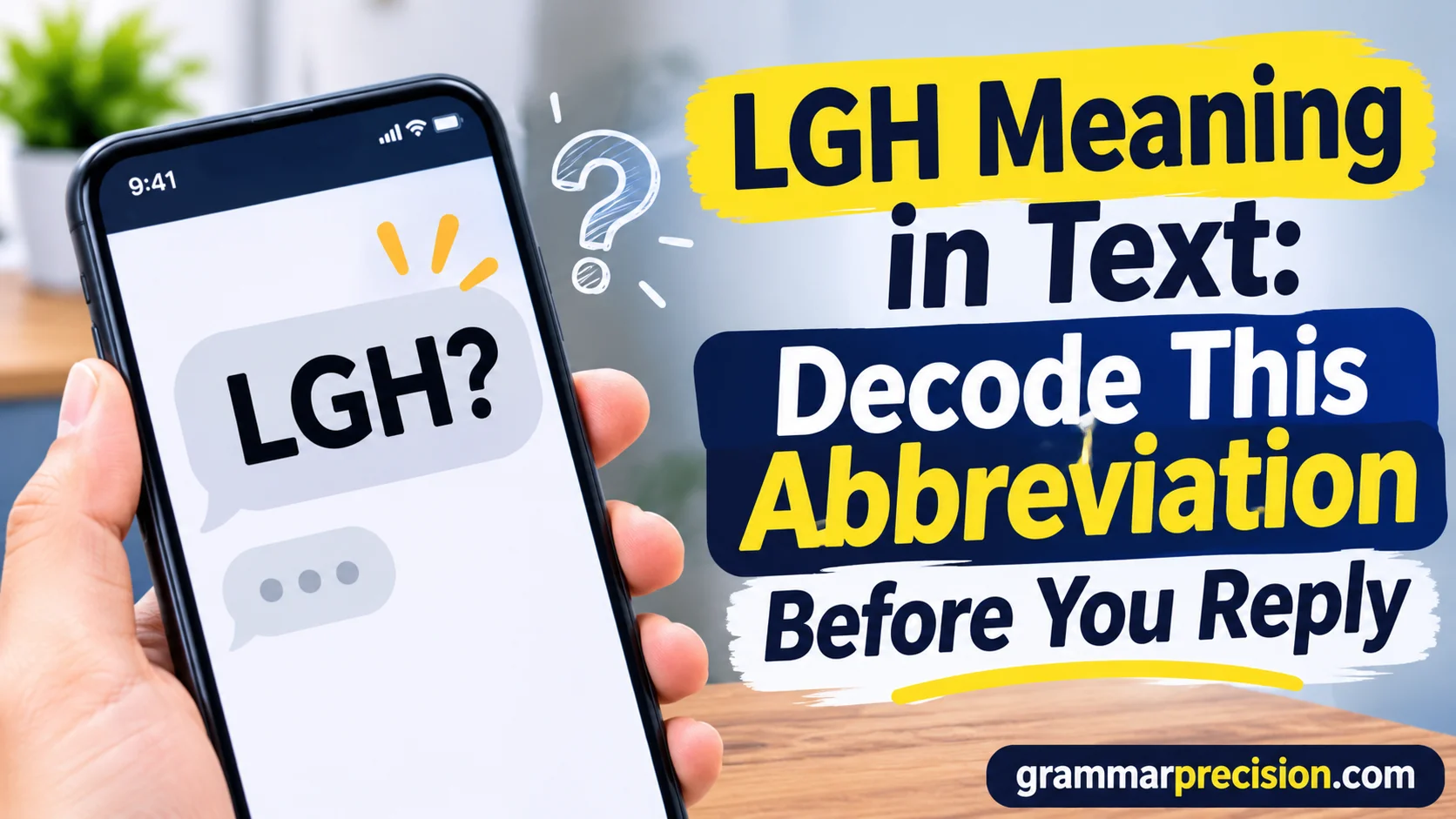
LGH Meaning in Text can leave you confused when unfamiliar abbreviations suddenly appear in everyday digital conversations.
Whether you’re chatting with friends or exploring social media, understanding LGH’s possible meanings requires attention to context. This guide explores its interpretations, texting examples, social media usage, and practical ways to respond confidently.
You’ll also discover how internet slang, online communication, and changing language habits influence modern texting. Learn to recognize unfamiliar abbreviations, avoid common misunderstandings, and maintain clear communication across casual and professional conversations.
LGH Meaning in Text: The Simple Explanation
LGH doesn’t have one universally established meaning across texting and social media. Unlike widely recognized abbreviations such as LOL and OMG, its interpretation depends heavily on context.
You might encounter LGH as a personal abbreviation, community-specific expression, or shorthand created within a particular conversation. Some people also use uncommon letter combinations as private jokes or references that outsiders wouldn’t immediately understand.
Therefore, the safest way to understand LGH is to examine the conversation surrounding it.
What Does LGH Stand For?
LGH consists of three letters: L, G, and H. However, those letters don’t automatically identify one specific phrase.
Different communities can assign different meanings to the same abbreviation. A gaming group might use it differently from friends chatting privately. Similarly, someone might create a shortened expression that only their close friends recognize.
Consider these situations:
- A friend sends LGH during a casual conversation.
- Someone includes LGH in a social media comment.
- A gaming teammate types LGH during a match.
- A person uses LGH as an inside joke.
Each situation provides different clues about the intended meaning.
Don’t assume LGH has a particular expansion without checking the surrounding message. If you’re unsure, asking the sender is usually the most reliable solution.
Why Is LGH Used in Messages?
People shorten words and phrases because digital conversations move quickly. Typing three letters can feel easier than writing an entire sentence.
However, speed isn’t the only reason people use abbreviations.
Here are several reasons someone might use LGH:
- Convenience: Short abbreviations reduce typing effort.
- Personal expression: Friends develop their own communication styles.
- Group identity: Online communities sometimes create expressions understood only by members.
- Humor: Unusual abbreviations can become part of an inside joke.
- Privacy: Some people use familiar shorthand that outsiders might not recognize.
Not every abbreviation becomes popular enough to appear in standard texting dictionaries. Some remain limited to smaller communities.
Is LGH a Slang Term, Acronym, or Initialism?
These terms sound similar but describe slightly different things.
| Term | Meaning | Example |
| Slang | Informal language used within social groups | Bruh |
| Acronym | An abbreviation pronounced as a word | NASA |
| Initialism | An abbreviation pronounced letter by letter | LOL |
| Shorthand | A shortened way of writing something | IDK |
LGH can function as an initialism if its letters represent a phrase pronounced individually. However, its classification depends on how the sender uses it.
It isn’t automatically a widely recognized slang expression simply because someone types it in a message.
The Hidden Context Behind LGH
Three letters can communicate different things depending on where they appear. That’s why context matters more than guessing.
Imagine receiving LGH without any explanation. You might interpret it one way while the sender intended something completely different.
Before responding, consider these important clues.
What LGH Might Mean in Different Situations
The meaning of LGH can depend on the communication environment.
For example, consider these possibilities:
- Private conversations: It might represent personal shorthand between two people.
- Group chats: Members might use an abbreviation established through previous conversations.
- Gaming communities: It could represent terminology specific to a particular game or team.
- Social media: It might appear as a username reference, caption abbreviation, or community expression.
- Professional communication: It could represent an industry-specific abbreviation rather than casual slang.
These examples describe possible contexts, not verified universal expansions of LGH.
If someone uses LGH repeatedly, previous messages may provide enough information to understand it.
How Tone Changes the Interpretation
Tone can completely change how you understand a message.
For example, compare these conversations:
Conversation A:
Friend 1: “I finally finished everything!”
Friend 2: “That’s amazing!”
The conversation has a positive tone. Any unfamiliar abbreviation appearing here might relate to the shared excitement.
Conversation B:
Friend 1: “I can’t believe what happened yesterday.”
Friend 2: “Seriously?”
This exchange suggests surprise or frustration.
The same abbreviation could carry different implications in these situations. However, you shouldn’t assign an emotional meaning without supporting context.
Pay attention to:
- The words immediately before LGH.
- The sender’s previous messages.
- Emojis accompanying the abbreviation.
- Whether the conversation feels serious or playful.
- The relationship between both people.
These details help you interpret unfamiliar expressions more accurately.
Why the Sender’s Intent Matters
Understanding who sent LGH can help you determine its intended meaning.
A close friend might use personal shorthand that you’ve never encountered elsewhere. Meanwhile, someone you recently met might use an abbreviation from their online community.
For example, imagine your friend regularly creates shortened expressions for everyday situations. You might recognize their communication style even when their abbreviations aren’t widely known.
However, a stranger’s message requires more caution.
The sender’s communication habits often provide better clues than an online abbreviation list.
LGH Meaning From Someone You Like
Receiving an unfamiliar abbreviation from someone you like can make an ordinary message feel surprisingly complicated.
You might wonder whether they’re flirting, joking, or simply communicating casually. However, LGH alone doesn’t establish romantic interest.
Instead of reading too much into three letters, examine the entire conversation.
What It Could Mean in Flirty Conversations
People sometimes use abbreviations to keep conversations short, playful, or informal.
Someone interested in you might use personal shorthand because they feel comfortable communicating casually.
For example:
Person A: “Are you coming to the party tonight?”
Person B: “Definitely! It’ll be fun.”
If LGH appears somewhere in a similar exchange, its meaning depends on the established context.
Look for additional signs of interest, including:
- Starting conversations regularly.
- Asking personal questions.
- Remembering small details about you.
- Giving genuine compliments.
- Making plans to spend time together.
- Maintaining conversations instead of sending occasional replies.
These behaviors provide more meaningful clues than an unexplained abbreviation.
Does LGH Suggest Interest or Friendship?
Not necessarily.
An unfamiliar abbreviation doesn’t automatically indicate attraction, affection, or romantic intentions.
Someone might use it while talking to friends, relatives, classmates, or romantic interests. The relationship alone doesn’t determine its meaning.
Consider the difference between these situations:
| Situation | What You Should Consider |
| A close friend sends LGH | Previous conversations and inside jokes |
| Someone you like sends LGH | Overall communication and relationship |
| A new acquaintance sends LGH | Their intended meaning and context |
| A gaming friend sends LGH | Community-specific terminology |
The best approach is to avoid making assumptions. Let the conversation provide the answer.
How to Avoid Misreading the Message
Misunderstanding slang can create unnecessary awkwardness, especially when emotions are involved.
Try these simple strategies:
- Read the complete conversation before interpreting LGH.
- Check whether the sender has used similar abbreviations.
- Notice whether the message sounds serious or playful.
- Avoid assuming romantic meaning without additional signs.
- Ask a friendly question when the abbreviation remains unclear.
A little curiosity can prevent a much bigger misunderstanding.
Decode LGH Through Real Text Conversations
Examples make unfamiliar abbreviations easier to understand. However, because LGH doesn’t have one confirmed universal expansion, these conversations demonstrate interpretation strategies rather than invented definitions.
Example: LGH Between Friends
Conversation:
Alex: “You remember what happened last weekend?”
Jordan: “Of course!”
Alex: “LGH 😂”
Jordan: “Wait, what does that mean?”
Explanation:
Here, the abbreviation appears between friends discussing a shared experience.
The laughing emoji suggests a playful atmosphere. However, the sender still needs to clarify what LGH means.
This example highlights an important point: familiarity with someone doesn’t guarantee you’ll understand their personal shorthand.
Example: LGH in a Romantic Chat
Conversation:
Mia: “I enjoyed talking to you yesterday.”
Noah: “Same! We should do it again.”
Mia: “LGH”
Noah: “Haha, you’ll have to explain that one.”
Explanation:
The conversation has a friendly, potentially romantic tone.
However, LGH doesn’t independently confirm flirting. The surrounding messages suggest warmth and interest, while the abbreviation remains unclear.
Noah’s response keeps the conversation comfortable without pretending to understand something unfamiliar.
Example: LGH in a Group Conversation
Conversation:
Chris: “Who’s joining us tomorrow?”
Taylor: “I’m definitely coming.”
Sam: “LGH”
Chris: “What does LGH mean here?”
Explanation:
Group chats frequently develop their own vocabulary.
One member might introduce an abbreviation that others gradually adopt. If you’re unfamiliar with the expression, asking the group can quickly resolve the confusion.
Example: LGH in Social Media Comments
Post: A creator shares a funny video about an embarrassing experience.
Comment 1: “This happened to me yesterday!”
Comment 2: “I can’t stop laughing.”
Comment 3: “LGH 😂”
Explanation:
Social media comments often contain personal expressions, abbreviations, and community-specific language.
The emoji provides an emotional clue, but it doesn’t establish LGH’s exact definition.
When interpreting comments, consider the original post and the creator’s audience.
What Should You Reply When Someone Says LGH?
You don’t need to understand every abbreviation immediately. Sometimes, the smartest response is simply asking what the other person means.
Your reply should match the conversation’s tone and your relationship with the sender.
Friendly Responses to LGH
If a friend sends LGH unexpectedly, keep your response relaxed.
Try these natural replies:
- “Wait, what does LGH mean?”
- “I’m lost. Explain that one!”
- “What’s that supposed to mean?”
- “Teach me your texting language.”
- “I haven’t seen that abbreviation before.”
- “Can you translate that for me?”
These responses show curiosity without making the conversation awkward.
Witty and Playful Responses to LGH
If you regularly joke around with the sender, a humorous response might work better.
Here are some playful options:
- “My texting dictionary needs an update.”
- “Another abbreviation I have to learn?”
- “Hold on, let me decode this mystery.”
- “You’re speaking a different language today.”
- “Three letters and absolutely no explanation!”
A little humor makes unfamiliar slang easier to discuss.
Curious Responses When You’re Unsure
Sometimes, a direct question works best.
Consider these responses:
| Response | Best Situation |
| “What does LGH stand for?” | When you want a clear definition |
| “Is that an abbreviation?” | When you’re unfamiliar with the expression |
| “What do you mean by LGH?” | When context is confusing |
| “Is that an inside joke?” | When chatting with friends |
| “Can you explain that?” | When you need clarification |
You don’t have to pretend you understand every internet abbreviation. Asking questions makes communication clearer.
LGH and the Evolution of Internet Language
Online communication constantly creates new ways to express familiar ideas.
People shorten words, combine letters, and develop expressions that spread through digital communities. Some become widely recognized while others disappear quickly.
Understanding this process explains why unfamiliar abbreviations continue appearing in everyday conversations.
Why Shortcuts Dominate Online Conversations
Modern communication happens across several platforms. People exchange messages while working, studying, gaming, and browsing social media.
Typing shorter expressions can make conversations feel quicker and more relaxed.
Consider these familiar abbreviations:
| Abbreviation | Meaning |
| LOL | Laughing Out Loud |
| OMG | Oh My God |
| IDK | I Don’t Know |
| BRB | Be Right Back |
| TBH | To Be Honest |
| IMO | In My Opinion |
| FYI | For Your Information |
| BTW | By The Way |
These expressions have become familiar because people repeatedly use them across digital conversations.
LGH, by comparison, requires more contextual interpretation.
How Gen Z and Other Online Communities Use Slang
Younger internet users frequently experiment with language. However, texting slang isn’t limited to one generation.
Different communities develop their own expressions based on shared interests and communication habits.
For example:
- Gaming communities use specialized terminology.
- Social media creators develop recognizable catchphrases.
- Friend groups create private abbreviations.
- Online fandoms use expressions connected to shared interests.
- Workplace teams sometimes develop internal shorthand.
These differences explain why an abbreviation can be familiar to one group but confusing to another.
Why Abbreviations Can Have Multiple Interpretations
Abbreviations have limited letters but potentially many interpretations.
Three letters might represent different phrases across industries, communities, and languages. That’s why searching for an abbreviation without context can produce confusing results.
Several factors contribute to this problem:
- Limited characters: Short combinations can represent many phrases.
- Different communities: Groups develop independent terminology.
- Changing trends: Internet language evolves quickly.
- Personal habits: Individuals create their own shortcuts.
- Platform differences: Expressions can vary between online environments.
Think of abbreviations like nicknames. One nickname might identify several people until you understand the situation.
Related Texting Slang and Abbreviations
Learning common abbreviations makes digital conversations easier. Even when you encounter an unfamiliar expression like LGH, recognizing familiar texting patterns provides useful context.
Here are several popular terms worth knowing.
Popular Three-Letter Texting Terms
| Abbreviation | Full Meaning | Common Use |
| LOL | Laughing Out Loud | Showing amusement |
| OMG | Oh My God | Expressing surprise |
| IDK | I Don’t Know | Showing uncertainty |
| TBH | To Be Honest | Introducing an honest opinion |
| BTW | By The Way | Adding information |
| BRB | Be Right Back | Temporarily leaving |
| SMH | Shaking My Head | Showing disappointment |
| TTYL | Talk To You Later | Ending a conversation |
These abbreviations are generally more recognizable than LGH.
Common Social Media Acronyms
Social media platforms have helped popularize many short expressions.
Some frequently encountered examples include:
- POV: Point of View.
- FYP: For You Page.
- DM: Direct Message.
- IRL: In Real Life.
- OOTD: Outfit of the Day.
- GRWM: Get Ready With Me.
- ICYMI: In Case You Missed It.
- TBT: Throwback Thursday.
You might encounter these expressions in captions, comments, videos, and private messages.
Other Confusing Internet Abbreviations
Some abbreviations create confusion because they have multiple interpretations or depend heavily on context.
For example:
- ATP: At This Point.
- PMO: Put Me On or other context-dependent meanings.
- NGL: Not Gonna Lie.
- ISTG: I Swear to God.
- BFR: Be For Real.
- WDYM: What Do You Mean?
Always examine the surrounding conversation before interpreting unfamiliar shorthand.
FAQs About LGH
Here are answers to common questions about LGH and its use in digital communication.
What Does LGH Mean in a Text Message?
LGH doesn’t have one universally established texting definition. Its intended meaning depends on the sender and conversation. Check the surrounding messages or ask the person who used it.
What Does LGH Mean From a Guy?
When a guy sends LGH, the abbreviation doesn’t automatically indicate flirting or romantic interest. Consider his communication style and the conversation before interpreting it.
What Does LGH Mean From a Girl?
A girl might use LGH as personal shorthand or an expression familiar within her social circle. The letters alone don’t establish her intentions.
Does LGH Have Multiple Meanings?
Yes, LGH can have different interpretations across communities and situations. However, you should verify a specific expansion before treating it as an established meaning.
Is LGH Used on Snapchat?
Someone can use LGH in a Snapchat message, but that doesn’t establish it as an official Snapchat abbreviation. Its intended meaning still depends on the conversation.
Can You Use LGH in Everyday Texting?
You can use LGH if your intended audience understands it. However, unfamiliar abbreviations can confuse people. Clarify your meaning when communicating with someone unfamiliar with the expression.
Is LGH Appropriate for Professional Conversations?
Generally, avoid unexplained abbreviations in professional messages. Clear wording helps prevent misunderstandings, especially when communicating with clients, colleagues, or customers.
Conclusion:
Understanding LGH Meaning in Text starts with recognizing that abbreviations don’t always have one fixed definition. Context, conversation tone, and the sender’s habits help you interpret unfamiliar letters. Before replying, consider the surrounding message to avoid confusion and misunderstandings in everyday digital conversations.
As texting and internet slang continue evolving, new abbreviations can appear without clear explanations. Pay attention to context clues, ask politely when something seems unclear, and avoid assuming every acronym has a universal meaning. These simple habits help you build clear communication, understand online conversations, and respond with confidence.