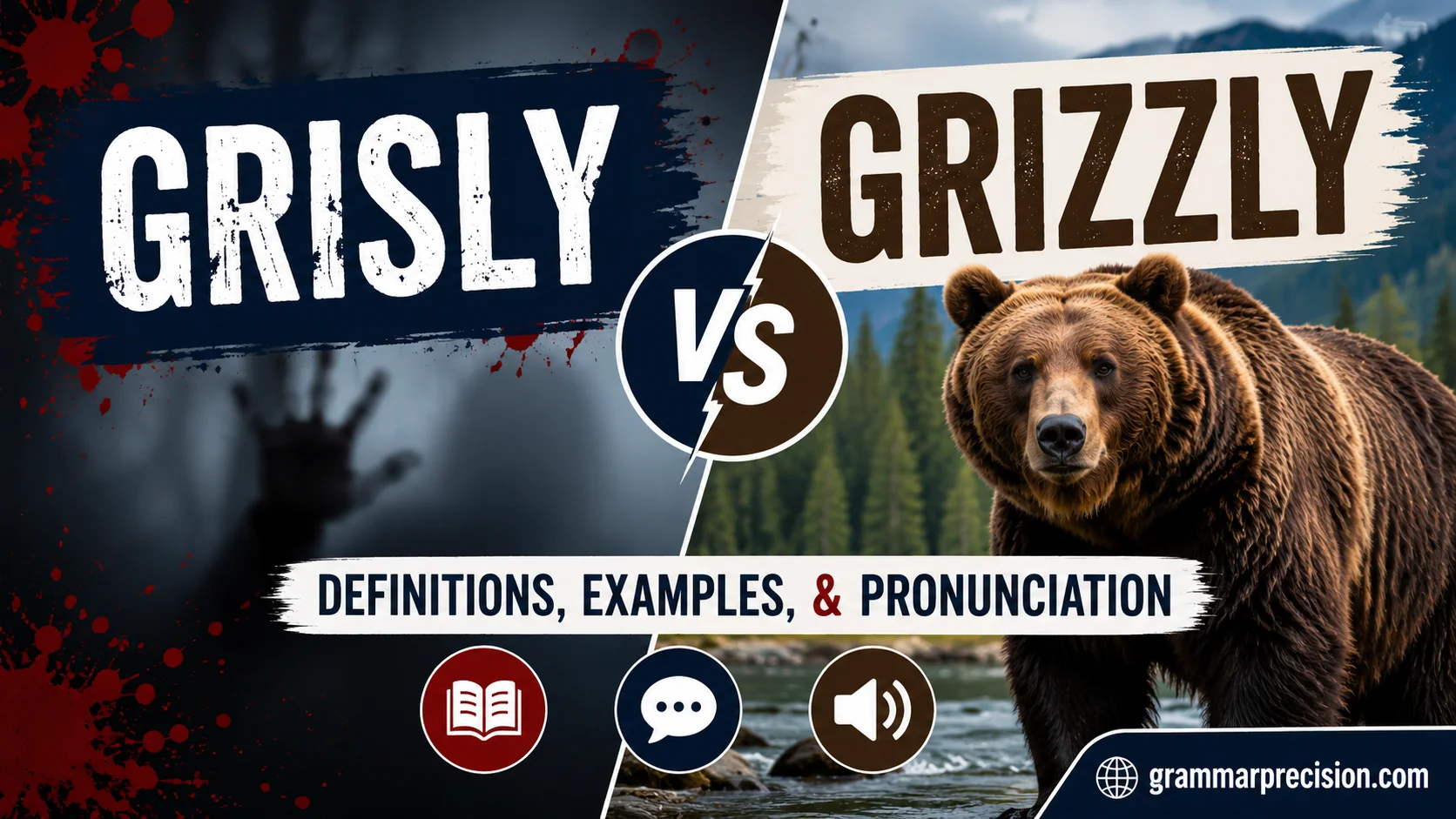
Grisly vs Grizzly can confuse English learners because these words sound similar and have similar spelling, but their meanings are completely different. Learning their distinct meanings makes choosing the correct word much easier.
Grisly describes something horrifying, shocking, or connected with death and severe injury. For example, a grisly crime may cause horror or disgust. Grizzly, however, usually refers to a grizzly bear, a large brown bear found in North America. It can also describe a grayish color.
A simple memory trick can help you remember the difference. Think of the z in grizzly as a clue for a bear, while grisly relates to something gruesome. These commonly confused words can cause mistakes in writing and speaking, but practical examples make the distinction easier to understand.
Grisly vs Grizzly at a Glance
The quickest rule is simple: grisly means horrifying or gruesome, while grizzly means gray-streaked or refers to a grizzly bear. They sound alike in standard American English, but they aren’t interchangeable.
| Word | Core meaning | Part of speech | Typical example |
| grisly | Horrifying, gruesome, or disturbing | Adjective | The investigators found a grisly scene. |
| grizzly | Gray-streaked; also a type of bear | Adjective, noun | A grizzly bear crossed the trail. |
Think of the distinction as two separate roads. Grisly leads toward horror; grizzly leads toward gray or bears. Once that mental map is clear, spelling becomes much easier.
The One-Line Rule
Use grisly when something inspires horror, fear, disgust, or revulsion. Use grizzly when you’re talking about the animal or a gray-streaked appearance.
For example:
- The newspaper described the grisly details of the murder.
- The hikers spotted a grizzly near the river.
- His grizzly beard was streaked with gray.
Notice how the surrounding noun gives you a clue. A “grisly murder” makes sense because the event is horrifying. A “grizzly bear” makes sense because the word identifies the animal.
What Does Grisly Mean?
Grisly is an adjective that describes something horrifying, gruesome, or likely to cause intense fear or disgust. It often appears when writers discuss violence, death, accidents, injuries, or disturbing discoveries.
The word doesn’t simply mean “bad” or “scary.” It usually carries a stronger emotional charge. A grisly scene suggests something unpleasant to look at or imagine, often because it involves blood, death, severe injury, or brutal circumstances.
Modern dictionaries trace grisly to Old English grislic, a word connected with fear and terror. Merriam-Webster records its first known use before the 12th century. That history fits its modern meaning remarkably well: the word has long been tied to things that make people recoil.
Grisly Definition and Meaning
In everyday English, grisly can mean:
- Inspiring horror or intense fear
- Causing disgust or strong distaste
- Horrifying because of violence, death, or disturbing details
It commonly modifies nouns rather than standing alone.
Consider these examples:
- The detective described a grisly murder.
- The documentary showed the grisly aftermath of the accident.
- Investigators made a grisly discovery inside the abandoned building.
- The novel contains several grisly descriptions of battle.
- The witness remembered the grisly scene for years.
The word often appears in journalism, crime writing, horror fiction, historical accounts, and serious descriptions of disasters. It can also appear figuratively when something feels especially unpleasant or disturbing.
Grisly Synonyms
Several words overlap with grisly, although each has its own shade of meaning.
| Synonym | Main shade of meaning |
| gruesome | Extremely unpleasant or horrifying, especially visually |
| horrific | Extremely shocking, terrible, or frightening |
| ghastly | Terrifying, shocking, or corpse-like |
| macabre | Focused on death and the disturbing side of mortality |
| shocking | Surprising or disturbing without necessarily involving violence |
| lurid | Sensational, vivid, and often deliberately shocking |
For instance, grisly and gruesome often overlap closely. A grisly murder is usually a gruesome murder. However, grisly tends to emphasize the horror or disturbing nature of what happened.
Grisly Example Sentences
Context makes the meaning much easier to recognize.
- The hikers stumbled upon a grisly discovery in the woods.
- The reporter avoided describing the grisly details.
- Police investigated the grisly murder throughout the night.
- The museum displayed artifacts from a particularly grisly battle.
- The accident left behind a grisly scene.
- The horror writer is famous for creating grisly scenes.
- The old newspaper contained a grisly account of the disaster.
A useful test is to replace grisly with gruesome. If the sentence still makes sense, grisly is probably the correct spelling.
For example, “The investigators found a gruesome scene” works naturally. “The hikers saw a gruesome bear” changes the meaning entirely. You probably mean grizzly bear.
What Does Grizzly Mean?
Grizzly has two closely related modern uses. It can describe something sprinkled or streaked with gray, and it can function as a noun referring to a grizzly bear.
The animal name comes from the color-related sense. Merriam-Webster explains that grizzly developed from Middle English grisel, meaning gray, and that the bear was named for the gray or pale tips in its brownish fur. The word’s first known use dates to 1594.
That detail is especially useful because it destroys a common misconception. The bear isn’t called a grizzly simply because it looks frightening. The name is connected to its grizzled, gray-streaked appearance.
Grizzly as a Noun
When grizzly functions as a noun, it means a grizzly bear.
Examples include:
- A grizzly appeared across the river.
- The photographer watched the grizzly from a safe distance.
- The park is home to several grizzlies.
- The hikers learned how to respond if a grizzly approached.
The plural is grizzlies, not “grizzly bears” in every context. Both forms are correct when the meaning is clear.
Grizzly as an Adjective
As an adjective, grizzly can describe something grayish or streaked with gray. It can also appear in compounds related to the animal.
Examples:
- He had a grizzly beard.
- The old sailor had grizzly hair.
- We watched a grizzly bear from a distant ridge.
- The ranger explained the behavior of the grizzly population.
This sense connects naturally with grizzled, which commonly describes hair or a person whose hair has become gray.
Grizzly Example Sentences
Here are several contexts that make the meaning obvious:
- A grizzly bear wandered through the valley.
- The wildlife guide photographed a grizzly near the stream.
- His grizzly beard made him look older than his actual age.
- The mountain ranger warned visitors about nearby grizzlies.
- Her hair had become grizzly with age.
- The documentary followed a mother grizzly and her cubs.
The context tells you whether grizzly refers to an animal or a gray-streaked appearance.
Grisly vs Grizzly: Key Differences
The spelling differs by only one letter, but the meanings diverge sharply.
| Feature | Grisly | Grizzly |
| Meaning | Horrifying, gruesome, or disturbing | Gray-streaked or related to a grizzly bear |
| Part of speech | Adjective | Noun and adjective |
| Common noun pairing | Grisly murder | Grizzly bear |
| Emotional tone | Horror, disgust, fear | Neutral when describing color; wildlife-related for the animal |
| Memory clue | Grisly = gruesome | Grizzly = gray or bear |
| Example | It was a grisly discovery. | A grizzly crossed the trail. |
Here’s the practical distinction: grisly describes what something feels like to encounter, while grizzly identifies what something is or what it looks like.
That isn’t an absolute rule for every sentence, but it works exceptionally well in ordinary writing.
Also Read This: Cleverer or More Clever? Grammar, Usage, and Examples
Grisly vs Grizzly Pronunciation
One reason these words cause so much confusion is pronunciation. In standard American English, grisly and grizzly are generally pronounced the same way: roughly “GRIZ-lee.”
That makes them homophones in common usage. Their spellings differ, yet their spoken forms can sound identical.
Because speech can’t always reveal the intended word, context becomes crucial. If someone says, “We saw a grizzly,” the listener uses context to understand that the speaker probably means a bear.
Likewise, “The article described a grisly scene” clearly points toward something horrifying.
When writing, however, you don’t get to rely on sound. You have to choose the correct spelling.
Why Are Grisly and Grizzly So Easy to Confuse?
The confusion isn’t surprising. Both words:
- Begin with griz-
- Usually sound the same
- Contain the same number of syllables
- Often appear in descriptive writing
- Have meanings that can overlap indirectly through fear
That last point makes the mix-up particularly tempting. A grizzly bear can certainly inspire fear, while a grisly scene might involve an animal attack. Still, the words developed from different roots.
Grisly comes from an Old English word associated with fear. Grizzly comes through a Middle English color word associated with gray.
In other words, the similar spelling is deceptive. English has plenty of word pairs that look like relatives but aren’t.
The History Behind Grisly and Grizzly
Word history gives this pair an especially interesting twist.
Grisly is the older word in English. Its history reaches back to Old English grislic, connected to a verb meaning to fear or shudder. Its basic emotional association with horror has therefore survived for many centuries.
Grizzly, meanwhile, comes from a different path. Its ancestor was a Middle English adjective meaning gray, derived through Anglo-French gris. The color sense eventually became associated with the grizzly bear’s distinctive coat.
So the words are linguistic look-alikes rather than true twins.
Why Is It Called a Grizzly Bear?
The answer lies in the bear’s coat. Grizzly bears typically have brownish to buff fur with silver or pale tips that can create a grizzled or gray-streaked appearance.
That color association explains why grizzly became the preferred spelling for the animal’s name. Merriam-Webster notes that the adjective meaning gray-streaked existed before the noun use for the bear. The noun later developed as a shortened form of grizzly bear.
This also explains why the supposed connection between “grizzly” and “grisly” is misleading. The bear’s name doesn’t simply mean “terrifying bear.”
Grisly vs Grizzly vs Gruesome
Adding gruesome to the comparison helps because writers often use these words in the same contexts.
Grisly and gruesome are close synonyms. Both can describe something horrifying, especially when violence or death is involved.
For example:
- The police documented the grisly scene.
- The police documented the gruesome scene.
Both sentences work.
However, grizzly doesn’t fit those sentences. It would change the meaning completely.
Compare these three:
The detective described the grisly crime scene.
The detective described the gruesome crime scene.
The detective described the grizzly crime scene.
The first two describe horror. The third sounds as though the crime scene somehow relates to a gray-streaked appearance or a bear.
That contrast is the heart of the entire distinction.
Grisly vs Grizzly in Real-World Contexts
Consider a short newsroom-style scenario. A reporter receives two unrelated stories on the same morning.
The first concerns a violent crime. The editor asks for a concise description of the grisly details without sensationalizing the event.
The second concerns wildlife. Rangers report that a grizzly bear has been spotted near a trail.
The reporter needs two different spellings because the stories involve two different meanings. The pronunciation won’t help. Context and spelling will.
This is why careful word choice matters. One extra z isn’t decorative. It changes the picture in the reader’s mind.
How to Remember Grisly vs Grizzly
Memory tricks work best when they connect spelling directly to meaning.
Grisly Means Gruesome
Both grisly and gruesome describe disturbing things. Notice the shared idea rather than trying to memorize a complicated rule.
Grisly → gruesome → horror
That three-step chain is easy to recall when you’re writing quickly.
Grizzly Means Gray or Bear
Connect the extra z in grizzly with the animal’s familiar name.
Grizzly → grizzly bear → wildlife
You can also connect grizzly with grizzled, which means streaked or mixed with gray.
Grizzly → grizzled → gray
Once those associations become automatic, the spelling choice takes almost no thought.
Common Mistakes With Grisly and Grizzly
Several errors appear repeatedly because the words sound identical.
Writing “Grizzly Details”
If you mean disturbing or horrifying details, write grisly details.
Correct: The report contained grisly details.
Incorrect: The report contained grizzly details.
Writing “Grisly Bear”
For the animal, the standard spelling is grizzly bear.
Correct: A grizzly bear crossed the road.
Incorrect: A grisly bear crossed the road.
The second sentence isn’t necessarily impossible to interpret, but it doesn’t name the animal correctly. It literally suggests that the bear itself is horrifying.
Assuming “Grizzly” Means Violent
The bear can be dangerous, but grizzly doesn’t mean violent.
Its color-related adjective sense and its animal noun developed separately from the horror meaning of grisly.
Assuming “Grisly” Describes Gray Hair
It doesn’t. For gray-streaked hair, use grizzly or more commonly grizzled, depending on the intended phrasing.
For example:
- He had grizzled hair.
- He had gray-streaked hair.
“Grisly hair” would suggest something horrifying about the hair itself.
A Quick Decision Guide
When you’re stuck, ask one question:
What exactly am I describing?
- Something horrifying or gruesome? → Grisly
- A grizzly bear? → Grizzly
- Something gray-streaked? → Grizzly
- Gray or weathered hair? → Usually grizzled
- A disturbing murder? → Grisly
- A wildlife encounter? → Grizzly
This simple decision tree handles most everyday uses.
Practice: Choose Grisly or Grizzly
Test yourself before checking the answers.
- The documentary included several ___ details about the accident.
- A ___ bear was spotted near the campsite.
- His ___ beard was almost completely gray.
- Detectives investigated the ___ murder.
- The park has a growing population of ___ bears.
Answers:
- grisly
- grizzly
- grizzly
- grisly
- grizzly
The pattern should now look obvious. Horror takes grisly. Bears and gray-streaked descriptions take grizzly.
Why This Distinction Matters in Professional Writing
Small spelling differences can create surprisingly large meaning problems. In journalism, academic writing, fiction, and everyday communication, readers depend on context to understand precise word choice.
A sentence such as “the grizzly evidence” can confuse readers because it doesn’t immediately communicate the intended idea. If the evidence is horrifying, grisly evidence may be clearer. If the subject involves a bear, grizzly is the natural choice.
Precision also improves credibility. When two words sound identical, correct spelling becomes the only visible signal of meaning. Choosing carefully shows that you understand not only the vocabulary but also the context surrounding it.
FAQs:
What is the difference between grisly and grizzly?
Grisly describes something horrifying, shocking, or related to death and severe injury. Grizzly usually refers to a grizzly bear, a large brown bear, or something grayish in color.
Is “grisly crime” or “grizzly crime” correct?
Grisly crime is correct when describing a horrifying or disturbing crime. Grizzly crime would suggest a connection with a grizzly bear, so it usually isn’t the intended expression.
Does grizzly only refer to a bear?
No. Grizzly commonly refers to a grizzly bear, but it can also describe something grayish or somewhat gray in color.
What does grisly mean?
Grisly means horrifying, gruesome, or disturbing, especially when something involves death, violence, or severe injury. It often describes unpleasant or shocking events.
What is an easy way to remember grisly and grizzly?
Remember that grizzly contains a z, which you can associate with a grizzly bear. Grisly relates to something gruesome or horrifying. This simple memory trick can prevent common spelling mistakes.
Conclusion:
Understanding grisly vs grizzly becomes simple once you learn their different meanings. Grisly describes something horrifying or gruesome, while grizzly usually refers to a bear or a grayish color. Although these words sound similar, they have different uses. Remember the z in grizzly as a clue for the bear, and you’ll avoid common mistakes in everyday English writing and speaking.