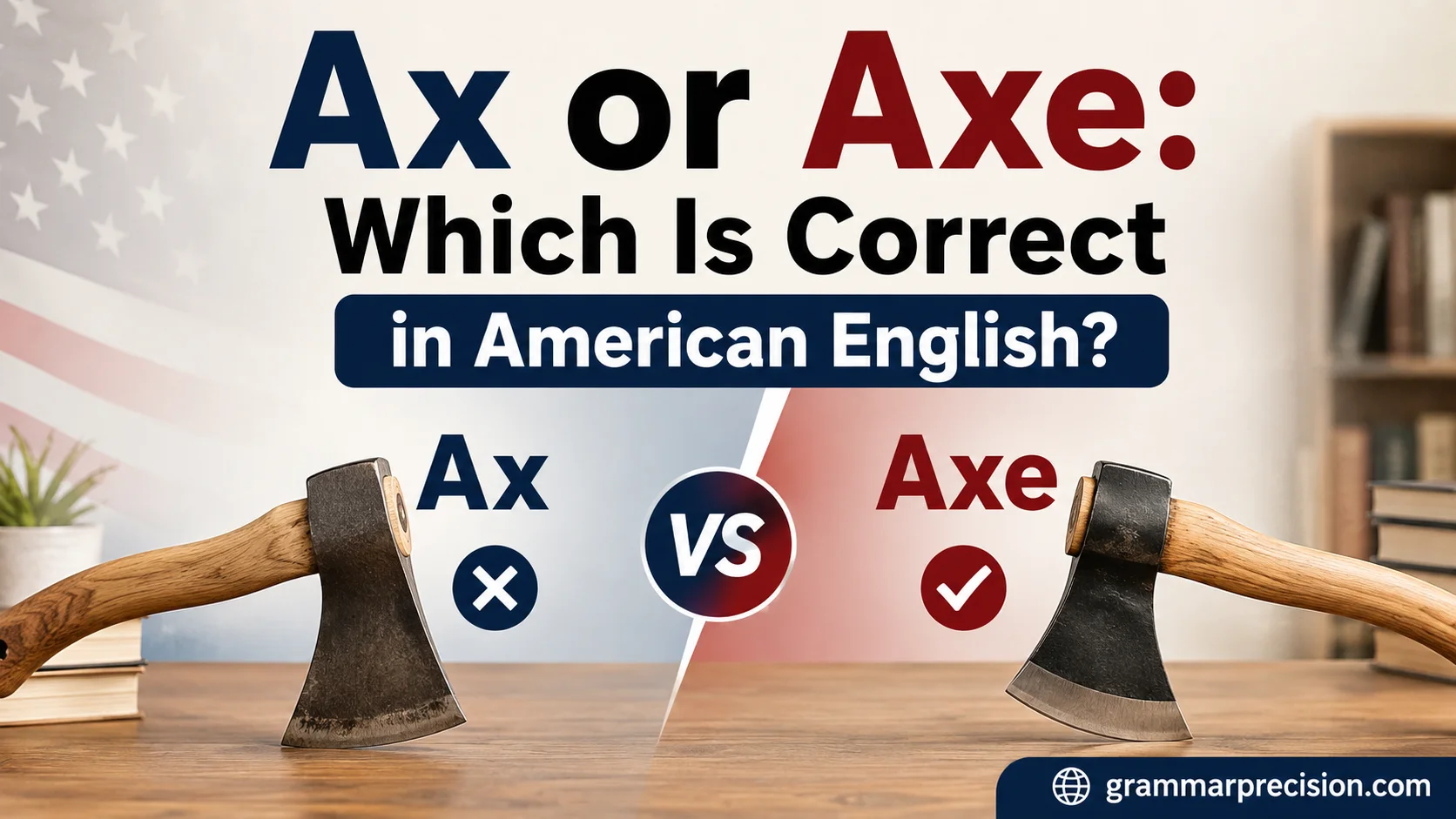
Ax or Axe are different spellings of the same word, with the same meaning and pronunciation. The main difference is which spelling is preferred in American English or British English.
An axe can mean a cutting tool, long-handled tool, or hammer with a sharp edge for dressing or spalling stone. It can also describe musical instruments, especially guitars and saxophones. As a verb, axe means abrupt removal, as in get the axe, meaning dismissal from a job.
Your choice depends on where you live and the style guidelines you follow. American English generally prefers ax, while British English primarily uses axe. This simple principle shows how English varieties can use different spellings without changing meaning. In formal writing, choose the form preferred by your audience.
Ax or Axe: Which One Is Correct?
Both ax and axe are correct spellings.
The two words have the same basic meanings and normally share the same pronunciation. The difference primarily reflects regional spelling conventions and usage preferences.
| Spelling | Common usage | Meaning |
| Ax | American English | A cutting tool; also a verb meaning to cut or eliminate |
| Axe | British English and many other varieties | A cutting tool; also a verb meaning to cut or eliminate |
For example:
- He picked up an ax and chopped the wood.
- He picked up an axe and chopped the wood.
- The company decided to ax several positions.
- The company decided to axe several positions.
Notice something important: changing ax to axe doesn’t change the meaning.
This isn’t a case like desert and dessert, where two spellings or forms represent different words. Instead, ax and axe are spelling variants of the same word.
Is “Ax” Correct in American English?
Yes. Ax is a fully established English word, not an abbreviation or informal shortcut.
American dictionaries commonly list ax as a noun and verb. The spelling fits a broader tendency in American English toward shorter forms in some words.
For US readers, therefore, ax is usually the most natural choice.
Is “Axe” Incorrect in American English?
No.
American English recognizes axe as well. You won’t automatically make a grammatical error by using it. However, axe can look less consistent with the spelling convention many American publications prefer.
Context matters. A US writer might choose axe when quoting British material, preserving a person’s original spelling, or following a particular publication’s style.
Ax vs. Axe: What’s the Difference?
The simplest answer is that there’s usually no difference in meaning.
Both spellings can describe a handheld tool with a sharp blade attached to a handle. Traditionally, people use an ax or axe for chopping wood, cutting branches, splitting logs, and similar tasks.
Both forms can also function as verbs.
For example:
The carpenter used an ax to cut through the thick branch.
Here, ax functions as a noun.
Now consider this sentence:
The network decided to ax the television show.
Here, ax functions as a verb. It means to cancel or eliminate something.
The same sentences could use axe without changing their core meaning.
Ax and Axe Have the Same Pronunciation
In ordinary English, ax and axe are pronounced the same way.
The final e in axe doesn’t create an additional syllable. You don’t pronounce it as if the word contained a separate vowel sound.
That makes the pair especially interesting. Unlike many English spelling differences, the written forms differ while the spoken forms remain essentially identical.
Think of it as two roads leading to the same destination. The route changes, but the destination doesn’t.
Ax vs. Axe as a Noun
As a noun, ax or axe refers to a tool traditionally used for cutting wood.
A typical ax has several basic parts:
- Head: The heavy metal portion containing the cutting edge.
- Blade: The sharpened section that cuts the material.
- Handle: The part held by the user.
- Eye: The opening through which the handle passes on many traditional axes.
Different axes serve different purposes. A small hatchet, for example, works well for lighter cutting jobs. A larger felling ax is designed for cutting down trees.
Examples of Ax as a Noun
- The ax was leaning against the shed.
- He sharpened the ax before cutting the logs.
- She carried an ax into the woods.
- The old ax had a wooden handle.
- A heavy ax can require considerable strength to control.
Examples of Axe as a Noun
- The axe was designed for splitting wood.
- He stored the axe in the tool shed.
- The farmer reached for an axe.
- The old axe had a worn wooden handle.
The grammatical role remains identical in each case.
Ax vs. Axe as a Verb
The verb ax has an important meaning that extends beyond physically cutting something.
To ax something can mean to remove, cancel, eliminate, or dismiss it.
For example:
The company axed the project after costs increased.
The company didn’t literally swing a blade at the project. Instead, it eliminated the project.
The verb appears frequently in journalism, business writing, entertainment coverage, and everyday speech.
Examples include:
- The network axed the show after two seasons.
- Management axed several unnecessary expenses.
- The company axed the position during restructuring.
- The committee axed the proposal.
- The publisher axed the planned edition.
The spelling axe can carry exactly the same figurative meaning.
The network axed the program.
The network axed the program.
In American English, however, ax often looks more familiar in edited prose.
What Does “Get the Ax” Mean?
The phrase “get the ax” means to be removed, dismissed, canceled, or eliminated.
For example:
Several employees got the ax after the company reorganized.
The phrase can refer to people, projects, programs, expenses, or other things facing elimination.
You may also see:
- give someone the ax
- get the ax
- face the ax
- take an ax to something
The exact wording depends on the context.
Is Ax or Axe Preferred in American English?
If you’re writing specifically for an American audience, ax is generally the better default.
That doesn’t make axe wrong. It simply reflects the spelling preference associated with US English.
American English contains many examples of spelling choices that differ from British English. Some differences are highly visible, such as color versus colour. Others are much smaller.
Ax versus axe belongs to this broader family of regional variation.
For a US-focused grammar website, the practical recommendation is straightforward:
Choose “ax” when you want the standard American English form.
If your publication follows another regional style, match that convention instead.
Is Ax or Axe Preferred in British English?
British English generally favors axe.
You can find axe throughout British writing, including news reports, literature, business coverage, and everyday communication.
For example:
The company announced plans to axe hundreds of jobs.
British readers recognize the word immediately.
The form also appears in figurative expressions:
- axe jobs
- axe a program
- get the axe
- have an axe to grind
So if you’re writing specifically for a UK audience, axe is usually the safer and more natural choice.
What About Other English-Speaking Countries?
English doesn’t stop changing at the US and UK borders.
Canadian, Australian, and other English varieties can show mixed or regionally influenced usage. Publication styles may also differ.
That’s why a rigid rule such as “one spelling is correct and the other is wrong” misses the point.
A better approach is to ask:
Who is reading the text, and which English variety does the publication use?
That question will usually settle the choice.
Why Do Both Ax and Axe Exist?
The history of ax and axe goes back centuries.
English inherited the word from older Germanic language traditions. Historical English texts used several spelling forms, and spelling wasn’t standardized in the way modern dictionaries have made it.
That matters because modern readers sometimes assume every English spelling developed from a single fixed version. It didn’t.
Before standardized spelling became widespread, writers had considerably more freedom to represent words in different ways.
The form axe became firmly established in English. The shorter ax also survived and later became especially prominent in American English.
This history explains why neither spelling needs to be treated as a modern invention.
Why Does “Axe” Have an Extra E?
The e in axe is part of the historical spelling of the word. It doesn’t mean that axe has a different pronunciation or meaning from ax.
English contains many words whose modern spellings preserve historical patterns that aren’t obvious from pronunciation alone.
In this case, the extra letter simply remains part of one accepted spelling.
There’s no hidden grammatical distinction waiting behind that final e.
Also Read This: Grisly vs Grizzly: Definitions, Examples, & Pronunciation
Ax or Axe in Common Expressions
Several familiar expressions use this word figuratively.
Have an Ax to Grind
To have an ax to grind means to have a personal motive, grievance, or hidden interest in a matter.
For example:
The critic clearly had an ax to grind against the company.
The expression suggests that someone isn’t offering a completely neutral opinion.
The British spelling can appear as:
He seemed to have an axe to grind.
Again, the spelling changes according to regional preference.
Bury the Ax
Bury the ax means to end a disagreement and make peace.
The phrase evokes the image of putting away a weapon instead of continuing a conflict.
For example:
After years of arguing, the two families finally buried the ax.
You may also encounter bury the axe, particularly in writing that follows British conventions.
Take an Ax to Something
To take an ax to something means to make major cuts, changes, or reductions.
For example:
The editor took an ax to the bloated report.
The expression usually suggests aggressive editing or substantial elimination.
Ax or Axe: Examples in Sentences
Seeing both forms in context makes the distinction easier to remember.
| Usage | American English | British English |
| Cutting tool | He grabbed an ax. | He grabbed an axe. |
| Cutting wood | She used an ax to split the log. | She used an axe to split the log. |
| Canceling a show | The network axed the program. | The network axed the program. |
| Removing jobs | The company axed several positions. | The company axed several positions. |
| Personal grievance | He has an ax to grind. | He has an axe to grind. |
| Making major cuts | They took an ax to the budget. | They took an axe to the budget. |
The table reveals an interesting pattern: the spelling difference doesn’t necessarily affect every form equally in appearance.
When the word becomes a verb, the American form remains ax, while the British form commonly appears as axe. Past-tense forms then become axed in either convention.
Common Mistakes With Ax and Axe
The biggest mistake isn’t choosing the “wrong” spelling. It’s misunderstanding regional consistency.
Here are a few problems worth avoiding.
Mistake: Assuming “Axe” Is Always Wrong
It isn’t.
Axe is an established English spelling. Calling it incorrect in every context would ignore British English and other established usage.
Mistake: Assuming “Ax” Is Informal
It isn’t merely slang or shorthand.
Ax is a legitimate dictionary spelling and has a strong place in American English.
Mistake: Thinking They Have Different Pronunciations
They generally don’t.
The additional e doesn’t create a separate pronunciation.
Mistake: Mixing Regional Styles Without a Reason
If you’re writing a US-focused article, using ax throughout creates consistency.
If you’re writing for British readers, axe usually fits better.
Consistency matters because readers quickly notice unexpected spelling changes.
Ax or Axe: A Quick Decision Guide
Still unsure which form to use? Use this simple guide.
Choose “ax” when:
- You’re writing in American English.
- Your audience mainly lives in the United States.
- Your publication follows US spelling conventions.
- You want the shorter American form.
Choose “axe” when:
- You’re writing in British English.
- Your audience mainly lives in the United Kingdom.
- Your publication follows British spelling conventions.
- You’re preserving a British source’s original spelling.
Neither choice requires an apology.
The key is matching the spelling to your audience and style guide.
Ax or Axe: Facts at a Glance
Here are the most useful facts to remember:
- Ax and axe are both correct English words.
- They generally have the same meaning.
- They normally have the same pronunciation.
- Ax is strongly associated with American English.
- Axe is strongly associated with British English.
- Both forms can function as nouns and verbs.
- The noun refers to a cutting tool.
- The verb can mean to remove, cancel, or eliminate something.
- Expressions such as “have an ax to grind” can use either spelling.
- The spelling difference does not create a difference in grammatical function.
FAQs:
Is “Ax” and “Axe” the Same Word?
Yes. Ax and axe are different spellings of the same word. They have the same basic meaning and pronunciation, although their usage can vary between American and British English.
Which Spelling Is Preferred in American English?
Ax is generally the preferred spelling in American English. You’ll often see it used for the familiar cutting tool, as well as in related expressions and meanings.
Which Spelling Is Preferred in British English?
Axe is generally more common in British English. If you’re following British spelling conventions or writing for a British audience, axe is usually the better choice.
Can “Axe” Be Used as a Verb?
Yes. Axe can work as a verb meaning to remove or dismiss something suddenly. For example, a company might axe a project, or an employee might get the axe and be dismissed from a job.
Does “Axe” Have Meanings Besides a Cutting Tool?
Yes. Axe can refer to a hammer with a sharp edge used for working with stone. Informally, axe can also describe musical instruments, particularly guitars and saxophones.
Conclusion:
Ax and axe have the same meaning and pronunciation, but their spelling preferences differ by English variety. American English generally favors ax, while British English commonly uses axe. Both forms can describe the familiar cutting tool, and axe has several additional meanings.
When writing, consider your audience and follow the appropriate style guidelines for consistent and clear usage.