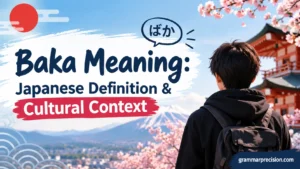
Have you ever heard someone say Baka Meaning in an anime, text, or casual conversation and wondered what it really implies? The word baka can mean “stupid,” “fool,” “silly,” or “idiot,” depending on context.
This guide explores its Japanese meaning, slang usage, pronunciation, emotional tone, cultural background, and everyday English usage. You’ll also see how context influences its interpretation in conversations, messages, and informal communication.
Beyond vocabulary, understanding baka involves grammar, consistency, regional preferences, and communication style. Unlike terms used in business communication, formal writing, meetings, scheduling, calendar management, project management, online booking, or broadcasting, baka belongs mainly to casual language.
US and UK style guides may differ in broader English usage, but the Japanese expression itself depends primarily on Japanese context. This article explains those nuances through examples, comparisons, and practical guidance so you can understand when the word sounds playful, affectionate, rude, or genuinely insulting.
What Does Baka Mean?
Baka (ばか/バカ/馬鹿) generally means foolish, stupid, silly, ridiculous, or idiot. It can describe a person, an action, an idea, or a situation. When someone says baka! directly to another person, the natural English equivalent might be “You idiot!” or “You dummy!” Yet a softer voice between close friends can make it closer to “You’re silly.”
The key point is simple: baka does not carry one fixed emotional strength. Context supplies much of its force. A friend laughing after a harmless mistake may sound playful. Someone saying the same word during a heated argument can sound genuinely insulting.
Japanese dictionaries and linguistic references also show that baka participates in many compounds and expressions. It can describe foolishness, contempt, excessive behavior, or something taken to an unusual degree.
Baka Meaning in Japanese: A Quick Guide
| Form | Meaning or role | Typical use |
| ばか | Baka in hiragana | Casual writing |
| バカ | Baka in katakana | Emphasis, casual writing, pop culture |
| 馬鹿 | Baka in kanji | Standard written representation |
| バカな | Foolish / stupid | Before a noun or in an exclamation |
| バカにする | To make fun of / treat with contempt | Negative expression |
| 大馬鹿 | Big fool / complete idiot | Stronger expression |
| バカ野郎 | Idiot / jerk | Harsh insult |
The spelling can affect presentation, especially online. However, spelling alone does not determine whether the word sounds affectionate or hostile. Tone and context remain crucial.
How Do You Pronounce Baka?
The word has two syllables: ba-ka. The vowels are short and clear, unlike some English pronunciations that stretch the first vowel.
For learners, pronunciation matters because Japanese rhythm differs from English stress patterns. Japanese speakers generally give each mora a relatively even timing pattern, although pitch accent can still shape how a word sounds. A Tokyo pronunciation of baka is commonly described with a falling pitch pattern after the first mora.
If you’re learning Japanese, don’t turn baka into a dramatic anime catchphrase every time you practice it. Real conversation usually sounds more restrained than entertainment dialogue.
What Is the Origin of Baka?
The origin of baka remains debated, which makes confident one-story explanations misleading. Several etymological theories exist, including connections to Sanskrit terms associated with foolishness or ignorance and older Japanese vocabulary.
The familiar kanji 馬鹿 literally contain the characters for “horse” and “deer.” However, those characters function as ateji, meaning they were used to represent a word’s sound rather than simply combining their literal meanings into the modern definition. Some traditions connect the characters with the Chinese story of “calling a deer a horse,” but that story should not be presented as the proven origin of the Japanese word.
One useful historical fact is that written examples of baka are old. References to bakamono (馬鹿者) appear in the medieval Japanese tradition, showing that the word has a long history rather than being a modern anime invention.
The “Horse and Deer” Story
The story behind the characters is memorable. A powerful official in ancient China supposedly presented a deer while insisting that it was a horse. The episode became associated with deliberately distorting reality and testing people’s willingness to follow authority.
Because 馬鹿 contains “horse” and “deer,” modern explanations sometimes connect the Japanese spelling directly to this tale. The connection is culturally interesting, but etymologists disagree about whether the story actually explains the word’s origin. Treat it as an associated explanation, not settled historical fact.
Is Baka a Bad Word?
Baka is an insult, but it isn’t automatically obscene or maximally offensive. Its effect depends heavily on who says it, who hears it, and why they say it.
Calling a close friend baka after they forget something minor can sound teasing. Calling a stranger, teacher, manager, customer, or other superior baka can be disrespectful and socially risky.
A useful rule for learners is this:
- Close friends: potentially playful
- Family: depends on relationship and tone
- Romantic partners: can be teasing or affectionate
- Strangers: usually avoid it
- Teachers or supervisors: avoid it
- Professional settings: generally inappropriate
- Arguments: potentially harsh
The safest interpretation isn’t “baka is always harmless” or “baka is always extremely offensive.” Neither captures real usage.
Baka Meaning Changes With Emotion
Imagine two people watching a friend make an obvious mistake. One laughs and says baka. Another person angrily says the same word after an argument. The dictionary meaning barely changes. The emotional message does.
Playful Baka
Among close friends, baka can function like “silly,” “dummy,” or “you fool.” The speaker may not intend serious criticism.
For example, a friend might tease someone who leaves their phone at home. The word becomes part of the joke rather than a serious attack.
Angry Baka
During conflict, baka can become much sharper. A clipped delivery, raised voice, or hostile facial expression can turn a familiar insult into direct contempt.
This is why translating every baka! as “silly” can be dangerously inaccurate.
Affectionate Baka
Japanese speakers can use insulting vocabulary affectionately when the relationship supports it. Romantic teasing sometimes creates this effect, especially in fictional dialogue.
However, learners shouldn’t assume that saying baka automatically sounds cute or romantic. The relationship creates the affectionate reading. The word itself doesn’t guarantee one.
Baka as an Adjective-Like Expression
One reason baka can confuse English speakers is that Japanese grammar lets it work in several patterns.
Baka na + Noun
Baka na can modify a noun and express something like “stupid,” “foolish,” or “ridiculous.”
Examples include:
- baka na koto — a stupid thing
- baka na hito — a foolish person
- baka na shitsumon — a stupid question
- baka na yume — a foolish dream
The exact English translation depends on the noun and situation. Japanese grammar often requires a な when this type of adjective modifies a noun.
Baka ni suru
The expression baka ni suru means to make fun of someone, treat someone lightly, or hold someone in contempt. It doesn’t simply mean “say baka.”
That distinction matters. A learner who memorizes individual words without learning expressions can easily produce unnatural Japanese.
Baka-rashii
Baka-rashii can describe something as ridiculous, absurd, foolish, or not worth taking seriously. Again, the surrounding context determines the most natural English translation.
Popular Baka Expressions
| Japanese expression | Natural meaning | Tone |
| バカ! | You idiot! / Dummy! | Highly context-dependent |
| バカな! | No way! / Impossible! | Shock or disbelief |
| バカなこと | Something foolish | Critical or dismissive |
| バカにする | Make fun of / belittle | Negative |
| 大馬鹿 | Complete fool | Strong |
| 馬鹿者 | Fool / stupid person | Formal-ish or dramatic |
| 馬鹿野郎 | Idiot / jerk | Harsh |
Notice that translation isn’t mechanical. A phrase can shift from “idiot” to “ridiculous” depending on what the speaker reacts to.
Baka in Anime and Manga
Anime made baka internationally recognizable. Characters shout it during arguments, romantic misunderstandings, comic scenes, and exaggerated emotional moments.
That visibility creates a trap for learners. Anime dialogue is scripted entertainment, not a complete model of ordinary Japanese conversation.
A character might yell baka! dramatically because the scene needs emotional energy. In real life, a speaker may use a quieter expression, different wording, or no insult at all.
Why Anime Uses Baka So Often
The word works extremely well in fiction because it communicates emotion quickly. One short expression can signal embarrassment, frustration, disbelief, affection, or anger.
Subtitles also create another layer. Translators choose English words that fit the scene rather than translating every occurrence identically. One baka might become “idiot,” while another becomes “stupid,” “dummy,” or “fool.”
The Tsundere Connection
Western anime fandom often associates baka with tsundere characters, whose dialogue swings between apparent hostility and emotional vulnerability.
That association is real within popular media, but it shouldn’t redefine the Japanese word itself. A tsundere character saying baka is a fictional characterization choice. Ordinary speakers aren’t automatically expressing romantic affection when they use the word.
Baka in Texting and Internet Culture
Written communication removes many vocal clues. That’s why punctuation, emojis, surrounding words, and relationship can influence how baka feels in a message.
Consider these broad possibilities:
- “バカ!” — potentially angry or emphatic
- “ばか😂” — potentially playful
- “ばか…” — may suggest embarrassment, disappointment, or hesitation
- “BAKA” — visually emphatic in casual online writing
These examples aren’t rigid rules. Digital language evolves quickly, and individual relationships create their own shorthand.
Japanese internet culture has also contributed to the word’s international spread. English-speaking fandom communities sometimes use baka as a deliberately playful Japanese-flavored insult. That fandom usage can differ substantially from natural Japanese conversation.
Baka vs. Aho: What’s the Difference?
Aho (アホ/あほ/阿呆) also means foolish, stupid, idiot, or silly. The two words overlap, but regional usage gives them different social flavors.
Baka is widely used across Japan and is strongly associated with eastern Japan, including the Kanto region. Aho is especially associated with western Japan and Kansai. In broad terms, speakers in Kanto may find baka more ordinary while aho can sound stronger. In Kansai, the pattern can reverse.
| Feature | Baka | Aho |
| Core meaning | Foolish / stupid | Foolish / stupid |
| Common association | Kanto / eastern Japan | Kansai / western Japan |
| Regional strength | Context-dependent | Context-dependent |
| Can be playful? | Yes | Yes |
| Fully interchangeable? | No | No |
The important lesson is don’t create a nationwide strength ranking. Regional speech habits matter, and fixed expressions may use one word rather than the other. For example, ahoge is established, while replacing aho with baka doesn’t automatically create a natural equivalent.
Also Read This: Thot Meaning: Examples & Modern Usage
Baka vs. English Words
English has several useful translations for baka, but none works everywhere.
| Baka context | Possible English equivalent |
| Mild teasing | Silly |
| Friendly joke | Dummy |
| Direct insult | Idiot |
| Criticism | Stupid |
| Serious contempt | Fool / jerk |
| Reaction to absurdity | Ridiculous |
| Fictional dramatic dialogue | You idiot! |
This table highlights an important translation principle: translate the situation, not just the dictionary entry.
How to Use Baka Naturally
If you’re learning Japanese, restraint is your friend. You don’t need to avoid the word forever. You simply need to understand its social weight.
Before using it, consider:
- Who are you talking to?
- How close are you?
- What happened?
- What tone are you using?
- Which region’s speech are you hearing?
- Are you speaking casually or formally?
A beginner copying an anime character can accidentally sound theatrical. That’s especially likely when the learner repeats exaggerated phrases without understanding their register.
Common Mistakes About Baka
“Baka Always Means Idiot”
Not exactly. Depending on context, it can mean silly, foolish, ridiculous, dummy, or stupid.
“Baka Is Always Offensive”
Not necessarily. Close relationships can soften the word considerably. Still, learners shouldn’t assume friendliness without clear context.
“Baka Is an Anime Word”
No. Anime popularized it internationally, but baka is a real Japanese word with a long history.
“Baka Always Comes From the Horse-and-Deer Story”
That claim is too certain. The spelling has a connection to the characters for horse and deer, but the word’s deeper etymology remains disputed.
“Baka and Aho Are Exactly the Same”
They overlap semantically, but regional usage, emotional force, and fixed expressions can differ.
A Practical Case Study: One Word, Three Situations
Imagine a student named Ken forgets his umbrella.
Situation one: Close friend
His friend laughs and says baka. Everyone smiles. Here, “dummy” or “silly” might capture the feeling.
Situation two: Heated argument
Someone angrily calls Ken baka. Now the same word carries direct contempt. “Idiot” becomes a more fitting translation.
Situation three: Anime scene
A character shouts baka! after an emotional misunderstanding. The subtitle might say “You idiot!” even though the Japanese word itself hasn’t changed.
The lexical item stays the same, but the pragmatic meaning shifts. That’s the heart of understanding baka.
Baka and Social Context: What Learners Should Notice
Language learners often memorize vocabulary while overlooking pragmatics, the way context shapes meaning. Baka is an excellent example. You can know the dictionary definition and still misunderstand the speaker.
Watch for these signals:
- Tone: A warm voice can soften the word.
- Facial expression: A smile may suggest teasing rather than hostility.
- Relationship: Close friends have more freedom with insults.
- Register: Casual language can sound inappropriate at work.
- Region: Kanto and Kansai speakers may attach different emotional values to related insults.
- Surrounding words: Nearby expressions can clarify what the speaker actually means.
For Japanese learners, the best approach is to observe complete sentences and situations. Notice who speaks, who listens, what happened, and how the listener reacts. Those details often reveal more than the word itself.
A Simple Learner Safety Rule
When you’re unsure, don’t use baka toward someone you don’t know well. You can understand the expression long before you need to produce it. That distinction helps you learn Japanese without creating an awkward social moment.
FAQs About Baka Meaning
What does baka mean in Japanese?
Baka usually means foolish, stupid, silly, idiot, or fool. The best English translation depends on the speaker’s tone, relationship with the listener, and situation.
Is baka a swear word?
Baka functions as an insult, but it isn’t best understood as an obscene swear word. Its seriousness varies considerably with context and social relationship.
Is baka rude?
It can be. Calling strangers, superiors, teachers, or coworkers baka can sound disrespectful. Among close friends, however, it may function as playful teasing.
Why do anime characters say baka?
Anime uses baka because it efficiently expresses frustration, embarrassment, disbelief, teasing, or anger. Fiction often exaggerates its delivery for dramatic or comedic effect.
What is the difference between baka and aho?
Both can mean stupid, foolish, idiot, or silly, but regional usage differs. Baka is strongly associated with eastern Japan, while aho is particularly common in Kansai and western Japan.
Conclusion:
Understanding baka meaning requires more than memorizing “stupid.” The Japanese word can express foolishness, teasing, irritation, disbelief, or affection depending on tone, relationship, region, grammar, and context.
Its long history and widespread use also explain why anime represents only one small part of its identity. Learn the surrounding expression, watch the social setting, and translate the feeling rather than forcing one English equivalent.