Have you ever heard someone use the word bookend and wondered what it means beyond holding books in place? The bookend meaning can vary depending on the context, from organizing books on a shelf to describing the beginning and ending of an event. In everyday English usage, this word also appears in business communication, broadcasting, meetings, and formal writing. Understanding its different meanings helps you communicate clearly and choose the right expression for each situation.
In this guide, you’ll discover how people use bookend as a noun, verb, and figurative expression. We’ll explore practical examples related to scheduling, time management, online booking, calendar management, and project management. You’ll also learn how bookending ideas can improve structure and consistency in your writing and conversations. Although American and British English generally use the word similarly, individual style guides may recommend different approaches depending on context. By the end, you’ll understand the word’s common meanings, grammatical role, and natural usage in everyday and professional settings.
What Does Bookend Mean?
Bookend means an object that supports books on a shelf or something that marks, frames, or connects the beginning and ending of an event, period, or experience.
The word has two main grammatical uses:
- Noun: An object that holds books in place at the end of a row.
- Verb: To mark or frame something at both ends, often with related events or experiences.
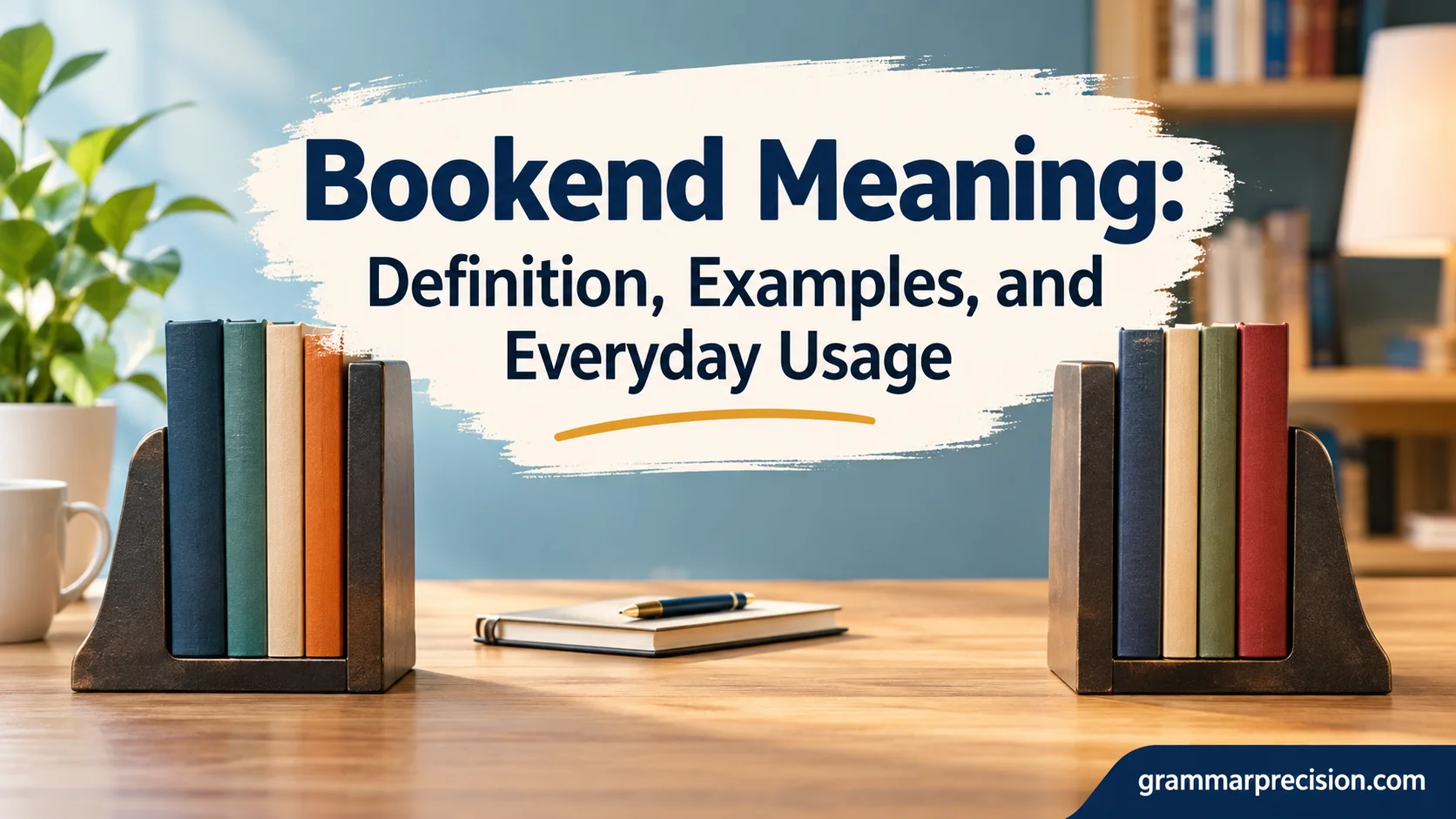
For example, consider a bookshelf with several novels arranged between two metal supports. Those supports are bookends because they prevent the books from falling over.
Now imagine attending a conference that begins with an inspiring keynote speech and ends with a similar speech from the same speaker. You could say that the two speeches bookended the conference.
Although these examples describe different situations, they share one central idea: something establishes or frames the boundaries of another thing.
Bookend Meaning in Simple Words
In simple terms, a bookend is something that holds books together or marks the two ends of an experience.
Here are a few easy examples:
- Literal: Two wooden bookends keep my cookbooks organized.
- Figurative: A family reunion and a farewell dinner bookended her vacation.
- Professional: Opening remarks and closing reflections bookended the meeting.
- Literary: The novel begins and ends with the same childhood memory, creating a bookend effect.
The meaning becomes clearer when you look at the surrounding sentence. If someone discusses furniture, the word probably refers to a physical object. If they discuss events or storytelling, it likely has a figurative meaning.
What Is a Bookend in Everyday Life?
10
Physical bookends are practical accessories designed to keep books upright, neat, and accessible. You usually place them at the left and right ends of a row of books.
Unlike built-in shelves or cabinets, ordinary bookends don’t require permanent installation. You can move them whenever you rearrange your collection.
Common Types of Physical Bookends
Bookends come in many styles, materials, and sizes. Their main purpose remains the same, although their appearance and stability can differ.
| Type | Common materials | Typical use |
| Wooden bookends | Oak, pine, bamboo | Home libraries and living rooms |
| Metal bookends | Steel, iron, aluminum | Offices and heavy books |
| Decorative bookends | Ceramic, stone, resin | Display shelves and gifts |
| Adjustable bookends | Metal or plastic | Desks and changing collections |
| Heavy bookends | Marble, concrete, cast iron | Large books and thick volumes |
A good bookend needs enough weight or shelf grip to resist the sideways pressure of leaning books. Lightweight supports may work for paperbacks but struggle with heavy textbooks.
Bookends also serve a decorative purpose. A pair shaped like animals, geometric figures, or architectural columns can turn an ordinary shelf into an attractive display.
Examples of Bookends in Real Life
You might encounter physical bookends in several places:
- A student uses metal bookends to organize textbooks on a desk.
- A librarian separates reference books from other materials.
- A homeowner displays matching stone bookends beside a collection of novels.
- An office worker keeps manuals upright using adjustable supports.
These examples demonstrate the literal meaning. However, the word becomes more interesting when people apply the same idea to events and experiences.
What Does Bookend Mean as a Verb?
When you use bookend as a verb, you describe how something marks, frames, or connects the two ends of another thing. The word often suggests that the beginning and ending share a meaningful relationship.
For example:
Two family celebrations bookended the summer vacation.
This sentence tells you that one celebration happened near the beginning and another occurred near the end. Together, they frame the vacation.
The verb often takes a direct object, which identifies the thing being framed.
Common sentence pattern:
Subject + bookend + object
Examples:
- Two major victories bookended the season.
- A welcome speech and a farewell toast bookended the event.
- Childhood memories bookend the memoir.
- Two important discoveries bookended her scientific career.
The word also appears in past-tense constructions. You might write, “The tournament was bookended by opening and closing ceremonies.”
How to Use Bookend in Different Tenses
The verb follows ordinary English conjugation rules.
| Tense or form | Example |
| Present | Two ceremonies bookend the festival. |
| Third-person singular | A celebration bookends the annual event. |
| Past | Two celebrations bookended the trip. |
| Present participle | The team is bookending the program with speeches. |
| Past participle | The conference was bookended by keynote presentations. |
| Future | Two performances will bookend the season. |
Notice the difference between bookend and bookended. Use bookend for the base form or present tense with plural subjects. Use bookended when describing completed actions or forming a passive construction.
What Does Bookend Mean Figuratively?
The figurative meaning of bookend describes two moments, events, objects, or experiences that frame a larger whole. Sometimes the two ends resemble each other. In other cases, they simply mark the beginning and ending.
Imagine starting your first day at a company with an introductory meeting and finishing your final day with a farewell gathering. Those events bookend your time at the company.
The metaphor works because physical bookends stand at opposite ends of a row of books. Figurative bookends perform a similar role in time, stories, and experiences.
Why Do People Use Bookend as a Metaphor?
The word communicates more than the idea of something happening first and something happening last. It can suggest connection, structure, contrast, or closure.
Consider these examples:
- Connection: A couple celebrates their engagement and anniversary at the same restaurant.
- Structure: Opening remarks and closing remarks frame a business conference.
- Contrast: A character begins a story full of fear and ends it with confidence.
- Closure: A memoir opens and closes with memories of the author’s childhood home.
Not every pair of events needs to be identical. The important point is that they frame the larger experience in a meaningful way.
For example, a graduation ceremony and a retirement party could bookend someone’s teaching career. These events differ, but they mark opposite ends of a professional journey.
What Does “Bookended By” Mean?
The phrase bookended by identifies the events or things that appear at the beginning and ending of something.
Examples include:
- The weekend was bookended by family dinners.
- Her career was bookended by two groundbreaking discoveries.
- The movie was bookended by scenes from the main character’s childhood.
- The conference was bookended by speeches from industry leaders.
In these sentences, the phrase helps readers understand what frames the central experience.
You can also use it to describe contrasting events. For instance, a difficult medical diagnosis and a celebration of recovery might bookend a person’s long journey toward better health.
The phrase doesn’t automatically mean that the events happened close together. They might occur months or years apart, depending on the period being described.
Bookend Meaning in Different Contexts
The word appears in several areas of life. Its central meaning stays consistent, but the details change according to the situation.
Bookend Meaning in Writing and Literature
Writers sometimes use bookending to give a story a clear structure. They may begin and end with the same setting, image, object, conversation, or memory.
For example, a novel might open with a child standing beside a river. In the final chapter, the now-grown character returns to that river with their own child.
The repeated setting creates a connection between the opening and closing scenes. Readers can recognize how the character has changed, even though the location remains the same.
Writers use this technique to:
- Create a satisfying sense of closure.
- Highlight character development.
- Reinforce a central theme.
- Connect the beginning with the ending.
- Give readers a reason to reconsider an earlier scene.
However, bookending doesn’t require an exact repetition. A story can return to a similar situation while changing its emotional meaning.
Bookend Meaning in Movies and Storytelling
In film and television, bookending often involves scenes that mirror each other. A director might repeat a camera angle, line of dialogue, or visual image at both ends of a movie.
Imagine a film that opens with its main character walking alone through a crowded train station. At the end, the character returns to the same station but happily reunites with a loved one.
The location remains unchanged, yet the character’s circumstances have transformed. This contrast gives the ending emotional weight.
Bookending can also appear in documentaries, television episodes, podcasts, and stage performances. A host might introduce a question at the beginning and revisit it at the end.
The technique helps an audience feel that the presentation has come full circle.
Bookend Meaning in Business and Presentations
In professional settings, bookending can help you organize meetings, presentations, workshops, and reports.
For example, you might begin a presentation by explaining a company’s biggest customer challenge. After presenting research and possible solutions, you return to that same challenge in your closing remarks.
This structure reminds your audience why the information matters.
Useful examples include:
- Opening and closing a meeting with the same project objective.
- Beginning and ending a workshop with reflections from participants.
- Framing a report with a business problem and its final solution.
- Starting and finishing a training session with the same key question.
The benefit is clarity. When you connect the opening and ending, your audience can more easily recognize the main message.
However, avoid repeating entire sections without a purpose. Effective bookending reinforces an idea while adding something meaningful at the end.
Bookend Meaning in Personal Experiences
People also use bookend to describe major life experiences. These might include relationships, education, travel, career changes, or personal achievements.
For example, a student might begin college by meeting a close friend during orientation and finish the experience by attending that friend’s graduation celebration.
Similarly, two family gatherings might frame a memorable holiday trip.
These situations illustrate how bookending can describe a period of time rather than a physical object. The beginning and ending provide a natural frame for everything that happened between them.
How to Use Bookend in a Sentence
The easiest way to understand a word is to see how people use it naturally. Bookend works in everyday conversations, professional communication, academic writing, and creative storytelling.
Here are examples that show its different meanings.
Simple Bookend Sentence Examples
- These wooden bookends keep my favorite novels organized.
- Two birthday parties bookended the family vacation.
- A welcome speech and a thank-you message bookended the ceremony.
- The documentary begins and ends with the same interview.
- Her first and last performances bookended an impressive theater career.
- The course was bookended by introductory and final assessments.
- Two historic elections bookended the decade.
- Morning coffee and an evening walk bookend his daily routine.
Each sentence uses the word to describe either physical supports or two things that frame a larger whole.
Bookend Examples in Formal Writing
In formal writing, bookend can express complex relationships without requiring a long explanation.
Consider these examples:
Academic writing: “The study’s initial hypothesis and final conclusion bookended a comprehensive investigation.”
Business writing: “The quarterly review was bookended by discussions of revenue growth and customer retention.”
Journalism: “Two historic court decisions bookended a period of significant legal change.”
Literary analysis: “The opening and closing chapters bookend the novel through repeated images of loss and renewal.”
These examples work because the surrounding details explain what the word connects.
A Short Dialogue Using Bookend
Alex: How did the conference feel so organized?
Jordan: The organizers bookended it with a welcome address and a closing discussion.
Alex: So the beginning and ending followed the same theme?
Jordan: Exactly. The final discussion returned to the main question raised at the start.
This conversation demonstrates how bookend can describe a deliberate structure in ordinary speech.
Bookend vs. Beginning and Ending: What’s the Difference?
The expressions bookend and beginning and ending share a basic idea, but they don’t always communicate the same thing.
Beginning and ending simply identify the first and final parts of something. Bookend often emphasizes how those parts frame the middle or connect with each other.
| Expression | Meaning | Example |
| Beginning and ending | The first and last parts of something | We discussed the beginning and ending of the story. |
| Bookend | To frame something at both ends | Two memories bookend the story. |
| Start and finish | The points where an activity begins and ends | The race starts and finishes downtown. |
| Frame | To surround or provide a structure | Personal stories frame the presentation. |
| Bracket | To mark or enclose a period or section | Two holidays bracket the school break. |
Suppose a documentary opens with a family photograph and ends with the same photograph. Saying that the scenes bookend the documentary emphasizes their relationship.
By contrast, saying that the documentary has a beginning and an ending tells readers only that it has two basic parts.
This distinction makes bookend especially useful when you want to highlight structure or meaning.
Bookend Synonyms and Related Expressions
Several words share aspects of the meaning of bookend. However, their meanings differ slightly, so choose the term that best fits your sentence.
| Word or expression | Meaning | Example |
| Frame | To surround or provide a structure | Two interviews frame the documentary. |
| Bracket | To mark the boundaries of something | Two celebrations bracket the holiday season. |
| Enclose | To surround something completely or partially | A fence encloses the garden. |
| Surround | To be positioned around something | Tall trees surround the house. |
| Bound | To mark or limit an area or period | Two major events bound the historical period. |
| Open and close | To begin and end something | Two speeches open and close the ceremony. |
| Anchor | To provide stability or a central point | A strong introduction anchors the presentation. |
Frame is a useful alternative when discussing a story or presentation. Bracket works well when you want to emphasize the boundaries of a period. Anchor usually emphasizes stability or importance rather than two opposite ends.
Remember that these words aren’t always interchangeable. Choose a synonym that preserves the intended meaning.
Bookend vs. Frame vs. Bracket
These three terms can overlap, especially in writing and professional communication. Still, each word has its own emphasis.
Bookend vs. Frame
To bookend something usually means to mark both ends. To frame something can mean to surround it, introduce it, or shape how people understand it.
For example:
- “Two speeches bookended the conference.”
- “The opening speech framed the conference’s main theme.”
The first sentence identifies two events at opposite ends. The second explains how one speech shaped the audience’s understanding.
Bookend vs. Bracket
To bracket a period means to mark its boundaries or set it apart. To bookend something often adds a sense of connection between the beginning and ending.
For example:
- “Two elections bracketed the period.”
- “Two historic elections bookended her political career.”
Both sentences can be correct. The second places more emphasis on how the elections frame the person’s career.
Bookend vs. Callback
A callback occurs when a story refers to an earlier joke, phrase, detail, or event. Bookending involves the structure at the beginning and end.
A story might include a callback in its middle section without bookending the entire story. Conversely, two scenes can bookend a movie without repeating a specific joke.
Understanding these differences helps you describe storytelling techniques accurately.
Common Mistakes to Avoid When Using Bookend
Although bookend is easy to understand, a few mistakes can make your writing confusing. Pay attention to its grammatical role and the relationship between the events you’re describing.
Confusing the Noun and Verb
A bookend is a physical object when you use the word as a noun. When you use it as a verb, it describes an action or relationship.
- Correct noun: The bookends match the color of my bookshelf.
- Correct verb: Two ceremonies bookend the celebration.
- Incorrect usage: I bought two bookend for my books.
The last sentence needs the plural noun bookends because it refers to two objects.
Assuming Bookending Requires Identical Events
Bookending doesn’t always involve repetition. Two different events can frame the same experience.
For example, a graduation ceremony and a retirement celebration might bookend a person’s career in education. The events differ, but they mark its beginning and end.
Using Bookend Without Clear Context
Readers should understand what the word connects. A sentence such as “The events bookended everything” doesn’t provide much useful information.
Instead, write, “Two family reunions bookended her year abroad.”
The revised sentence identifies the events and explains the period they frame.
Confusing Bookend With a Simple Ending
An ending marks the conclusion of something. Bookending describes how something frames both ends.
A farewell speech might end a conference, but it doesn’t bookend the conference by itself. An opening address and a farewell speech together could bookend it.
A Practical Example: Bookending a Business Conference
Imagine a company hosting a one-day conference about customer service. The organizers want attendees to remember three main lessons.
They begin with a customer describing a frustrating experience. Throughout the day, speakers discuss communication, problem-solving, and service quality. At the end, the same customer returns to explain how better service changed the experience.
The opening and closing presentations bookend the conference because they connect the day’s lessons through one customer’s story.
This approach offers three benefits:
- Consistency: The audience encounters the same central issue at both ends.
- Engagement: The opening creates curiosity, while the ending shows the results.
- Closure: The final presentation helps attendees connect the lessons with a real outcome.
The example also illustrates an important point: effective bookending doesn’t simply repeat information. It gives the audience a clearer understanding of how the central message develops.
FAQs About Bookend Meaning
What Does Bookend Mean in Simple Terms?
Bookend means an object that holds books upright or something that marks the beginning and ending of an experience. For example, two celebrations might bookend a family vacation.
Is Bookend a Noun or a Verb?
Bookend can function as both a noun and a verb. As a noun, it refers to a support for books. As a verb, it means to frame something at both ends.
What Does Bookended By Mean?
Bookended by describes something framed by two events, people, objects, or experiences. For example, “The year was bookended by two major achievements” means those achievements marked its beginning and ending.
Is Bookend a Metaphor?
Yes, bookend often works as a metaphor when people use it to describe events or experiences. The word compares the way two moments frame a period with the way physical bookends support a row of books.
What Is Another Word for Bookend?
Depending on the context, alternatives include frame, bracket, surround, and mark the beginning and end. Each has a slightly different meaning, so choose one that fits your sentence.
What Does Bookending Mean in a Story?
Bookending in a story means connecting its opening and ending through related scenes, images, characters, or ideas. Writers use this technique to reinforce themes, show character development, and create a satisfying sense of closure.
Can You Use Bookend in Formal Writing?
Yes. Bookend works well in academic papers, professional reports, presentations, and literary analysis. For example, “The report is bookended by an introduction and a summary of the findings” clearly describes its structure.
Conclusion:
Understanding the bookend meaning helps you use this word confidently in everyday conversations, professional communication, and formal writing. Whether describing book supports or framing events, context determines its intended meaning and use.
With practical examples and grammar tips, you can recognize bookend as both a noun and a verb. Apply this knowledge to improve English usage, strengthen writing consistency, and communicate your ideas clearly across different situations.q