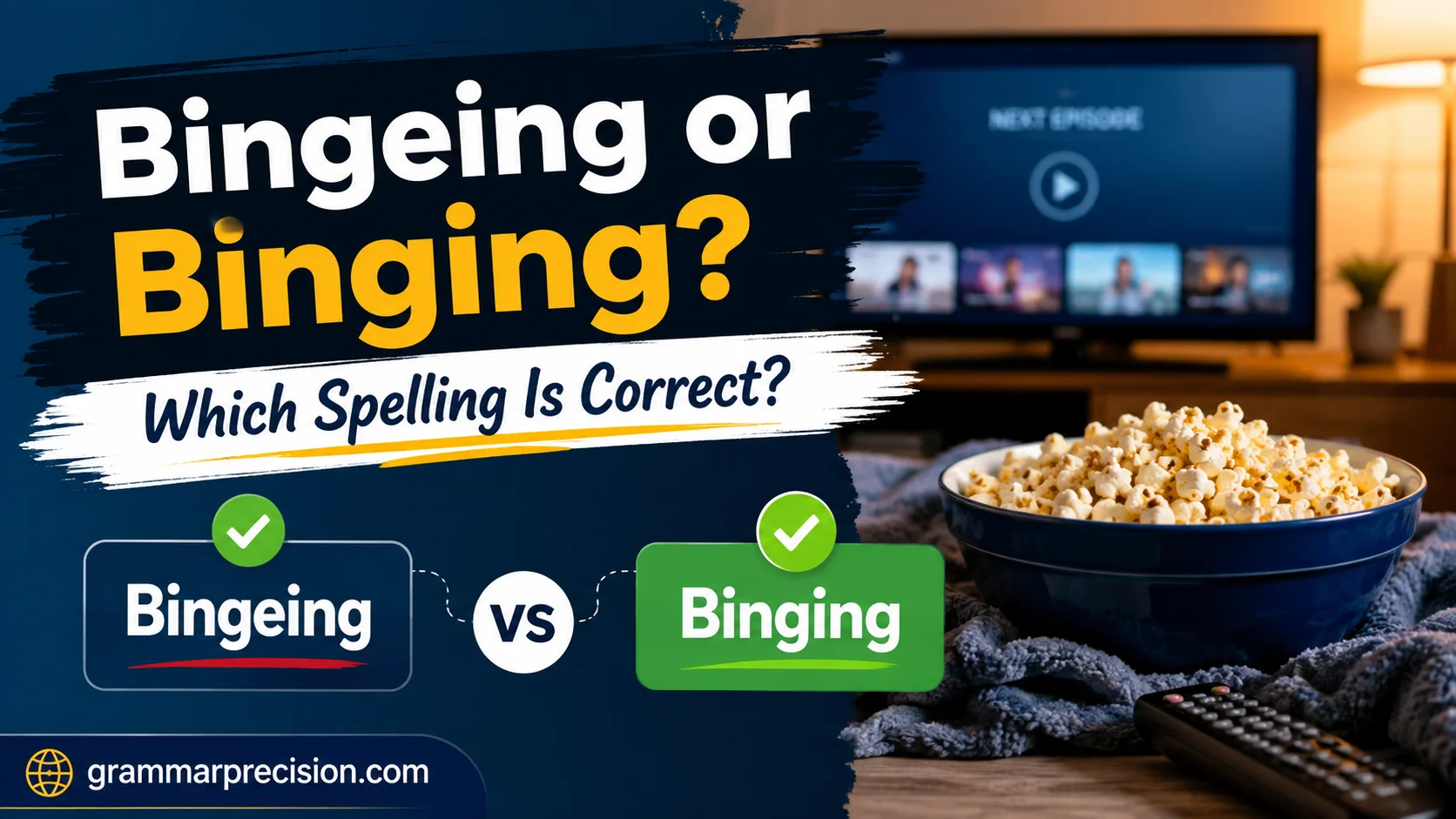
Bingeing or Binging can confuse writers because both spellings appear online, but traditional English generally favors bingeing as the correct form.
When writing about a favorite show, a whole new season, or several episodes, you may wonder whether bingeing or binging is correct. Both forms appear online, but bingeing follows the traditional spelling pattern and keeps the final -e from the base word binge.
The difference becomes clearer in binge-watching and binge-eating. For careful writing, bingeing is traditionally preferred, while binging remains common in popular usage. Remembering the base word and its -e can make this spelling choice easier for learners and help prevent confusion in everyday English.
Bingeing or Binging: The Answer in One Minute
Bingeing and binging are both accepted present participles of the verb binge. Major dictionaries recognize both forms. Merriam-Webster lists “binged; bingeing or binging,” while Cambridge gives both spellings for the present participle.
So, is one spelling wrong? No.
However, bingeing preserves the spelling of the base word more visibly. Binging removes the final e, which makes the word look more like many other verbs ending in a silent e. Neither spelling changes the basic meaning.
Here’s the quick version:
| Form | Status | Meaning | Best takeaway |
| bingeing | Correct | Doing something excessively | Traditional-looking form |
| binging | Correct | Doing something excessively | Common alternative |
| binge | Base verb | To indulge excessively | Root word |
| binged | Past tense | Indulged excessively | Standard past form |
If you’re writing a formal article, essay, or educational piece, bingeing is a safe, clear choice. If you’re writing casually, binging works too.
What Does Bingeing Mean?
Bingeing means engaging in something excessively or without much restraint. The activity can involve food, alcohol, entertainment, shopping, reading, gaming, or other forms of consumption.
The verb binge originally had strong associations with excessive drinking. Merriam-Webster traces the noun to the mid-nineteenth century and records the verb from the late nineteenth century. Today, the word has expanded far beyond its older associations.
Consider these examples:
- “She spent Saturday bingeing on old sitcoms.”
- “He stayed home bingeing on a new crime series.”
- “They were bingeing on snacks during the movie marathon.”
- “I spent the afternoon bingeing on mystery novels.”
Notice something important: bingeing doesn’t automatically describe an unhealthy behavior. Context determines what the person is doing and whether the behavior has a negative meaning.
That distinction matters because modern English uses binge in playful and harmless ways. Someone might say they are bingeing a television series simply because they watched several episodes in one sitting.
What Does Binging Mean?
Binging has the same basic meaning as bingeing. It is the present participle of binge, and dictionaries recognize it as a legitimate form.
Cambridge specifically lists binging and bingeing as present participles. Its American Dictionary entry also gives both forms.
For example:
- “We spent the weekend binging our favorite comedy.”
- “She was binging on chocolate while studying.”
- “He started binging shows after finishing his exams.”
There’s no hidden difference in meaning. You don’t choose binging because the activity is more extreme, and you don’t choose bingeing because it sounds more formal grammatically.
The difference is mainly spelling preference and usage.
That’s the key point many quick grammar explanations miss.
What Is the Difference Between Bingeing and Binging?
The simplest answer is this: there is no meaningful difference in definition.
Both forms come from the verb binge. Both describe an ongoing action. Both can appear after helping verbs such as is, was, and has been when the grammar calls for the present participle.
Compare:
She is bingeing on a documentary series.
She is binging on a documentary series.
The sentences mean essentially the same thing.
The spelling difference becomes noticeable because English handles verbs ending in silent e in several ways. Writers often expect the final e to disappear before -ing, as in:
- make → making
- write → writing
- hope → hoping
- bake → baking
That pattern makes binging feel natural.
Yet English has exceptions and special cases. Some words keep the final e to prevent confusion with another word or preserve pronunciation. Bingeing belongs to that larger spelling landscape.
Why Does “Bingeing” Keep the Letter E?
The spelling bingeing keeps the final e from binge before adding -ing.
At first glance, that may seem strange. English learners often learn a simple rule: when a verb ends in a silent e, drop the e before adding -ing. That rule works in many familiar cases, but English spelling rarely behaves like a perfectly engineered machine.
For example:
- dance → dancing
- love → loving
- use → using
- move → moving
So why do people write bingeing?
One reason is that the spelling helps preserve the recognizable relationship between binge and bingeing. It also avoids making the word visually resemble another form built around bing.
A useful comparison is singeing. The word singe means to burn something slightly. Its -ing form is commonly written singeing, not singing, because singing already represents the present participle of sing.
That example shows why English sometimes keeps a final e. Spelling can help readers distinguish words that would otherwise collide.
Why Does “Binging” Look So Natural?
There’s a simple reason binging feels comfortable to many writers: it follows a familiar visual pattern.
English has countless words in which a short verb stem takes -ing:
- sing → singing
- ring → ringing
- bring → bringing
- cling → clinging
Because these forms are so familiar, binging looks perfectly ordinary at first glance.
Modern usage also plays a role. As binge-watching and streaming culture became everyday concepts, people began using binge in new combinations. That increased the frequency of related forms such as binging, bingeing, binge-watched, and binge-watcher.
Dictionary evidence confirms that binging is not simply a random internet misspelling. Cambridge defines it as the present participle of binge, and Merriam-Webster explicitly lists it as a variant.
In other words, the spelling has earned a place in standard reference works.
Is Binging Wrong?
No. Calling binging “wrong” oversimplifies the issue.
When a major dictionary lists a form as an accepted variant, writers should distinguish between incorrect spelling and alternative standard usage. That distinction matters in grammar writing because language changes through repeated use.
Merriam-Webster currently lists the verb as “binged; bingeing or binging.” Cambridge likewise lists both present-participle forms.
That gives you a strong practical rule:
If your dictionary accepts both forms, don’t treat one as a spelling error.
Instead, consider consistency. If an article uses bingeing throughout, switching randomly to binging can make the writing look careless. Pick the form that suits your audience and stick with it.
Bingeing Examples You Can Use
Seeing the word in context makes the spelling much easier to remember.
Everyday examples
- “I was bingeing on comedy shows last night.”
- “She spent the afternoon bingeing on detective novels.”
- “We started bingeing the series after dinner.”
- “He admitted to bingeing on snacks during the game.”
More formal examples
- “The study examined patterns associated with repeated bingeing.”
- “The report discusses the effects of excessive bingeing.”
- “Researchers observed changes in participants’ bingeing behavior.”
When the subject involves eating, alcohol, or another sensitive behavior, context becomes especially important. Bingeing can describe a casual episode in everyday speech, but it can also appear in discussions of serious health conditions.
For example, binge eating has a specific medical meaning. Merriam-Webster defines it as excessive or compulsive consumption of food and distinguishes it from occasional overeating.
That difference is worth preserving in careful writing.
Binging Examples and Common Contexts
Binging appears frequently in casual writing and everyday descriptions.
Try these examples:
- “We were binging a comedy series all weekend.”
- “She kept binging on documentaries.”
- “I started binging the show after seeing one episode.”
- “They spent the holiday binging movies.”
The word works especially naturally in informal contexts.
You’ll also see binging in discussions of eating behavior. Cambridge’s corpus examples include the word in contexts involving excessive eating.
Again, context does the heavy lifting. The spelling stays the same, but the meaning can range from casual entertainment to a serious behavioral issue.
Bingeing vs. Binging in Formal and Informal Writing
If you’re deciding which form to use, think about your audience first.
| Writing situation | Recommended approach |
| Academic paper | Bingeing is a clear choice |
| Grammar article | Bingeing works well |
| Business writing | Either, but stay consistent |
| Blog post | Either form can work |
| Social media | Binging is perfectly natural |
| Casual text | Either is fine |
| Medical discussion | Follow the terminology of your source or style guide |
There’s no universal rule saying formal writers must use bingeing.
Still, bingeing often looks more deliberate because it keeps the relationship with the base word visible. If you’re explaining spelling to students, that visual connection can help.
Meanwhile, binging may feel lighter and more conversational.
Think of it like choosing between two outfits that fit the same occasion. Both work. One simply creates a different impression.
Also Read This: Coliseum vs Colosseum: Which One Should You Use?
Bingeing or Binging in American English
American English accepts both bingeing and binging. Cambridge’s American Dictionary specifically records both forms, while Merriam-Webster lists them as alternatives.
That means American writers don’t need to invent a rule that excludes one.
For an American English grammar article, a practical approach is to introduce both forms clearly:
Bingeing and binging are both correct spellings of the present participle of “binge.”
Then choose one as your main house style.
If consistency matters more than personal preference, establish the preferred form at the beginning of your project. For example, a publication might use bingeing across its articles while still acknowledging binging as an accepted variant.
Words That Follow Similar Spelling Patterns
The spelling issue becomes easier when you compare bingeing with other words.
| Base word | -ing form | Why it matters |
| binge | bingeing / binging | Both forms are accepted |
| singe | singeing | Keeps the e to distinguish it from singing |
| dye | dyeing | Keeps the e to distinguish it from dying |
| shoe | shoeing | Retains the e |
| toe | toeing | Retains the e |
| make | making | Drops the silent e |
| write | writing | Drops the silent e |
This table reveals an important truth: English spelling rules have patterns, not perfect formulas.
The word singeing is particularly useful. If you wrote singing when you meant “burning slightly,” you’d create a completely different word. The extra e protects the meaning.
Similarly, dyeing keeps the e so readers don’t confuse it with dying.
That’s why blindly applying “drop the e before -ing” can sometimes lead you astray.
Common Binge-Related Words
Once you understand the main spelling, several related expressions become easier.
Binge-watching
Binge-watching means watching multiple episodes or substantial amounts of video content in a concentrated period.
Example:
“We spent Saturday binge-watching the entire season.”
Binge-eating
Binge-eating refers to episodes of excessive food consumption. In health contexts, the term can have a specific clinical meaning, so casual overeating shouldn’t automatically be labeled a disorder.
Binge drinking
Binge drinking refers to a pattern of consuming alcohol heavily within a short period. Unlike casual uses of binge, this phrase often appears in public-health and medical contexts.
Binge-reading
Binge-reading describes reading many chapters, articles, or books in one concentrated stretch.
Binge-listening
Binge-listening can describe consuming many podcast episodes, songs, or other audio programs in succession.
These expressions show how flexible binge has become. The word has moved from its older associations with excessive drinking into modern media and entertainment vocabulary.
A Simple Trick to Remember Bingeing or Binging
Here’s an easy memory trick:
BINGE → BINGEING
Imagine the base word staying visible while -ing attaches to it.
If you prefer the shorter spelling, remember this:
BINGE → BINGING
Both paths are accepted.
The most important thing isn’t memorizing a complicated rule. It’s remembering that bingeing and binging are both dictionary-recognized forms.
If you’re writing for a particular publication, however, check its style guide. A house style may prefer one form even when general dictionaries accept both.
Quick Comparison: Bingeing vs. Binging
| Question | Bingeing | Binging |
| Is it a word? | Yes | Yes |
| Is it a form of binge? | Yes | Yes |
| Is it a present participle? | Yes | Yes |
| Does the meaning change? | No | No |
| Is it accepted by major dictionaries? | Yes | Yes |
| Can it appear in formal writing? | Yes | Yes |
| Can it appear in casual writing? | Yes | Yes |
| Should you use both randomly? | No | No |
The final row deserves attention.
Correctness doesn’t eliminate the need for consistency.
If you choose bingeing, use it consistently throughout an article unless you’re quoting a source or discussing the alternative spelling. The same principle applies if you choose binging.
FAQs:
Is “Bingeing” or “Binging” correct?
Bingeing is traditionally considered the correct spelling because it keeps the final -e from the word “binge” before adding “-ing.”
Is “Binging” also a correct word?
Yes, binging is widely used, especially in informal and online writing. However, bingeing is generally preferred in more careful or traditional English.
Why does “Bingeing” keep the “e”?
The spelling bingeing keeps the final -e to make the connection with the base word “binge” clear. This follows a traditional spelling pattern.
Which spelling should I use for binge-watching?
For formal or careful writing, use binge-watching and bingeing. Although binging is common, bingeing is the safer traditional choice.
What is the difference between bingeing and binging?
There is no major difference in meaning. Both refer to doing or consuming something excessively, such as watching many episodes or eating a large amount of food. The main difference is spelling and usage.
Conclusion:
Bingeing and binging have the same basic meaning, but their spelling differs. Bingeing is traditionally preferred in standard and careful English writing. Binging is also common, particularly in informal and online usage.
When in doubt, choose bingeing for a more traditional and widely accepted form.