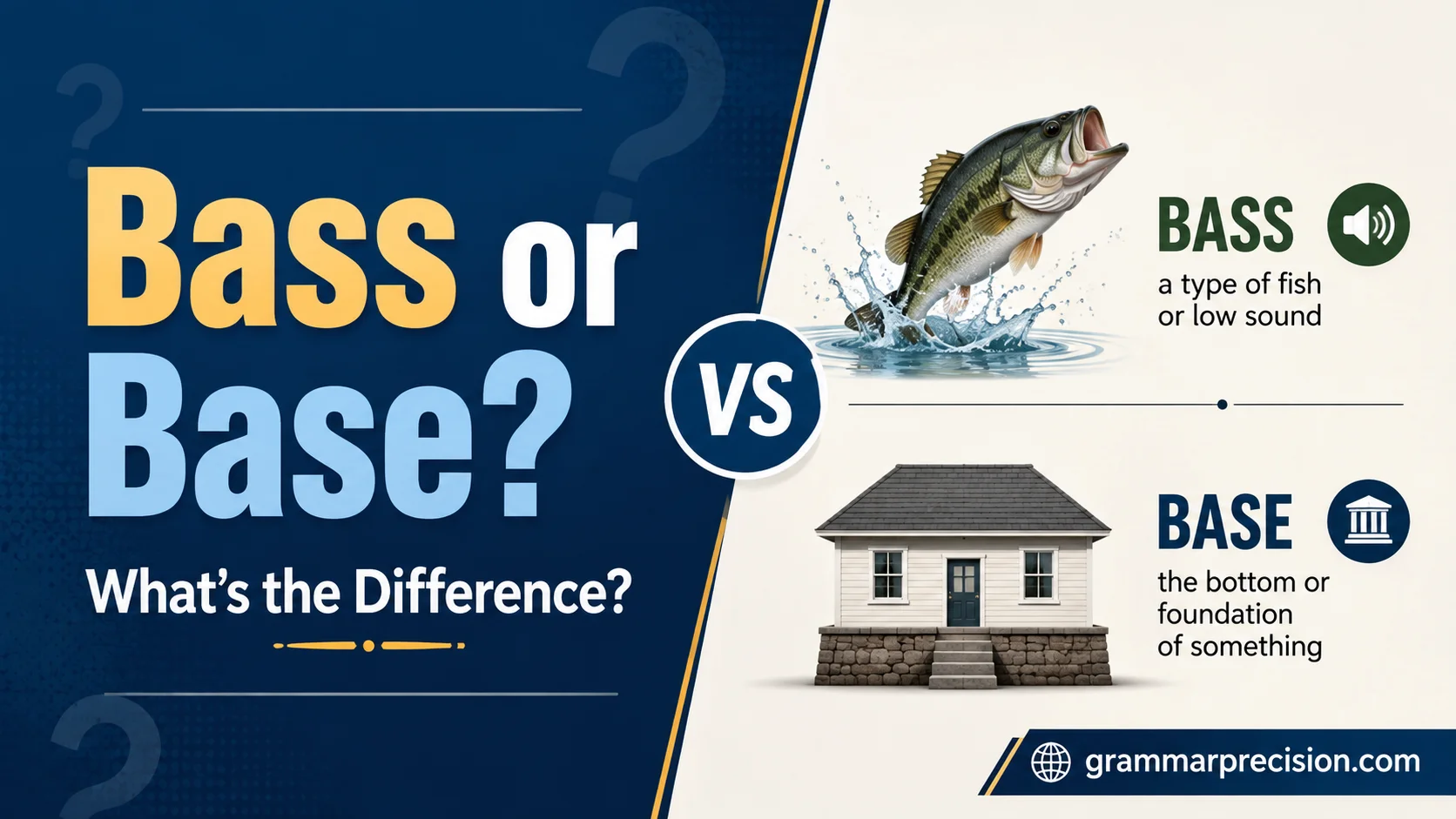
Bass or Base can be confusing because both words look similar, but their meanings, uses, and pronunciations differ. Knowing the difference helps you write with confidence.
Base usually means a foundation, bottom support, or starting point. It can describe a military base, company headquarters, or a central place of operation. Bass refers to low-frequency sound, a bass guitar, deep singing voice, or a freshwater fish. Context helps you choose correctly.
To remember the difference, connect base with a foundation or place, while bass relates to low sound or music. These easy tricks can improve your spelling skills, grammar accuracy, and writing confidence. Always consider the context before using either word in your speaking or writing.
Bass or Base: Which One Is Correct?
Both bass and base are correct English words. Neither spelling is simply a “wrong version” of the other.
The important difference lies in meaning and context.
| Word | Main Meaning | Pronunciation | Example |
| Bass | A type of fish | Like “base” | We caught a bass. |
| Bass | A low musical sound | Like “bays” | The bass shook the room. |
| Base | Foundation or bottom part | Like “base” | The lamp has a heavy base. |
| Base | Starting point or headquarters | Like “base” | The soldiers returned to base. |
A useful rule is simple:
If you’re talking about music or a fish, think “bass.” If you’re talking about a foundation, starting point, or headquarters, think “base.”
That rule won’t cover every technical use, but it works remarkably well in everyday writing.
What Does Bass Mean?
Bass has two major meanings. One belongs to the world of music, while the other refers to several species of freshwater and saltwater fish.
The meanings aren’t related. They simply share the same spelling.
Bass as a Musical Term
In music, bass refers to sounds that have a relatively low frequency or pitch. It can describe a sound, musical part, singer, instrument, or range.
For example:
- The song has a powerful bass.
- She plays the bass guitar.
- The singer has a deep bass voice.
- Turn down the bass on the speakers.
- The bass line gives the song its groove.
The bass section often provides the musical foundation that connects rhythm and harmony. In many modern genres, including rock, funk, hip-hop, electronic music, and pop, bass helps create the physical sense of depth and movement listeners feel.
Bass can also refer to a low male vocal range. A bass singer generally sings lower notes than a baritone or tenor.
The word can therefore function in several related ways:
- Bass sound: a low-frequency sound
- Bass guitar: a stringed instrument
- Bass player: someone who plays bass
- Bass line: a sequence of low musical notes
- Bass voice: a very low male vocal range
- Bass clef: a musical notation system commonly used for lower-pitched instruments and voices
Bass as a Fish
Bass also names various fish species. These fish belong to different biological groups, so “bass” isn’t a single scientific species.
Common examples include:
- Largemouth bass
- Smallmouth bass
- Spotted bass
- Striped bass
- White bass
- Black sea bass
For example:
We spent the morning fishing for bass.
The lake is famous for its large largemouth bass.
Here’s the interesting part: when bass means the fish, it’s pronounced exactly like base.
That means these two sentences contain words that sound alike:
The boat returned to its base.
The fisherman caught a bass.
The spelling tells you which meaning the writer intends.
What Does Base Mean?
Base has a broad group of meanings centered around the idea of a foundation, starting point, bottom, or central position.
You can use it literally or figuratively.
Base as a Foundation
A base can be the bottom part that supports something above it.
For example:
- The statue has a marble base.
- The vase rests on a wide base.
- The table has a sturdy base.
- The tower stands on a concrete base.
Think of a building. Before you worry about the walls, windows, or roof, you need something that supports the structure.
That supporting part is its base.
Base as a Starting Point
Base can also mean a place or position from which someone operates or begins an activity.
For example:
The hikers returned to their base before sunset.
The company uses Chicago as its main base of operations.
This meaning extends into business, sports, travel, military operations, and everyday conversation.
You might also hear base camp, which means a central camp used as a starting or support point during an expedition.
Base as a Military or Operational Location
A base can be a facility where military personnel, equipment, or operations are located.
For example:
The aircraft returned to the military base.
The unit established a temporary base near the border.
The word doesn’t have to describe a military location, however. Companies, research teams, emergency organizations, and other groups can also establish an operational base.
Base in Mathematics and Science
The word base takes on more specialized meanings in academic subjects.
In mathematics, a number system has a base that determines how numbers are represented. Our everyday decimal system uses base 10, while computers commonly work with base 2, known as binary.
In geometry, the base of a shape is a chosen side or surface used as a reference.
In chemistry, a base is a substance that can accept hydrogen ions or, in another common framework, donate an electron pair. Familiar examples include baking soda and sodium hydroxide, although their chemical behavior differs significantly.
So, even in technical writing, base generally carries the underlying idea of a starting point, foundation, or reference.
How Do You Pronounce Bass?
This is where bass vs. base becomes particularly tricky.
The word bass has two standard pronunciations because it has two distinct meanings.
Bass Meaning Fish: “Base”
When bass means a fish, pronounce it like base.
Bass = /beɪs/
Example:
We caught a large bass.
Here, bass rhymes with words such as face, place, and case.
Bass Meaning Low Sound: “Bays”
When bass refers to low musical sound, pronounce it approximately like “bays.”
Bass = /beɪs/ for the fish
Bass = /beɪs?/ Wait—the musical pronunciation is conventionally /beɪs/? Actually, the standard musical pronunciation is /beɪs/ in American English.
This distinction is worth correcting clearly: bass is pronounced “base” in both its fish and musical senses in modern American English. The pronunciation “bays” is not the standard pronunciation of the musical term.
For example:
The bass guitar sounded deep and powerful.
You pronounce bass like base.
The spelling is unusual, but the pronunciation is consistent in these common modern uses.
How Do You Pronounce Base?
Base is pronounced like “base.”
Its pronunciation is:
Base = /beɪs/
It rhymes with:
- face
- case
- place
- race
- space
- trace
That means the fish bass, musical bass, and base are all pronounced the same way in standard American English.
The difference exists primarily in spelling and meaning, not pronunciation.
Bass vs. Base: Key Differences
Once you understand their meanings, the distinction becomes much easier.
| Feature | Bass | Base |
| Main meanings | Fish or low musical sound | Foundation, starting point, headquarters, reference point |
| Pronunciation | “Base” | “Base” |
| Common contexts | Music and fishing | Construction, business, military, math, science |
| Example | The bass was huge. | The house has a solid base. |
| Related words | Bassist, bassline, bass guitar | Basic, basement, baseboard, based |
The most important point is this:
You cannot choose between bass and base by pronunciation. You must choose based on meaning.
That’s why context matters so much.
Also Read This: Barn or Burner? Which Word Is Correct?
Bass vs. Base Examples
Seeing the words in real sentences makes the difference much clearer.
Examples With Bass
The bass guitar provided the song’s rhythmic foundation.
We went fishing and caught three bass.
The musician adjusted the bass on the amplifier.
A large bass jumped near the boat.
His deep bass voice filled the auditorium.
The band added a stronger bass line to the chorus.
Examples With Base
The lamp has a circular base.
The explorers returned to base camp after the climb.
The military base covers a large area.
The statue’s stone base was cracked.
Ten is the base of our decimal number system.
The company established a new regional base in Texas.
Notice how the surrounding words immediately reveal the intended meaning.
Bass guitar, bass line, and bass fishing point toward bass. Base camp, base level, and base of the statue point toward base.
Bass or Base in Common Phrases
Certain combinations make the spelling almost automatic.
Bass Guitar
A bass guitar is designed to produce lower-pitched notes than a standard guitar.
He bought a five-string bass guitar.
Bass Line
A bass line is a sequence of lower notes that contributes to a song’s rhythm and harmony.
The song has an unforgettable bass line.
Bass Player
A bass player or bassist plays the bass instrument.
The bass player locked into the drummer’s rhythm.
Bass Fishing
Bass fishing refers to fishing for bass species.
Bass fishing attracts thousands of anglers each year.
Military Base
A military base is a facility used by armed forces.
The aircraft landed at the military base.
Base Camp
A base camp serves as a central support location, especially during expeditions or challenging outdoor activities.
The climbers returned to base camp before nightfall.
Based On
The phrase based on means founded on, developed from, or supported by something.
The movie is based on a true story.
This word is base, not bass.
Common Bass and Base Mistakes
Even experienced writers can stumble over these words because English spelling rarely behaves as neatly as we’d like.
Mistake: Using Bass for a Foundation
Incorrect:
The statue has a marble bass.
Correct:
The statue has a marble base.
A statue doesn’t have a fish or musical sound underneath it. It has a base that supports it.
Mistake: Using Base for a Fish
Incorrect:
We caught a large base at the lake.
Correct:
We caught a large bass at the lake.
When you’re talking about the fish, bass is the correct spelling.
Mistake: Using Base for a Musical Instrument
Incorrect:
She plays the base guitar.
Correct:
She plays the bass guitar.
The instrument is a bass guitar.
Mistake: Assuming Similar Meaning
Although bass and base sound alike, they aren’t interchangeable.
This is a classic example of homophonic words: words that share a pronunciation but have different spellings and meanings.
Other familiar examples include:
- right / write
- sea / see
- pair / pear
- flour / flower
- brake / break
The key difference is that bass and base have distinct meanings despite sharing the same sound.
A Simple Way to Remember Bass vs. Base
Memory tricks work best when they connect a word to a vivid image.
For bass, picture a fish jumping out of a lake or a bass guitar vibrating beside an amplifier.
For base, picture the bottom of a statue or a camp at the foot of a mountain.
Try this shortcut:
Bass = fish or music.
Base = foundation or starting point.
Another useful trick is to remember common compounds.
If you see:
- bass guitar → bass
- bass fishing → bass
- bass player → bass
- military base → base
- base camp → base
- baseboard → base
- base level → base
The word beside it often acts like a signpost.
A Quick Bass vs. Base Quiz
Choose bass or base in each sentence.
- The fisherman caught a huge ___.
- The building has a reinforced concrete ___.
- She plays the ___ guitar.
- The expedition returned to ___ camp.
- Turn down the ___ on the speakers.
- The soldiers traveled back to the ___.
- The statue rests on a stone ___.
- He enjoys ___ fishing.
- The song has a deep ___ line.
- The number system has a ___ of ten.
Answers
| # | Answer | Reason |
| 1 | bass | Fish |
| 2 | base | Foundation |
| 3 | bass | Musical instrument |
| 4 | base | Starting/support location |
| 5 | bass | Low-frequency sound |
| 6 | base | Operational location |
| 7 | base | Supporting foundation |
| 8 | bass | Fish |
| 9 | bass | Music |
| 10 | base | Mathematics |
If you got all ten right, you’ve mastered the basic distinction.
Bass vs. Base: A Real-World Case Study
Imagine a sentence from a music magazine:
The band’s new bass player gave the track a heavier sound.
The word must be bass because the sentence discusses music. Writing base player would completely change the meaning and produce an obvious error.
Now consider a travel article:
The climbers returned to their base camp after reaching a higher elevation.
Here, base means a central starting or support point.
Finally, imagine a fishing report:
Anglers caught several largemouth bass near the shoreline.
Again, bass is correct because the subject is fish.
The three examples use words that sound identical. Context does the heavy lifting.
Bass or Base: Final Cheat Sheet
When you’re stuck between bass or base, don’t focus on the sound. Ask what the sentence means.
Use bass when you’re talking about:
- A fish
- Bass guitar
- Low musical sound
- Bass lines
- Bass singers
- Bass instruments
- Bass fishing
Use base when you’re talking about:
- A foundation
- A bottom supporting part
- A starting point
- A headquarters
- A military facility
- Base camp
- A mathematical reference system
- A scientific concept
- Something on which another thing is built
The easiest rule remains:
Bass belongs to fish and music. Base belongs to foundations, starting points, and reference points.
FAQs:
What is the difference between Bass and Base?
Bass usually refers to low-frequency sound, a bass guitar, a deep singing voice, or a freshwater fish. Base means a foundation, bottom support, starting point, or central place of operation.
Is Bass and Base pronounced the same?
They can be homophones, but bass has more than one pronunciation depending on its meaning. The musical term sounds like “base,” while the fish has a different pronunciation.
When should I use Base?
Use base when you mean a foundation, bottom support, starting point, or central place of operation. For example, “The lamp has a wide base” and “The soldiers returned to the base.”
When should I use Bass?
Use bass when talking about low sounds, music, a bass guitar, a bass speaker, a deep singing voice, or a type of freshwater fish. For example, “The bass made the song sound deeper.”
How can I remember Bass vs Base?
A simple trick is to connect base with a foundation or support, while bass is connected with low sound or music. Checking the context can also help you choose the correct word.
Conclusion:
Understanding Bass vs Base becomes easier when you focus on their meanings and contexts. Use base for a foundation, support, starting point, or place of operation. Use bass for low sound, music, a deep voice, or a freshwater fish.
Remembering these simple differences can improve your spelling, grammar, and writing confidence.