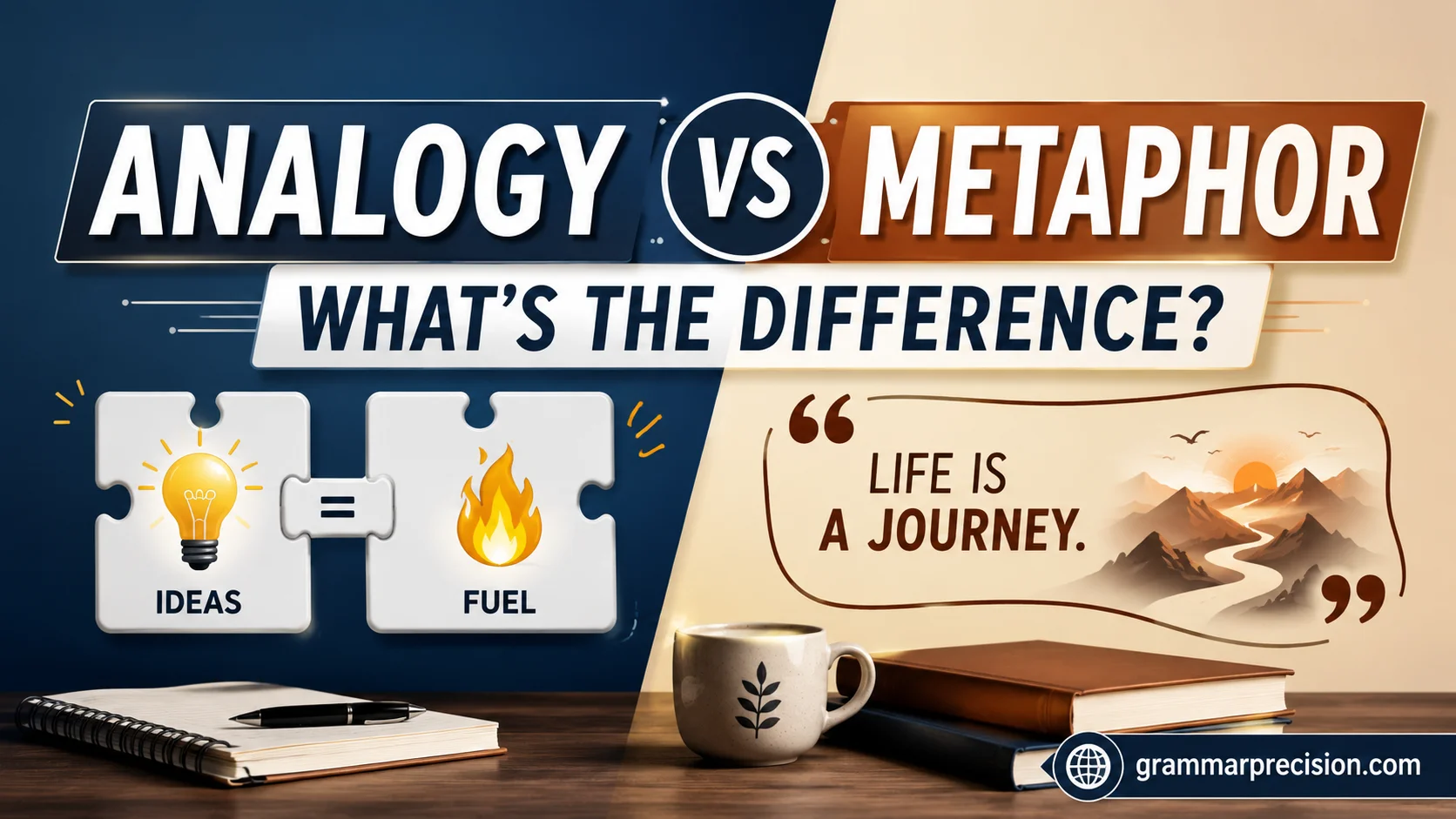
Analogy vs Metaphor helps you understand how these literary devices use comparison to express ideas clearly, create meaning, and form vivid images in the reader’s mind.
At a basic level, writing uses words, symbols, and punctuation to express thoughts and ideas. A metaphor is a figure of speech that connects one thing with another, while an analogy gives a clearer logical explanation of their relationship. A simile also makes comparisons but works differently.
It’s easy to mix up these terms because analogies and metaphors appear in everyday life and literature. A metaphor creates memorable mental images, while an analogy provides new understanding through a meaningful comparison. Learning their difference helps writers use these devices effectively to explain a scene, theme, person, place, or complex idea.
Analogy vs. Metaphor in One Minute
Here’s the easiest way to remember the difference:
A metaphor says one thing is another to create an image or association. An analogy compares two things to explain how they are alike in a particular way.
Consider these examples:
- Metaphor: The classroom was a zoo.
- Analogy: Running a classroom is like conducting an orchestra because the teacher has to coordinate many different people at once.
The metaphor paints a picture. The analogy explains a relationship.
| Feature | Analogy | Metaphor |
| Main purpose | Explain or clarify | Create an image or association |
| Typical structure | Compares relationships or situations | Equates one thing with another |
| Length | Can be short or extended | Often short |
| Meaning | Often explanatory | Usually figurative |
| Common use | Teaching, reasoning, explanation | Creative writing, speech, everyday language |
| Example | Learning a language is like training a muscle. | Her words were a hammer. |
A useful memory trick is simple: metaphors make you picture; analogies make you understand.
What Is an Analogy?
An analogy is a comparison between two different things, situations, or ideas that share a meaningful relationship.
The goal isn’t merely to say that two things resemble each other. A good analogy uses a familiar situation to explain something less familiar.
For example:
Learning to write well is like learning to play an instrument. You improve through practice, feedback, and repeated correction.
Writing and playing an instrument obviously aren’t the same activity. However, their learning processes have a similar structure. Both require practice, patience, feedback, and refinement.
How an Analogy Works
Most useful analogies have two sides:
- The familiar idea: something the audience already understands.
- The unfamiliar idea: something you want the audience to understand better.
The comparison connects the two.
Imagine explaining computer memory to someone unfamiliar with technology. You might say:
Computer memory is like a desk. The larger the desk, the more information you can keep immediately available while working.
That’s an analogy. The desk doesn’t literally represent computer memory in every respect. It simply provides a familiar framework for understanding one aspect of it.
Types of Analogies
Analogies can take several forms.
Simple analogy:
The baby’s skin was as soft as velvet.
Explanatory analogy:
Managing a busy restaurant is like directing traffic because many moving parts must stay coordinated.
Logical analogy:
If a locked door prevents everyone from entering a room, a missing password can similarly prevent users from accessing an account.
Extended analogy:
A writer may spend several sentences or even paragraphs comparing one situation with another.
Extended analogies often appear in speeches, essays, teaching materials, and persuasive writing because they can develop a complicated idea step by step.
What Is a Metaphor?
A metaphor is a figure of speech that describes one thing in terms of another to create a particular image, quality, feeling, or association.
Consider:
The city was a sleeping giant.
The city isn’t literally a giant. The metaphor suggests that the city has enormous power or potential that hasn’t yet been fully activated.
Metaphors often make abstract ideas easier to picture. They can also make ordinary language more memorable.
Instead of saying:
She was extremely nervous.
you might write:
Butterflies filled her stomach.
The metaphor gives the emotion a physical image.
How Metaphors Create Meaning
A metaphor usually focuses on one or more shared qualities.
For example:
His mind is a sponge.
A sponge absorbs liquid. The metaphor suggests that the person absorbs information quickly.
The comparison doesn’t claim that the person’s brain literally contains a sponge. It transfers a recognizable quality from one object to another.
Common Types of Metaphors
Direct metaphor:
The world is a stage.
Implied metaphor:
She attacked every problem that appeared on her desk.
The word attacked suggests that problems are being treated like opponents.
Extended metaphor:
A comparison continues across several sentences or paragraphs.
Dead metaphor:
A metaphor has become so familiar that people often don’t notice its figurative origin.
Examples include:
- The foot of the mountain
- The leg of a table
- The heart of the city
- The branches of a company
These expressions once carried stronger imagery, but everyday use has made them ordinary.
Analogy vs. Metaphor: The Core Difference
The biggest difference lies in purpose and structure.
A metaphor usually compresses a comparison into a vivid expression. An analogy tends to unpack a relationship and explain it.
Compare these:
Metaphor: The internet is a highway.
Analogy: The internet is like a highway because information travels along connected routes, users enter and leave through different access points, and congestion can slow everything down.
The first sentence creates an image. The second develops an explanation.
Analogy vs. Metaphor Side by Side
| Question | Analogy | Metaphor |
| Does it compare two things? | Yes | Yes |
| Does it usually explain a relationship? | Yes | Not necessarily |
| Does it create imagery? | Sometimes | Frequently |
| Can it be extended? | Yes | Yes |
| Does it need to be literally true? | No | No |
| Is it commonly used in teaching? | Yes | Yes |
| Is it common in creative writing? | Yes | Very common |
Neither device is automatically better. The right choice depends on what you want your reader to experience.
If you want clarity and explanation, an analogy often works better. If you want imagery and emotional impact, a metaphor may be the stronger choice.
Analogy vs. Metaphor Examples
Examples make the distinction much easier to see.
Everyday Examples
Analogy:
Planning a vacation is like solving a puzzle because you need to fit transportation, lodging, timing, and activities together.
Metaphor:
Her vacation plan was a puzzle.
The analogy explains the similarity. The metaphor turns the plan itself into an image.
Funny Examples
Analogy:
Trying to get a toddler to eat vegetables is like negotiating a peace treaty.
Metaphor:
Dinner was a battlefield.
Both can make a situation humorous. The analogy gives more context, while the metaphor delivers the punch quickly.
Examples for Students
Analogy:
Studying for an exam is like preparing for a marathon. You need consistent training rather than one enormous effort the night before.
Metaphor:
The exam was a mountain.
The metaphor conveys difficulty. The analogy explains why preparation matters.
Business Examples
Analogy:
A successful team is like a rowing crew. Everyone must move in coordination or the boat loses speed and direction.
Metaphor:
Our sales team is a machine.
The analogy highlights coordination. The metaphor emphasizes efficiency and power.
Science Examples
Analogy:
The nucleus of an atom can be compared to the central control area of a system because it contains the information needed to direct important processes.
Metaphor:
The cell is a factory.
The metaphor gives readers an immediate mental picture. An extended analogy can then explain how different parts of the cell resemble different factory functions.
Literary Examples
Literature relies heavily on metaphor because figurative language can communicate ideas that plain statements cannot capture as effectively.
Consider:
Hope is the thing with feathers.
The comparison gives hope a living, delicate, persistent quality.
An analogy, by contrast, might explain hope through a longer comparison:
Hope is like a small lamp during a power outage. It may not illuminate everything, but it gives you enough light to keep moving.
The metaphor creates a striking image. The analogy develops an idea.
Can an Analogy Also Be a Metaphor?
Yes. The boundaries can overlap. This is one reason people often confuse the two.
Consider:
Life is a journey.
That’s a metaphor. Life isn’t literally a journey from one physical destination to another.
Now expand it:
Life is a journey. Some choices put you on unfamiliar roads, some people become traveling companions, and some destinations force you to change direction.
Now the comparison has developed into an analogy.
In other words, a metaphor can become the starting point for an extended analogy.
The distinction depends partly on how the comparison functions.
- If the comparison mainly creates an image, it behaves like a metaphor.
- If the comparison develops a relationship to explain something, it behaves more like an analogy.
Analogy vs. Metaphor vs. Simile
You can’t fully understand analogy vs. metaphor without looking at the simile.
A simile makes a direct comparison using words such as like or as.
For example:
Her voice was like velvet.
That’s a simile.
A metaphor removes the explicit comparison:
Her voice was velvet.
An analogy can go further:
Her voice was like velvet because it had a smooth, soft quality that made even ordinary words sound comforting.
Here’s the basic distinction:
| Device | Example | Primary function |
| Simile | He runs like a deer. | Direct comparison |
| Metaphor | He is a deer on the track. | Figurative image |
| Analogy | Training for a race is like building a house because both require a strong foundation and gradual progress. | Explanation |
A simple rule helps:
Simile compares. Metaphor transforms. Analogy explains.
The categories aren’t always airtight, but this rule works well in everyday writing.
Also Read This: Bass or Base? What’s the Difference?
How Analogies Help Explain Difficult Ideas
A strong analogy can turn an abstract concept into something you can almost touch.
Teachers use analogies because unfamiliar information becomes easier to process when students can connect it to existing knowledge.
For example, explaining blood circulation can become easier through a transportation analogy:
- Blood vessels are like roads.
- The heart functions like a pump.
- Blood cells travel through the network.
- Oxygen gets delivered to tissues like supplies delivered to destinations.
The analogy doesn’t mean the cardiovascular system literally operates like a road network. It gives the learner a familiar framework.
Why Good Analogies Work
Useful analogies generally:
- Connect unfamiliar ideas to familiar ones.
- Highlight an important relationship.
- Reduce mental complexity.
- Give readers a framework for remembering information.
- Make technical explanations more approachable.
However, every analogy has limits. A road system and the circulatory system aren’t identical. Taking the comparison too literally can create confusion.
How Metaphors Make Writing More Powerful
Metaphors excel at compression. They can communicate an emotional or conceptual idea in just a few words.
Compare:
The company experienced a difficult period and eventually recovered.
with:
The company weathered the storm.
The second sentence creates a stronger image. The reader can imagine dark clouds, heavy rain, and eventual calm.
Metaphors can help writers:
- Create vivid imagery.
- Express emotions.
- Make abstract concepts concrete.
- Add personality to ordinary language.
- Make ideas memorable.
- Strengthen storytelling.
A good metaphor doesn’t merely decorate a sentence. It can change how the reader thinks about the subject.
When Should You Use an Analogy?
Choose an analogy when your main goal is to explain.
An analogy works particularly well when:
- Your audience doesn’t know the subject.
- The concept contains several connected parts.
- You need to show how two systems relate.
- You’re teaching a technical topic.
- You want to support an argument.
- A single metaphor wouldn’t provide enough detail.
For example, if you’re explaining a complicated software process to a beginner, an analogy can provide a map rather than a single snapshot.
When Should You Use a Metaphor?
Choose a metaphor when you want to create an impression.
Metaphors work especially well when:
- You’re writing creatively.
- You want to evoke emotion.
- You’re describing an abstract experience.
- You want a sentence to stick in the reader’s mind.
- You’re writing speeches, stories, essays, or persuasive copy.
For instance:
Fear is a shadow.
That short metaphor doesn’t explain every aspect of fear. It doesn’t need to. It suggests something that follows you, changes with circumstances, and can seem larger than it really is.
How to Write a Great Analogy
A powerful analogy shouldn’t feel forced. Start with the idea you need to explain, then search for a familiar system that behaves in a similar way.
Start With the Difficult Idea
Ask yourself:
What exactly does the reader need to understand?
Don’t compare everything. Focus on one important relationship.
Find a Familiar Comparison
Choose something your audience already knows.
If you’re explaining budgeting to teenagers, a household budget may be less useful than a familiar example involving a limited allowance.
Explain the Connection
Don’t make readers guess why the comparison matters.
State the shared relationship clearly.
Know Where the Analogy Ends
This step often gets ignored.
Every analogy has limits. Tell readers enough to prevent them from assuming that the two things are identical.
How to Write a Powerful Metaphor
A memorable metaphor starts with a meaningful connection.
Choose a Strong Image
Pick something concrete that carries useful associations.
Instead of:
The situation was difficult.
try:
The situation was quicksand.
The image immediately suggests danger and difficulty escaping.
Focus on One Strong Quality
A metaphor becomes muddy when it tries to carry too many unrelated ideas.
Choose the quality you want to emphasize: speed, pressure, loneliness, strength, confusion, or another clear trait.
Avoid Clichés
Expressions such as busy as a bee or heart of gold are familiar, but familiarity can weaken their impact.
Fresh comparisons usually attract more attention.
Keep the Image Clear
A metaphor shouldn’t require a decoder ring.
If readers spend more time figuring out the comparison than understanding the idea, simplify it.
Common Mistakes With Analogies and Metaphors
Even experienced writers can misuse figurative comparisons.
Treating Every Comparison as a Metaphor
Not every comparison qualifies as a metaphor. Some comparisons function primarily as analogies because they explain a relationship.
Stretching an Analogy Too Far
An analogy becomes misleading when its similarities stop matching the original idea.
Use the comparison where it helps, then stop.
Mixing Metaphors
A mixed metaphor combines incompatible images.
For example:
We need to get the ball rolling and hit the ground running.
Each metaphor works independently, but combining them can make the sentence feel cluttered.
Using a Tired Metaphor
Overused expressions may communicate the intended meaning, but they rarely make writing memorable.
Choosing an Unfamiliar Comparison
A clever analogy isn’t useful if your audience doesn’t understand the reference.
Clarity should win over cleverness.
Analogy or Metaphor? Test Yourself
Try identifying each example before checking the answers.
Example 1: The news spread like wildfire.
Example 2: Building trust is like building a bridge. Both require a strong foundation and careful maintenance.
Example 3: Her smile was sunshine.
Example 4: A good editor is like a mechanic because both find small problems before they become major ones.
Example 5: The classroom was a zoo.
Answers
- Example 1: Simile
- Example 2: Analogy
- Example 3: Metaphor
- Example 4: Analogy
- Example 5: Metaphor
The key isn’t simply spotting comparison. Ask what the comparison is doing.
If it creates an image, you’re probably looking at a metaphor. If it explains a relationship, you’re probably looking at an analogy.
A Practical Case Study: Explaining a Difficult Concept
Imagine that someone needs to explain cybersecurity to a beginner.
A metaphor might say:
Your password is a key.
That’s memorable and concise.
An analogy could expand the idea:
Your password works like a key to your house. A strong key makes unauthorized entry harder, while sharing it with strangers creates a security risk. Using a different password for every account is similar to using separate keys for different doors.
The metaphor gives the reader a mental image. The analogy builds a working explanation around that image.
This illustrates an important principle: metaphors and analogies don’t have to compete. They can work together.
FAQs:
What is the main difference between an analogy and a metaphor?
A metaphor directly describes one thing as another to create a clear or vivid image. An analogy makes a broader comparison to explain an idea or relationship. In simple terms, a metaphor creates meaning, while an analogy helps you understand something more clearly.
Is an analogy the same as a metaphor?
No, an analogy and a metaphor are related but not identical. A metaphor is usually a short figure of speech, while an analogy provides a more detailed explanation by showing how two different things are similar. Both can make writing more engaging and easier to understand.
What is an example of a metaphor?
A common example is, “Her voice is music to my ears.” This doesn’t mean her voice is literally music. Instead, the metaphor suggests that her voice sounds pleasant. It creates a vivid image and adds emotional meaning to the sentence.
What is an example of an analogy?
An example is, “Learning a language is like building a house; you need a strong foundation before adding more.” This analogy compares language learning with building a house to explain the importance of learning basic skills first.
How can I remember the difference between analogy and metaphor?
Remember that a metaphor usually makes a direct comparison, while an analogy uses comparison to explain an idea. If the comparison mainly creates an image or adds meaning, it may be a metaphor. If it helps explain how two things relate, it is more likely an analogy.
Conclusion:
Understanding Analogy vs Metaphor becomes easier when you focus on their main purpose. A metaphor creates a strong image, while an analogy explains a relationship through comparison. Both literary devices can make your writing clearer, richer, and more memorable.
Once you know the difference, you can use each one more effectively in everyday and academic writing.