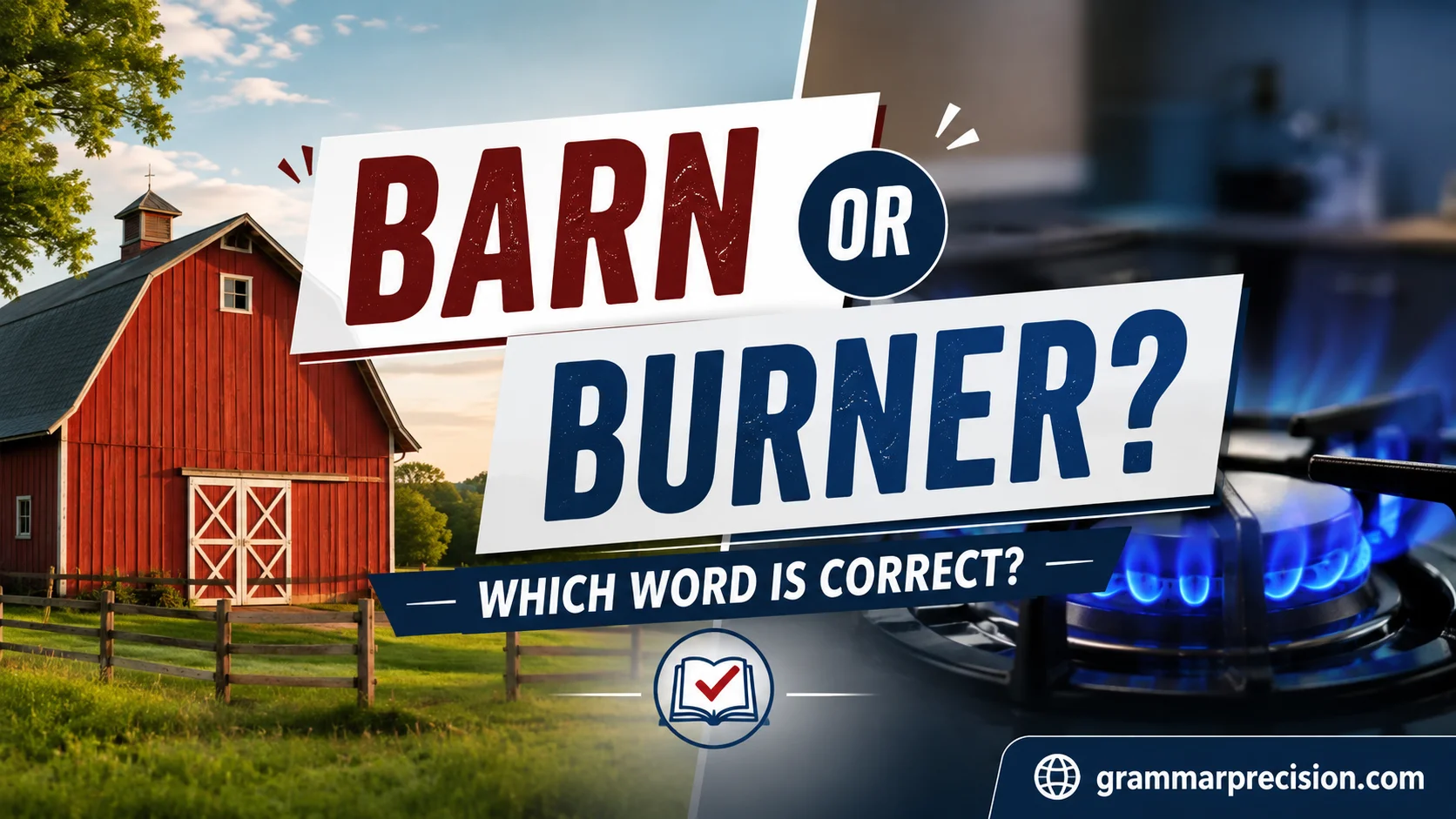
Barn or Burner can be confusing because both words look similar, but they have different meanings and uses in English.
A barn is a building used for storing crops, hay, tools, or farm equipment, while a burner refers to a device that produces heat or flame. Understanding this difference helps you choose the correct word in everyday writing and avoid common spelling mistakes.
If you’ve ever wondered whether barn or burner fits your sentence, you’re not alone. This guide explains their definitions, meanings, pronunciation, examples, and proper usage in simple English. By the end, you’ll know exactly when to use each word with confidence.
Barn or Burner: The Answer at a Glance
Before digging into the finer details, here’s the essential distinction:
| Word | Basic meaning | Typical context | Example |
| Barn | A farm building | Agriculture, livestock, storage | The horses are resting in the barn. |
| Burner | Something that burns or produces heat | Cooking, heating, industry | Turn off the burner after cooking. |
The two words don’t form a traditional confusing pair like affect and effect. Instead, barn or burner is usually a question about identifying the word that matches the intended meaning.
Think of it this way: a barn is usually a place or structure, while a burner performs a function related to heat or burning.
Quick rule: If you can picture a farm building, choose barn. If you can picture a source of flame or heat, choose burner.
That simple distinction solves most cases.
What Does “Barn” Mean?
A barn is a large building commonly found on a farm. Farmers traditionally use barns to shelter animals, store hay or grain, and protect agricultural equipment from weather.
The exact purpose of a barn varies by region and farm. One barn might house horses, while another stores machinery or harvested crops.
The word is a noun, which means it names a person, place, thing, or concept. In ordinary English, barn refers to the physical structure itself.
Examples of “Barn” in Sentences
- The farmer repaired the roof of the barn.
- We kept the horses in the barn during the storm.
- Several tractors stood behind the old barn.
- The children helped carry hay into the barn.
- A red barn stood beside the farmhouse.
Notice how naturally the word connects with farming and rural settings.
However, modern English sometimes uses barn in broader ways. You might hear barn conversion, for example, when someone transforms an old agricultural building into a home or another usable space.
Common Things Found in a Barn
Depending on its purpose, a barn may contain:
- Horses, cows, sheep, or other livestock
- Hay and straw
- Grain and feed
- Tractors and farm machinery
- Tools
- Saddles and other riding equipment
- Agricultural supplies
A barn doesn’t have to contain animals. That’s an important detail. Some barns function mainly as storage buildings.
What Does “Burner” Mean?
A burner is a device or component that produces heat, usually by burning fuel or using another heat-producing process.
You’ll encounter the word frequently in kitchens. On a gas or electric stove, the part that heats your cookware is commonly called a burner.
The word can also describe equipment used for heating, industrial processes, or other purposes.
Examples of “Burner” in Sentences
- Put the pan on the front burner.
- The gas burner won’t light.
- Turn the burner down before the milk boils.
- The technician inspected the furnace burner.
- Never leave a hot burner unattended.
Unlike barn, burner has a direct connection to the verb burn.
The suffix -er often creates a noun referring to someone or something that performs an action. For example:
- teach → teacher
- run → runner
- drive → driver
- burn → burner
Of course, English doesn’t always follow word-building patterns perfectly. Still, this pattern provides a useful clue.
Burner Doesn’t Always Mean a Stove Component
Here’s where things become more interesting. Burner has several meanings depending on context.
It can refer to:
- A stove component that produces heat.
- A device used to burn fuel.
- Industrial heating equipment.
- A person or thing that burns something.
- Something described figuratively in certain expressions.
For example, back burner appears in the expression put something on the back burner. Here, the phrase means to postpone something or give it less immediate attention.
“The company put the expansion project on the back burner.”
Nobody is literally placing the project on a stove. The expression borrows the idea of a stove’s back burner to describe something that isn’t currently receiving priority.
What Is the Key Difference Between Barn and Burner?
The biggest difference is meaning.
A barn is primarily a structure associated with farming. A burner is something connected with burning, heat, or flame.
Their grammatical roles can look similar because both commonly function as nouns. Their meanings, however, travel in completely different directions.
| Feature | Barn | Burner |
| Word class | Noun | Noun |
| Main meaning | Farm building | Device or thing that burns |
| Main association | Farming | Heat or burning |
| Typical setting | Farm | Kitchen, heating system, industry |
| Related verb | — | Burn |
| Example | The cows are in the barn. | The burner is hot. |
Imagine two mental pictures.
First, picture a large red building surrounded by fields. That’s a barn.
Now picture a flame heating a metal pan. That’s a burner.
Once those images become connected to the words, the distinction becomes much harder to forget.
How the “-er” Changes the Meaning
The relationship between burn and burner provides a useful vocabulary lesson.
Burn can function as a verb:
The wood will burn quickly.
Add -er, and you get burner, a noun that can describe something that burns or produces heat:
The gas burner needs cleaning.
English uses this pattern in many everyday words. Consider these examples:
| Verb | Noun | Meaning |
| Teach | Teacher | A person who teaches |
| Drive | Driver | A person who drives |
| Run | Runner | A person who runs |
| Bake | Baker | A person who bakes |
| Burn | Burner | Something or someone associated with burning |
This doesn’t mean every word ending in -er follows exactly the same semantic pattern. English word formation has plenty of exceptions and historical quirks. Still, the connection between burn and burner makes the latter relatively easy to recognize.
Barn, on the other hand, doesn’t come from burn. The two words simply happen to share some letters.
Barn or Burner in Different Contexts
Context provides one of the fastest ways to choose between these words.
In Agriculture, Choose “Barn”
When you’re describing a farm building, barn is the natural choice.
For example:
- The farmer stored hay in the barn.
- The horses returned to the barn before sunset.
- The old barn needed a new roof.
- We walked past the red barn.
Words such as hay, horses, farm, cows, tractor, and livestock often signal that barn is the appropriate word.
In Cooking, Choose “Burner”
When you’re talking about the heat source on a stove, use burner.
For example:
- The soup is simmering on the back burner.
- Don’t touch the burner because it’s still hot.
- She turned the burner to a lower setting.
- The front burner stopped working.
Here, cooking vocabulary immediately points toward burner.
In Heating, “Burner” Often Fits
The word also appears in heating equipment.
A heating system may use a burner to ignite fuel and generate heat. The exact design depends on the system and fuel source.
For instance:
The technician replaced the faulty oil burner.
This sentence has nothing to do with a kitchen. The word still works because the component performs a heating function.
In Figurative English, “Burner” Can Change Meaning
English loves turning ordinary objects into metaphors. Burner appears in several expressions where the meaning isn’t completely literal.
The most familiar example is back burner.
“She put her vacation plans on the back burner.”
This means she postponed the plans because something else became more important.
Another expression is front burner, which describes an issue receiving immediate attention.
“The budget problem is now on the front burner.”
These expressions demonstrate why understanding the broader meaning of burner can be more useful than memorizing only its kitchen definition.
Also Read This: Joint or Join? Which Is Correct?
Common Phrases With “Barn”
You may encounter barn in several compounds and expressions.
Barn Door
A barn door is the large door of a barn. The term can also describe doors designed in a barn-door style.
The old barn door creaked in the wind.
Barnyard
A barnyard is the area around a barn where farm animals may move or gather.
The chickens wandered around the barnyard.
Barn Dance
A barn dance traditionally refers to a social dance associated with rural communities, often featuring group or folk dancing.
The community held a barn dance on Saturday night.
Barn Owl
A barn owl is a distinctive owl species known for its pale face and widespread distribution.
We spotted a barn owl near the farm.
These compounds reinforce the central meaning of barn: a building or farm-related setting.
Common Phrases With “Burner”
Burner has an even wider range of everyday uses.
Stove Burner
This is perhaps the most common meaning in ordinary conversation.
The left stove burner isn’t heating properly.
Gas Burner
A gas burner uses gas as fuel to create heat.
The chef adjusted the gas burner carefully.
Back Burner
To put something on the back burner means to postpone it or reduce its priority.
They put the renovation on the back burner until next year.
Front Burner
Something on the front burner receives urgent attention.
Customer complaints are now on the front burner.
Burner Account
In modern informal usage, a burner account can refer to a temporary or secondary online account used separately from someone’s main account.
The expression isn’t connected to a literal flame. Instead, it draws on the idea of something temporary or disposable.
Barn vs. Burner: Pronunciation and Spelling
Pronunciation can help distinguish the words, especially when you’re listening rather than reading.
Barn is a single-syllable word. In common US pronunciation, it sounds approximately like “barn.”
Burner has two syllables: BUR-ner.
The vowel sounds differ, and burner contains the extra -er ending. When people speak quickly, though, unfamiliar listeners may not catch every sound clearly.
That’s why context matters.
If someone says:
“Put the pan on the ___.”
You can infer that burner makes sense.
If someone says:
“The horses are inside the ___.”
The missing word is clearly barn.
A Simple Spelling Check
When you’re unsure, look at the meaning first.
- Farm building → barn
- Something that burns or produces heat → burner
Don’t try to solve the problem by staring at the spelling alone. Meaning gives you the better clue.
Why Do People Confuse Barn and Burner?
Although barn and burner have different meanings, several factors can cause confusion.
First, both words are relatively short. Second, they share the letters b, r, and n. Third, unfamiliar pronunciation can blur vowel differences during fast conversation.
There can also be interference from related words such as:
- Burn
- Burning
- Burner
- Barn
- Barnyard
A learner who knows burn but hasn’t encountered barn often may mentally connect the two.
Another issue comes from typing. When you write quickly, a spell-checker or autocorrect system may suggest a different word if the surrounding sentence doesn’t provide enough context.
The solution isn’t complicated: pause and identify the meaning before choosing the spelling.
Common Mistakes to Avoid
The most common mistake involves treating barn and burner as interchangeable words. They aren’t.
Mistake 1: Using “Burner” for a Farm Building
Incorrect:
The cows are sleeping in the burner.
Correct:
The cows are sleeping in the barn.
A burner can’t describe the building where livestock stay.
Mistake 2: Using “Barn” for a Stove Component
Incorrect:
Turn off the barn after cooking.
Correct:
Turn off the burner after cooking.
The stove contains a burner. It doesn’t contain a barn.
Mistake 3: Assuming “Barn” Comes From “Burn”
The words look somewhat alike, but that doesn’t make them grammatical forms of one another.
Barn and burner have separate meanings and shouldn’t be treated as variations of the same word.
Mistake 4: Ignoring Context
When you’re unsure, read the entire sentence.
Words surrounding the blank often provide a strong clue. Terms such as hay, farm, and horse point toward barn. Words such as stove, flame, and heat point toward burner.
Case Study: Choosing the Right Word From Context
Consider these sentences:
The farmer moved the equipment into the ___.
The phrase farmer and equipment create an agricultural setting. Barn fits naturally.
Now consider:
The cook lowered the heat on the ___.
The words cook, lowered the heat, and the implied stove context point toward burner.
Here’s another example:
The old ___ stood beside the farmhouse.
A building beside a farmhouse is likely a barn.
Compare that with:
The gas ___ produced an uneven flame.
A device producing a flame is a burner.
The interesting part is that you don’t need a dictionary every time. Context acts like a signpost.
Barn vs. Burner: A Quick Comparison
| Question | Barn | Burner |
| Is it usually a building? | Yes | No |
| Is it associated with farming? | Yes | Sometimes, but not normally |
| Is it associated with heat? | No | Yes |
| Can it be part of a stove? | No | Yes |
| Can it describe a farm structure? | Yes | No |
| Does it relate directly to “burn”? | No | Yes |
| Common compound | Barnyard | Gas burner |
| Common idiom | Barn dance | Back burner |
This table gives you the entire distinction in seconds.
The Easiest Memory Trick for Barn vs. Burner
If you frequently mix these words up, create two mental pictures.
For barn, imagine a big red farm building filled with hay.
For burner, imagine a blue flame under a cooking pan.
Now connect each picture to its word.
Barn = building.
Burner = burning or heat.
That’s it.
You can make the trick even stronger by remembering the word family:
burn → burner
The burner is the thing that burns or creates heat.
There isn’t an equivalent barn family that means a heating device. Once the two mental categories separate, the confusion usually disappears.
Mini Quiz: Can You Choose the Right Word?
Test yourself before moving on.
Which Word Fits?
1. The farmer repaired the roof of the old ___.
2. Place the saucepan on the front ___.
3. The horses ran back into the ___.
4. The gas ___ won’t ignite.
5. We stored the hay inside the ___.
Answers
1. Barn — It’s a farm building.
2. Burner — A stove uses burners to provide heat.
3. Barn — Horses may be housed or sheltered in a barn.
4. Burner — A gas burner produces heat by burning gas.
5. Barn — A barn can provide storage for hay.
If you got all five right, you’ve mastered the basic distinction.
FAQs:
What is the difference between barn and burner?
A barn is a building commonly used on a farm to store hay, crops, animals, tools, or equipment. A burner is a device that produces heat or flame, such as a gas burner on a stove. They have completely different meanings and uses.
Is barn a correct English word?
Yes, barn is a correct and common English word. It usually refers to a farm building used for storing agricultural products, housing animals, or keeping farming equipment. For example, “The farmer stored the hay in the barn.”
What does burner mean in English?
A burner is a device that creates heat or a flame, usually by burning gas or another fuel. You can find burners in stoves, heaters, furnaces, and cooking equipment. For example, “Turn off the gas burner after cooking.”
How can I remember the difference between barn and burner?
An easy way to remember them is to connect barn with farming and burner with burning. A barn is related to a farm or storage building, while a burner produces heat or fire. This simple connection can help you avoid confusion.
Can barn and burner be used interchangeably?
No, barn and burner cannot be used interchangeably because they describe completely different things. A barn is a building or structure, whereas a burner is a heat-producing device. Using the wrong word can change the meaning of your sentence.
Conclusion:
Understanding barn or burner becomes easy when you remember their different meanings. A barn is mainly connected with farms, storage, and animals, while a burner produces heat or flame. Although the words may look somewhat similar, they aren’t interchangeable.
Knowing this distinction will help you use the correct word confidently in everyday English.