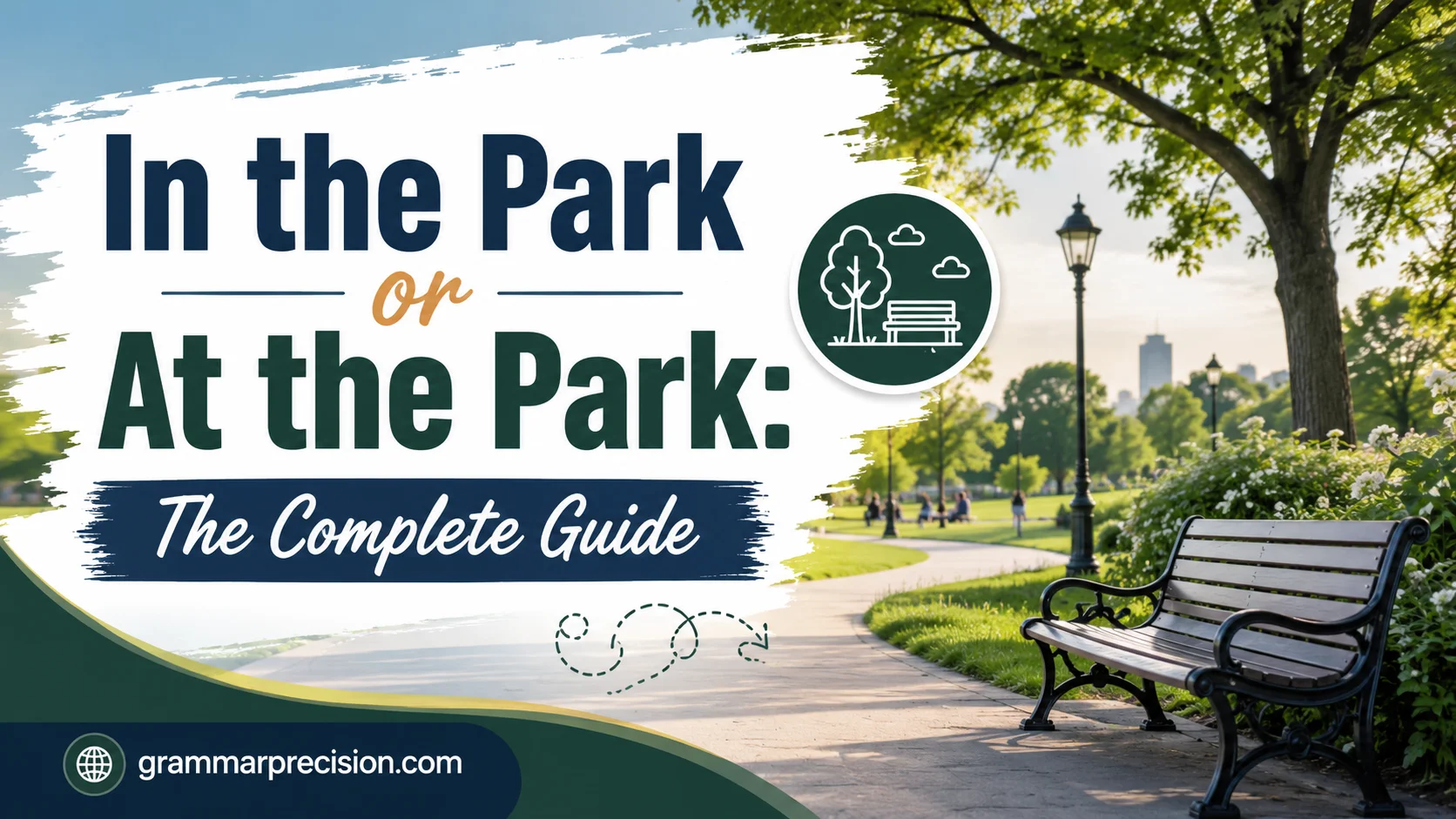
In the Park or At the Park explains how two small prepositions can change the focus of a sentence. Both expressions are correct, but context helps you choose the natural one.
In the park usually emphasizes an area or being inside a physical space. At the park often identifies a general location or meeting point. Your choice depends on what you mean, especially when discussing activities, directions, meetings, or everyday plans.
Both phrases are commonly used in English, and understanding their difference makes speaking and writing easier. In the park works well when you focus on being within the park, while at the park highlights the general location or destination.
In the Park or At the Park: The Short Answer
Both “in the park” and “at the park” are correct.
However, they emphasize different aspects of the location.
| Expression | Main idea | Example |
| In the park | Within the park’s area | The children are playing in the park. |
| At the park | At the park as a location or destination | I’ll meet you at the park. |
Use in the park when you want to highlight that someone or something is physically within the park.
Use at the park when you simply identify the park as the place where someone is, meets someone, or takes part in an activity.
That distinction isn’t absolute. Natural English allows some overlap. In fact, two speakers can describe the same person with different prepositions without either sentence being grammatically wrong.
The easiest rule to remember
In = inside or within the area.
At = a location, destination, or point.
For example:
- She is in the park. → She is somewhere within the park.
- She is at the park. → The park is her current location.
- Let’s meet in the park. → The meeting will happen somewhere inside the park.
- Let’s meet at the park. → The park is the meeting point.
What Does “In the Park” Mean?
The preposition in usually presents a place as an area that contains someone or something. When you say “in the park,” you normally mean within the boundaries or general physical space of the park.
The British Council explains that in is used for places inside larger spaces and specifically gives “The children are playing in the park” as an example.
Consider this sentence:
The children are playing in the park.
The important idea is their physical presence inside the park. They could be running across the grass, playing soccer, sitting beneath a tree, or walking along a path.
The sentence doesn’t identify an exact spot. It simply places their activity within the park.
When “In the Park” Sounds Natural
Use in the park when you’re talking about:
- Walking around the park
- Running on a park path
- Playing on the grass
- Sitting beneath a tree
- Having a picnic
- Watching birds
- Taking photographs
- Finding something within the park
- Describing something located inside the park
For example:
- We went for a walk in the park.
- I saw a beautiful fountain in the park.
- My kids are playing in the park.
- There’s a small pond in the park.
- She found her lost phone in the park.
- They spent the afternoon in the park.
Here, in works because the speaker focuses on the park as an area.
“In” Doesn’t Mean the Park Must Have Walls
This point often confuses English learners.
A park usually doesn’t have four walls around it. Yet we still say in the park because we can understand the park as a defined area with boundaries.
The same idea appears in phrases such as:
- in the garden
- in the forest
- in the city
- in the neighborhood
- in the countryside
- in the stadium
The boundaries don’t need to look like the walls of a room. They can simply define an area.
What Does “At the Park” Mean?
The phrase “at the park” treats the park more like a location or point on a map. You aren’t necessarily emphasizing your exact position inside its boundaries.
For instance:
I’ll meet Sarah at the park.
The sentence tells Sarah where the meeting will happen. It doesn’t tell us whether you’ll stand near the entrance, sit beside the playground, wait in the parking area, or walk toward the picnic tables.
That’s the strength of at. It identifies the relevant location without necessarily zooming in on its internal space.
Cambridge Grammar describes at as a way to refer to a position or location viewed as a point. It also notes that at commonly appears with places considered locations for activities.
When “At the Park” Sounds Natural
You can use at the park when talking about:
- A destination
- A meeting place
- Someone’s general location
- Arriving somewhere
- Waiting for someone
- An event
- An activity associated with the park
Examples include:
- I’ll see you at the park.
- Dad is waiting at the park.
- We arrived at the park around noon.
- There’s a concert at the park tonight.
- She’s at the park with her friends.
- I’ll be at the park until five.
Notice something interesting: these sentences don’t need to explain exactly where inside the park the person is.
That’s why at feels broader.
The Biggest Difference: Space vs. Point
The clearest way to understand in the park vs. at the park is to imagine a map.
Picture a large green park on your phone’s screen.
If you say:
I’m at the park.
You’re essentially pointing to the park as a location.
If you say:
I’m in the park.
You’re mentally placing yourself inside that area.
A simple visual model looks like this:
THE PARK
┌─────────────────────┐
│ │
│ 🌳 🚶 🌳 │
│ │
│ ⚽ │
│ │
│ 🧺 🌳 │
│ │
└─────────────────────┘
IN = within the area
AT = the park as a location
📍
This isn’t a mathematical rule. It’s a useful mental picture.
In zooms into the area. At steps back and identifies the location.
A Quick Comparison
Imagine your friend calls and asks, “Where are you?”
You answer:
“I’m at the park.”
Your friend now knows your general location.
But if your friend asks:
“Where exactly are you?”
You might answer:
“I’m in the park, near the fountain.”
Now you’re describing your position within the larger location.
That’s the subtle difference.
Why Both “In the Park” and “At the Park” Can Be Correct
Here’s where things become interesting.
Prepositions don’t simply label physical spaces. They also express the speaker’s perspective.
Suppose your brother calls while you’re sitting on a bench.
You could say:
I’m in the park.
You’re emphasizing your physical location inside the park.
You could also say:
I’m at the park.
You’re giving him the park as your current location.
Both statements can describe the same real-world situation.
This doesn’t mean the two expressions are always interchangeable. Instead, their meanings overlap while their emphasis differs.
A grammar guide from the University of Victoria similarly teaches in a park as an example of a location within an area, while at commonly identifies points such as a desk, door, station, or stop.
Case Study: Meeting a Friend
Imagine you’re planning to meet Alex.
Option one:
Meet me at the park.
This gives Alex the park as the destination. The exact meeting spot may still need clarification.
Option two:
Meet me in the park.
This more strongly suggests that you want Alex to come inside the park rather than remain outside it.
You might even make the distinction clearer:
Meet me at the park, near the main entrance.
or:
Meet me in the park, beside the fountain.
The extra detail removes any ambiguity.
When Should You Use “In the Park”?
Choose in the park when the sentence focuses on what happens within the park’s area.
Here are some useful patterns.
Activities Inside the Park
We played soccer in the park.
The activity takes place within the park.
She goes jogging in the park every morning.
The phrase describes where the jogging happens.
They had lunch in the park.
Again, the focus is the activity occurring inside the area.
Things Located Within the Park
There’s a beautiful lake in the park.
The lake exists within the park’s boundaries.
We found a small café in the park.
The café is physically located within the park.
A new playground was built in the park.
The phrase tells us where the playground exists.
Movement Within the Park
We walked in the park for two hours.
The dog was running in the park.
She rode her bicycle in the park.
These examples focus on movement or activity within the space.
Also Read This: Bring vs Brang vs Brung: Which Is Correct in English?
When Should You Use “At the Park”?
Choose at the park when the park functions as a general location, destination, or point of activity.
Meeting Someone
I’ll meet you at the park.
This is one of the most natural uses.
You’re identifying the park as the meeting location rather than describing the exact place where you’ll stand.
Talking About Arrival
We arrived at the park just before sunset.
Here, at highlights the destination.
Compare that with:
We walked in the park until sunset.
The first sentence focuses on reaching the location. The second focuses on activity within it.
Referring to an Event
There’s a music festival at the park this weekend.
The park serves as the venue.
This use follows a broader pattern in English. We often use at with places viewed as locations for particular activities, events, or purposes.
Giving Your General Location
I’m at the park right now.
This answer works naturally when someone wants to know where you are.
You don’t necessarily need to explain whether you’re on a walking trail, near the playground, or beside a bench.
In the Park vs. At the Park: 20 Examples
| Sentence | Why it works |
| I’m in the park. | Focuses on being within the area. |
| I’m at the park. | Gives the park as the general location. |
| She’s jogging in the park. | Jogging happens inside the park. |
| I’ll meet you at the park. | The park is the meeting location. |
| We ate lunch in the park. | Lunch happened within the park. |
| We arrived at the park early. | Focuses on reaching the destination. |
| There’s a fountain in the park. | The fountain is located within it. |
| Dad is waiting at the park. | Gives his general location. |
| They played baseball in the park. | The activity occurs within the area. |
| There’s a festival at the park. | The park is the event venue. |
| I lost my wallet in the park. | The wallet was lost somewhere within it. |
| She’ll be at the park after work. | Identifies her destination/location. |
| We walked in the park all afternoon. | Walking occurred inside the area. |
| I’ll see you at the park at six. | The park is the meeting point. |
| Birds nest in the park. | Their location is within the park. |
| The children are in the park. | They are physically within its area. |
| My friends are at the park. | Their general location is the park. |
| We took photographs in the park. | The activity happened within it. |
| The concert is at the park. | The park serves as the venue. |
| Meet me in the park near the lake. | The meeting occurs inside the park. |
In the Park vs. At the Park in Everyday American English
In everyday American English, you’ll hear both expressions frequently.
The choice often depends on what information matters at that moment.
If someone asks where your children are, you might say:
They’re at the park.
You’re giving their general whereabouts.
If you’re describing what they’re doing, you might say:
They’re playing in the park.
Now the focus shifts to the activity and physical space.
This pattern appears in many other location expressions too. English speakers regularly use at when a place functions as a destination or activity point and in when they emphasize physical presence within an area.
Related Preposition Patterns You Should Know
Understanding in the park vs. at the park becomes easier when you notice similar patterns elsewhere.
In the Building vs. At the Building
She is in the building.
This emphasizes that she’s physically inside.
She is at the building.
This can identify the building as her general location, possibly near the entrance or outside.
In the Restaurant vs. At the Restaurant
We ate in the restaurant.
The focus is on being inside the restaurant.
We met at the restaurant.
The restaurant acts as the meeting location.
In the Stadium vs. At the Stadium
Thousands of fans were cheering in the stadium.
The fans are physically inside the stadium.
We met at the stadium.
The stadium is the designated meeting location.
In the City vs. At the City
Here, you need to be more careful.
We normally say:
I live in New York City.
We don’t normally say “I live at New York City.”
That’s because in naturally describes being within a city or larger geographical area. Standard grammar references list cities and countries among the locations commonly used with in.
This shows why you shouldn’t memorize prepositions as simple interchangeable substitutes. The noun and intended meaning both matter.
The Location Test for Choosing In or At
When you’re unsure about in the park or at the park, ask yourself four quick questions.
Am I emphasizing being inside the area?
If yes, choose in.
The children are playing in the park.
Am I identifying the place as a destination?
If yes, at may work better.
I’ll meet you at the park.
Am I describing an activity happening within the area?
If yes, in often fits naturally.
We had a picnic in the park.
Am I simply saying where someone is?
If you’re giving a general location, at can work well.
She’s at the park.
This four-question test won’t solve every English preposition problem. Still, it gives you a reliable starting point.
Common Mistakes With In the Park and At the Park
Mistake: Thinking Only One Phrase Is Correct
Both phrases are legitimate.
❌ Only “in the park” is correct.
That’s too simplistic.
✅ “In the park” and “at the park” can both be correct.
The context determines which one better expresses the intended meaning.
Mistake: Assuming “At” Always Means Outside
It doesn’t.
If someone says:
She’s at the library.
She may be physically inside the library.
The preposition at doesn’t automatically mean “outside.” It presents the library as the relevant location or activity point.
Mistake: Treating “In” as Only Meaning “Inside a Building”
That’s another common misunderstanding.
You can be:
- in the park
- in the garden
- in the forest
- in the city
- in the country
- in the lake
The idea is being within a defined area, not necessarily inside a building.
Mistake: Using a Rule Without Considering Context
Preposition rules are useful, but context wins.
For example:
Let’s meet at the park.
sounds perfectly natural when the park is simply the meeting destination.
Meanwhile:
Let’s meet in the park.
can sound more specific because it suggests meeting somewhere within the park.
The best choice depends on the message you want your reader or listener to receive.
Quick Practice Quiz
Choose in or at for each sentence.
- The children are playing ___ the park.
- I’ll meet you ___ the park at six.
- We found a beautiful pond ___ the park.
- She is waiting ___ the park.
- They had a picnic ___ the park.
- We arrived ___ the park before noon.
- There’s a new playground ___ the park.
- My friends are ___ the park right now.
- We walked ___ the park for an hour.
- The festival will take place ___ the park.
Answers
- in
- at
- in
- at
- in
- at
- in
- at
- in
- at
Notice the pattern. Activities and things physically located within the park often favor in. Destinations, general locations, and events often favor at.
Still, don’t treat that pattern as an unbreakable law. Natural English allows overlap.
FAQs:
Is “In the Park” Correct?
Yes, “in the park” is correct and commonly used. It usually means that someone is inside the park area. For example, “The children are playing in the park” focuses on their activity within the park.
Is “At the Park” Correct?
Yes, “at the park” is also correct. It usually refers to the park as a general location or meeting point. For example, “I’ll meet you at the park” focuses on the place where the meeting will happen.
What Is the Difference Between “In the Park” and “At the Park”?
The main difference is the focus. In the park emphasizes being within the park’s area, while at the park emphasizes the general location. The correct choice depends on the context and what you want to express.
Should I Say “In the Park” for Activities?
Usually, yes. “In the park” sounds natural when you’re describing activities that happen within the park, such as walking, playing, running, or relaxing. For example, “We spent the afternoon in the park.”
When Should I Use “At the Park”?
Use “at the park” when you’re treating the park as a general destination, location, or meeting point. For example, “She’s waiting at the park” focuses more on where she is than on what she’s doing inside the park.
Conclusion:
Both “in the park” and “at the park” are grammatically correct and natural in English. Use “in the park” when you want to emphasize being within the park’s area. Use “at the park” when you mean the general location or meeting point.
The best choice ultimately depends on the context and the meaning you want to express.