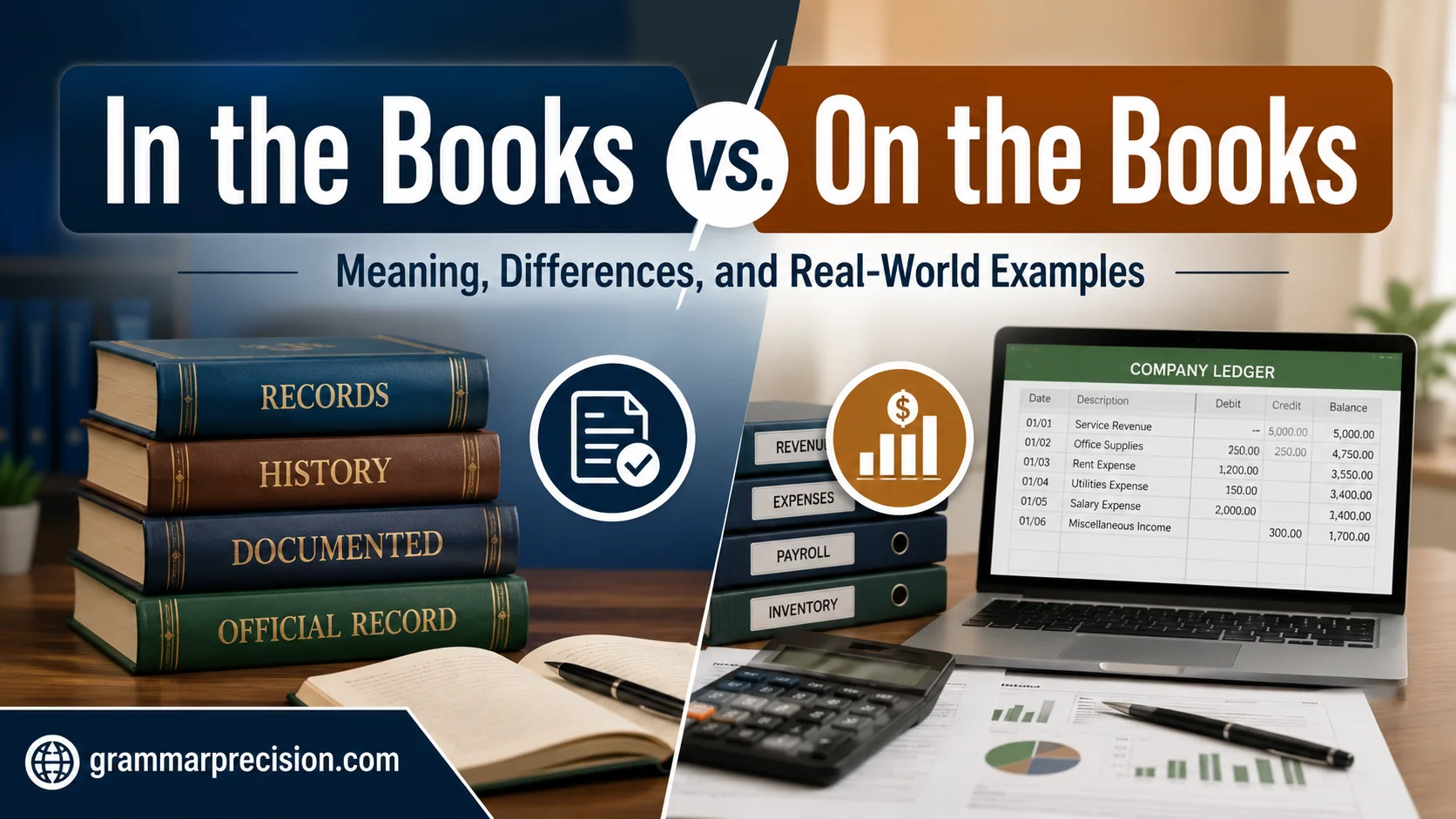
Understanding In the Books vs. On the Books helps you see the difference between these phrases through proper context and English grammar because a small preposition change creates new meanings.
Many writers and learners confuse these phrases because they look similar, but the preposition creates a clear semantic difference and contextual difference. In the Books often describes something completed, while On the Books refers to official records and documentation. These examples make the correct usage easier to understand with practical tips and memorable explanations today.
Reading books can improve your knowledge and thinking by exposing you to new ideas, cultures, and experiences. A strong understanding of language usage helps you remember why every chapter matters and how learning develops personal growth. As Theodore Roosevelt suggested, reading helps people expand their minds and gain overall knowledge through useful lessons and insights.
What Is the Difference Between “In the Books” and “On the Books”?
The easiest way to understand “in the books” vs. “on the books” is to look at whether something has already happened or whether it still exists as an official record.
| Phrase | Main Meaning | Typical Use |
| In the books | Completed, finished, or recorded as part of history | Events, achievements, experiences |
| On the books | Officially recorded, listed, scheduled, or active | Laws, rules, plans, agreements |
Think of it this way:
- In the books means a chapter has been completed.
- On the books means something is still written on an official list.
For example:
- “The 2025 season is in the books.”
→ The season has ended. - “The new policy is on the books.”
→ The policy officially exists.
Although both phrases involve records, they focus on different points in time.
What Does “In the Books” Mean?
The phrase “in the books” means that something has been completed, finished, or officially recorded as a past event. It often suggests that an experience, achievement, or period has reached its conclusion.
When people say something is “in the books,” they usually mean that it is now part of history.
Imagine a diary. Once you finish writing a particular chapter, you close the book and move forward. That completed chapter is now in the books.
How to Use “In the Books”
You can use “in the books” when talking about:
- Completed projects
- Finished events
- Past achievements
- Historical moments
- Completed seasons or periods
- Final results
Examples of “In the Books”
- “After months of hard work, the project is finally in the books.”
- “Another successful year is in the books.”
- “The championship victory is now in the books.”
- “The meeting is over, and the decision is in the books.”
In each example, something has already happened. The phrase looks backward rather than forward.
Why Do People Say “In the Books”?
The expression comes from the idea of keeping written records. For centuries, people used physical books to store important information such as:
- Financial records
- Historical events
- Legal decisions
- Personal achievements
- Business transactions
Once information entered those records, people considered it officially documented.
Over time, “in the books” developed a more figurative meaning. It stopped referring only to actual books and became a way to describe anything that had been completed or recognized.
For example:
A company may say:
“The biggest product launch in our history is now in the books.”
Nobody is putting the launch inside a physical book. The phrase simply means the event has finished and has become part of the company’s history.
What Does “On the Books” Mean?
The phrase “on the books” means that something is officially recorded, recognized, scheduled, or documented.
Unlike “in the books,” this phrase often describes something that is still active or relevant.
If something is “on the books,” it appears on an official record somewhere. It may be a law, agreement, appointment, plan, or financial entry.
How to Use “On the Books”
You can use “on the books” when discussing:
- Laws and regulations
- Official agreements
- Scheduled events
- Business plans
- Financial records
- Existing rules
Examples of “On the Books”
- “The new environmental law is now on the books.”
- “We have three major projects on the books for next year.”
- “The company has several contracts on the books.”
- “The appointment is already on the books.”
These examples show something that has been officially recorded but may not be completed yet.
Why Do People Say “On the Books”?
The phrase comes from the traditional practice of writing information into official records. Important details were often written on the pages of books, such as:
- Government documents
- Accounting ledgers
- Court records
- Business registers
The idea was simple: if something appeared in the official record, it was “on the books.”
Today, the phrase has expanded beyond physical books. A digital database, calendar system, or government website can also represent “the books.”
For example:
- “The new law is on the books.”
This means the law has officially passed and exists within the legal system.
“In the Books” vs. “On the Books”: Side-by-Side Comparison
The difference becomes much clearer when you compare the two phrases directly.
| Feature | In the Books | On the Books |
| Focus | Completion | Official existence |
| Time | Usually past | Present or future |
| Meaning | Finished and recorded | Listed or documented |
| Common Areas | Events, achievements, experiences | Laws, schedules, plans |
| Question It Answers | “What has been completed?” | “What officially exists?” |
Compare These Sentences:
Example One:
- “The football season is in the books.”
- “The football season is on the books.”
The first sentence means the season has ended.
The second sentence means the season has been officially scheduled or planned.
Example Two:
- “The agreement is in the books.”
- “The agreement is on the books.”
The first suggests the agreement has been completed and recorded.
The second suggests the agreement officially exists, perhaps before completion.
Why Do People Confuse “In the Books” and “On the Books”?
Many English learners and even native speakers confuse these expressions because both phrases involve the same noun: books.
The confusion happens because people connect “books” with records. Since both phrases relate to documentation, the difference between them feels small.
However, the preposition creates the meaning.
The Role of Prepositions in English
Prepositions often control the entire meaning of an expression.
Consider these examples:
- In trouble → experiencing a problem
- On trouble → incorrect usage
- In progress → currently happening
- On progress → incorrect usage
- On schedule → happening according to a plan
- In schedule → incorrect usage
Similarly:
- In the books → completed record
- On the books → official listing
A tiny word can completely change the message.
A Simple Memory Trick to Remember the Difference
If you struggle with these phrases, use this easy trick:
Think About a Finished Book Chapter
When something is completed, it goes inside the history of the book.
That means:
Finished = In the books
Examples:
- The tournament is over → It is in the books.
- The year ended → It is in the books.
Think About an Official List
When something appears on an official record, it stays on the list.
That means:
Officially listed = On the books
Examples:
- A law exists → It is on the books.
- A meeting is scheduled → It is on the books.
A quick shortcut:
In = finished inside history
On = officially listed somewhere
This simple association prevents most mistakes.
Also Read This: In US or In The US: The Complete Grammar Guide
Common Mistakes With “In the Books” vs. “On the Books”
Even experienced writers sometimes mix up these expressions. Here are some common errors.
Mistake: Using “In the Books” for Future Plans
Incorrect:
“We have a new marketing campaign in the books for next month.”
This sounds like the campaign has already finished.
Better:
“We have a new marketing campaign on the books for next month.”
The campaign is planned, not completed.
Mistake: Using “On the Books” for Completed Events
Incorrect:
“The wedding is finally on the books.”
This sounds like the wedding is simply recorded or scheduled.
Better:
“The wedding is finally in the books.”
The wedding has already happened.
Mistake: Assuming “Books” Always Means Printed Pages
Modern usage has moved beyond physical books.
Today, “books” can represent:
- Digital records
- Databases
- Official documents
- Company systems
- Historical archives
The expression is about records, not paper.
Real-Life Examples of “In the Books” and “On the Books”
Understanding examples from different situations makes these expressions easier to remember.
Workplace Examples
In the Books:
“The annual review process is finally in the books.”
Meaning: The review process has finished.
On the Books:
“We have several client projects on the books this quarter.”
Meaning: The projects are officially planned.
Business Examples
In the Books:
“The company’s best sales year is now in the books.”
Meaning: The year has ended.
On the Books:
“The company has $5 million in confirmed contracts on the books.”
Meaning: Those contracts officially exist.
Legal Examples
In the Books:
“The court case is now in the books.”
Meaning: The case has concluded.
On the Books:
“The regulation has been on the books for decades.”
Meaning: The regulation officially exists.
How Native Speakers Decide Between “In the Books” and “On the Books”
Native speakers usually don’t stop and analyze grammar rules before choosing between “in the books” vs. “on the books.” Instead, they think about the situation.
The key question is:
Is this something that has already happened, or is it something that officially exists?
If the answer is “it’s finished,” native speakers usually choose “in the books.”
If the answer is “it’s recorded, planned, or still active,” they usually choose “on the books.”
Consider these examples:
- “The conference is in the books.”
The conference has ended. - “The conference is on the books for October.”
The conference is scheduled.
The event itself does not change. The timing and context change the phrase.
“In the Books” vs. “On the Books” in Different Contexts
These phrases appear in many areas of life. However, each phrase has its own natural environment.
Sports and Entertainment
Sports commentators often use “in the books” after a major event ends.
Examples:
- “The World Cup final is now in the books.”
- “Another incredible season is in the books.”
- “That record-breaking performance will go down in the books.”
The phrase creates a feeling of closure. It tells the audience that a moment has passed and people will remember it.
Meanwhile, “on the books” appears when discussing upcoming schedules.
Examples:
- “Three games are still on the books this month.”
- “The team has several matches on the books before the playoffs.”
Business and Finance
Business professionals frequently use both expressions.
“In the Books” in Business
Companies use this phrase after completing major milestones.
Examples:
- “The merger is finally in the books.”
- “The fourth quarter results are now in the books.”
Here, the focus is on completed actions.
“On the Books” in Business
Businesses use this phrase for confirmed records and upcoming opportunities.
Examples:
- “The company has several new orders on the books.”
- “The contract is officially on the books.”
Here, the focus is on existing documentation.
Government and Law
Legal language often uses “on the books.”
A law that exists officially is considered to be “on the books.”
Examples:
- “The state has strict privacy laws on the books.”
- “That regulation has been on the books since 2010.”
This does not mean the law recently finished. It means the law officially exists.
However, legal professionals may use “in the books” when discussing completed cases or decisions.
Example:
- “The landmark decision is now in the books.”
Meaning: The decision has become part of legal history.
Case Studies: Seeing the Difference in Action
Real-world scenarios make the distinction much easier to understand.
Case Study: A Company Launches a New Product
Imagine a technology company spends two years developing a new smartphone.
After the launch event ends, the CEO says:
“The biggest product launch in our company’s history is now in the books.”
This means the event is complete.
However, before the launch happens, the marketing team might say:
“The product launch is on the books for September 15.”
This means the launch is officially scheduled.
The same event uses different phrases because the timeline changes.
Case Study: A New Law
A government approves a new environmental law.
After approval, someone might say:
“The new environmental protection law is now on the books.”
The law officially exists.
Years later, historians may say:
“That law-changing decision is now in the books as an important moment.”
The first sentence focuses on official status.
The second focuses on historical importance.
Case Study: Personal Achievements
Imagine someone completes a difficult marathon.
After crossing the finish line, they might say:
“My first marathon is officially in the books.”
The achievement is complete.
Before the race, they could say:
“My first marathon is on the books for next weekend.”
The event is planned.
Related Expressions You Should Know
The word “book” appears in many English expressions. Learning related phrases can improve your vocabulary and prevent confusion.
| Expression | Meaning | Example |
| In the books | Completed or recorded | The project is in the books. |
| On the books | Officially recorded or scheduled | The meeting is on the books. |
| Off the books | Secret, unofficial, or not recorded | The payment was kept off the books. |
| By the book | Following rules exactly | She always does everything by the book. |
| Cook the books | Falsify financial records | The company was accused of cooking the books. |
Each expression uses “book” differently. The surrounding words determine the meaning.
“In the Books” vs. “In the Book”: Is There a Difference?
Some people wonder whether “in the book” and “in the books” mean the same thing.
Usually, they do not.
“In the Book”
This normally refers to something written inside a specific book.
Example:
“The answer appears in the book.”
Meaning: The answer is physically written inside a publication.
“In the Books”
This is an idiomatic expression meaning something has been completed or recorded.
Example:
“The season is in the books.”
Meaning: The season has ended.
The plural form creates the idiomatic meaning.
Quick Quiz: Test Your Understanding
Choose the correct phrase: in the books or on the books.
Question One
“The company has three new contracts ______ for next year.”
Answer:
On the books
Why? The contracts are officially recorded and planned.
Question Two
“The historic election is now ______.”
Answer:
In the books
Why? The election has already happened.
Question Three
“The new safety regulation has been ______ since 2018.”
Answer:
On the books
Why? The regulation officially exists.
Question Four
“After ten years, the coach’s career is finally ______.”
Answer:
In the books
Why? The career period has ended.
How to Use These Phrases in Professional Writing
Although both expressions are common in conversation, choosing the right one matters in professional communication.
Use “In the Books” When You Want to Highlight Completion
Good examples:
- “The successful campaign is now in the books.”
- “The annual report is officially in the books.”
This creates a sense of achievement and closure.
Use “On the Books” When You Want to Highlight Confirmation
Good examples:
- “The agreement is now on the books.”
- “The meeting is on the books for Monday.”
This emphasizes official recognition or scheduling.
FAQs:
What is the difference between In the Books and On the Books?
In the Books usually means something is completed, finished, or recorded as an event that has already happened. On the Books refers to something officially recorded, recognized, or still active, such as laws, accounts, or documents. The main difference comes from the preposition and the context where each phrase is used.
When should you use In the Books?
You should use In the Books when talking about something that is already completed or considered finished. For example, after finishing a successful project, you might say it is “in the books.” This phrase focuses on a completed action, achievement, or past event that has been recorded.
When should you use On the Books?
You use On the Books when something exists in an official record or remains active. It is commonly used for laws, rules, accounts, and official documentation. For example, a company policy can be “on the books” because it is still recognized and officially maintained.
Why do people confuse In the Books and On the Books?
People often confuse these phrases because both contain the word books and relate to records or information. However, the small change in the preposition changes the meaning completely. Understanding the context, timeline, and purpose of the sentence helps you choose the correct expression.
How can I remember the difference between these phrases?
A simple way to remember is that In the Books often points to something finished or stored as a completed record, while On the Books suggests something officially listed or currently active. Focus on the meaning and intent of the sentence rather than only the words.
Conclusion:
Understanding In the Books vs. On the Books becomes easier when you focus on context, prepositions, and meaning. In the Books describes completed events, while On the Books refers to official records or active information. Learning this small difference improves your English grammar, writing accuracy, and overall language usage skills.