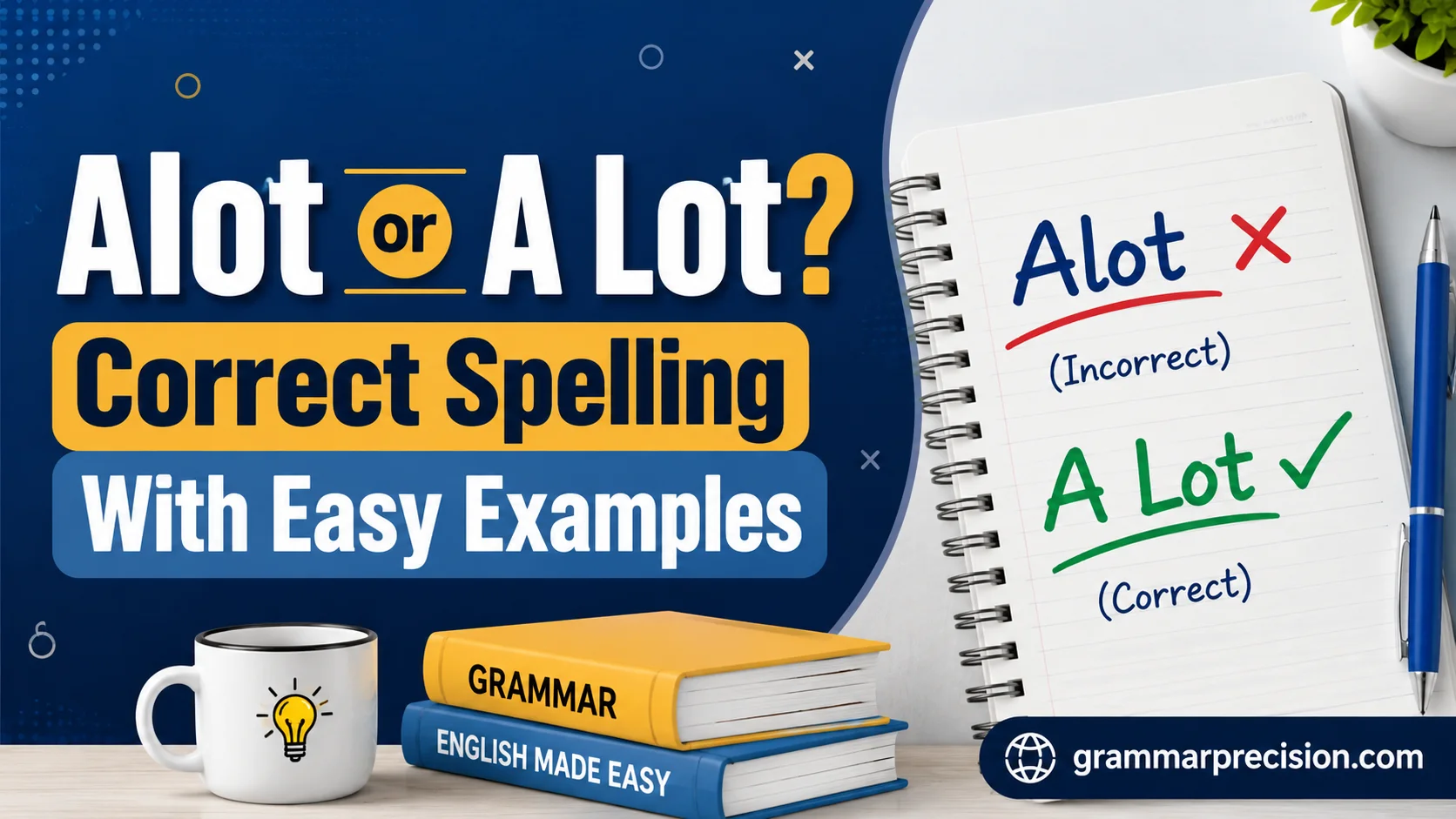
When you wonder Alot or A Lot, the answer is simple: a lot is correct. Learn the spelling, meaning, grammar rules, and examples to avoid this common mistake.
The confusion between alot and a lot happens because both forms sound identical when spoken. However, standard English always uses a lot as two separate words when you mean many, much, or frequently. Once you understand how this phrase works, you’ll find the distinction surprisingly easy to remember.
Interestingly, a lot can serve several purposes in everyday English. It can describe a large quantity, emphasize a degree, or show frequency. Meanwhile, allot is a completely different word meaning to assign or distribute something. Knowing these subtle differences will help you write with greater accuracy and confidence.
Alot or A Lot: The Short Answer
A lot is correct when you mean “many,” “much,” “a large amount,” or “frequently.”
- Correct: I have a lot of work today.
- Correct: She travels a lot.
- Incorrect: I have alot of work today.
- Incorrect: She travels alot.
The mistake happens because a lot behaves like a single unit in speech. When you say it quickly, the boundary between the two words nearly disappears. Writing, however, keeps that boundary visible.
Merriam-Webster describes a lot as a phrase formed from the article a and the noun lot. It can function as a noun phrase or work adverbially to express degree or frequency.
Quick comparison
| Form | Correct? | Meaning | Example |
| a lot | Yes | Much, many, frequently | We learned a lot. |
| alot | No | Nonstandard spelling | Avoid this form. |
| allot | Yes | Assign or distribute | We’ll allot each person ten minutes. |
That distinction solves most confusion immediately.
What Does “A Lot” Mean?
The phrase a lot generally describes a large quantity, amount, degree, or frequency.
Its exact meaning depends on where it appears in the sentence.
Consider these examples:
- A lot of students joined the class.
- She has a lot of patience.
- We laughed a lot.
- This version is a lot better.
- I don’t have a lot left.
The first two examples describe quantity. The third expresses frequency. The fourth indicates degree, while the last example refers to an amount that the context makes clear.
Cambridge Grammar notes that a lot and lots can discuss quantities, amounts, and degrees. When a noun follows them, a lot of is used.
“A lot” meaning a large number
Use a lot of with plural countable nouns when you mean many.
A lot of people attended the concert.
A lot of books were donated to the library.
A lot of questions came up during the meeting.
Here, a lot of tells you that the number is large without giving an exact figure.
“A lot” meaning a large amount
You can also use a lot of with uncountable nouns.
We need a lot of water.
She has a lot of experience.
They spent a lot of money.
Words such as water, money, and experience normally function as uncountable nouns in these meanings. Therefore, a lot of works naturally with them.
“A lot” meaning frequently
You don’t always need of.
When a lot modifies a verb and means “frequently” or “to a great degree,” it commonly appears without a noun after it.
I exercise a lot.
They argue a lot.
We travel a lot.
She thinks about it a lot.
This is one reason the phrase deserves more attention than a simple spelling correction. A lot can perform different grammatical jobs depending on context.
Why Is “A Lot” Two Words?
The answer becomes easier when you look at the phrase itself.
Historically and grammatically, a lot contains two separate elements: the indefinite article a and the noun lot. The noun lot has long been associated with a portion, share, or quantity.
Over time, a lot developed its familiar quantity-related meanings. English speakers now use the phrase so frequently that it can feel like one indivisible word.
That perception creates the spelling error alot.
Think about spoken English. When you say:
“I like it a lot.”
You don’t pause dramatically between a and lot. The phrase flows together. Your ear hears one rhythmic unit even though your writing should show two words.
This phenomenon isn’t unusual. English contains many expressions that sound tightly connected while remaining separate words.
The important point is simple: common pronunciation doesn’t determine correct spelling.
How to Use “A Lot” in a Sentence
Once you understand the basic meaning, using a lot becomes straightforward.
“A Lot” With Plural Countable Nouns
Use a lot of before plural countable nouns when you mean many.
A lot of students attended the lecture.
A lot of cars were parked outside.
A lot of ideas came from the discussion.
The pattern is:
a lot of + plural countable noun
For example:
a lot of books
a lot of people
a lot of problems
a lot of opportunities
“A Lot” With Uncountable Nouns
Use a lot of with singular uncountable nouns when you mean a large amount.
We need a lot of time.
He showed a lot of confidence.
The project requires a lot of work.
The pattern is:
a lot of + uncountable noun
This makes a lot of especially flexible because it works with both plural countable nouns and singular uncountable nouns.
“A Lot” Without a Following Noun
Sometimes the noun is obvious from context, so you can leave it out.
“How much money did you spend?”
“A lot.”
“Did many people come?”
“Yes, a lot.”
In these cases, a lot stands alone because the listener already understands what quantity you’re discussing.
“A Lot” as an Adverb
A lot can modify a verb and indicate frequency or degree.
I read a lot.
She worries a lot.
We enjoyed the trip a lot.
It can also strengthen a comparison:
This laptop is a lot faster.
The new system is a lot easier to use.
He feels a lot better today.
Cambridge Grammar recognizes these adverbial uses for frequency, quantity, and degree.
A Lot With Countable and Uncountable Nouns
One of the most useful features of a lot of is its broad grammatical range.
| Noun type | Correct example |
| Plural countable | A lot of students joined. |
| Plural countable | A lot of questions remain. |
| Uncountable | A lot of information was shared. |
| Uncountable | A lot of money was spent. |
| Uncountable | A lot of time was wasted. |
Notice that the noun itself determines whether you use a plural or singular form.
You wouldn’t normally write:
A lot of informations
Instead, write:
A lot of information
Likewise, advice is normally uncountable:
She gave me a lot of advice.
Not:
She gave me a lot of advices.
So learning a lot can also sharpen your understanding of countable and uncountable nouns.
Alot vs. A Lot: Why Is “Alot” Wrong?
Alot is a common misspelling of a lot.
You may encounter it in informal online writing, social media posts, comments, or quick messages. Its visibility doesn’t make it standard.
Most major usage authorities treat a lot as the standard form when the intended meaning is “a large amount” or “very much.” Merriam-Webster specifically advises using a lot rather than alot.
That distinction matters because frequency and correctness aren’t the same thing.
A mistake can become widespread without becoming standard.
Incorrect
I’ve learned alot from this experience.
Correct
I’ve learned a lot from this experience.
Incorrect
There were alot of reasons.
Correct
There were a lot of reasons.
A useful editing trick is to train your eyes to notice the space. When proofreading, mentally separate the phrase:
a + lot
If you mean “a large amount,” keep those two words apart.
A Lot vs. Allot: The Difference
Here’s where things get more interesting.
A lot and allot sound the same in many varieties of English, but they don’t mean the same thing.
Allot is a verb meaning to assign, distribute, or give someone a particular share.
Compare:
We have a lot of work.
We will allot three hours to the project.
The first sentence says the amount of work is large. The second says someone will assign a specific amount of time.
Side-by-side comparison
| Expression | Meaning | Example |
| a lot | A large amount or degree | She has a lot of energy. |
| allot | Assign a share or portion | We’ll allot each team two hours. |
| alot | Nonstandard spelling | Don’t use it in standard writing. |
A simple memory trick works well:
A lot = amount.
Allot = assign.
If you can replace the word with assign, allot may be the word you need.
The manager will allot five minutes to each speaker.
You could say:
The manager will assign five minutes to each speaker.
That substitution confirms the meaning.
Also Read This: Should Of or Should Have? Meaning, Usage, and Examples
A Lot vs. Lots vs. Lots of
These expressions are closely related, but they don’t have exactly the same tone.
A lot and lots are common in informal English. Cambridge notes that lots is generally even more informal than a lot.
Compare:
I have a lot of homework.
I have lots of homework.
Both are natural. The second sounds slightly more casual.
When a noun follows, use of:
a lot of people
lots of people
a lot of money
lots of money
When the noun is obvious, you can omit of:
“Do you have enough?”
“Yes, a lot.”
“Did she buy anything?”
“Yes, lots.”
Don’t write “lots of” when no noun follows and the intended construction requires lots alone.
Is “A Lot” Correct in Formal Writing?
Yes, a lot is grammatically correct. However, context matters.
The phrase is common and natural in everyday English, particularly in affirmative statements. Cambridge recommends a lot of and lots of as common informal quantity expressions and notes that more formal styles often favor alternatives such as a great deal of or a large number of.
For example:
Conversational:
A lot of people supported the proposal.
More formal:
A large number of people supported the proposal.
Both sentences are grammatical. The second simply has a more formal register.
Likewise:
The policy created a lot of concern.
could become:
The policy created a great deal of concern.
The best choice depends on your audience, purpose, and tone.
Don’t replace every a lot automatically. Precision matters more than sounding artificially formal.
Stronger Alternatives to “A Lot”
Sometimes a lot is exactly right. Other times, repeating it several times makes your writing feel vague.
Choose a more precise alternative when the context allows.
| Instead of “a lot” | Consider |
| a lot of people | many people |
| a lot of problems | numerous problems |
| a lot of money | a substantial amount of money |
| a lot of time | considerable time |
| a lot of improvement | significant improvement |
| a lot of interest | considerable interest |
| like it a lot | like it very much |
| happens a lot | happens frequently |
For example:
The company received a lot of complaints.
is perfectly understandable.
But:
The company received hundreds of complaints.
is stronger if you actually know the number.
That is an important writing principle: replace vague quantity with exact quantity whenever reliable evidence exists.
Common Mistakes With “A Lot”
Even after learning the correct spelling, writers sometimes stumble over related grammar points.
Writing “Alot”
This remains the biggest mistake.
❌ I miss you alot.
✅ I miss you a lot.
Confusing “A Lot” With “Allot”
❌ We have to a lot ten minutes to each speaker.
✅ We have to allot ten minutes to each speaker.
Here, the intended meaning is “assign,” so allot is correct.
Adding “of” When It Isn’t Needed
When a lot functions adverbially, you don’t need of.
✅ She studies a lot.
❌ She studies a lot of.
However, when a noun follows, a lot of is normally required:
✅ She studies a lot of material.
Using “A Lot” Too Repeatedly
Consider this paragraph:
I learned a lot. I read a lot. I practiced a lot. I made a lot of notes and asked a lot of questions.
Nothing is grammatically disastrous here, but the repetition sounds dull.
A stronger version might say:
I learned a great deal. I read extensively, practiced regularly, made detailed notes, and asked plenty of questions.
The lesson isn’t “never use a lot.” It’s use it when it serves the sentence.
Thirty Examples of “A Lot” in Everyday English
Here are practical examples showing how flexible the phrase can be:
- I learned a lot from that mistake.
- She talks a lot.
- We have a lot of work today.
- He has a lot of experience.
- They bought a lot of books.
- There are a lot of reasons to wait.
- I don’t have a lot of time.
- She spends a lot of money on travel.
- We saw a lot of people downtown.
- He exercises a lot.
- I like this restaurant a lot.
- They laughed a lot during dinner.
- This one is a lot better.
- The new model is a lot faster.
- She feels a lot happier now.
- We received a lot of feedback.
- There was a lot of traffic.
- He showed a lot of courage.
- I have a lot to learn.
- They still have a lot to discuss.
- A lot of students passed the exam.
- A lot of information was available.
- Did you eat a lot?
- Have you traveled a lot?
- We didn’t spend a lot.
- She doesn’t complain a lot.
- There aren’t a lot of options.
- He doesn’t have a lot of patience.
- I appreciate it a lot.
- We enjoyed ourselves a lot.
Notice how a lot moves around the sentence. Its position and function depend on what you want it to modify.
A Quick Case Study: One Space Changes Everything
Imagine a student writes this sentence in an essay:
The research provides alot of useful information.
The meaning is obvious. A reader will probably understand it instantly. Yet the spelling error can undermine the writer’s credibility, particularly in academic or professional work.
The corrected sentence is:
The research provides a lot of useful information.
Now consider a different sentence:
The committee will allot each applicant ten minutes.
Changing allot to a lot would completely destroy the sentence’s meaning.
This small comparison illustrates why spelling isn’t merely cosmetic. A missing space can turn a standard phrase into an error, while a different-looking word can change the meaning entirely.
Alot or A Lot: Quick Memory Trick
Here’s the easiest rule to remember:
If you mean “many,” “much,” or “frequently,” write “a lot.”
Think of the phrase as a little two-piece puzzle:
A + LOT = A LOT
Don’t let pronunciation trick your spelling.
For allot, remember:
ALLOT = ASSIGN
If you’re distributing time, money, resources, seats, responsibilities, or portions, allot may be the word you need.
Quick Quiz: Can You Spot the Correct Form?
Choose a lot, alot, or allot.
- We have ___ of work to finish.
- The manager will ___ five minutes to each speaker.
- She travels ___ for work.
- I learned ___ from the experience.
- There were ___ of people at the event.
- The teacher will ___ each student a different task.
- He worries ___.
- They spent ___ of money on repairs.
- She improved ___ after practicing.
- The committee decided to ___ more resources to the project.
Answers
- a lot
- allot
- a lot
- a lot
- a lot
- allot
- a lot
- a lot
- a lot
- allot
The pattern becomes much clearer once you focus on meaning rather than sound.
FAQs:
Is “alot” or “a lot” correct?
A lot is correct when you mean many, much, a large amount, or frequently. It should always appear as two separate words in standard English. Alot is a common spelling mistake and should be avoided in formal and informal writing.
Is “alot” a real English word?
Alot isn’t considered a standard English word when used to mean a large amount. Although you may see it online or in casual messages, standard writing requires a lot as two separate words.
What is the difference between “a lot” and “allot”?
A lot means a large amount, number, or degree, while allot is a verb meaning to assign or distribute something. For example, “I have a lot of work” differs from “We will allot each person ten minutes.”
Can I use “a lot” in formal writing?
Yes, a lot is grammatically correct, but it can sound somewhat informal in certain formal contexts. Depending on the sentence, you might choose alternatives such as many, numerous, considerably, or a substantial amount for a more precise tone.
How can I remember the correct spelling of “a lot”?
Remember that a lot contains two words: a + lot. If you’re describing many, much, or a large amount, keep the space. If you’re talking about assigning something, use allot instead.
Conclusion:
When choosing between alot or a lot, always use a lot when you mean a large amount, many, much, or frequently. The word allot has a different meaning: to assign or distribute something. Remembering this simple distinction will help you avoid a common spelling mistake and make your everyday and professional writing more accurate.