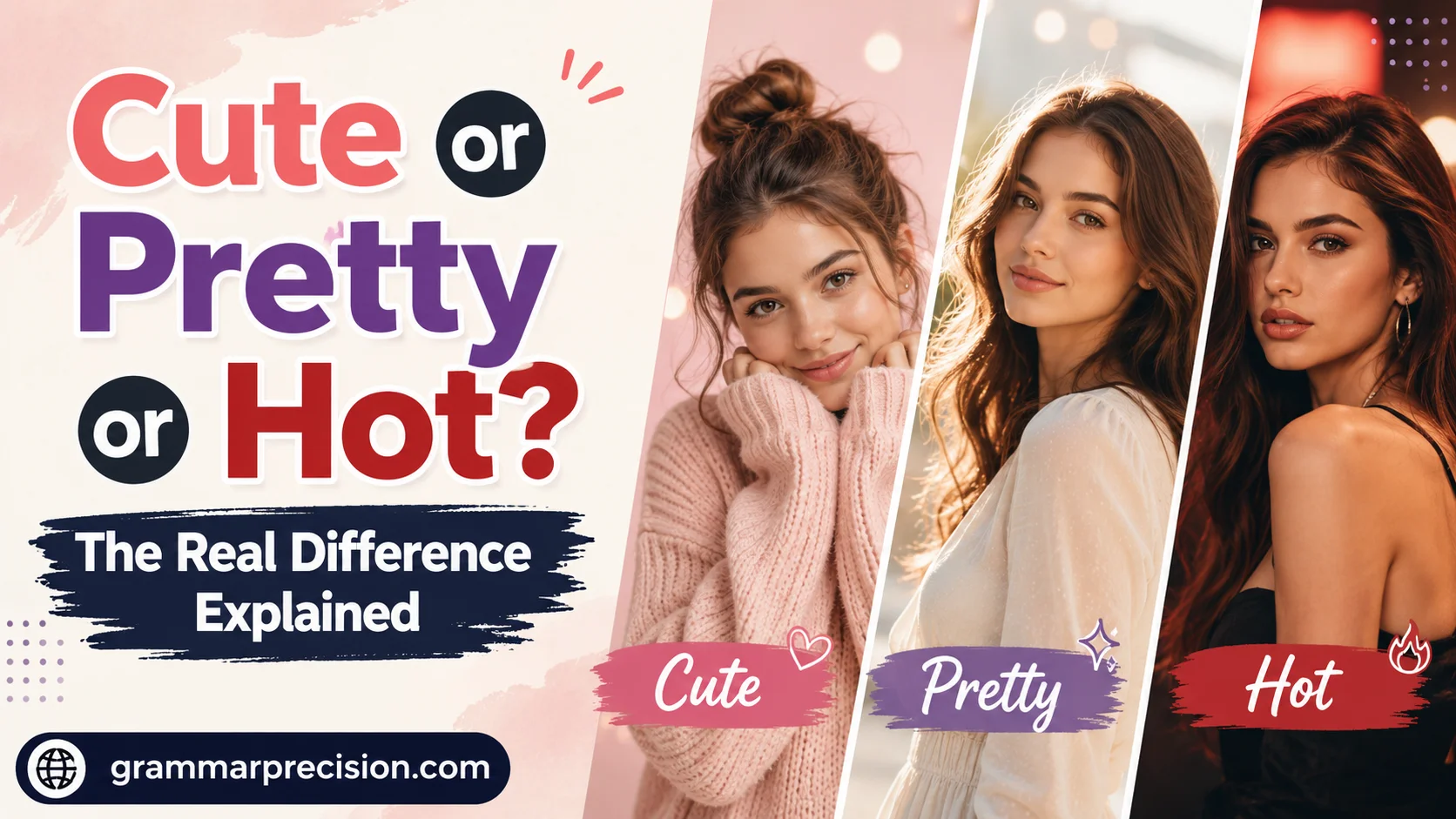
Cute or Pretty or Hot can describe someone’s appearance, but these words don’t mean exactly the same thing. Each word expresses a different kind of attraction, beauty, or appeal, so choosing the right one depends on context, tone, and what you want to say.
The word cute usually describes someone who looks adorable, charming, or sweet. It can suggest a youthful or lovable appearance without focusing strongly on physical beauty. You might call someone cute because of their smile, expressions, style, or personality. For example, “She has a cute smile” sounds friendly, warm, and affectionate.
Pretty generally means pleasant and attractive in appearance. It often focuses on someone’s facial features, beauty, clothing, or overall look. Unlike “cute,” it usually sounds more mature and elegant. For example, “She looks pretty in that dress” gives a clear compliment about her appearance while keeping the tone polite, positive, and respectful.
Hot has a stronger and more direct meaning. It usually describes someone who looks sexually attractive, desirable, or physically appealing. Because of its more intense tone, you should consider the relationship, setting, and audience before using it. “He’s hot” can sound casual among friends, but it may feel too personal or inappropriate in a professional or formal situation.
Cute or Pretty or Hot: What’s the Difference?
At a glance, the three words describe different kinds of appeal:
| Word | Main Meaning | Typical Feeling | Attraction Level | Common Use |
| Cute | Charming, endearing, or pleasantly attractive | Warm and affectionate | Mild to strong | Personality, looks, behavior |
| Pretty | Visually attractive or beautiful | Pleasant and admiring | Moderate | Appearance, clothes, features |
| Hot | Strongly physically attractive | Bold and intense | Strong | Physical attraction, flirting |
| Beautiful | Highly pleasing or attractive | Admiring and sincere | Moderate to strong | Appearance, personality, things |
| Sexy | Sexually appealing | Intimate and suggestive | Strong | Romantic or sexual contexts |
Think of these words as different lenses rather than steps on a ladder.
“Cute” often highlights charm. “Pretty” usually highlights beauty. “Hot” emphasizes physical attraction. Someone can easily be all three at different moments.
For example, someone might look cute in an oversized hoodie, pretty at a formal event, and hot during a confident night out. The person hasn’t changed into three different people. The speaker is simply emphasizing different qualities.
What Does “Cute” Mean?
Cute describes something or someone that is appealing in a charming, sweet, playful, or endearing way. It often carries a softer emotional tone than “hot.”
You can use “cute” for appearance, behavior, expressions, clothing, animals, objects, and personality traits.
Consider these examples:
- “You look cute today.”
- “That puppy is so cute.”
- “Her smile is really cute.”
- “That was a cute message.”
- “He has a cute laugh.”
Notice something important: cute doesn’t always mean physically attractive.
A person’s mannerisms can be cute. Their reaction to a surprise can be cute. Even the way someone gets excited about their favorite hobby can seem cute.
Cute Isn’t Just About Looks
This is where cute vs pretty becomes especially interesting.
“Pretty” generally points toward appearance. “Cute” can describe the entire impression someone creates.
Imagine a person laughing because they can’t pronounce a difficult word. You might call the moment cute. You’re responding to the person’s behavior and charm, not judging their facial features.
That’s why “cute” often feels more personal.
It can communicate:
“There’s something about you that I find charming and endearing.”
That message may be friendly, romantic, playful, or affectionate depending on context.
Cute Personality vs Cute Appearance
Someone can have a cute personality without fitting a traditional idea of physical beauty.
For instance, a person who gets excited easily, tells silly jokes, makes funny faces, or reacts enthusiastically to small things may seem cute because their behavior creates warmth.
You can also describe physical features as cute:
- a cute smile
- cute dimples
- cute hairstyle
- cute outfit
- cute shoes
- cute facial expression
The word often makes a compliment feel lighter and less intense.
Is “Cute” Romantic or Friendly?
It can be either.
If a close friend says, “That’s a cute jacket,” the comment probably concerns the jacket. If someone you’re dating says, “You’re so cute when you’re nervous,” the meaning can become much more romantic.
Context does the heavy lifting.
Here are some common interpretations:
| Situation | Possible Meaning of “Cute” |
| Friend compliments your outfit | Pleasant or stylish |
| Partner compliments you | Affectionate or romantic |
| Crush texts “You’re cute” | Possibly flirtatious |
| Someone praises your reaction | Endearing |
| Person comments on a pet | Simply charming |
So, don’t assume cute always means friend-zoned. It can be a very affectionate romantic compliment.
What Does “Pretty” Mean?
Pretty usually describes someone or something that looks attractive, pleasing, or beautiful.
It’s often more appearance-focused than “cute.”
You might say:
- “You look pretty tonight.”
- “That’s a pretty dress.”
- “She has pretty eyes.”
- “What a pretty garden.”
- “The sunset looks pretty.”
The word can sound gentle and complimentary without automatically carrying a sexual message.
That’s one reason “pretty” works in many more situations than “hot.”
Pretty as a Beauty Compliment
When you call someone pretty, you’re generally praising their visual appearance.
You may be referring to:
- facial features
- hair
- clothing
- overall appearance
- smile
- eyes
- makeup
- presentation
The compliment can be romantic, friendly, or simply appreciative.
For example, “You look pretty in that dress” focuses on how the dress and the person’s appearance work together. It doesn’t necessarily suggest intense physical desire.
Pretty vs Beautiful
Although pretty and beautiful overlap, they aren’t always identical in tone.
“Pretty” often sounds softer, lighter, and more casual.
“Beautiful” can sound deeper or more emphatic.
Compare:
- “You look pretty today.”
- “You look beautiful today.”
Both are positive. However, “beautiful” may feel more emotionally powerful depending on the relationship.
This doesn’t mean “pretty” is weaker in every situation. Tone, facial expression, and context can completely change the impact.
Can Pretty Sound Romantic?
Absolutely.
A person saying “You look pretty” to someone they love can express genuine admiration. The word itself doesn’t determine whether the statement is romantic.
Compare these two situations:
Friend: “Your new dress is pretty.”
Partner: “You look so pretty tonight.”
The vocabulary is nearly identical. The relationship changes the emotional meaning.
What Does “Hot” Mean?
Hot is much more direct. When you call someone hot, you’re usually saying that you find them strongly physically attractive.
For example:
- “You look hot tonight.”
- “He’s really hot.”
- “That actor is incredibly hot.”
- “She looked hot in that outfit.”
Unlike “cute,” which can describe charm, or “pretty,” which usually emphasizes beauty, “hot” centers on strong physical appeal.
That’s why it deserves more caution.
Hot vs Sexy
“Hot” and “sexy” overlap heavily, but they aren’t perfect synonyms.
Hot often works as a broad expression of strong physical attraction.
Sexy more directly suggests sexual appeal.
For example:
- “She’s hot.” → Strong physical attraction.
- “That outfit is sexy.” → The outfit creates a sexually appealing impression.
Depending on the situation, both can carry a sexual undertone.
Why Hot Has a Stronger Edge
Calling someone hot can sound bold because it tells them that you find their physical appearance highly attractive.
That’s very different from:
“That’s a cute sweater.”
The first statement evaluates a person’s physical attractiveness. The second evaluates clothing.
As a result, hot usually requires more awareness of boundaries.
A partner may love hearing it. A stranger may not appreciate it. A coworker could find it inappropriate.
When “Hot” Can Become Awkward
The problem isn’t the word itself. The problem is context.
Calling your spouse hot is generally easy to understand as romantic admiration. Saying the same thing to someone you barely know can feel intrusive.
Before using the word, consider:
- How well do you know the person?
- Is the relationship romantic?
- Are you in a private or public setting?
- Could the comment make the person uncomfortable?
- Is the environment professional?
- Does the person welcome that kind of language?
When there’s doubt, pretty or cute may communicate admiration without crossing a boundary.
The Hidden Emotional Difference Between Cute, Pretty, and Hot
The simplest way to understand cute or pretty or hot is to look at what each word tends to emphasize.
Cute: “You’re Charming”
Cute often communicates warmth, affection, playfulness, or endearment.
It can suggest that you enjoy something about the person’s personality or behavior.
Pretty: “You’re Beautiful”
Pretty usually communicates visual admiration.
You’re noticing that someone looks attractive, pleasant, or elegant.
Hot: “I’m Strongly Attracted to You”
Hot communicates intense physical attraction.
The word can be flirtatious and may carry a sexual undertone.
Here’s the distinction in miniature:
Cute → charm and affection
Pretty → beauty and appearance
Hot → strong physical attraction
That isn’t an absolute rule. Language is flexible. Still, this framework makes the difference much easier to understand.
Also Read This: Bit or Bitten? Unpacking the Grammar to Master the Difference
Is Cute Less Attractive Than Pretty?
Not necessarily.
This is one of the biggest misconceptions about these words.
“Cute” doesn’t mean unattractive. It simply describes a different kind of appeal. Someone can be extremely attractive while still looking cute.
Picture a person smiling shyly after receiving a compliment. You may think they’re attractive, but “cute” might describe the moment better than “hot.”
Attraction isn’t a measuring tape.
Someone can be:
- cute because of their personality
- pretty because of their appearance
- hot because of their physical appeal
All three can coexist.
Is Pretty Less Attractive Than Hot?
Again, not necessarily.
Pretty and hot emphasize different qualities.
“Pretty” can describe beauty without suggesting sexual desire. “Hot” usually puts stronger emphasis on physical attraction.
For example, someone might say:
“She has a pretty face.”
That focuses on beauty.
Another person might say:
“She looks hot tonight.”
That focuses on strong physical attraction.
Neither statement establishes an objective ranking. They’re communicating different impressions.
Can Someone Be Cute and Hot at the Same Time?
Yes. In fact, this happens all the time.
A person might have an adorable sense of humor and a striking physical appearance. Calling them cute emphasizes their charm. Calling them hot emphasizes their physical appeal.
The combination can be especially common in romantic relationships.
For example:
“You’re so cute when you laugh, but you look incredibly hot tonight.”
The two compliments don’t contradict each other. They describe different dimensions of attraction.
One is emotional and endearing. The other is strongly physical.
Can Someone Be Pretty Without Being Hot?
Definitely.
Beauty and sexual attraction aren’t identical.
You might think someone has beautiful eyes, elegant style, or a lovely face without personally feeling strong physical attraction toward them.
Likewise, someone may look hot to you without fitting your idea of traditionally pretty.
Personal taste matters enormously here.
Attraction is subjective, while “pretty” can sometimes describe a more general visual quality.
Why “Hot” Can Be Risky
Words related to physical or sexual attraction can easily cross social boundaries.
A useful rule is simple:
The closer the relationship, the more freedom you generally have to use intimate compliments.
That doesn’t mean familiarity gives unlimited permission. It simply means context matters.
Workplace Situations
In professional environments, avoid calling coworkers or clients hot. Even if intended as a compliment, the word can make a professional interaction uncomfortable.
“Your presentation looked great” is appropriate.
“You look hot today” is a completely different message.
Strangers and Casual Acquaintances
With strangers, strong physical compliments can feel intrusive. A neutral compliment about someone’s clothing or style is usually safer.
For example:
- “That’s a great jacket.”
- “I like your style.”
- “That color looks great on you.”
These statements show appreciation without making the interaction intensely personal.
Cute vs Pretty vs Hot Across Different Situations
Context can completely change which word works best.
| Situation | Cute | Pretty | Hot |
| Complimenting a child | Yes | Sometimes | No |
| Talking to a partner | Yes | Yes | Yes |
| Complimenting a close friend | Yes | Yes | Depends |
| Flirting with a date | Yes | Yes | Yes |
| Professional setting | Usually | Usually | Avoid |
| Complimenting clothing | Yes | Yes | Sometimes |
| Talking about a celebrity | Yes | Yes | Yes |
| Complimenting a stranger | Usually | Usually | Risky |
The table reveals an important principle: there’s no universally “best” word.
The right choice depends on what you want the listener to understand.
What Does It Mean When Someone Calls You Cute?
If someone calls you cute, look at the context rather than the word alone.
A friend might mean you’re charming. A romantic partner might mean you’re adorable and attractive. A crush might be flirting subtly.
Look for supporting clues:
- Do they frequently compliment you?
- Do they use playful or romantic language?
- Are they noticeably interested in you?
- Did they compliment your personality or appearance?
- Did they say it privately or casually in a group?
One word rarely tells the entire story.
What Does It Mean When Someone Calls You Pretty?
Being called pretty usually means the person finds your appearance pleasant or attractive.
It can be a straightforward compliment. It can also carry romantic meaning.
For example, “Your hair looks pretty today” is mainly appearance-focused. “You’re so pretty” can feel more personal because it directly evaluates the person.
Again, tone and relationship matter.
What Does It Mean When Someone Calls You Hot?
If someone calls you hot, they’re usually expressing strong physical attraction.
Unlike “pretty,” the statement tends to feel more intense. Unlike “cute,” it generally doesn’t emphasize innocence or endearing charm.
If the person is flirting, “hot” may be an intentional signal of attraction.
However, don’t automatically assume romantic interest based on one word. Some people use “hot” casually when discussing celebrities, fashion, or popular culture.
How to Tell Which Meaning Someone Intended
When you’re interpreting cute, pretty, or hot, consider five clues.
Relationship
A partner’s “You’re hot” carries a different meaning from a stranger’s comment.
Tone
Playful, teasing, serious, affectionate, and flirtatious tones can change the message.
Situation
A private date and a workplace meeting have completely different social expectations.
Body Language
Facial expression, eye contact, and general behavior can provide additional context.
Surrounding Words
Compare:
“That’s a cute dress.”
with:
“You’re cute.”
The first focuses on clothing. The second focuses directly on the person.
How to Choose the Right Compliment
Before choosing between cute or pretty or hot, ask yourself one question:
What exactly am I trying to communicate?
If you want to emphasize charm or affection, choose cute.
If you want to emphasize beauty, choose pretty.
If you want to communicate strong physical attraction, choose hot.
A quick decision guide can help:
- Cute → “You have an adorable, charming quality.”
- Pretty → “You look beautiful or attractive.”
- Hot → “I find you strongly physically attractive.”
When you’re unsure, start with the least intense option that still expresses your meaning.
25 Natural Examples of Cute, Pretty, and Hot
Examples With “Cute”
- “You look cute in that sweater.”
- “That’s such a cute smile.”
- “Your laugh is cute.”
- “That was a cute reaction.”
- “You have a cute sense of humor.”
- “Your dog is ridiculously cute.”
- “That’s a cute little café.”
Examples With “Pretty”
- “You look pretty tonight.”
- “That’s a pretty dress.”
- “She has pretty eyes.”
- “Your handwriting is pretty.”
- “That’s a pretty shade of blue.”
- “The garden looks pretty in spring.”
- “You have a really pretty smile.”
Examples With “Hot”
- “You look hot tonight.”
- “That actor is really hot.”
- “You look incredibly hot in that outfit.”
- “She looked hot at the party.”
- “He thinks his girlfriend is hot.”
- “That photo is seriously hot.”
- “You somehow look both cute and hot.”
The final example shows why these categories aren’t mutually exclusive.
Common Mistakes With Cute, Pretty, and Hot
A few misunderstandings appear again and again.
Treating the Words as a Strict Ranking
Cute isn’t automatically below pretty. Pretty isn’t automatically below hot. Each word describes a different quality.
Assuming Cute Means Childish
Cute can describe adults, romantic partners, fashion, behavior, personality, and appearance.
Using Hot in Professional Settings
Even when meant positively, “hot” can sound sexual. Keep professional compliments focused on appropriate qualities.
Assuming Pretty Always Means Romantic Interest
Someone can call you pretty without flirting. The word can simply express admiration.
Ignoring Context
The same sentence can feel sweet in one situation and uncomfortable in another. Context is the invisible punctuation of conversation.
Cute, Pretty, or Hot? A Simple Decision Guide
Use this quick guide when you’re stuck:
Want to sound sweet? → Cute
Want to praise beauty? → Pretty
Want to express strong physical attraction? → Hot
There’s your shortcut.
But remember that language doesn’t operate like a vending machine. You can’t insert a word and guarantee one exact emotional response. People interpret compliments through their relationship, culture, expectations, tone, and personal preferences.
FAQs:
What is the difference between cute, pretty, and hot?
Cute suggests someone is adorable, charming, or sweet. Pretty describes someone who looks attractive and beautiful. Hot usually means someone is strongly or sexually attractive. The best choice depends on the context, relationship, tone, and level of attraction you want to express.
Is cute a compliment for someone’s appearance?
Yes, cute is a positive compliment. It often describes someone’s smile, face, outfit, behavior, or overall appearance. The word can also suggest a warm, playful, or youthful quality. However, its meaning can change slightly depending on the situation and relationship between the speakers.
Is pretty stronger than cute?
Not necessarily. Cute and pretty express different types of attraction rather than different levels. Cute often feels more sweet, charming, or playful, while pretty sounds more beautiful, graceful, or mature. Your choice depends on the person’s appearance and the specific quality you want to highlight.
Is it appropriate to call someone hot?
Calling someone hot can be appropriate in casual conversations, especially when discussing physical attraction with friends or someone you’re comfortable with. However, it can sound sexual or personal, so you should avoid using it in professional, formal, or unfamiliar situations where the comment could make someone uncomfortable.
Can cute, pretty, and hot describe the same person?
Yes, the same person can be cute, pretty, and hot because each adjective highlights a different quality. Someone may have a cute smile, pretty facial features, and a hot overall appearance. The meaning depends on what you notice and the type of attraction you want to communicate.
Conclusion:
Cute or Pretty or Hot each describes attraction differently. Cute feels sweet and charming, pretty emphasizes beauty, and hot expresses stronger physical attraction. Choosing the right word depends on the person, context, relationship, and tone of your sentence.
When you understand these differences, your compliments become more accurate and natural. Use cute for an adorable quality, pretty for attractive beauty, and hot when you mean strong physical appeal. Always consider your audience and setting, especially in professional conversations.
In everyday English, context matters just as much as meaning. A simple word can create a very different impression depending on how you use it. By learning the subtle differences between cute, pretty, and hot, you can communicate your feelings clearly while keeping your language appropriate and respectful.