Have you ever seen CDL and wondered what those three letters actually mean? In everyday English usage, abbreviations can create confusion, especially when they appear in business communication, scheduling, or professional documents.
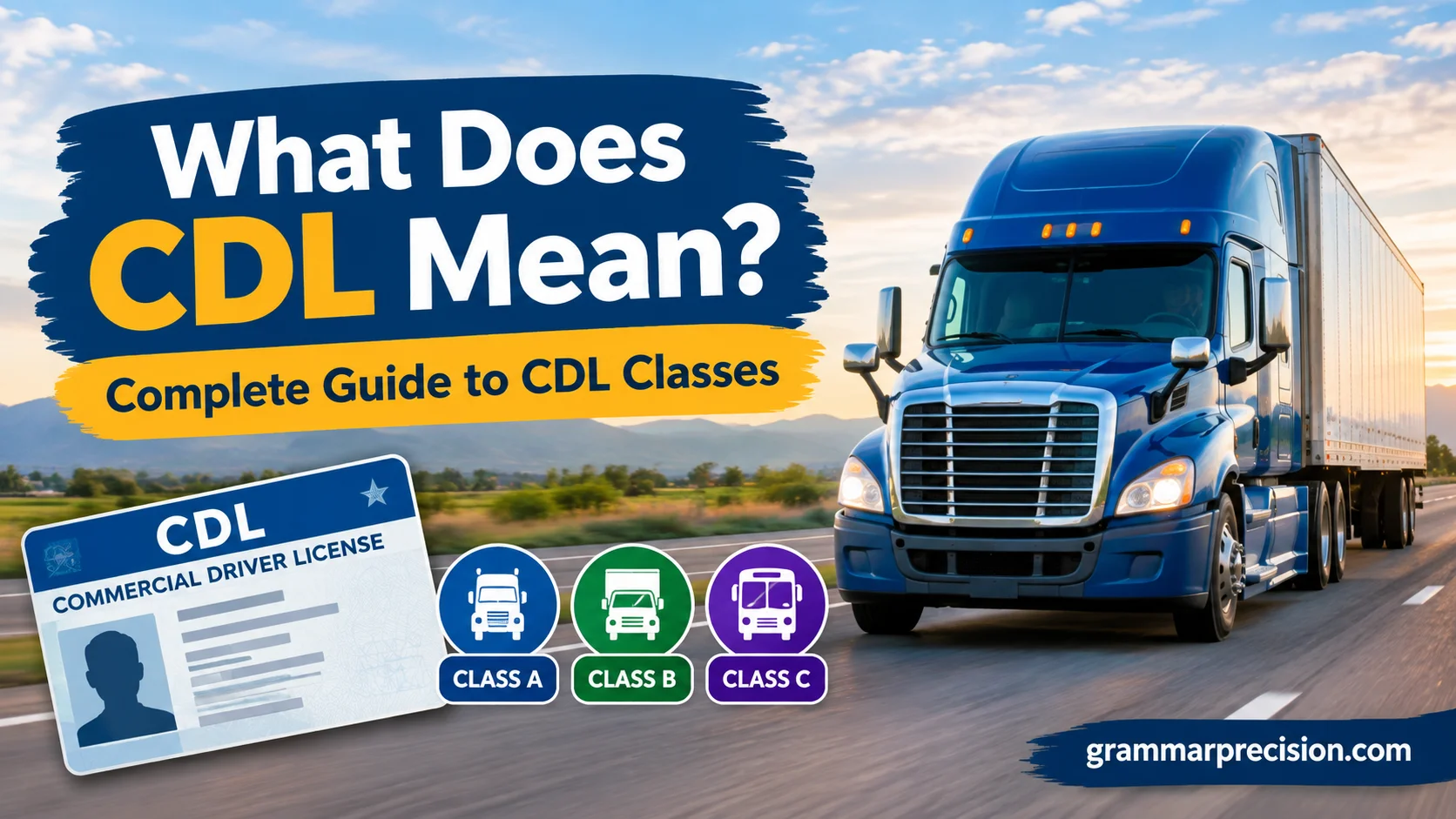
What Does CDL Mean? usually refers to a Commercial Driver’s License, a credential that allows qualified drivers to operate certain commercial vehicles in the United States. In this guide, you’ll learn what CDL means, where the abbreviation comes from, and how people use it in different contexts. We’ll also clarify related terms so you can recognize CDL correctly in messages, calendars, meetings, and formal writing.
Understanding abbreviations matters when consistency, grammar, and clear communication count. You might encounter CDL while handling project management, online booking, broadcasting schedules, or workplace records. Although US English commonly uses “CDL” for Commercial Driver’s License, regional style guides can influence spelling, punctuation, and terminology. UK English may use different licensing terms altogether. This article will explain the meaning, usage, requirements, and common contexts surrounding CDL, giving you a clear answer without unnecessary jargon.
What Does CDL Mean?
CDL means Commercial Driver’s License. It is a credential issued by a state that authorizes a qualified person to operate certain types of commercial motor vehicles.
The federal government establishes minimum standards for the CDL system. However, state driver licensing agencies actually issue CDLs and manage much of the application process. The Federal Motor Carrier Safety Administration, or FMCSA, does not directly hand drivers their licenses.
A CDL becomes necessary when the vehicle or driving activity falls within federal or state commercial licensing requirements. For example, a person driving a large tractor-trailer for commercial transportation generally needs a CDL appropriate for that vehicle.
What Does CDL Stand for in Simple Terms?
In plain English:
CDL = Commercial Driver’s License
Think of it as a professional driving credential. Instead of proving only that you can safely operate a normal passenger vehicle, a CDL demonstrates that you have met additional requirements for certain commercial vehicles.
Depending on the situation, those requirements can include:
- Knowledge testing
- Driving skills testing
- Medical qualification
- Commercial learner’s permit requirements
- Entry-level driver training
- Additional endorsement testing
- Driving-record checks
The exact combination depends on the CDL class, endorsements, vehicle, and applicable state and federal rules.
Why Is a CDL Different From a Regular Driver’s License?
The biggest difference involves what you are legally qualified to drive.
A standard driver’s license generally covers ordinary personal vehicles. A CDL applies to specific commercial motor vehicles that meet defined federal or state criteria.
Commercial vehicles can weigh far more than ordinary cars. Some also carry dozens of passengers or transport materials that require specialized handling. Consequently, CDL drivers need additional knowledge and practical skills.
For example, imagine two drivers approaching the same intersection. One operates a compact sedan. The other controls a fully loaded tractor-trailer. Both face the same traffic signal, yet their vehicles behave very differently.
The truck needs significantly more space for braking, turning, positioning, and maneuvering. CDL training helps drivers understand those demands.
CDL vs. Regular Driver’s License
| Feature | Regular Driver’s License | CDL |
| Primary purpose | Personal driving | Commercial driving |
| Typical vehicles | Cars, SUVs, small vehicles | Trucks, buses, and other qualifying CMVs |
| Specialized endorsements | Generally not applicable | Available for specific operations |
| Commercial testing | Usually not required | Knowledge and/or skills testing applies |
| Professional driving | Limited | Designed for qualifying commercial operations |
| Federal CDL standards | Generally not applicable | Apply to the CDL system |
The important point is simple: having a regular license doesn’t automatically qualify you to operate every commercial vehicle.
What Are the Different CDL Classes?
The United States uses three primary CDL classes: Class A, Class B, and Class C.
The class determines the broad category of commercial vehicle you can operate. However, endorsements and restrictions can further change what you are allowed to drive.
Class A CDL
A Class A CDL generally covers combination vehicles with a gross combination weight rating or gross combination weight of 26,001 pounds or more, when the vehicle being towed exceeds 10,000 pounds under the federal definition.
This class commonly applies to tractor-trailers.
Examples include:
- Tractor-trailers
- Large semi-trucks
- Certain truck-and-trailer combinations
- Other qualifying combination vehicles
Class A is often viewed as the broadest CDL class because it can open the door to many heavy combination-vehicle driving jobs.
However, a Class A license doesn’t automatically grant every specialized qualification. You may still need endorsements for certain types of cargo or passengers.
Class B CDL
A Class B CDL generally covers a single vehicle with a gross vehicle weight rating or gross vehicle weight of 26,001 pounds or more, or a vehicle towing another vehicle that falls within the applicable federal weight threshold.
Common examples include:
- Large straight trucks
- Some heavy delivery vehicles
- Certain buses
- Other qualifying heavy single vehicles
A Class B CDL can make sense when your career involves operating a heavy vehicle without the combination configuration typically associated with Class A driving.
Class C CDL
A Class C CDL covers certain commercial vehicles that don’t fall under Class A or Class B but meet federal CDL criteria.
This category can include certain vehicles designed to transport 16 or more passengers, including the driver, or vehicles transporting hazardous materials requiring a placard.
The right endorsement may also be necessary.
CDL Class Comparison
| CDL Class | General Vehicle Type | Common Example |
| Class A | Heavy combination vehicle | Tractor-trailer |
| Class B | Heavy single vehicle | Large straight truck |
| Class C | Certain other qualifying commercial vehicles | Certain passenger or hazardous-material vehicles |
These descriptions summarize federal classifications. State rules can add requirements or use additional categories, so you should always check your state’s CDL manual before applying. FMCSA specifically advises drivers to use their state’s CDL manual when preparing for licensing and testing.
What Are CDL Endorsements?
A CDL class tells you the general type of commercial vehicle you can operate. Endorsements add specialized qualifications.
Think of the CDL class as the foundation and an endorsement as an additional permission attached to it.
Federal CDL regulations recognize several major endorsements:
| Endorsement | Meaning |
| T | Double or triple trailers |
| P | Passenger vehicles |
| N | Tank vehicles |
| H | Hazardous materials |
| X | Combination of hazardous materials and tank vehicle qualifications |
| S | School buses |
Drivers seeking specialized endorsements must complete the applicable testing requirements.
Passenger Endorsement
The P endorsement applies to qualifying passenger vehicles. It can be important for drivers operating buses or other commercial vehicles designed to transport passengers.
The requirements include specialized knowledge and skills testing.
School Bus Endorsement
The S endorsement applies to qualifying school bus operations.
Because school buses involve children and specialized safety procedures, the qualification includes additional training and testing requirements.
Tank Vehicle Endorsement
The N endorsement applies to qualifying tank vehicles.
Tank vehicles behave differently from ordinary cargo trucks because liquid cargo can shift while the vehicle moves. That movement can affect handling, braking, and stability.
Hazardous Materials Endorsement
The H endorsement applies to qualifying hazardous-material transportation.
Hazardous-material drivers face additional federal requirements. Applicants must meet applicable eligibility and security standards in addition to completing the required knowledge process.
X Endorsement
The X endorsement combines hazardous-material and tank-vehicle qualifications.
It can be useful for drivers whose work involves transporting hazardous materials in qualifying tank vehicles.
Double and Triple Trailer Endorsement
The T endorsement covers qualifying double and triple trailer combinations.
These configurations require careful attention to turning, braking, spacing, and trailer movement.
Who Needs a CDL?
Whether you need a CDL depends on the vehicle you operate and how it is used.
Federal CDL standards focus on commercial motor vehicles that meet defined classifications. Weight, vehicle configuration, passenger capacity, and hazardous-material transportation can all matter.
You may need a CDL if you operate a qualifying:
- Tractor-trailer
- Heavy straight truck
- Bus
- Passenger vehicle
- Hazardous-material vehicle
- Combination vehicle
However, don’t assume that every commercial vehicle requires the same CDL class. A delivery truck and a tractor-trailer can fall under different classifications.
Do You Need a CDL for Your Job?
Ask these questions:
- What vehicle will you drive?
- What is its GVWR or GCWR?
- Will you tow a trailer?
- How much does the trailer weigh?
- Will you transport passengers?
- Will you transport hazardous materials?
- Does your state impose additional requirements?
- Will you operate interstate or intrastate?
That checklist can quickly narrow down the licensing category you need.
How to Get a CDL
Getting a CDL isn’t simply a matter of passing one driving test. The process involves several stages, and state procedures can vary.
FMCSA describes the basic pathway as obtaining a Commercial Learner’s Permit, completing applicable training, and then obtaining the CDL after meeting testing requirements.
Start With Your State CDL Manual
Your state’s CDL manual should be your first reference point.
It explains local application procedures, testing arrangements, documentation, fees, and other requirements. Federal rules establish minimum standards, but states administer their own licensing systems.
Get a Commercial Learner’s Permit
A Commercial Learner’s Permit, or CLP, allows you to practice operating a qualifying commercial vehicle under prescribed conditions.
A CLP isn’t the same thing as a full CDL. It functions as the learning stage before full commercial licensing.
FMCSA states that applicants undergo eligibility checks and generally need appropriate medical qualification documentation. A CLP holder also practices with a properly qualified CDL holder under applicable rules.
Complete Required Entry-Level Driver Training
Entry-Level Driver Training, commonly called ELDT, is a major part of the modern CDL process.
Federal ELDT requirements apply to people seeking a Class A or Class B CDL for the first time, upgrading a CDL, or obtaining a first-time H, P, or S endorsement in applicable circumstances. Training must come from a provider listed in the FMCSA Training Provider Registry.
One useful detail often missed in CDL articles is that federal ELDT rules do not establish a universal minimum number of behind-the-wheel training hours. Training providers evaluate whether students demonstrate the required proficiency.
Pass the CDL Skills Test
The CDL skills test includes three major components:
- Vehicle inspection
- Basic vehicle control
- Road test
FMCSA states that applicants must successfully complete all three parts of the skills test.
The vehicle inspection portion checks whether you understand important safety components. Basic controls test your ability to maneuver the vehicle. The road test evaluates your performance in actual traffic conditions.
What Are the CDL Knowledge Tests Like?
CDL applicants may need general knowledge tests plus specialized tests depending on their vehicle and endorsements.
Federal standards require the general knowledge test to cover defined subject areas. FMCSA’s guidance states that the general knowledge test contains at least 30 questions, with an 80% minimum passing score for the applicable knowledge tests.
Topics can include:
- Vehicle operation
- Safe driving practices
- Cargo handling
- Vehicle inspection
- Emergency procedures
- Hazard awareness
- Air brakes, when applicable
- Specialized endorsement subjects
Your state may organize and administer these examinations according to its own procedures while meeting federal minimum standards.
How Long Does It Take to Get a CDL?
There’s no single nationwide timeline.
Your schedule depends on the state, CDL class, training provider, testing availability, and whether you need endorsements.
One important federal timing rule is that a CLP holder generally must possess the permit for at least 14 days before taking the CDL skills test. Applicable ELDT requirements must also be completed.
Training itself can take considerably longer depending on your experience and the program you choose.
For example, someone learning manual vehicle control from scratch may need more practice than an experienced commercial driver upgrading to a different qualification.
How Much Does a CDL Cost?
CDL costs vary considerably because states and training providers set different fees.
Potential expenses include:
- CLP application fee
- CDL application fee
- Knowledge testing fees
- Skills testing fees
- Medical examination costs
- CDL training tuition
- Endorsement fees
- Retesting fees
- License renewal fees
There isn’t a reliable single national price for the entire process.
Training can represent the largest expense for new drivers. However, some employers or workforce programs may offer tuition assistance or sponsored training.
The smarter approach is to calculate the complete licensing cost, rather than looking only at the state application fee.
What Can Disqualify You From Getting or Keeping a CDL?
CDL eligibility isn’t just about passing a test.
Serious driving offenses, medical qualification issues, false information, and other regulatory violations can affect commercial driving privileges.
For example, states conduct driving-record checks as part of the CDL process. FMCSA also notes that fraudulent information or certifications can lead to disqualification.
Potential problems can include:
- Serious traffic violations
- Certain impaired-driving offenses
- Fraudulent licensing information
- Failure to meet applicable medical requirements
- Certain criminal or regulatory violations
- Operating outside CDL restrictions
The consequences depend heavily on the offense and circumstances. A person shouldn’t assume that an old violation automatically prevents licensing without checking the applicable rules.
What Jobs Can You Get With a CDL?
A CDL can qualify you for a wide range of transportation careers.
Depending on your class, endorsements, experience, and employer requirements, options may include:
- Long-haul truck driver
- Local delivery driver
- Freight driver
- Dump truck operator
- Bus driver
- School bus driver
- Tanker driver
- Specialized freight driver
- Heavy equipment transportation
- Construction-related driving
The CDL class and endorsements you hold can directly influence your job options.
For example, a driver interested in school transportation needs the appropriate passenger and school bus qualifications. A tanker driver may need the relevant tank endorsement. A hazardous-material driver faces additional requirements.
That means choosing a CDL isn’t merely about getting a license. It’s about matching the credential to the career you actually want.
A Simple CDL Career Case Study
Consider a fictional driver named Marcus.
Marcus wants to become a long-haul tractor-trailer driver. He doesn’t need a bus qualification, but he does need credentials appropriate for the combination vehicle he plans to operate.
His path might look like this:
Regular license → CLP → required training → CDL skills test → Class A CDL → trucking job
Now imagine that Marcus later wants to haul qualifying hazardous materials in tank vehicles. His original CDL may not automatically cover that work.
He would need to meet the additional requirements for the appropriate endorsements.
This illustrates an important lesson: your CDL is not necessarily the final word on what you can operate. Endorsements and restrictions matter too.
CDL vs. CLP: What’s the Difference?
These two terms sound similar, but they serve different purposes.
| Credential | Main Purpose |
| CLP | Allows supervised commercial driving practice under applicable rules |
| CDL | Full commercial driver’s license for qualifying operations |
The CLP comes before the full CDL for many new commercial drivers.
A CLP doesn’t mean you’ve completed the entire licensing process. You still need to satisfy the remaining training, testing, and state requirements.
Common CDL Restrictions You Should Understand
A CDL can also contain restrictions.
Restrictions limit certain types of commercial driving based on the vehicle used for testing, the driver’s qualifications, or other circumstances.
For example, federal CDL regulations recognize restrictions involving areas such as air brakes, passenger or school bus qualifications, vehicle configuration, and medical variances.
This creates an important distinction:
A CDL class tells you what category of vehicle you’re qualified to operate. A restriction can narrow that authority.
Therefore, don’t look only at the big “Class A” or “Class B” label. Read the endorsements and restrictions as well.
Common CDL Mistakes New Drivers Make
New applicants often focus heavily on the written test and overlook the bigger picture.
Choosing the Wrong CDL Class
Don’t choose a class simply because someone told you it’s “better.” Start with the vehicle and job you actually want.
Ignoring Endorsements
A CDL may not provide every specialized qualification automatically. If your career involves passengers, school buses, tank vehicles, hazardous materials, or multiple trailers, check the applicable endorsement requirements.
Using the Wrong Study Material
Federal standards matter, but your state’s CDL manual should guide your preparation.
Underestimating the Skills Test
A driver can understand the rules and still struggle with backing, vehicle inspection, lane positioning, or controlled maneuvers.
Practical preparation matters.
Assuming Training Has a Fixed Federal Length
ELDT doesn’t impose a universal minimum number of behind-the-wheel hours. Training providers assess proficiency instead.
That means the goal isn’t simply to collect hours. The goal is to become competent enough to operate the vehicle safely.
FAQs About CDL
What does CDL mean?
CDL means Commercial Driver’s License. It is a state-issued credential that authorizes qualified drivers to operate certain commercial motor vehicles.
What does CDL stand for in trucking?
In trucking, CDL stands for Commercial Driver’s License. Truck drivers typically need a CDL class appropriate for the commercial vehicle they operate.
What are the three CDL classes?
The three primary CDL classes are Class A, Class B, and Class C. Each covers different categories of commercial motor vehicles.
Is a CDL the same as a commercial driver’s permit?
No. A Commercial Learner’s Permit, or CLP, generally allows qualifying supervised practice before a driver obtains the full CDL.
Do all CDL drivers need endorsements?
No. Endorsements depend on the type of commercial vehicle or operation. Examples include passenger, school bus, tanker, hazardous materials, and double/triple trailer endorsements.
Is CDL training required?
For certain first-time applicants and upgrades, federal Entry-Level Driver Training requirements apply. This includes specified Class A and Class B applicants and certain first-time H, P, and S endorsement applicants.
Conclusion:
Understanding What Does CDL Mean? helps you recognize this important abbreviation in professional, transportation, and workplace contexts. It commonly refers to a Commercial Driver’s License in the United States.
Knowing the CDL meaning, licensing context, and proper usage can improve English communication, formal writing, and workplace clarity. Whether you encounter CDL during scheduling, meetings, or project management, understanding it keeps your communication accurate and consistent.