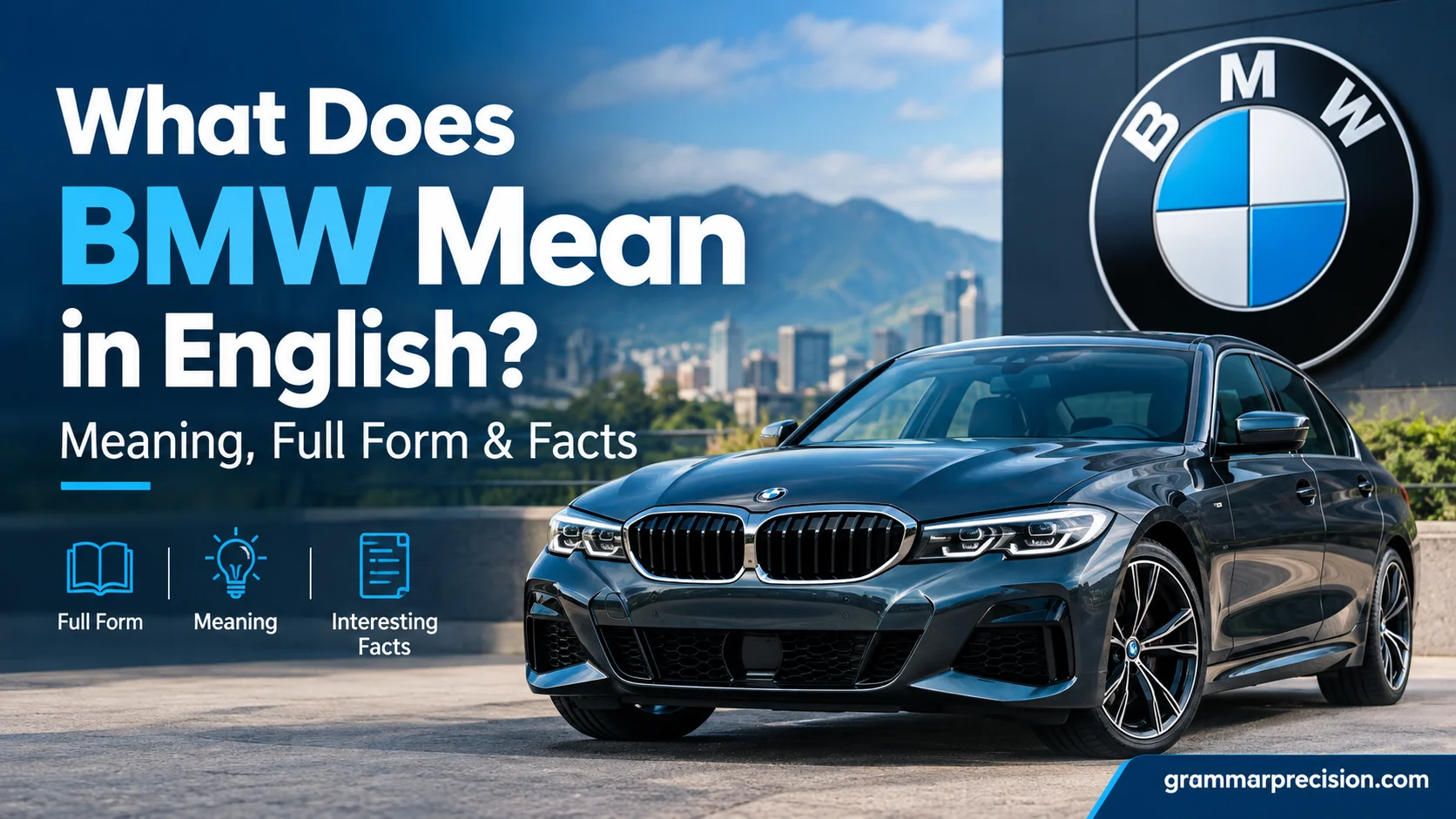
Have you ever seen BMW and wondered what those three letters actually mean in English? What Does BMW Mean in English is a common question when exploring car names, English usage, and brand terminology. BMW comes from the German name Bayerische Motoren Werke, which translates into English as Bavarian Motor Works. In this guide, you’ll learn the meaning, origin, pronunciation, and everyday usage of BMW. We’ll also explain how context affects formal writing, business communication, and general consistency.
Understanding abbreviations can make everyday communication much clearer. Whether you encounter BMW in scheduling, time management, online booking, broadcasting, meetings, a calendar, or project management, knowing the intended meaning prevents confusion. We’ll also discuss grammar, capitalization, and style preferences, including common differences between US and UK English. While major style guides may vary in small details, consistency remains essential whenever you write about brands, organizations, or technical terms.
What Does BMW Mean?
BMW means “Bayerische Motoren Werke” in German. The closest English translation is “Bavarian Motor Works.”
Each word contributes something important to the company’s identity:
| German Word | English Meaning | What It Refers To |
| Bayerische | Bavarian | The German state of Bavaria |
| Motoren | Engines | Motors or engines |
| Werke | Works | Manufacturing works or industrial facilities |
So, when someone asks, “What does BMW stand for?”, the full answer is Bayerische Motoren Werke.
The company kept its German name rather than translating it into English for international markets. That decision helped preserve its identity and connection to Bavaria.
BMW Full Form in German
The official German name is Bayerische Motoren Werke AG. The abbreviation BMW comes from the first letters of the three main words.
The AG at the end stands for Aktiengesellschaft, a German term for a public limited company. In everyday conversation, however, people simply use BMW.
BMW Meaning in English
The natural English translation is Bavarian Motor Works.
“Bavarian” identifies the company’s regional roots. “Motor Works” describes an industrial business involved in manufacturing engines and mechanical products.
Therefore, BMW meaning in English can be understood as a reference to an engine and motor manufacturing company based in Bavaria.
What Does BMW Stand For?
BMW stands for Bayerische Motoren Werke.
Although people now associate those letters with luxury vehicles, the name reflects an earlier period when engine manufacturing was central to BMW’s business.
The company’s history began with aviation-related engine production. Later, BMW moved into motorcycles and eventually automobiles. That evolution explains why the company’s original name focuses on motor works rather than cars.
Bayerische Motoren Werke Explained
The word Bayerische means Bavarian. Bavaria is Germany’s largest state by area and includes Munich, where BMW has its headquarters.
Motoren means engines or motors. This part of the name reflects BMW’s early focus on engine technology.
Werke roughly means works or manufacturing facilities. In an industrial company name, it suggests a place or organization devoted to manufacturing.
Put together, Bayerische Motoren Werke describes a Bavarian motor manufacturing company.
Why BMW Uses Its German Name
BMW operates globally, yet its name remains German. That consistency reinforces its heritage.
Think of the name as part of the brand’s identity rather than merely an abbreviation. Just as a family name can tell you where a family came from, BMW tells you something about the company’s origins.
Its German name also fits the brand’s long-standing association with German engineering, precision, technology, and manufacturing.
What Is the English Translation of BMW?
The commonly used English translation of Bayerische Motoren Werke is Bavarian Motor Works.
However, you usually won’t see BMW officially rebranded as “Bavarian Motor Works” in English-speaking markets. The three-letter abbreviation is much more recognizable worldwide.
What Does “Bavarian Motor Works” Mean?
The phrase breaks down quite naturally:
- Bavarian = connected to Bavaria
- Motor = relating to engines or motors
- Works = an industrial manufacturing operation
The translation gives English speakers a basic picture of the company’s original purpose.
It also explains why the brand’s identity has such a strong connection to Bavaria and Munich.
Is “Bavarian Motor Works” the Official English Name?
No. BMW remains the company’s established brand name internationally.
“Bavarian Motor Works” works as an English translation of the German name. It isn’t simply an alternative brand name that BMW uses in English-speaking countries.
That distinction matters because people sometimes assume BMW literally means “Bavarian Motor Works” as an official English company name. Technically, the German name is the original.
BMW Meaning and Company History
Understanding what BMW means becomes easier when you know how the company developed.
BMW traces its roots to the early 20th century and became closely associated with aircraft-engine production during its early years. The company later expanded into motorcycles before entering automobile manufacturing.
Its history is less straightforward than the modern luxury-car image suggests.
BMW’s Bavarian Origins
BMW’s story is strongly tied to Munich, Bavaria.
The company’s heritage emerged from several German engineering and manufacturing businesses. BMW became established as a company in 1917, following the restructuring of an aircraft-engine business.
That date is important because BMW didn’t begin as the automobile manufacturer most people recognize today.
Its early expertise centered on engines and engineering. Those foundations eventually shaped the company’s approach to motorcycles and cars.
From Aircraft Engines to Motorcycles
During the early 20th century, BMW became known for producing aircraft engines.
After Germany’s post-World War I restrictions affected aircraft-engine production, BMW had to explore new products. The company moved toward other forms of engineering and eventually developed motorcycle engines.
BMW produced its first motorcycle, the R 32, in 1923.
The R 32 became an important milestone because it established engineering principles that would influence BMW motorcycles for decades. Its horizontally opposed twin-cylinder engine, commonly called a boxer engine, became closely associated with BMW’s motorcycle heritage.
BMW’s Entry Into the Car Market
BMW entered automobile manufacturing in 1928 after acquiring Fahrzeugfabrik Eisenach.
Its early automobiles were based on existing designs rather than being entirely developed from scratch by BMW. Over time, however, BMW developed its own vehicles and established a stronger identity in the automotive industry.
After World War II, the company faced major financial and strategic challenges. Its later recovery helped shape the modern BMW brand.
The BMW 1500, introduced in the early 1960s, became particularly important. It helped establish the company as a manufacturer of sporty, relatively compact cars with strong performance.
What Does the BMW Logo Mean?
The BMW logo is one of the most recognizable automotive symbols in the world.
Its circular design features blue and white sections surrounded by a dark outer ring. Those colors have a direct connection to Bavaria.
Blue and White: The Bavarian Connection
The blue and white colors reflect the traditional colors associated with the Bavarian flag.
That connection makes the logo a visual extension of the company’s name. BMW’s identity doesn’t just say “Bavarian” in words. Its visual branding also carries that regional heritage.
Over the decades, BMW has updated the appearance of its logo while retaining its recognizable basic structure.
The Propeller Myth
One of the most famous stories about the BMW logo claims that the blue and white sections represent a spinning aircraft propeller against the sky.
It’s an appealing story, especially because BMW produced aircraft engines during its early history.
However, the propeller explanation isn’t the original meaning of the logo.
The blue and white design connects primarily to Bavarian colors. BMW advertising from the late 1920s helped popularize the propeller interpretation, which later became deeply associated with the brand.
This is a great example of how a marketing image can become part of popular history.
How BMW’s Logo Has Changed
BMW has refined its emblem several times since the company’s early years.
The basic circular form remained recognizable while typography, shading, and graphic treatment changed. In 2020, BMW introduced a flatter, more modern version of its roundel for corporate communications and selected branding applications.
The core identity remained intact.
Blue. White. BMW.
That consistency helped make the logo instantly recognizable across generations.
How Do You Pronounce BMW?
The pronunciation depends partly on the language you’re speaking.
In English, most people pronounce BMW by saying the three letters individually:
“Bee-em-double-you.”
In German, the pronunciation sounds closer to:
“Bay-em-vay.”
That difference comes from the German names of the letters.
| Language | Common Pronunciation |
| American English | Bee-em-double-you |
| British English | Bee-em-double-you |
| German | Bay-em-vay |
Neither pronunciation changes the meaning of BMW.
If you’re speaking English, “Bee-em-double-you” is perfectly natural.
What Do Bimmer, Beemer, and Beamer Mean?
BMW has collected several nicknames over the years. You may hear Bimmer, Beemer, or Beamer, especially among automotive enthusiasts.
These terms don’t always mean exactly the same thing historically.
Bimmer Meaning
Bimmer generally refers to a BMW automobile.
The term became particularly common among BMW enthusiasts and is now widely understood in automotive culture.
For example:
“He bought a new Bimmer last weekend.”
In that sentence, “Bimmer” simply means a BMW car.
Beemer Meaning
Beemer is another nickname associated with BMW.
Historically, the term became strongly connected with BMW motorcycles. Over time, however, many people began using “Beemer” for BMW cars as well.
As a result, everyday usage can vary depending on the community and region.
Beamer Meaning
Beamer is often used informally to describe a BMW, especially in casual American speech.
However, BMW enthusiasts may prefer Bimmer when referring specifically to cars.
The distinctions aren’t absolute today. Language changes through everyday use, and automotive slang is no exception.
Bimmer vs. Beemer at a Glance
| Term | Common Association | Typical Use |
| Bimmer | BMW cars | Automotive enthusiasts |
| Beemer | Historically BMW motorcycles | Casual BMW reference |
| Beamer | BMW vehicles | Informal speech |
If you want the safest term for a BMW car among enthusiasts, Bimmer is a solid choice.
Why Is BMW So Famous?
BMW’s popularity comes from more than its logo or German name.
The company built its reputation around a combination of engineering, performance, design, technology, and premium positioning.
German Engineering
BMW has long marketed itself around engineering and driving dynamics.
Its vehicles have often emphasized balanced handling, responsive steering, powerful engines, and driver-focused layouts.
That approach helped create the brand’s reputation as a manufacturer for people who genuinely enjoy driving.
Luxury and Performance
BMW occupies a premium position in the global automotive market.
Its lineup has included everything from compact executive cars to large luxury SUVs and high-performance vehicles.
The company’s M division is particularly famous for performance-oriented models. BMW M began with motorsport and later developed road cars that combined everyday usability with higher levels of power and handling.
BMW’s Global Brand Recognition
BMW operates as a global automotive company with manufacturing and sales operations across multiple regions.
The company sells vehicles under several major families, including:
- BMW 2 Series
- BMW 3 Series
- BMW 4 Series
- BMW 5 Series
- BMW 7 Series
- BMW X models
- BMW Z models
- BMW M models
- BMW i electric models
This broad lineup allows BMW to reach different segments while maintaining a consistent premium identity.
BMW’s Electric Vehicles
BMW has also expanded its electric-vehicle portfolio through the BMW i brand and newer electric versions of established models.
The company’s electric strategy shows how the meaning of BMW has evolved. The name still refers to its historical Bavarian motor works, but the technology now extends far beyond traditional gasoline engines.
Modern BMW engineering includes battery-electric powertrains, advanced driver-assistance systems, connected technology, digital interfaces, and energy-efficient manufacturing.
BMW Meaning vs. Other German Car Brands
BMW isn’t the only major German automaker with a name rooted in language and history.
| Brand | Name | General Meaning or Origin |
| BMW | Bayerische Motoren Werke | Bavarian Motor Works |
| Volkswagen | Volkswagen | People’s Car |
| Mercedes-Benz | Mercedes-Benz | Brand name formed from Mercedes and Benz |
| Audi | Audi | Latin form of “Horch,” meaning “listen” |
| Porsche | Porsche | Family surname |
This comparison shows why BMW’s name stands out.
Its name directly describes a regional and industrial identity. Volkswagen’s German name also has a literal meaning, while Porsche uses a family surname.
10 Interesting BMW Facts
BMW’s history contains plenty of details that don’t appear in a typical “BMW meaning” definition.
Here are ten worth knowing:
- BMW was established in 1917 in Germany.
- The company has deep historical roots in Bavaria.
- BMW initially became known for aircraft engines.
- BMW produced its first motorcycle, the R 32, in 1923.
- BMW entered automobile manufacturing in 1928.
- The BMW headquarters and museum are located in Munich.
- BMW’s blue and white branding connects strongly to Bavarian identity.
- The propeller interpretation of the logo became famous but doesn’t explain the logo’s original color symbolism.
- Bimmer commonly refers to a BMW automobile in enthusiast culture.
- BMW now produces electric vehicles alongside combustion-engine and hybrid models.
These facts reveal an important point: BMW wasn’t born as a luxury-car company. Its modern identity developed through more than a century of engineering and reinvention.
A Simple Case Study: How the BMW Name Builds Brand Identity
Consider two hypothetical automotive brands.
Brand A calls itself “Global Auto Technologies.” The name sounds broad and modern, but it doesn’t tell you much about its heritage.
Brand B uses a name that identifies its region and industrial roots.
BMW belongs closer to the second category.
The words Bayerische Motoren Werke communicate history before you even know what the company sells. “Bayerische” creates a geographic connection. “Motoren Werke” points toward engineering and manufacturing.
That makes the name more than an abbreviation.
It functions as a compact piece of brand storytelling.
The same idea appears in BMW’s logo. The blue and white colors reinforce Bavaria, while the circular design creates immediate visual recognition.
In other words, BMW’s identity works on several levels at once:
- Name: Bavarian industrial heritage
- Logo: Bavarian colors
- History: Engine and mechanical expertise
- Products: Cars, motorcycles, and modern electric vehicles
- Reputation: Premium engineering and performance
That combination helps explain why three letters can carry such enormous global recognition.
BMW Meaning in Simple Terms
If you need the simplest possible explanation, remember this:
BMW stands for Bayerische Motoren Werke, which translates into Bavarian Motor Works in English.
The name reflects BMW’s Bavarian roots and historical connection to engine manufacturing.
Today, BMW is known primarily for premium cars, SUVs, motorcycles, and electric vehicles. Yet its original name still tells an important part of the story.
So the next time someone asks, “What does BMW mean in English?”, you can give more than a three-word translation.
You can explain that those three letters represent a company whose history began with engines, grew through motorcycles and automobiles, and eventually became one of the most recognizable premium automotive brands worldwide.
FAQs About BMW Meaning
What does BMW mean in English?
BMW means Bavarian Motor Works in English. It comes from the German name Bayerische Motoren Werke, which refers to the company’s Bavarian roots and original connection to motor manufacturing.
What does BMW stand for?
BMW stands for Bayerische Motoren Werke. The company is headquartered in Munich, Bavaria, and its name reflects its German regional heritage.
What is BMW’s German name?
BMW’s German corporate name is Bayerische Motoren Werke AG. The abbreviation BMW comes from the first letters of Bayerische, Motoren, and Werke.
Is BMW a German company?
Yes. BMW is a German automotive company headquartered in Munich, Bavaria. It has a global manufacturing and sales presence.
What does Bimmer mean?
Bimmer is an informal term commonly used for a BMW automobile. The word appears frequently in BMW enthusiast communities and automotive discussions.
Is BMW short for Bavarian Motor Works?
Yes, in terms of English translation. Bavarian Motor Works is the English rendering of the German name Bayerische Motoren Werke.
What does the BMW logo represent?
The BMW logo’s blue and white colors are closely associated with Bavaria. Although many people connect the design to an aircraft propeller, that interpretation doesn’t represent the original meaning of the logo’s colors.
How do Germans pronounce BMW?
German speakers commonly pronounce BMW approximately as “Bay-em-vay.” English speakers usually say “Bee-em-double-you.”
Did BMW originally make cars?
No. BMW’s early history centered heavily on engine manufacturing, particularly aircraft engines. The company later produced motorcycles and entered automobile manufacturing in the late 1920s.
What is BMW best known for?
BMW is best known for premium automobiles, driving performance, engineering, motorcycles, luxury SUVs, and increasingly electric vehicles. Its reputation combines technology with a strong emphasis on driving dynamics.
Conclusion:
Understanding What Does BMW Mean in English helps you recognize its German origin and English translation, Bavarian Motor Works, while using the abbreviation accurately in everyday communication.
BMW represents Bayerische Motoren Werke, meaning Bavarian Motor Works in English. Knowing this origin adds useful context when discussing cars, brands, language, grammar, and formal writing, especially when accuracy and consistent English usage matter.