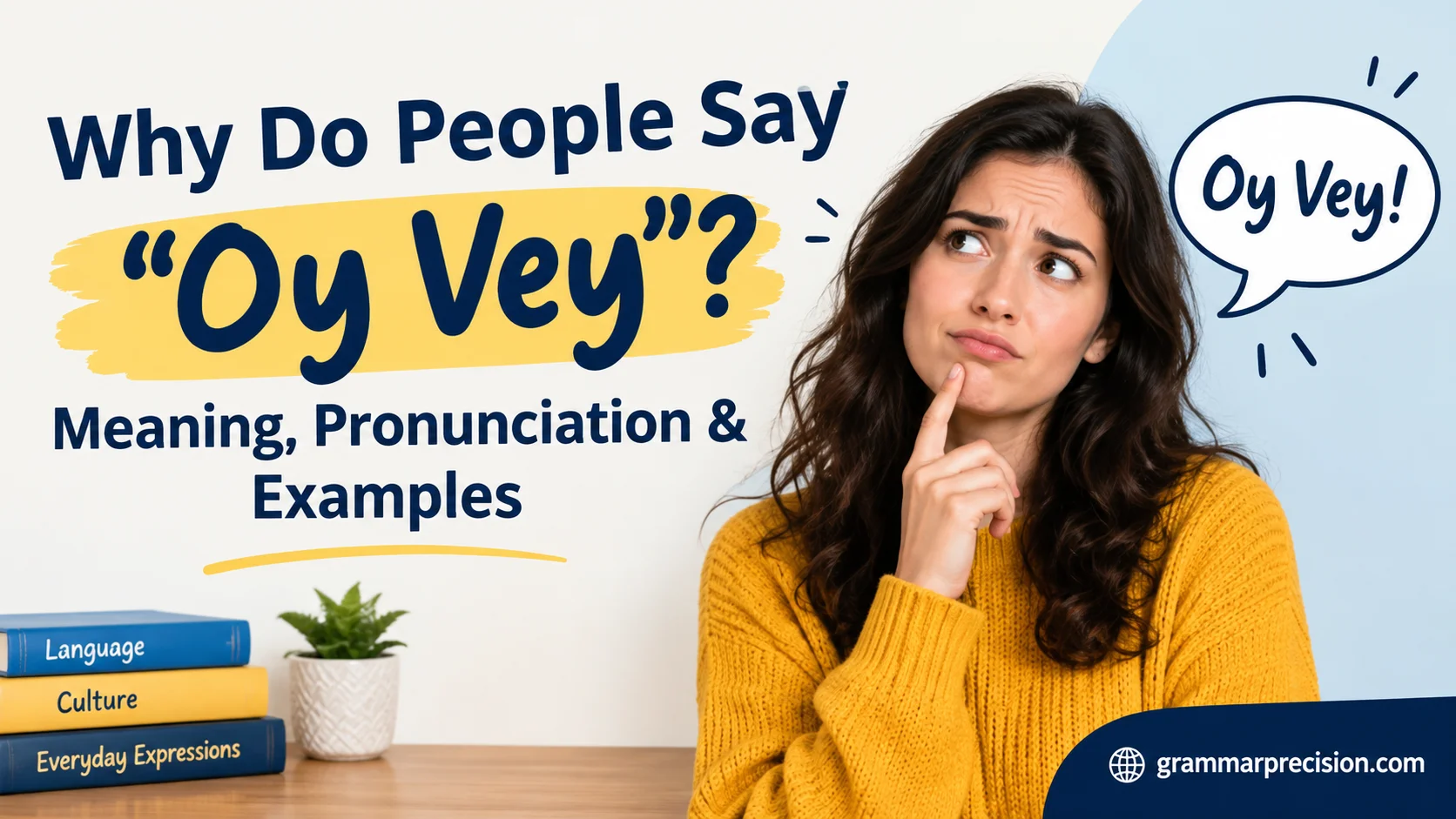
Why do people suddenly say “Oy Vey” when something goes wrong? You may hear it after a stressful day, unexpected news, or a frustrating meeting. This expressive Yiddish phrase can signal dismay, worry, frustration, sympathy, or playful exasperation. But where did it come from, and what does it really mean in modern English usage? This article explores its meaning, origin, pronunciation, cultural context, spelling, tone, and real-life examples, helping you understand when the expression sounds natural. You’ll also see how context shapes its meaning in everyday conversations, workplace business communication, and informal writing.
Understanding expressions like “Oy Vey” also requires attention to grammar, consistency, and regional language preferences. Whether you encounter it in scheduling discussions, online booking, calendar updates, meetings, project management, or even broadcasting, its emotional meaning depends more on context than sentence structure. The guide also explains its relationship to formal writing and compares common US and UK preferences, since style guides and regional conventions can influence word choice and punctuation. By the end, you’ll know exactly why people say “Oy Vey” and how to recognize its tone without overthinking it.
Oy Vey Meaning at a Glance
“Oy vey” is a Yiddish exclamation used to express dismay, distress, frustration, worry, or exasperation. In natural English, it can often resemble “oh no,” “what a mess,” “good grief,” or “this is bad.”
There isn’t one perfect English translation. The speaker’s tone does much of the work.
For example:
- “Oy vey, I forgot my passport.” → I have a serious problem.
- “Oy vey, that meeting lasted three hours.” → That was exhausting or frustrating.
- “Oy vey, what happened to your car?” → I’m surprised or concerned.
- “Oy vey, you’re going to need a lot of coffee.” → A playful reaction to someone’s situation.
The phrase is generally informal and expressive. It works especially well when you want to react emotionally without making a long statement.
What Emotion Does “Oy Vey” Express?
Think of “oy vey” as a compact emotional sigh. It can carry several related feelings:
| Situation | Likely meaning | Typical tone |
| Something went wrong | “Oh no” | Concerned |
| A problem keeps repeating | “Here we go again” | Frustrated |
| Someone shares bad news | “That’s terrible” | Sympathetic |
| A situation becomes overwhelming | “What a mess” | Exasperated |
| A friend makes a silly mistake | “Oh, come on” | Playful |
Context matters. The same two words can sound serious, sympathetic, dramatic, or humorous. That flexibility makes the phrase especially useful in casual speech.
Why Do People Say “Oy Vey”?
People say “oy vey” because it provides a quick emotional reaction to an unpleasant or difficult situation. It doesn’t require a complete sentence. One short exclamation can communicate a whole bundle of feelings.
Imagine receiving five unexpected bills in the same week. You might stare at them, sigh, and say, “Oy vey.” The phrase captures the immediate sense of this is going to be a headache.
“Oy Vey” for Frustration
Frustration is one of its most familiar uses. You might say it after a plan falls apart, a computer crashes, or someone creates another avoidable problem.
“Oy vey, the printer jammed again.”
Here, the speaker isn’t necessarily devastated. The phrase simply releases some irritation.
“Oy Vey” for Bad News
The expression can also respond to genuinely unpleasant news.
“Oy vey, they canceled the flight.”
Depending on delivery, this could communicate disappointment, worry, or sympathy. The surrounding conversation determines how strong the emotion feels.
“Oy Vey” for Sympathy
You can use the phrase when someone else has encountered trouble.
“Oy vey, you had to work all weekend?”
In this setting, the speaker isn’t complaining about their own problem. They’re reacting to another person’s difficult experience.
“Oy Vey” for Humor
Modern speakers often use “oy vey” playfully. A person might say it after hearing that a friend adopted a fourth pet despite already having three.
“Oy vey, your house is officially a zoo.”
The phrase makes the response theatrical rather than harsh.
What Is the Origin of “Oy Vey”?
The phrase “oy vey” comes from Yiddish, a Germanic language historically spoken by Ashkenazi Jewish communities. Yiddish developed through contact among several languages, especially varieties of German, Hebrew and Aramaic, Slavic languages, and others.
The expression itself is commonly understood as an exclamation of woe, distress, or dismay. The two elements are short interjections rather than a literal sentence that maps neatly onto modern English grammar.
What Does “Oy” Mean?
“Oy” is an interjection associated with pain, distress, surprise, or other strong emotion. Similar forms appear in several languages and language traditions, although their histories and exact uses differ.
In Yiddish, “oy” can stand alone. It may communicate something like “oh!” or “ouch!” depending on the context.
What Does “Vey” Mean?
“Vey” relates to the idea of woe or distress. It comes from the Germanic side of Yiddish vocabulary and is related to words for suffering or misery.
Together, “oy vey” expresses a reaction to something troubling. A rigid literal translation can therefore sound awkward. “Oh, woe!” conveys the general idea but doesn’t capture the natural conversational force of the phrase.
How “Oy Vey” Entered American English
Yiddish speakers brought the language to North America through migration, particularly during major waves of Jewish immigration from Europe in the late nineteenth and early twentieth centuries. In American cities with large Jewish communities, Yiddish influenced local speech, food vocabulary, humor, literature, and popular culture.
Over time, some Yiddish words and expressions entered broader American English. Oy vey became one of the most recognizable examples.
How Do You Pronounce “Oy Vey”?
In common English usage, “oy vey” is often pronounced roughly like “oy vay.” The first word rhymes with “boy,” while the second resembles “say” or “day,” depending on the speaker’s accent and pronunciation tradition.
A simple pronunciation guide is:
oy vey → oy vay
Don’t worry about forcing an exaggerated accent. In English conversation, the expression has developed familiar American pronunciations.
Is “Oy Vey” One Word or Two?
The standard spelling is generally two words: “oy vey.” You may encounter variants such as “oy-vey” or “oyvey,” especially in informal writing, but “oy vey” is the clearest and most recognizable form.
Because it is an interjection, capitalization depends on its position in a sentence:
- “Oy vey, what a day.”
- “I could only sigh and say, ‘oy vey.’”
How Do You Use “Oy Vey” in a Sentence?
The easiest way to understand the expression is to see how it behaves in real conversations. It often appears at the beginning of a sentence, but it can also stand alone.
Casual Conversation Examples
Example 1:
“Oy vey, I left my keys at home.”
Example 2:
“Oy vey, this traffic is unbelievable.”
Example 3:
“She looked at the broken vase and whispered, ‘Oy vey.’”
Example 4:
“Oy vey, you have three exams tomorrow?”
Each example carries a slightly different shade of emotion. The first expresses frustration. The second shows exasperation. The third suggests dismay. The fourth sounds sympathetic and mildly amused.
“Oy Vey” in Text Messages
The phrase works particularly well in texting because text conversations lack facial expressions and vocal tone. A short “Oy vey 😩” can replace an entire explanation.
For example:
Friend: “The landlord says the repair will take another week.”
Reply: “Oy vey. That’s rough.”
You can also stretch the expression for comic effect:
“Oyyyy vey.”
That spelling is informal and deliberately expressive. It isn’t the standard written form.
“Oy Vey” at Work
Although “oy vey” is informal, you may hear it in relaxed workplace conversations.
“Oy vey, the presentation file disappeared.”
However, it usually doesn’t belong in formal reports, legal documents, academic papers, or professional correspondence unless you’re deliberately quoting dialogue.
For a formal setting, choose a neutral phrase such as “Unfortunately,” “This is concerning,” or “That presents a problem.”
“Oy Vey” in Humor
Comedy often depends on exaggeration, and “oy vey” fits that role perfectly. Its compact sound can make a minor problem feel theatrically enormous.
“You bought another notebook when you already own twenty? Oy vey.”
The humor comes from the contrast between the dramatic expression and the relatively harmless situation.
“Oy Vey” vs. “Oy Vey Is Me”
These expressions sound related because they are related in spirit, but they aren’t interchangeable.
“Oy vey” is a general exclamation of distress or exasperation. “Oy vey is me” is a more elaborate expression of personal woe.
Compare them:
- “Oy vey, the car won’t start.” → A reaction to a problem.
- “Oy vey is me; everything went wrong today.” → A more theatrical complaint about one’s misfortune.
“Oy vey is me” also echoes the older English expression “woe is me,” which traditionally expresses sorrow or self-pity.
“Oy Vey” vs. “Oy Gevalt”
“Oy gevalt” is another Yiddish exclamation associated with alarm, distress, or astonishment. It can overlap with “oy vey,” but the emotional flavor may differ.
In broad everyday terms:
| Expression | General sense | Possible English equivalent |
| Oy vey | Worry, frustration, dismay | “Oh no” / “Good grief” |
| Oy gevalt | Alarm, shock, distress | “Oh my!” / “Good heavens!” |
| Woe is me | Personal sorrow | “Poor me” |
These are approximate comparisons rather than exact translations. Yiddish expressions carry cultural and emotional nuances that a single English phrase may not reproduce.
Is “Oy Vey” Still Used Today?
Yes. “Oy vey” remains recognizable in contemporary English, especially in American English. Its presence extends beyond everyday speech into books, entertainment, online conversations, and humorous writing.
Its modern meaning can also be broader than its historical context. Some speakers use it simply as a colorful way to express annoyance or disbelief.
That wider use has made the phrase familiar to people who don’t speak Yiddish. At the same time, its cultural history hasn’t disappeared. The expression remains rooted in Yiddish and Jewish linguistic heritage.
“Oy Vey” on Social Media
Online, people often use “oy vey” as a compact reaction:
- “Oy vey, Monday came fast.”
- “Oy vey, look at this mess.”
- “Oy vey 😂”
- “Oyyyy vey, what happened?”
Emoji, punctuation, capitalization, and spelling can alter the mood. “Oy vey.” feels restrained. “OY VEY!!!” sounds dramatic. “Oy vey 😂” usually signals humor.
Is “Oy Vey” a Stereotype?
The expression itself has a genuine Yiddish linguistic and Jewish cultural history. However, popular culture has sometimes exaggerated or caricatured Yiddish expressions as part of stereotyped portrayals of Jewish speech.
That distinction is worth keeping in mind.
Using “oy vey” naturally because you know the expression is different from performing an exaggerated accent or stacking multiple stereotypical expressions together for comic effect. Context, intention, and delivery can change how language is received.
A respectful approach is simple: understand the expression before using it. You don’t need to imitate an accent to use a Yiddish-derived phrase.
Common “Oy Vey” Mistakes
Even a tiny expression can cause confusion when speakers use it without understanding its tone.
Mistake 1: Treating It as a Literal Translation
“Woe” captures part of the historical sense, but “oy vey” functions as a conversational exclamation. Context gives it much of its meaning.
Mistake 2: Using It in Every Situation
The phrase usually fits informal emotional reactions. It can sound out of place in a formal report or serious business document.
Mistake 3: Assuming It Always Means Something Terrible
Not necessarily. Someone can say “oy vey” about a genuinely painful event or a minor inconvenience. Tone reveals the difference.
Mistake 4: Overdoing the Accent
You don’t need an artificial accent to make the phrase authentic. Forced pronunciation can distract from the actual expression.
Mistake 5: Confusing It With “Oh Boy”
Although “oy” and “oh” can look similar in casual writing, “oy vey” has its own Yiddish history and meaning. It isn’t simply a quirky spelling of “oh boy.”
When Should You Use “Oy Vey”?
Use “oy vey” when you want an informal, expressive reaction to frustration, dismay, worry, or an overwhelming situation.
It fits especially well in:
- Casual conversations
- Text messages
- Humorous dialogue
- Informal social media posts
- Personal storytelling
- Friendly reactions to minor problems
Think twice before using it in:
- Academic papers
- Legal writing
- Formal reports
- Professional announcements
- Highly sensitive situations where a playful tone could seem dismissive
The key isn’t a rigid rule. Tone and context do the heavy lifting.
A Quick Case Study: How Tone Changes “Oy Vey”
Consider one sentence:
“Oy vey, that’s a lot to deal with.”
Now imagine three situations.
Situation A: Serious news. A friend has experienced a major setback. The phrase sounds sympathetic and concerned.
Situation B: A stressful workday. Five meetings were added to the calendar. The phrase communicates frustration.
Situation C: A friend bought ten pairs of shoes. The same phrase becomes playful teasing.
The words remain identical. The emotional meaning changes because context, facial expression, timing, and vocal delivery change.
That’s one reason “oy vey” has survived so well. It is flexible without becoming meaningless.
What Are Good Alternatives to “Oy Vey”?
The best substitute depends on what you want to communicate.
| If you mean… | Try… |
| Mild frustration | “Oh, come on.” |
| Bad news | “Oh no.” |
| Surprise | “Wow.” |
| Concern | “That’s concerning.” |
| Exhaustion | “What a day.” |
| Exasperation | “Good grief.” |
| Sympathy | “That’s rough.” |
| Formal concern | “That’s unfortunate.” |
These aren’t perfect synonyms. Each carries a slightly different emotional color.
FAQs About “Oy Vey”
Why do people say “Oy Vey”?
People say “oy vey” to express dismay, frustration, worry, distress, or exasperation. The phrase works as a short emotional reaction to something troublesome.
Is “Oy Vey” Yiddish?
Yes. “Oy vey” is a Yiddish expression with roots in the language’s Germanic vocabulary and its Jewish cultural history.
What does “Oy Vey” literally mean?
A rough literal interpretation relates to “oh” and “woe,” but no single English translation captures every use. In conversation, it functions primarily as an emotional exclamation.
Is “Oy Vey” offensive?
The expression itself isn’t inherently offensive. It has authentic Yiddish roots. However, using it as part of a caricature or stereotyped imitation can create a different effect.
Is “Oy Vey” still used?
Yes. English speakers still use it, particularly in informal American English, humor, writing, texting, and popular culture.
What does “Oy Vey Is Me” mean?
“Oy vey is me” is a more theatrical expression of personal trouble or sorrow. It resembles the older phrase “woe is me.”
Is “Oy Vey” one word?
The most recognizable standard spelling is two words: “oy vey.” Informal variants exist, but the two-word form is the clearest choice.
Conclusion:
In short, Why Do People Say “Oy Vey”? explores a phrase expressing frustration, worry, surprise, or distress in everyday conversation and popular culture.
Understanding “Oy Vey” helps you recognize its Yiddish roots, emotional meaning, and modern usage. Whether spoken humorously or seriously, the expression adds personality and emotion to casual communication while reflecting its Jewish cultural heritage.