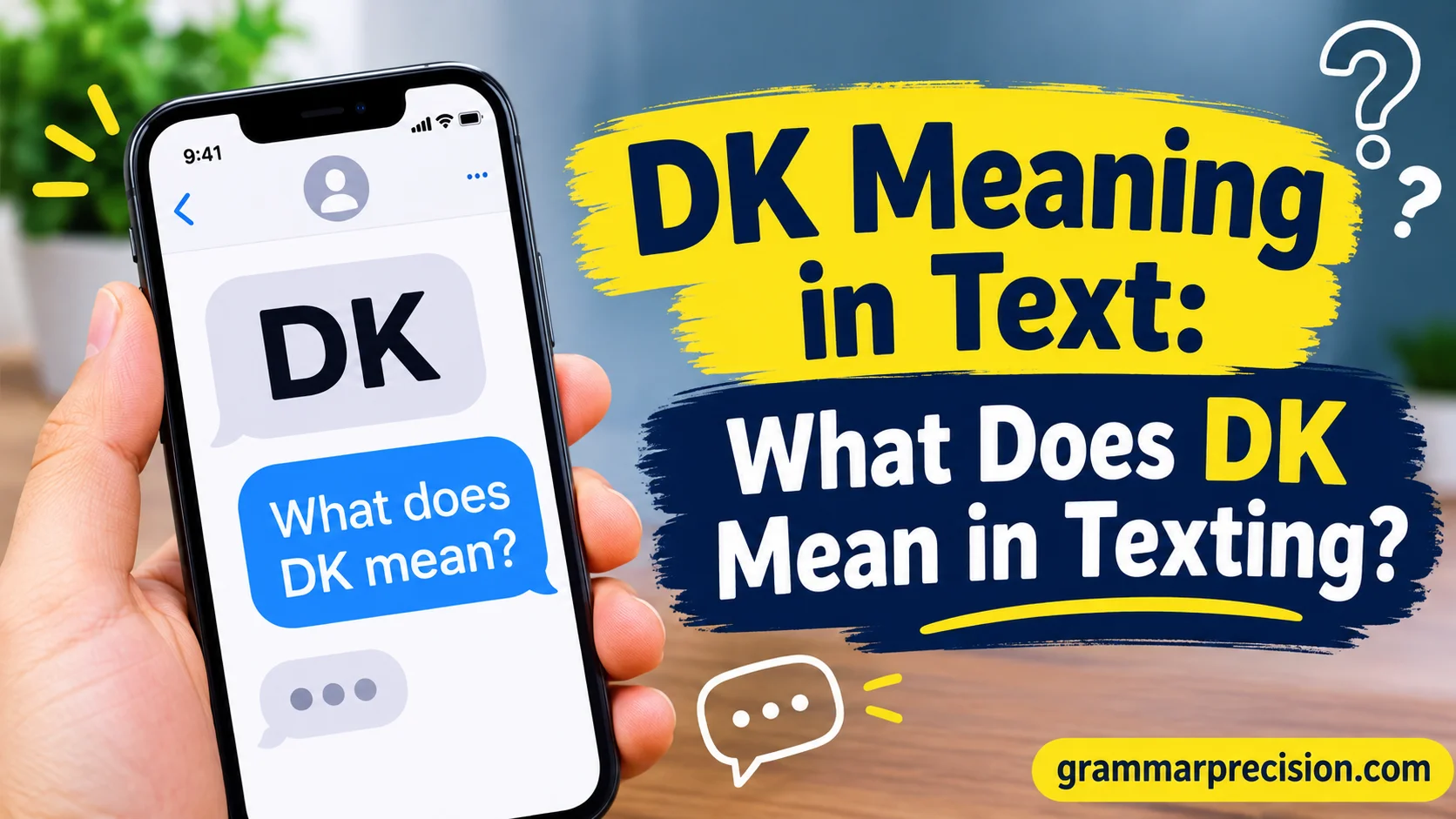
Have you ever received a short message and wondered what two letters actually mean? The DK meaning in text reveals how people express uncertainty through everyday digital conversations.
Understanding DK vs. IDK helps you interpret texting slang, recognize conversational tone, and avoid misunderstandings. This guide explores their definitions, differences, examples, and appropriate usage across social media, casual chats, and everyday communication.
Whether you’re interpreting messages or improving your English usage, knowing these abbreviations strengthens digital communication. You’ll also discover how context influences meaning, why consistency matters, and when complete expressions work better in formal writing and business communication.
Quick Answer: What Does DK Mean in Text?
DK means “Don’t Know” in texting and online conversations. It’s a short abbreviation people use when they don’t know something, aren’t sure about an answer, or cannot provide specific information.
For example:
- Friend: Are you coming to the party tonight?
- You: DK yet. I’ll let you know later.
In this example, the sender hasn’t decided whether they’ll attend. They’re communicating uncertainty rather than giving a definite yes or no.
People sometimes use DK instead of writing the complete phrase. It’s quick, casual, and easy to understand when both people recognize the abbreviation.
What Does DK Stand For in Texting?
In everyday digital communication, DK commonly stands for “Don’t Know.” It expresses a lack of knowledge or certainty about something.
Imagine your friend asks you about tomorrow’s weather. If you haven’t checked the forecast, you might reply, “DK, maybe it’ll rain.” The abbreviation communicates that you don’t have reliable information.
DK can serve several conversational purposes:
- Expressing uncertainty: You aren’t sure about something.
- Showing limited knowledge: You don’t have the information someone needs.
- Avoiding a definite answer: You cannot confirm or deny something.
- Keeping messages short: You prefer a quick response instead of a complete sentence.
- Buying time: You need more time to think before answering.
Although these uses share the same basic meaning, their emotional tone can differ.
For example, “DK” might sound neutral when discussing weekend plans. However, it could sound dismissive when someone asks an important personal question.
The Difference Between DK and Its Full Form
DK works as an informal abbreviation of “Don’t Know.” It removes the complete words and keeps their initial letters.
Here’s a simple comparison:
| Expression | Meaning | Communication style |
| DK | Don’t Know | Very brief and casual |
| Don’t know | Lack of knowledge | Direct and conversational |
| I’m not sure | Uncertainty | Polite and natural |
| I have no idea | Stronger uncertainty | Casual and expressive |
| IDK | I Don’t Know | Popular texting abbreviation |
Remember that abbreviations don’t always follow strict grammar rules. People often leave out words when texting because the surrounding conversation already explains their meaning.
Why Do People Say DK Instead of IDK?
You might wonder why someone would type DK when IDK already exists.
The answer is simple: texting habits vary from person to person. Some people prefer shorter expressions, while others develop their own abbreviations through everyday conversations.
Here are several reasons someone might choose DK:
1. They want to save time. Typing two letters takes less effort than writing a complete sentence.
2. They follow personal texting habits. Some people naturally shorten expressions without considering whether everyone uses the same version.
3. They want a quick response. When someone asks a simple question, a short answer may feel sufficient.
4. They communicate casually. Friends and family members often use informal language that wouldn’t suit professional communication.
5. They want to avoid overexplaining. Sometimes a brief response is enough to communicate uncertainty.
However, DK isn’t necessarily more popular than IDK. In mainstream internet slang, IDK remains the more familiar and widely recognized expression.
DK Meaning on Social Media and Different Platforms
Texting abbreviations frequently move between messaging apps, social networks, and online communities. DK can appear anywhere people exchange short, informal messages.
Its basic interpretation usually remains “Don’t Know.” However, the surrounding conversation helps determine what the sender means.
DK Meaning on Snapchat
On Snapchat, people often exchange quick messages, pictures, and short replies. DK can appear when someone doesn’t know the answer to a question.
For example:
- Friend: Who’s going to the movie?
- You: DK, nobody told me yet.
The sender simply lacks information about the plans.
Because Snapchat conversations often move quickly, short expressions can feel more convenient than complete sentences.
DK Meaning on Instagram
Instagram users communicate through direct messages, comments, and group conversations. DK may appear when someone responds to a question or discusses something unfamiliar.
For example:
- Person A: Do you know where she bought that dress?
- Person B: DK, but it looks amazing.
Here, the sender doesn’t know where the dress came from. They still add a friendly comment to keep the conversation going.
DK Meaning on TikTok
TikTok conversations often involve comments about trending videos, creators, challenges, and viral discussions.
Someone might use DK when they don’t understand a trend or cannot identify something in a video.
For example:
- User A: What’s the name of this song?
- User B: DK, but the beat is fire!
The abbreviation communicates a lack of knowledge without interrupting the casual tone.
DK Meaning on WhatsApp
WhatsApp supports private chats, family groups, professional conversations, and community discussions.
People might use DK when answering questions about schedules, meetings, locations, or everyday plans.
For example:
- Friend: Are we meeting at 6 or 7?
- You: DK yet. Waiting for everyone’s confirmation.
In this situation, DK indicates that the sender hasn’t received enough information to confirm the meeting time.
DK Meaning in Discord and Online Gaming
Online gaming communities depend on quick communication. Players frequently use abbreviations because they need to respond while playing.
For example:
- Player A: Where’s the enemy team?
- Player B: DK, haven’t seen them.
The player doesn’t know the enemy team’s location.
In gaming conversations, DK can be particularly useful when players need to communicate quickly. Still, abbreviations vary across communities, so context remains important.
How to Understand DK Based on Conversation Context
Two identical messages can communicate different feelings depending on the situation. That’s why you shouldn’t interpret DK without considering the surrounding conversation.
Let’s examine some common situations.
When Someone Doesn’t Know an Answer
This is the most straightforward use of DK.
Someone asks a question, and the sender doesn’t have the information needed to answer.
Example:
- You: What time does the store close?
- Friend: DK. Check their website.
The sender doesn’t know the closing time and suggests another way to find it.
When Someone Feels Uncertain
DK can also communicate uncertainty rather than a complete lack of knowledge.
For instance, someone might understand the situation but still feel unsure about what will happen.
Example:
- You: Do you think we’ll win tomorrow?
- Friend: DK, the other team looks strong.
The sender doesn’t want to make a prediction because the outcome remains uncertain.
When Someone Avoids Giving an Answer
Sometimes people use DK when they don’t want to discuss something.
However, this interpretation depends heavily on the conversation. A short reply doesn’t automatically mean someone is hiding information.
Example:
- You: Did Sarah tell you about the surprise?
- Friend: DK.
If your friend previously discussed the surprise, the response might feel evasive. Still, you shouldn’t assume dishonesty without additional evidence.
When Someone Uses DK Casually
People sometimes use abbreviations simply because they’re comfortable with informal texting.
Example:
- You: What should we order tonight?
- Friend: DK, anything works.
Here, the sender doesn’t have a particular preference. They’re leaving the decision to you.
DK Meaning From a Guy or Girl
Does DK mean something different when a guy or girl sends it? Not necessarily.
The abbreviation generally retains its meaning regardless of the sender’s gender. However, your relationship and conversation history can influence how you interpret the response.
What Does DK Mean From a Guy?
When a guy texts DK, he usually means he doesn’t know something or cannot provide a definite answer.
For example:
- You: Are you free this weekend?
- Him: DK yet. I’ll check.
He might still be working out his schedule. The response doesn’t automatically indicate a lack of interest.
Consider these possibilities:
- He genuinely doesn’t know his plans.
- He’s waiting for someone else’s confirmation.
- He hasn’t made a decision.
- He wants more time before answering.
Look at his overall communication habits instead of judging one abbreviation.
What Does DK Mean From a Girl?
When a girl sends DK, she generally communicates the same idea: “Don’t Know.”
For example:
- You: Which restaurant should we visit?
- Her: DK, you choose!
She might not have a preference or simply want you to make the decision.
Depending on the conversation, her message could express uncertainty, flexibility, or a lack of information.
Does DK Suggest Disinterest?
Not by itself.
A short reply might seem cold, especially when you’re expecting an enthusiastic response. However, people use brief messages for many reasons.
Consider these factors before drawing conclusions:
- Does the person usually send short messages?
- Do they continue the conversation afterward?
- Do they ask you questions in return?
- Are they busy or distracted?
- Does their overall behavior show interest?
One abbreviation cannot reliably reveal someone’s feelings. Pay attention to the entire conversation instead.
20 DK Examples in Everyday Text Conversations
The easiest way to understand an abbreviation is to see how people use it naturally. These examples show how DK can fit different everyday situations.
| Situation | Text conversation | Meaning |
| Weekend plans | “Are you traveling?” “DK yet.” | Don’t know yet. |
| School | “What’s the homework?” “DK, ask Alex.” | Doesn’t know. |
| Shopping | “Which shirt looks better?” “DK, both look good.” | Can’t decide. |
| Weather | “Will it rain?” “DK.” | Doesn’t know. |
| Friendship | “Is Mike coming?” “DK, he hasn’t replied.” | Has no information. |
| Dating | “Do you like him?” “DK honestly.” | Feels uncertain. |
| Movies | “What’s that movie called?” “DK.” | Doesn’t know the title. |
| Food | “Pizza or burgers?” “DK, you pick.” | Has no preference. |
| Work | “Is the meeting canceled?” “DK yet.” | Cannot confirm. |
| Travel | “When does the train leave?” “DK, check the schedule.” | Doesn’t know. |
| Gaming | “Where’s the next mission?” “DK.” | Doesn’t know the location. |
| Music | “Who’s singing this song?” “DK, sounds familiar.” | Doesn’t know the singer. |
| Family | “Is everyone coming?” “DK, Mom hasn’t confirmed.” | Doesn’t have confirmation. |
| Sports | “Who’ll win tonight?” “DK, should be close.” | Can’t predict. |
| School exam | “Will question five be included?” “DK.” | Doesn’t know. |
| Events | “What time is the wedding?” “DK, ask Sarah.” | Lacks the information. |
| Shopping | “Is this available in blue?” “DK.” | Doesn’t know. |
| Social media | “Who posted this first?” “DK.” | Doesn’t know the original poster. |
| Plans | “Should we leave now?” “DK, maybe wait.” | Isn’t certain. |
| Conversations | “Are you upset?” “DK, just tired.” | Uncertain about feelings or how to explain them. |
Notice how the surrounding words make each message easier to understand. DK rarely needs a complicated explanation when the conversation provides enough context.
How to Reply When Someone Says DK
Receiving DK doesn’t have to end your conversation. You can respond with another question, suggest an option, or keep things lighthearted.
Your best reply depends on the topic and your relationship with the sender.
Friendly Replies to DK
If a friend uses DK, respond naturally without making the conversation uncomfortable.
Here are some friendly options:
- “No worries!”
- “That’s okay. Let me know when you find out.”
- “We can figure it out together.”
- “Fair enough!”
- “I’ll check and tell you.”
- “Okay, just keep me updated.”
- “Let’s decide later.”
These responses work well when someone genuinely doesn’t have an answer.
Funny Replies to DK
Want to add some humor? A playful response can make an ordinary conversation more entertaining.
Try these examples:
- “Same here. We’re both clueless!”
- “Well, that’s two of us!”
- “Google might have an answer.”
- “Mystery of the day!”
- “Guess we’ll never know.”
- “Let’s ask the universe.”
- “Detective mode activated!”
Use these replies with people who appreciate your sense of humor. A joke might not fit every serious conversation.
Flirty Replies to DK
If you’re texting someone you like, you can keep things playful without putting pressure on them.
Consider these responses:
- “Well, let’s figure it out together.”
- “Maybe I can help you decide.”
- “That’s okay. I have a few ideas.”
- “Guess we’ll need another conversation.”
- “I’ll make the decision easier for you.”
For example:
- You: Want to grab coffee this weekend?
- Crush: DK yet.
- You: No pressure. Let me know when you decide!
This approach keeps the conversation friendly while respecting the other person’s uncertainty.
Replies That Keep the Conversation Going
Sometimes the best response is another question. This works especially well when you want more information.
Try these:
- “What makes you unsure?”
- “Want me to help you figure it out?”
- “When do you think you’ll know?”
- “Should we look it up?”
- “What do you think is most likely?”
These questions encourage a more meaningful exchange instead of ending the conversation with another abbreviation.
DK vs. IDK: What’s the Difference?
DK and IDK look similar because they communicate nearly identical ideas. However, they aren’t exactly the same abbreviation.
DK means “Don’t Know,” while IDK means “I Don’t Know.”
The additional letter in IDK represents the word “I.” Both expressions communicate uncertainty or a lack of information.
Here’s a quick comparison:
| Feature | DK | IDK |
| Full form | Don’t Know | I Don’t Know |
| Number of letters | 2 | 3 |
| General meaning | Lack of knowledge | Lack of knowledge |
| Popularity | Less standardized | Widely recognized |
| Common use | Informal texting | Texting and social media |
| Formality | Informal | Informal |
Example conversations:
- Question: Do you know his name?
- DK response: DK.
- IDK response: IDK.
Both responses communicate that the sender doesn’t know the person’s name.
However, IDK generally sounds more complete because it includes the subject “I.” DK works as a shortened conversational response when the meaning is already clear.
DK vs. Other Popular Texting Abbreviations
DK isn’t the only abbreviation people use to communicate uncertainty, opinions, or reactions.
Understanding similar expressions can help you interpret messages more accurately.
| Abbreviation | Full form | Meaning |
| DK | Don’t Know | Lacks knowledge |
| IDK | I Don’t Know | Doesn’t have an answer |
| IDC | I Don’t Care | Shows indifference |
| IK | I Know | Shows understanding |
| IKR | I Know, Right? | Expresses agreement |
| IDTS | I Don’t Think So | Expresses disagreement or doubt |
| TBH | To Be Honest | Introduces an honest opinion |
| NGL | Not Gonna Lie | Introduces a candid statement |
| IMO | In My Opinion | Shares a personal viewpoint |
These abbreviations might appear together in the same conversation.
For example:
- Person A: Do you think we’ll finish the project today?
- Person B: IDK, but IMO we need more time.
- Person A: IKR. IDC if we finish tomorrow.
Each abbreviation adds a different meaning. Understanding the distinctions helps you avoid confusing uncertainty with agreement or indifference.
Is DK Rude or Disrespectful?
Generally, DK isn’t inherently rude. It’s simply a shortened way to express that you don’t know something.
However, the way someone uses it can influence how the message feels.
For example, replying “DK” to a casual question about dinner probably won’t offend anyone. Sending the same response to someone asking for important emotional support might seem dismissive.
Consider these examples:
Casual situation:
- Friend: What’s your favorite ice cream flavor?
- You: DK, I like too many!
This response feels playful and harmless.
Sensitive situation:
- Friend: Do you think everything will be okay?
- You: DK.
This reply might feel cold because the other person could be looking for reassurance.
To avoid misunderstandings, consider adding a few words when the situation matters.
Instead of replying only “DK,” try:
- “I’m honestly not sure.”
- “I don’t have an answer yet.”
- “Let me think about it.”
- “I’m not certain, but I’ll find out.”
A little extra context can make your message sound more thoughtful.
Is DK Appropriate for Work Emails and Formal Messages?
DK usually isn’t suitable for professional emails, official documents, or formal business communication.
Although coworkers might understand it in casual chats, abbreviations can make important messages sound rushed or unclear.
For professional situations, choose complete expressions instead.
| Informal expression | Professional alternative |
| DK | I don’t know. |
| DK yet | I haven’t confirmed yet. |
| IDK | I’m not certain. |
| DK, ask John | John may have that information. |
| DK when | I don’t have the confirmed time. |
For example, imagine your manager asks whether a report will be ready tomorrow.
Instead of replying:
“DK.”
You could write:
“I’m not certain yet. I’ll review the remaining tasks and confirm the timeline this afternoon.”
The second response communicates uncertainty while showing responsibility.
Professional communication doesn’t require knowing every answer. It requires being clear, respectful, and honest about what you know.
Common Misunderstandings About DK
Short abbreviations can create confusion because people interpret them differently. DK is no exception.
Here are some common mistakes worth avoiding.
Mistake 1: Assuming DK and IDK are completely different.
Both generally communicate a lack of knowledge. IDK simply includes the word “I.”
Mistake 2: Thinking DK always indicates disinterest.
A short reply doesn’t automatically mean someone wants to end the conversation.
Mistake 3: Assuming DK is appropriate everywhere.
Casual messaging and professional communication have different expectations.
Mistake 4: Treating every DK message as rude.
The sender might simply lack information or prefer shorter messages.
Mistake 5: Ignoring conversation context.
The surrounding messages often explain exactly what someone doesn’t know.
The easiest way to avoid these misunderstandings is to read the entire conversation before interpreting two letters.
FAQs About DK Meaning in Text
What Does DK Mean in Text Messages?
DK commonly means “Don’t Know” in text messages. People use it when they lack information, feel uncertain, or cannot answer a question. It’s an informal abbreviation similar to IDK.
What Is the Difference Between DK and IDK?
DK means “Don’t Know,” while IDK means “I Don’t Know.” Both communicate a lack of knowledge. However, IDK is more widely recognized in everyday texting and online conversations.
What Does DK Mean From a Guy?
When a guy texts DK, he usually means he doesn’t know something or isn’t sure about an answer. It doesn’t automatically indicate romantic disinterest. Consider the conversation and his overall communication habits.
What Does DK Mean From a Girl?
A girl generally uses DK to communicate “Don’t Know.” She might lack information, feel uncertain, or have no particular preference. The surrounding conversation helps clarify her intended meaning.
Is DK the Same as Don’t Care?
No. DK commonly means “Don’t Know,” while IDC means “I Don’t Care.” One expresses a lack of knowledge, whereas the other communicates indifference toward something.
Is DK Still Used in Texting?
Yes, people may still use DK in casual messages and online conversations. However, IDK is the more familiar abbreviation. Usage varies depending on individual texting habits and online communities.
Can DK Have Different Meanings?
Yes. DK can represent different things in specialized settings, organizations, gaming communities, or technical discussions. However, in ordinary texting, “Don’t Know” is a common interpretation. Always consider the surrounding context.
Should I Use DK in Professional Communication?
It’s better to avoid DK in formal emails and workplace documents. Write “I don’t know,” “I’m not certain,” or “I haven’t confirmed yet” instead. These expressions sound clearer and more professional.
How Should I Respond When Someone Texts DK?
You can reply with “No worries,” “Let’s figure it out,” or “Let me know when you find out.” If the conversation is playful, a funny response can also work.
Is DK a Common Texting Slang Term?
DK appears in informal digital communication, but it isn’t as widely recognized as IDK. Many people understand its intended meaning from context. Still, using the full phrase can prevent confusion.
Conclusion:
Understanding the DK meaning in text helps you recognize how people express uncertainty in everyday digital conversations. Whether someone uses DK or IDK, both abbreviations communicate a lack of knowledge. Context helps you interpret messages and respond appropriately.
Although DK works well in casual chats, IDK remains more widely recognized across social media and messaging platforms. Choose clear expressions when conversations require professionalism. By understanding these texting abbreviations, you can improve your digital communication, avoid misunderstandings, and make every message more effective.