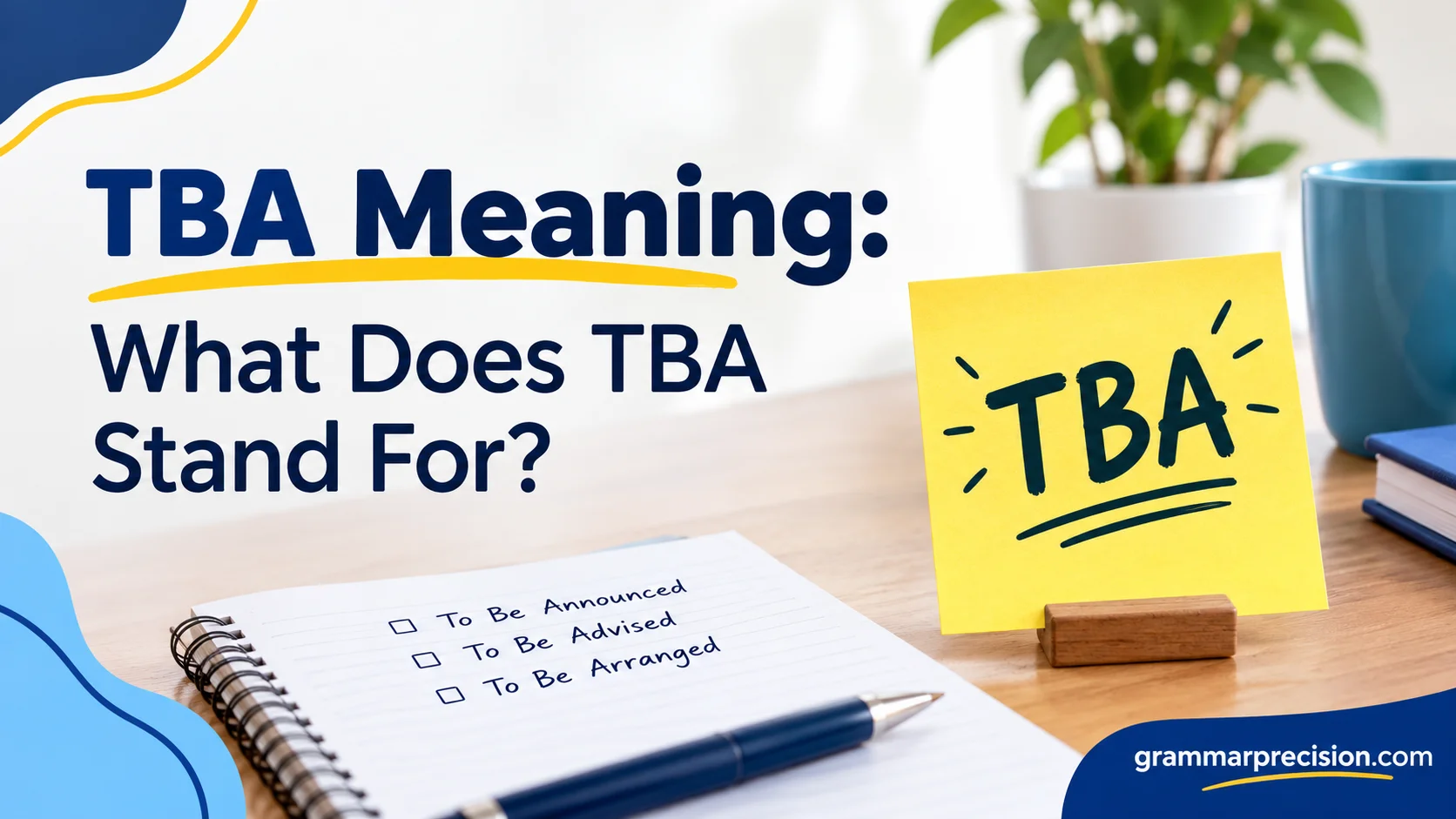
Have you ever seen TBA in a meeting invitation, online booking confirmation, or business announcement and wondered what it means? TBA meaning is most commonly “To Be Announced,” a phrase people use when they plan to share details later. You may encounter it in scheduling, time management, broadcasting, project management, and everyday business communication. It often appears when organizers have not finalized a date, location, speaker, or other important information. Understanding this abbreviation helps you interpret calendars, event updates, and professional messages without confusion.
In this article, you’ll learn what TBA means, how people use it in different contexts, and how it differs from similar abbreviations such as TBD (To Be Determined) and TBC (To Be Confirmed). We’ll explore practical examples involving meetings, online booking, and formal announcements, along with tips for using TBA correctly in English usage, grammar, and formal writing. We’ll also touch on regional preferences and style-guide conventions, including differences between US and UK English, to help you maintain clarity and consistency in professional and everyday communication.
What Does TBA Mean?
TBA means “To Be Announced.” It tells readers that someone will share specific information at a later time. The abbreviation doesn’t provide the missing information itself. Instead, it signals that an announcement is still forthcoming.
For example, imagine that a music festival advertises a performance with the following details:
- Event: Summer Music Festival
- Date: August 15
- Location: TBA
- Opening performer: TBA
The festival has announced its date but hasn’t revealed the location or opening performer. Attendees must wait for another update to learn those details.
TBA helps organizers publish useful information without waiting until every part of an event or plan becomes available.
What Is the Full Form of TBA?
The full form of TBA is To Be Announced. It commonly appears in schedules, announcements, event listings, and other situations where people expect information to become public later.
Consider these examples:
- Meeting location: TBA — The organizer will announce the location later.
- Guest speaker: TBA — The speaker’s identity hasn’t been announced.
- Release date: TBA — The release date will be announced later.
- Competition schedule: TBA — Officials will share the schedule in a future announcement.
The abbreviation works as a placeholder. Rather than leaving a blank space, writers use TBA to show that they expect to provide the missing details.
What Does TBA Mean in Simple Terms?
In everyday language, TBA means “We’ll announce the details later.”
Imagine that your college posts a timetable for the next semester. Most classes have assigned rooms, but one course displays “Room: TBA.” You know the college expects to provide the room assignment later, even though you don’t know which classroom you’ll use.
However, TBA doesn’t guarantee that an announcement will arrive on a particular date. Unless the organizer provides a deadline, you shouldn’t assume the information will appear today, tomorrow, or next week.
What Does TBA Mean in Different Contexts?
The basic definition stays the same across most situations, but the information that remains unavailable can vary. Understanding the context helps you interpret TBA correctly.
TBA Meaning in Text Messages and Online Chats
In texting, TBA usually means “To Be Announced.” People use it when they plan to share details about an upcoming activity, gathering, or decision later.
For example:
Friend 1: “Are we meeting at your place on Saturday?”
Friend 2: “The location is TBA. I’ll let everyone know.”
Here, the second friend hasn’t shared the meeting location yet. They expect to announce it when the details become available.
You might encounter TBA in conversations about:
- Weekend plans and group outings
- Birthday parties and celebrations
- Online gaming tournaments
- Social media announcements
- Upcoming trips and meetups
Example text messages:
- “The party starts at 7, but the venue is TBA.”
- “Our next gaming tournament date is TBA.”
- “We’re planning a group trip. Destination TBA!”
- “The surprise guest is TBA, so don’t spoil anything.”
TBA isn’t generally a secret code or a slang expression with a hidden meaning. It usually communicates that information will come later.
TBA Meaning at Work and in Business Emails
In professional communication, TBA helps teams share preliminary plans while they wait for final announcements. Employees, managers, and project coordinators often use it in meeting invitations, project schedules, and internal documents.
For example, a manager might send this meeting notice:
Project Review Meeting
Date: November 12 Time: 10:00 a.m. Conference room: TBA Participants: Marketing and sales teams
The team knows when the meeting will happen, but the organizer hasn’t announced the room.
TBA can also appear in project plans when a presentation date, training session, or product launch announcement remains pending.
However, use the abbreviation thoughtfully. If your colleagues need a confirmed location to arrange travel or prepare equipment, provide an update as soon as possible.
Professional example: “The client presentation is scheduled for Thursday. The final meeting room is TBA, and I’ll share the details once they’re confirmed.”
This wording makes the situation clear without creating unnecessary confusion.
TBA Meaning in School and College Schedules
Schools, colleges, and universities use TBA when they haven’t announced specific academic details.
You might see it on a class timetable, examination schedule, course registration page, or campus event notice.
| Academic listing | What TBA means |
| Classroom: TBA | The classroom assignment will be announced later. |
| Exam date: TBA | The examination date will be announced later. |
| Instructor: TBA | The instructor’s identity hasn’t been announced. |
| Orientation venue: TBA | The venue details will follow. |
| Workshop time: TBA | The workshop time hasn’t been announced. |
For students, the distinction between missing information and confirmed information matters. A course showing TBA doesn’t automatically mean the class has been canceled.
Instead, check the institution’s official announcements, learning platform, or student portal for updates. If an examination date remains TBA close to the exam period, contact the relevant department rather than relying on assumptions.
TBA Meaning in Events, Concerts, and Ticket Listings
Event organizers frequently use TBA to indicate that they will announce details later. Concerts, festivals, conferences, award ceremonies, and sports events may all include the abbreviation.
For example, a concert listing might display:
- Event date: December 5
- Doors open: 6:00 p.m.
- Venue: TBA
- Supporting artists: TBA
This listing tells potential attendees that the event has a planned date, but the organizer hasn’t announced every detail.
Ticket buyers should pay particular attention to the information marked TBA. A missing venue can affect transportation, accommodation, accessibility, and travel costs.
Before buying tickets, consider these practical steps:
- Check which event details the organizer has confirmed.
- Review the ticket seller’s refund and cancellation policies.
- Follow the organizer’s official announcements.
- Avoid assuming that an unannounced venue will be near your home.
- Save confirmation emails and other purchase records.
A useful rule: TBA signals that an announcement is expected, not that every part of the event is guaranteed to proceed exactly as planned.
TBA Meaning in Sports, Entertainment, and News
Sports organizations and entertainment companies also use TBA when they haven’t publicly announced certain details.
In sports, TBA might appear beside a match venue, broadcast channel, or participant. Tournament organizers may publish a preliminary schedule before confirming every matchup.
In entertainment, a film’s promotional page might list an upcoming appearance with the location or guest lineup marked TBA.
News organizations may use TBA in event calendars or program schedules when they expect to release further information.
For example:
- Match venue: TBA — Officials will announce the venue later.
- Broadcast time: TBA — The broadcast time hasn’t been announced.
- Special guest: TBA — The guest’s identity remains unannounced.
- Premiere details: TBA — Additional premiere information will follow.
Always check the surrounding information to understand exactly which detail remains unavailable.
TBA Examples in Real-Life Sentences
The easiest way to understand an abbreviation is to see how people use it. The following examples demonstrate TBA in everyday conversations, professional messages, and public announcements.
TBA in Casual Conversations
Friends often use TBA when they’re organizing plans but haven’t settled every detail.
Examples include:
- “We’re going hiking next weekend, but the trail is TBA.”
- “The restaurant for my birthday dinner is TBA.”
- “Our vacation dates are confirmed, but the destination is TBA.”
- “The next family reunion location is TBA.”
- “The surprise activity will remain TBA until Friday.”
In these sentences, TBA replaces information that someone expects to announce later. It keeps the conversation brief without suggesting that the plan has disappeared.
TBA in Professional Emails
In workplace writing, TBA can make a preliminary schedule easier to read. However, the surrounding message should explain what will happen next whenever that information matters.
Here are some examples:
- “The training room is TBA. I’ll send an updated calendar invitation once the booking is complete.”
- “The product demonstration date is TBA pending confirmation from the client.”
- “The new employee orientation location is TBA. Human Resources will share the details soon.”
- “The final presentation schedule remains TBA while the team coordinates with the speakers.”
These examples work because they identify the missing detail and, where appropriate, explain the next step.
TBA in Event Announcements
Event organizers can use TBA in advertisements, event pages, and preliminary schedules.
| Example announcement | Meaning |
| “Festival lineup: TBA” | Performers haven’t been announced. |
| “Registration deadline: TBA” | The deadline will be announced later. |
| “Workshop location: TBA” | The venue hasn’t been announced. |
| “Keynote speaker: TBA” | The speaker’s identity remains unannounced. |
| “Doors open: TBA” | The opening time hasn’t been announced. |
One important distinction: a listing with several TBA entries provides less certainty than a listing with a confirmed schedule. Readers should consider that uncertainty when making plans.
TBA vs. TBD vs. TBC: What’s the Difference?
TBA, TBD, and TBC look similar because all three relate to information that isn’t fully settled or communicated. However, they serve different purposes.
- TBA: To Be Announced
- TBD: To Be Determined
- TBC: To Be Confirmed
The key difference lies in whether someone needs to announce information, make a decision, or verify an existing arrangement.
TBA vs. TBD
TBA means someone will announce information later, while TBD means someone still needs to determine or decide something.
For example, a conference organizer might have selected a venue but decide to reveal it next month. The venue could appear as TBA.
By contrast, if the organizer hasn’t chosen a venue yet, TBD may be more appropriate.
Consider these examples:
- “Conference venue: TBA” — The venue will be announced later.
- “Conference venue: TBD” — The venue hasn’t been determined yet.
In everyday use, people sometimes use these abbreviations loosely. Still, choosing the more precise term helps readers understand the situation.
TBA vs. TBC
TBC means “To Be Confirmed.” People use it when a detail needs confirmation before they can treat it as final.
For instance, a speaker may have tentatively agreed to attend a conference, but the organizers are waiting for final confirmation.
The listing might say “Guest speaker: TBC.”
TBA would suggest that the speaker’s identity or participation will be announced later. TBC emphasizes that the detail remains subject to confirmation.
Examples:
- “Meeting room: TBA” — The room assignment will be announced later.
- “Meeting time: TBC” — The proposed time still needs confirmation.
- “New project deadline: TBD” — The team hasn’t determined the deadline yet.
TBA, TBD, and TBC Comparison Table
| Abbreviation | Full form | Main purpose | Example |
| TBA | To Be Announced | Communicates that information will be announced later | Event venue: TBA |
| TBD | To Be Determined | Indicates that a decision remains outstanding | Launch date: TBD |
| TBC | To Be Confirmed | Indicates that a detail needs confirmation | Guest speaker: TBC |
These distinctions are useful rather than absolute rules. Organizations sometimes adopt their own conventions, so follow any definitions provided in the document or workplace style guide.
How to Use TBA Correctly
Using TBA correctly means making the missing information clear without confusing your reader. The abbreviation works best when people understand what remains unavailable and where they can look for an update.
Use TBA When an Announcement Is Pending
Choose TBA when you expect someone to announce information later.
For example:
- Correct: “The event location is TBA.”
- Clearer with context: “The event location is TBA. Organizers will announce the venue after final arrangements.”
The second version gives readers a little more guidance. It’s especially helpful when people need the information to make travel or scheduling decisions.
Avoid Using TBA for Every Unanswered Question
TBA doesn’t automatically mean that a decision hasn’t been made. If nobody has selected the venue, TBD may communicate the situation more accurately.
Likewise, if an organizer has proposed a date but still needs approval, TBC may fit better.
Before choosing an abbreviation, ask yourself:
- Has someone made the decision?
- Does the information simply need to be announced?
- Does someone still need to make a decision?
- Is the detail awaiting confirmation?
Your answers will help you select the right term.
Explain Important Deadlines When Possible
A bare TBA entry can frustrate readers if they need the missing information urgently. Whenever possible, pair it with a useful update or expected announcement date.
For example:
Less helpful: “Workshop location: TBA.”
More helpful: “Workshop location: TBA. We’ll announce the venue by November 10.”
The second version sets a clear expectation. However, only include a deadline when the organizer can reasonably support it.
What Should You Do When You See TBA on a Schedule?
Seeing TBA doesn’t necessarily mean you need to worry. It simply means that a particular detail hasn’t been announced.
Your next step depends on how important that information is to your plans.
Check Official Updates
Start with the source that published the original schedule. Look for updates on the organizer’s website, event page, email announcements, or official social media accounts.
Avoid relying on rumors or unofficial posts when the missing detail affects an important commitment.
Contact the Organizer When Necessary
If you need the information to make a decision, ask the relevant person or organization directly.
For example, if a conference venue is TBA and you need to book a hotel, you could ask when the venue announcement is expected.
A simple, polite question often saves time and prevents unnecessary assumptions.
Don’t Treat TBA as a Confirmation
TBA does not guarantee that an event will happen, that a particular person will attend, or that a proposed schedule will remain unchanged.
It only tells you that the relevant information hasn’t been announced yet.
If you need certainty before spending money or making travel arrangements, check the event’s confirmed details and applicable cancellation policies first.
Common Mistakes to Avoid When Using TBA
Although TBA is easy to understand, a few common mistakes can lead to confusion.
- Confusing TBA with TBD: TBA focuses on an announcement, while TBD focuses on a decision that hasn’t been made.
- Assuming the information will arrive immediately: TBA doesn’t specify when the announcement will happen.
- Treating TBA as a cancellation: A missing detail doesn’t automatically mean someone canceled the event.
- Using TBA without context: If readers can’t tell which detail remains unavailable, rewrite the entry for clarity.
- Leaving TBA in a final document: Replace the placeholder once the information becomes available.
For example, a published conference schedule should not continue displaying “Room: TBA” after organizers have confirmed the room. Updating the schedule helps attendees avoid confusion.
How to Replace TBA With Clearer Wording
Sometimes, spelling out the situation works better than using an abbreviation. This is especially true when you’re communicating with customers, students, or people unfamiliar with workplace shorthand.
| Instead of writing | Consider writing |
| Date: TBA | We will announce the date later. |
| Venue: TBA | The venue announcement is forthcoming. |
| Speaker: TBA | We will reveal the speaker’s name soon. |
| Schedule: TBA | We will publish the finalized schedule after confirmation. |
| Location: TBA | The location hasn’t been announced yet. |
Choose wording that reflects the actual situation. Don’t promise an announcement soon unless you have a reasonable basis for that expectation.
A Real-World Example: Understanding TBA on an Event Listing
Imagine that a university announces a career fair scheduled for December 3. The announcement lists the date and participating departments, but the venue appears as TBA.
Students now know when the event is planned, yet they cannot determine where to go.
Here’s how they might interpret the listing:
- Confirmed: The career fair is scheduled for December 3.
- Not yet announced: The venue.
- Recommended action: Check the university’s official updates before making travel arrangements.
Suppose the university announces the venue a week later. The original TBA entry can then be replaced with the building name and room number.
This example highlights the main purpose of TBA: it allows organizations to communicate available information without pretending that every detail is ready.
As a reader, you should distinguish between what an announcement confirms and what it leaves open.
FAQs About TBA Meaning
What Does TBA Stand For?
TBA stands for To Be Announced. It indicates that someone will share specific information later, such as an event location, release date, meeting time, or guest speaker.
What Does TBA Mean in Texting?
In texting, TBA usually means To Be Announced. Friends might use it when discussing plans, parties, trips, or activities whose details aren’t available yet.
For example, “The meetup location is TBA” means the location will be announced later.
Is TBA the Same as TBD?
No. TBA means To Be Announced, while TBD means To Be Determined. TBA emphasizes a future announcement; TBD indicates that someone still needs to determine a detail.
People sometimes use them interchangeably, but their intended meanings differ.
What Does TBC Mean?
TBC stands for To Be Confirmed. It indicates that a detail still needs confirmation before people can consider it final.
For example, a tentative meeting time might appear as TBC while the organizer waits for approval.
Is TBA Formal or Informal?
TBA works in both formal and informal settings. You can use it in text messages, workplace emails, academic schedules, business documents, and event listings.
For important communications, consider spelling out the meaning if your audience might not recognize the abbreviation.
Does TBA Mean the Date Hasn’t Been Decided?
Not necessarily. A date marked TBA may already be decided internally, but the organizer hasn’t announced it publicly. If nobody has chosen the date, TBD may be more accurate.
Always consider the context before interpreting the abbreviation.
Can TBA Mean Something Other Than To Be Announced?
Yes. Abbreviations can have different meanings in specialized industries or particular contexts. However, To Be Announced is the standard interpretation in schedules, events, and everyday communication.
If you encounter TBA in a technical document, check the surrounding text to confirm its intended meaning.
How Should You Reply When Someone Says TBA?
Your response depends on the situation. You might say, “Okay, let me know when the details are available,” or “Thanks! Do you know when the announcement is expected?”
For a professional conversation, try: “Thank you for the update. Please share the confirmed details when they’re available.”
Is TBA Appropriate in a Professional Email?
Yes. TBA is widely understood in professional schedules and planning documents. However, explain the missing information and provide an expected announcement date when possible.
For example, “The meeting room is TBA. I’ll update the calendar invitation once the room is confirmed.”
What Should You Do if an Event Listing Says TBA?
Check the organizer’s official website, event page, or email updates. If the missing information affects your travel or purchase decisions, contact the organizer before committing to additional expenses.
Conclusion:
TBA meaning is To Be Announced, a common abbreviation used when details will be shared later. It appears in event schedules, business communication, meetings, and online bookings. Understanding this term helps you interpret messages clearly and avoid confusion.
Knowing the difference between TBA, TBD, and TBC improves your English usage and professional writing. Use these abbreviations appropriately to maintain clarity, consistency, and effective communication. Whether you encounter TBA on a calendar, announcement, or booking confirmation, you can understand its meaning and context with confidence.