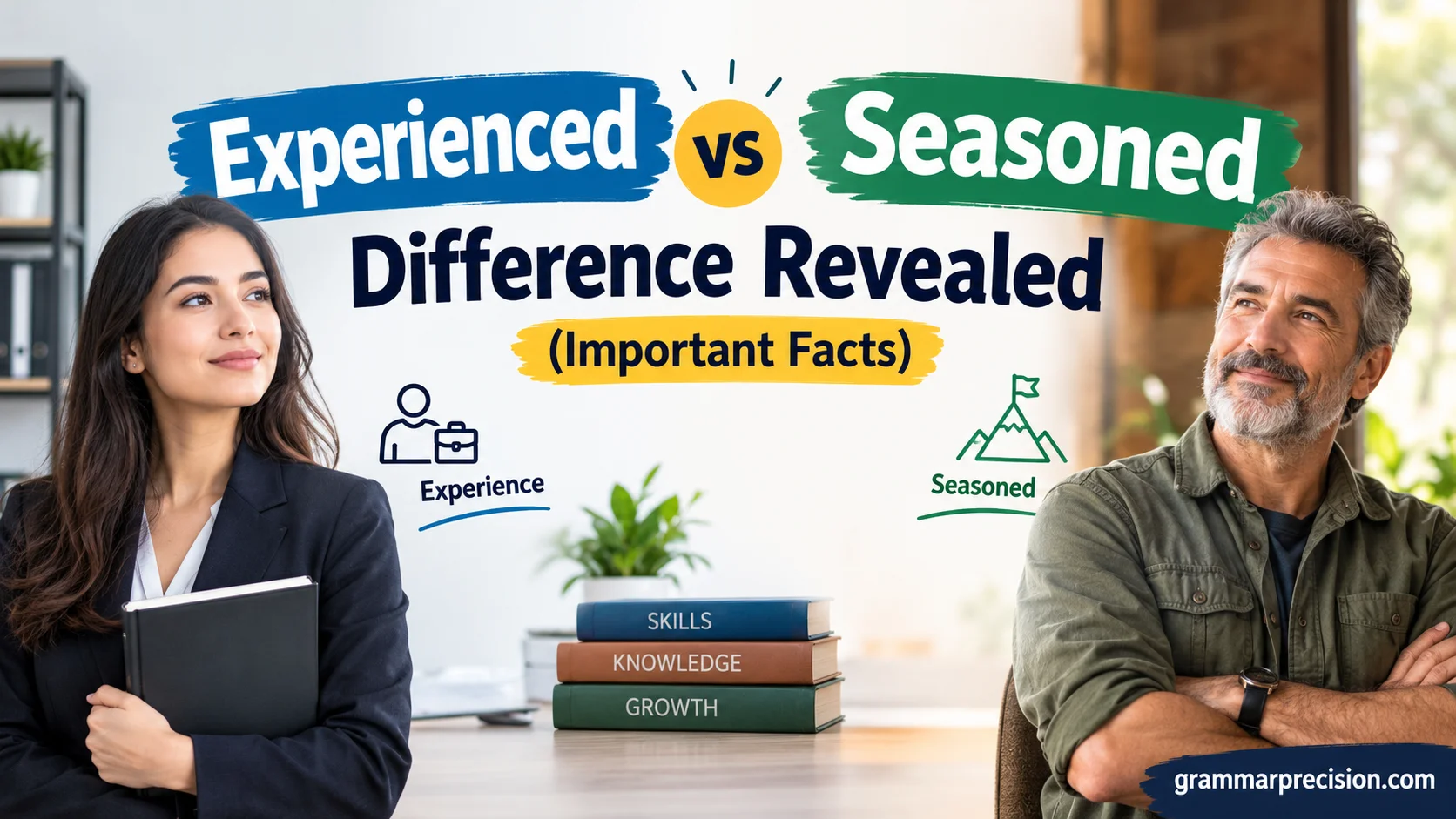
Choosing between Experienced vs Seasoned can be confusing because both words describe knowledge and skill. However, they have different meanings and uses. Understanding these terms helps improve writing clarity, professional communication, and English vocabulary for everyday and workplace situations.
The comparison of Experienced vs Seasoned is important for anyone who wants to use English accurately and professionally. While both words suggest expertise, experienced often highlights practical knowledge gained through work or activities, whereas seasoned emphasizes deep wisdom developed over many years. Knowing the distinction strengthens communication skills, improves content quality, and supports SEO-friendly writing that readers and search engines easily understand.
In professional and academic writing, choosing the right word can improve credibility, authority, and reader trust. The terms experienced and seasoned are frequently used in resumes, business content, and career discussions. Learning their proper usage helps create clear messaging, enhances user experience, and aligns with Google E-E-A-T principles, which value expertise, experience, authoritativeness, and trustworthiness in high-quality content.
Understanding Experienced vs Seasoned also improves your ability to select words based on context and audience. A professional may be experienced after gaining relevant skills, while a seasoned expert often possesses advanced insight earned through years of practice. This distinction supports effective communication, semantic SEO optimization, natural language usage, and better content performance, helping writers create valuable information that meets modern search engine standards.
Experienced vs. Seasoned: What’s the Difference?
The simplest distinction is this:
Experienced means someone has gained knowledge or skill by doing something. Seasoned usually means someone has gained extensive experience and has developed maturity, confidence, and practical judgment.
Think of experience as the number of roads you’ve traveled. Being seasoned suggests that you’ve traveled enough difficult roads to know how to handle unexpected turns.
| Word | Basic Meaning | Main Suggestion | Tone |
| Experienced | Having experience | Practice and exposure | Neutral |
| Seasoned | Highly or extensively experienced | Experience plus maturity | Positive |
| Skilled | Having strong ability | Ability or competence | Positive |
| Expert | Extremely knowledgeable or capable | High-level mastery | Strong |
| Veteran | Having long experience | Long service or exposure | Respectful |
For example, “She is an experienced manager” tells you that she has managed people before. “She is a seasoned manager” suggests that she has spent considerable time handling teams, difficult decisions, workplace problems, and changing circumstances.
Neither word is automatically better. The right choice depends on the message.
What Does Experienced Mean?
Experienced describes someone who has gained knowledge, ability, or familiarity through practice and real-world involvement.
If you’ve done something repeatedly, you can reasonably describe yourself as experienced in it. The word doesn’t necessarily tell the reader how long you’ve been doing it or whether you’re among the best in the field.
Consider these examples:
- She is an experienced teacher.
- He is an experienced software developer.
- We need an experienced driver.
- Maria is experienced in customer service.
- The company hired an experienced project manager.
In each sentence, the important point is previous exposure and practice.
Someone can become experienced relatively early in a career if they spend a great deal of time practicing a particular skill. Experience isn’t determined by age alone. A young professional can have substantial experience in a specialized field.
Common Uses of “Experienced”
The adjective commonly appears with professions, skills, activities, and areas of knowledge.
Some natural combinations include:
- experienced employee
- experienced worker
- experienced professional
- experienced teacher
- experienced leader
- experienced engineer
- experienced lawyer
- experienced traveler
- experienced writer
- experienced designer
You can also use different prepositions depending on the sentence:
- experienced in marketing
- experienced with accounting software
- experienced at solving technical problems
For example, “She is experienced in digital marketing” sounds natural when describing her field of knowledge.
What Does Seasoned Mean?
Seasoned describes someone who has developed considerable experience through long or repeated exposure to a particular activity, profession, or situation.
However, there’s more to the word than simply “experienced.”
When you call someone seasoned, you’re often suggesting that experience has changed how they perform. They may have encountered difficult situations, learned from mistakes, developed better judgment, and become confident under pressure.
For example:
A seasoned negotiator doesn’t panic when the other side makes an aggressive demand.
The sentence doesn’t merely tell us that the negotiator has negotiated before. It suggests that the person has seen difficult tactics and knows how to respond.
That’s the special flavor of seasoned.
Why Does “Seasoned” Sound Stronger?
The word often carries several implied qualities:
- Extensive experience
- Practical wisdom
- Confidence
- Good judgment
- Adaptability
- Composure
- Familiarity with difficult situations
These qualities aren’t guaranteed whenever you use the word. They’re simply common associations.
That’s why “seasoned professional” often sounds more impressive than “experienced professional.”
Compare:
She is an experienced journalist.
This tells us she has worked as a journalist and knows the profession.
She is a seasoned journalist.
This suggests she has covered many stories, dealt with pressure, learned how newsrooms work, and developed strong professional instincts.
The second sentence paints a richer picture.
Experienced vs. Seasoned: The Biggest Difference
The biggest difference comes down to depth and implication.
Experienced focuses mainly on having experience. Seasoned often focuses on what extensive experience has produced.
Imagine two chefs.
Chef A has worked professionally for several years and can prepare dishes efficiently. Chef B has also worked for years but has managed busy kitchens, solved supply problems, trained junior cooks, handled demanding customers, and adapted menus during unexpected shortages.
Both chefs are experienced.
Chef B is more naturally described as seasoned because the word highlights the practical judgment gained from varied situations.
This distinction can be summarized as:
Experience = exposure and practice
Seasoned experience = exposure + repetition + maturity + practical judgment
Of course, real life isn’t a mathematical formula. Someone doesn’t become seasoned after reaching a specific number of years. Context matters.
Experienced vs. Seasoned Examples
Examples make the distinction much easier to see.
Professional Examples
Experienced:
Daniel is an experienced accountant who has worked with several small businesses.
Seasoned:
Daniel is a seasoned accountant who can handle complicated financial issues under tight deadlines.
The first sentence emphasizes Daniel’s background. The second highlights his ability to navigate demanding situations.
Leadership Examples
She is an experienced manager with a strong background in team development.
She is a seasoned manager who knows how to guide teams through major organizational changes.
Both sentences are correct. The second carries a stronger sense of maturity and resilience.
Sports Examples
The team signed an experienced goalkeeper.
This means the goalkeeper has played before and brings useful experience.
The team signed a seasoned goalkeeper.
Now the reader may picture someone who has faced high-pressure matches and knows how to remain calm when the stakes rise.
Travel Examples
He’s an experienced traveler who has visited many countries.
He’s a seasoned traveler who can handle unexpected delays, unfamiliar customs, and complicated travel arrangements without much trouble.
Again, seasoned adds a sense of practiced confidence.
Experienced vs. Seasoned in a Sentence
Both adjectives normally come before a noun:
- an experienced teacher
- a seasoned teacher
- an experienced leader
- a seasoned leader
- an experienced negotiator
- a seasoned negotiator
They can also appear after linking verbs:
She is experienced in managing large teams.
He is seasoned in political negotiations.
However, some constructions are more natural than others. In everyday professional English, phrases such as “seasoned professional,” “seasoned veteran,” “seasoned leader,” and “seasoned expert” are common.
Be careful with combinations that sound unnecessarily repetitive. For example, “seasoned veteran” can be natural because it emphasizes long experience, but in some contexts it may feel like deliberate emphasis rather than essential information.
Where “Seasoned” Works Especially Well
Certain nouns naturally pair with seasoned because these fields often reward judgment gained through repeated challenges.
Seasoned Professional
A seasoned professional usually has substantial experience and understands how the field works beyond basic theory.
The company needs a seasoned professional to lead the expansion.
Seasoned Leader
A seasoned leader suggests someone who has led people through different circumstances and understands how to make difficult decisions.
The board chose a seasoned leader to guide the organization through the transition.
Seasoned Negotiator
A seasoned negotiator has likely encountered many negotiation styles and knows how to stay composed.
The seasoned negotiator didn’t rush to accept the first offer.
Seasoned Journalist
A seasoned journalist suggests someone familiar with deadlines, interviews, research, breaking news, and editorial pressure.
Seasoned Traveler
A seasoned traveler has considerable practical experience dealing with different destinations and unexpected travel problems.
These examples show why seasoned often works best when experience has a practical dimension.
Also Read This: Loss vs Lost: Understanding the Grammatical and Meaningful
Where “Experienced” Works Better
Sometimes experienced is the cleaner and more precise choice.
Use it when you simply want to establish that someone has relevant experience without suggesting seniority or exceptional maturity.
For example:
We need an experienced technician to repair the equipment.
Here, the key question is whether the technician knows how to perform the work. There’s no need to imply that the person has spent decades in the industry.
Similarly:
She is experienced in using Excel.
This sentence communicates a specific ability without adding the broader connotations of seasoned.
Experienced also works particularly well in job descriptions, application forms, resumes, and technical contexts where precision matters more than rhetorical impact.
Is “Seasoned” Always a Compliment?
Usually, seasoned has a positive or respectful tone when it describes a person’s professional ability.
Calling someone a seasoned leader normally suggests competence and maturity.
Still, context can change the effect.
For example:
He is a seasoned political campaigner.
This may be praise for his experience and strategic ability. Depending on the surrounding discussion, it could also suggest someone who has been involved in politics for a very long time.
The word itself isn’t automatically negative. Context creates the final meaning.
The same principle applies to expressions such as seasoned veteran. In many situations, it conveys respect. In others, it may emphasize how long someone has been involved in a field.
Does “Seasoned” Mean Old?
No.
This is one of the most common misunderstandings.
Seasoned refers primarily to experience and maturity within an activity or profession, not someone’s chronological age.
A younger person can become highly seasoned if they’ve spent years dealing with demanding situations and developed strong practical judgment.
For instance:
At 32, she was already a seasoned emergency-response coordinator.
The sentence doesn’t claim she is old. It emphasizes her accumulated experience and ability to handle pressure.
Age and experience often correlate, but they aren’t identical.
Experienced vs. Seasoned vs. Expert vs. Veteran
These words overlap, yet each one highlights something different.
| Term | What It Emphasizes | Example |
| Experienced | Previous practice and exposure | An experienced designer |
| Seasoned | Extensive experience and maturity | A seasoned designer |
| Skilled | Ability to perform well | A skilled designer |
| Expert | Exceptional knowledge or mastery | An expert designer |
| Veteran | Long experience or service | A veteran designer |
This distinction is important because experience doesn’t automatically equal expertise.
Someone might have performed the same task for ten years without developing exceptional skill. Another person might gain advanced expertise much faster through intensive practice, study, and challenging work.
Likewise, someone can be skilled without being seasoned. A talented newcomer may perform brilliantly despite having relatively little professional experience.
Experience vs. Expertise vs. Maturity
Think about these concepts as separate pieces of a larger puzzle.
Experience answers:
“How much practical exposure has this person had?”
Expertise answers:
“How advanced is this person’s knowledge or ability?”
Maturity answers:
“How well does this person handle situations and make judgments?”
The word seasoned often brings all three ideas closer together, although it doesn’t formally guarantee expertise.
Case Study: Two Professionals, Similar Experience
Consider two project managers who each have five years of professional experience.
The first manager has worked on routine projects with predictable schedules. She performs her responsibilities well but rarely encounters major disruptions.
The second manager has managed projects involving missed deadlines, changing requirements, difficult clients, staff shortages, and emergency decisions. She has also trained junior managers and learned to recognize problems before they become serious.
Both are clearly experienced project managers.
However, the second manager could more naturally be called seasoned.
Why?
Because her experience isn’t merely a matter of time. She has faced varied challenges, developed judgment, and learned how to adapt.
That’s the deeper idea behind the word.
Best Synonyms for Experienced
Depending on the context, useful alternatives include:
- Skilled
- Knowledgeable
- Proficient
- Accomplished
- Practiced
- Capable
- Competent
- Expert
- Veteran
These aren’t perfect substitutes. Each carries its own shade of meaning.
For example, proficient focuses on ability. Veteran highlights long experience. Expert implies a particularly high level of knowledge or skill.
So don’t replace experienced mechanically. Choose a synonym based on the exact idea you want to communicate.
Best Synonyms for Seasoned
Depending on the sentence, alternatives can include:
- Highly experienced
- Veteran
- Accomplished
- Skilled
- Mature
- Well-practiced
- Proficient
- Knowledgeable
The phrase highly experienced is especially useful when you want to make the meaning of seasoned completely explicit.
For example:
She is a highly experienced consultant.
This is close in meaning to:
She is a seasoned consultant.
However, the first sounds more direct and factual. The second has a slightly richer, more polished tone.
Experienced vs. Seasoned in Resumes and Job Applications
Word choice can influence how a professional profile sounds.
Experienced is safe, clear, and widely understood:
Experienced marketing specialist with a background in content strategy and campaign management.
Seasoned can create a stronger impression:
Seasoned marketing specialist with a proven record of leading complex campaigns.
The second phrase suggests depth and confidence. However, don’t use seasoned simply because it sounds impressive. Your supporting achievements should justify the description.
Strong resume writing combines descriptive language with evidence.
Instead of:
Seasoned manager with extensive experience.
Consider:
Seasoned operations manager who has led cross-functional teams, improved workflow efficiency, and managed complex projects.
The second version gives the reader something concrete.
A Simple Resume Rule
Use experienced when you want straightforward accuracy.
Use seasoned when extensive experience, judgment, leadership, or resilience is genuinely relevant.
Common Mistakes With Experienced and Seasoned
Treating Them as Perfect Synonyms
They overlap, but seasoned usually carries additional meaning.
Assuming Seasoned Means Old
It doesn’t. The word describes accumulated experience rather than a person’s age.
Confusing Experience With Expertise
Doing something for many years doesn’t automatically make someone an expert.
Using Seasoned Everywhere
Seasoned has a stronger tone. In technical or factual writing, experienced may be more precise.
Ignoring Context
The best adjective depends on what you’re trying to emphasize: experience, ability, maturity, seniority, or mastery.
Quick Cheat Sheet: Which Word Should You Choose?
Use experienced when:
- You want a neutral description.
- You simply need to show relevant experience.
- You’re writing a technical or factual statement.
- You don’t want to imply seniority.
- You want to describe familiarity with a skill or activity.
Use seasoned when:
- The person has extensive experience.
- Practical judgment matters.
- You want to emphasize maturity.
- The person has handled difficult situations.
- You want a more polished professional description.
A useful mental shortcut is:
Experienced tells readers that you’ve been there. Seasoned suggests that you’ve been there enough times to know what to do when things get messy.
That’s not an absolute grammatical rule, but it’s a helpful way to remember the distinction.
FAQs:
What is the main difference between experienced and seasoned?
An experienced person has gained knowledge through practice, while a seasoned person usually has extensive experience and deeper insight developed over many years.
Can someone be experienced but not seasoned?
Yes, a person can be experienced in a field after gaining relevant skills, but they may not yet be considered seasoned without long-term exposure and advanced expertise.
Which word is better for a professional resume?
Experienced is more commonly used on resumes because it clearly highlights skills, qualifications, and work history in a professional manner.
Is seasoned always related to age?
No, seasoned is not about age alone. It refers to someone who has developed strong judgment, knowledge, and expertise through significant experience.
When should I use seasoned instead of experienced?
Use seasoned when describing a person with extensive knowledge, proven success, and years of practical understanding in a particular field.
Conclusion:
Understanding Experienced vs Seasoned helps writers and speakers choose the most accurate word for different situations. Both terms describe expertise, but their meanings and levels of professional development can vary significantly.
An experienced individual has gained valuable knowledge through practical work, training, and real-life situations. A seasoned professional, however, often possesses deeper understanding, stronger judgment, and long-term expertise. Knowing this distinction improves writing accuracy, professional communication, and content clarity, making your message more effective and meaningful for readers in every context.
Choosing the correct term can enhance readability, strengthen vocabulary skills, and create more precise communication. Whether you are writing business content, academic material, or everyday messages, understanding Experienced vs Seasoned helps deliver information with greater confidence, credibility, and clarity, ensuring your content remains useful, engaging, and easy for readers to understand.