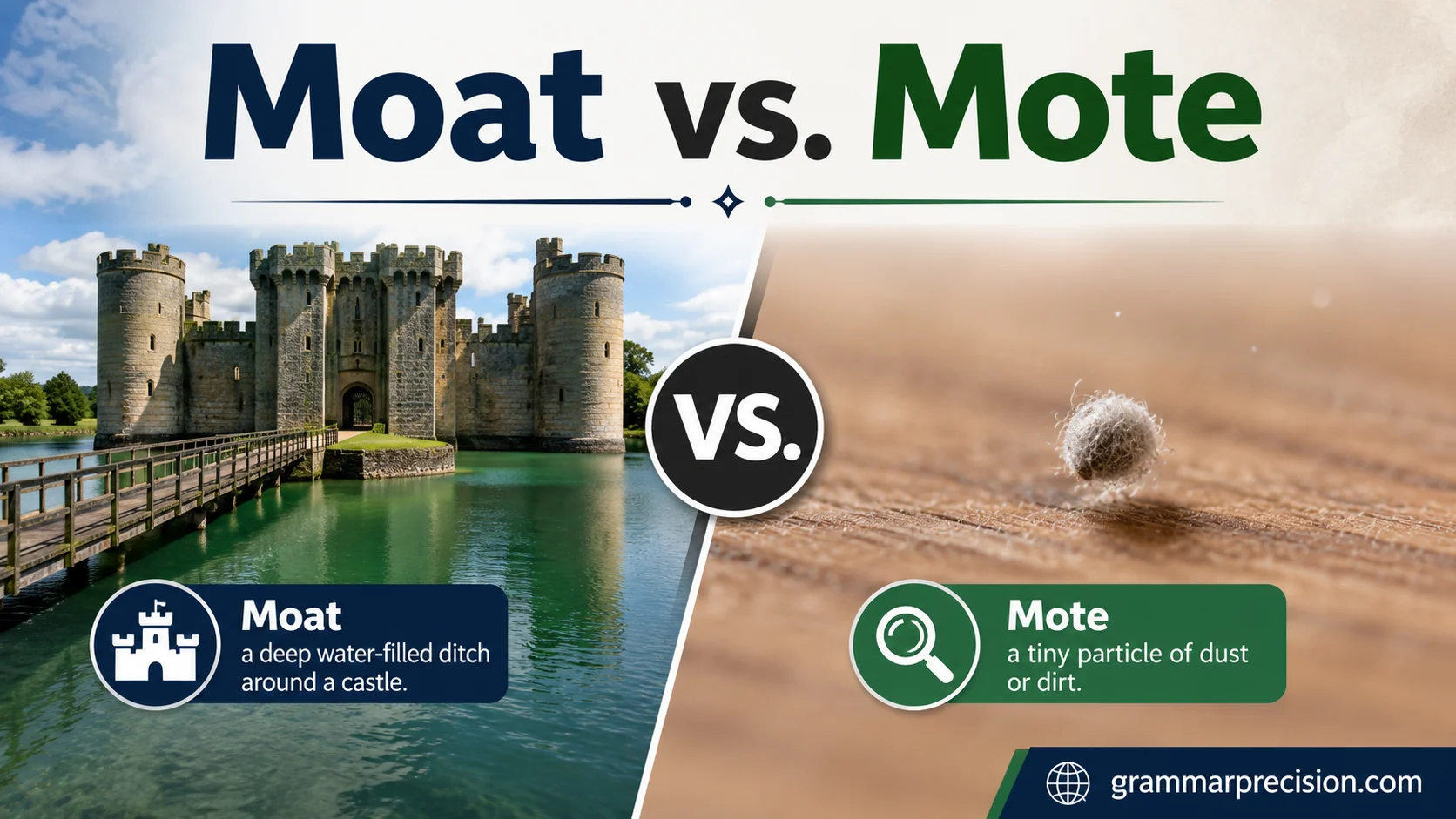
Moat vs. Mote often confuses English learners because the words look similar but have completely different meanings. Understanding this distinction helps you write and speak with greater accuracy.
Although Moat and Mote differ by just one letter, they describe entirely different things. A moat is a deep water-filled ditch surrounding a castle for protection, while a mote refers to a tiny particle of dust or another very small object. Knowing this difference prevents common writing mistakes and improves your vocabulary.
Many writers accidentally mix up Moat vs. Mote because of their similar spelling and pronunciation. However, remembering their definitions, real-life examples, and correct usage makes choosing the right word much easier. This guide will explain each term clearly so you can use both words with complete confidence.
Moat vs. Mote: Quick Difference Explained
The easiest way to remember the difference is to focus on size.
A moat is something large. It is a deep ditch, often filled with water, built around a castle or fortress for protection.
A mote is something small. It means a tiny piece of dust, a speck, or a very small particle.
Here is a quick comparison:
| Word | Meaning | Size | Example |
| Moat | A deep ditch around a castle or building for defense | Large | The castle was surrounded by a wide moat. |
| Mote | A tiny particle or small speck | Very small | A mote of dust floated through the sunlight. |
The key difference is simple:
- Moat = massive barrier
- Mote = microscopic speck
Are Moat and Mote Homophones?
Yes, moat and mote are homophones because they have the same pronunciation but different meanings and spellings.
Both words sound like:
/moht/
However, their meanings come from completely different backgrounds.
Homophones often confuse writers because our ears recognize the sound but not the spelling. Similar examples include:
- Flour vs. flower
- Knight vs. night
- Sea vs. see
- Right vs. write
When you hear “moat” or “mote,” you need context to know which word fits.
For example:
- “The castle had a huge ___ around it.”
→ Moat is correct because castles have defensive ditches. - “A tiny ___ of dust appeared in the sunlight.”
→ Mote is correct because dust particles are tiny.
What Does Moat Mean?
A moat is a deep, wide ditch that surrounds a castle, fortress, or protected area. Historically, many moats contained water, but some were dry.
The main purpose of a moat was defense. It created an obstacle that made it harder for enemies to attack.
Imagine trying to reach a castle wall while standing on the other side of a wide water-filled ditch. Soldiers would have struggled to cross it, especially while carrying heavy weapons.
The History Behind Moats
Moats became especially famous during the Middle Ages when European castles needed strong defenses.
A typical medieval castle defense system included:
- Thick stone walls
- Watchtowers
- Drawbridges
- Gates
- Defensive ditches or moats
A moat added another layer of protection before attackers could even reach the walls.
How Moats Protected Castles
Moats helped defenders by:
- Slowing enemy attacks
- Preventing large siege equipment from reaching walls
- Making direct entry difficult
- Creating a safer distance between attackers and defenders
A castle surrounded by a moat forced enemies to overcome multiple obstacles before entering.
Types of Moats
Not every moat looked the same. Different locations used different designs.
| Type of Moat | Description |
| Wet moat | Filled with water and often connected to rivers or lakes |
| Dry moat | A deep empty ditch without water |
| Defensive moat | Built mainly for military protection |
| Decorative moat | Used around buildings for appearance rather than defense |
Some famous castles still feature moats today as historical attractions.
For example, Windsor Castle and other historic castles preserve defensive features that show how medieval builders protected important locations.
Moat Meaning in Modern Language
Although “moat” originally described a physical structure, people also use it in a figurative way.
One popular modern use appears in business.
A business moat means a strong advantage that protects a company from competitors.
For example:
- A powerful brand
- Unique technology
- Loyal customers
- Lower production costs
- Exclusive resources
A company with a strong business moat is harder for competitors to defeat.
Example:
“The company’s strong customer loyalty created a moat that protected it from new competitors.”
Here, “moat” does not mean a literal ditch. It represents protection and competitive strength.
What Does Mote Mean?
A mote means a tiny particle, speck, or small piece of something.
The word often describes things so small that they are difficult to see.
Common examples include:
- Dust particles
- Tiny pieces of dirt
- Small floating objects
- Very small amounts
A classic image of a mote is dust floating through a beam of sunlight inside a room.
You may have seen this yourself: when sunlight enters through a window, tiny particles appear to dance in the air. Those tiny particles are called motes.
The Meaning of Mote in Literature
The word mote often appears in literature because it creates a strong visual image.
Writers use it to describe:
- Smallness
- Fragility
- Something insignificant
For example:
“A mote of dust drifted across the quiet room.”
The sentence creates a picture of something delicate and almost invisible.
The word also appears in older expressions, such as:
“See the mote in your brother’s eye.”
This phrase comes from a biblical reference and uses “mote” to represent a small fault or problem.
Moat vs. Mote: Key Differences at a Glance
| Feature | Moat | Mote |
| Meaning | Defensive ditch around a castle | Tiny particle or speck |
| Size | Large | Extremely small |
| Main association | Protection and barriers | Dust and small objects |
| Historical connection | Medieval castles | Literature and descriptions |
| Common use today | Business strategy and protection | Describing tiny things |
The easiest mental picture:
A moat surrounds something important. A mote floats around something tiny.
Moat vs. Mote Examples in Sentences
Seeing examples makes the difference easier to understand.
Examples of Moat
- The ancient castle was protected by a deep moat.
- Visitors crossed the wooden bridge over the moat.
- The fortress used a wide moat as a defensive barrier.
- The company created a strong market moat through innovation.
- The castle’s moat was once filled with water.
Examples of Mote
- A mote of dust floated through the sunlight.
- She noticed a tiny mote on the surface of the table.
- The microscope revealed every tiny mote in the sample.
- A single mote of ash landed on the paper.
- The room was filled with sparkling motes of light.
Common Mistakes With Moat and Mote
Many people confuse these words because they sound exactly the same.
Here are some common mistakes:
Using Mote for a Castle Defense
Incorrect:
The king built a large mote around his castle.
Correct:
The king built a large moat around his castle.
A castle needs a defensive structure, so moat is the correct choice.
Using Moat for Tiny Particles
Incorrect:
A moat of dust floated in the air.
Correct:
A mote of dust floated in the air.
Dust particles are tiny, so use mote.
Confusing Business Moat With Physical Moat
Incorrect:
The company built a water-filled moat against competitors.
Correct:
The company built a competitive moat against competitors.
In business writing, “moat” means an advantage that protects a company.
Also Read This: This or These Information? The Complete Grammar Guide
Memory Trick to Remember Moat vs. Mote
A simple memory trick can help you remember forever.
Think Big vs. Small
Moat = Massive
Both words start with “M,” but connect the “A” sound in moat with awesome size.
A moat is:
- Big
- Wide
- Strong
- Protective
Mote = Mini
A mote is:
- Tiny
- Small
- Almost invisible
You can remember:
A moat protects a castle. A mote hides in dust.
Moat vs. Mote Pronunciation Guide
Both words have the same pronunciation.
Moat
Pronounced:
Moht
Example:
The castle had a moat.
Mote
Pronounced:
Moht
Example:
A mote of dust entered the room.
The spelling tells you the meaning, not the sound.
Why Correct Word Choice Matters
Using the right word improves your writing in several ways.
Better Communication
Readers understand your message faster when you choose accurate words.
Compare:
The castle had a mote.
A reader might imagine a tiny object instead of a defensive structure.
Better:
The castle had a moat.
Now the image is clear.
Stronger Professional Writing
Correct word choice matters in:
- Articles
- Reports
- Emails
- Academic writing
- Business documents
Small spelling differences can completely change meaning.
Moat vs. Mote: A Simple Quiz
Test yourself:
The medieval castle was surrounded by a deep ______.
Answer: moat
A tiny ______ of dust appeared in the sunlight.
Answer: mote
The company’s technology gave it a competitive ______.
Answer: moat
The scientist examined a tiny ______ under the microscope.
Answer: mote
If you remember large protection vs. tiny particle, you’ll choose correctly every time.
Words Related to Moat and Mote
Synonyms for Moat
Depending on the context, similar words include:
- Ditch
- Barrier
- Defense
- Protection
- Trench
- Wall
However, these words don’t always have exactly the same meaning.
A moat specifically refers to a ditch, especially one used for protection.
Synonyms for Mote
Similar words include:
- Speck
- Particle
- Fleck
- Grain
- Fragment
- Spot
Again, “mote” usually suggests something extremely small.
FAQs:
What is the difference between Moat and Mote?
A moat is a deep ditch, often filled with water, built around a castle for defense. A mote, on the other hand, is a tiny speck or particle, such as a grain of dust. Although they look alike, their meanings are completely different.
Is Moat used in modern English?
Yes. While moat is most commonly used in historical contexts, it also appears in modern writing. In business, the term economic moat describes a company’s long-term competitive advantage over its rivals.
What does Mote mean in everyday language?
A mote refers to a very small particle, especially a speck of dust floating in the air. Although it is less common in everyday conversation, it still appears in literature, poetry, and descriptive writing.
How can I remember the difference between Moat and Mote?
Think of moat as surrounding a medieval castle with water for protection. Remember mote as a tiny dust particle that you can barely see. This simple association makes the difference much easier to recall.
Are Moat and Mote pronounced the same?
Yes. Moat and Mote are pronounced the same, making them homophones. Because they sound identical but have different meanings and spellings, you should rely on the context of the sentence to choose the correct word.
Conclusion:
Understanding Moat vs. Mote is essential for using these commonly confused words correctly. A moat is a defensive ditch around a castle, while a mote is a tiny particle or speck. By remembering their distinct meanings, spellings, and contexts, you can write with greater accuracy, avoid common mistakes, and communicate more confidently in both academic and everyday English.