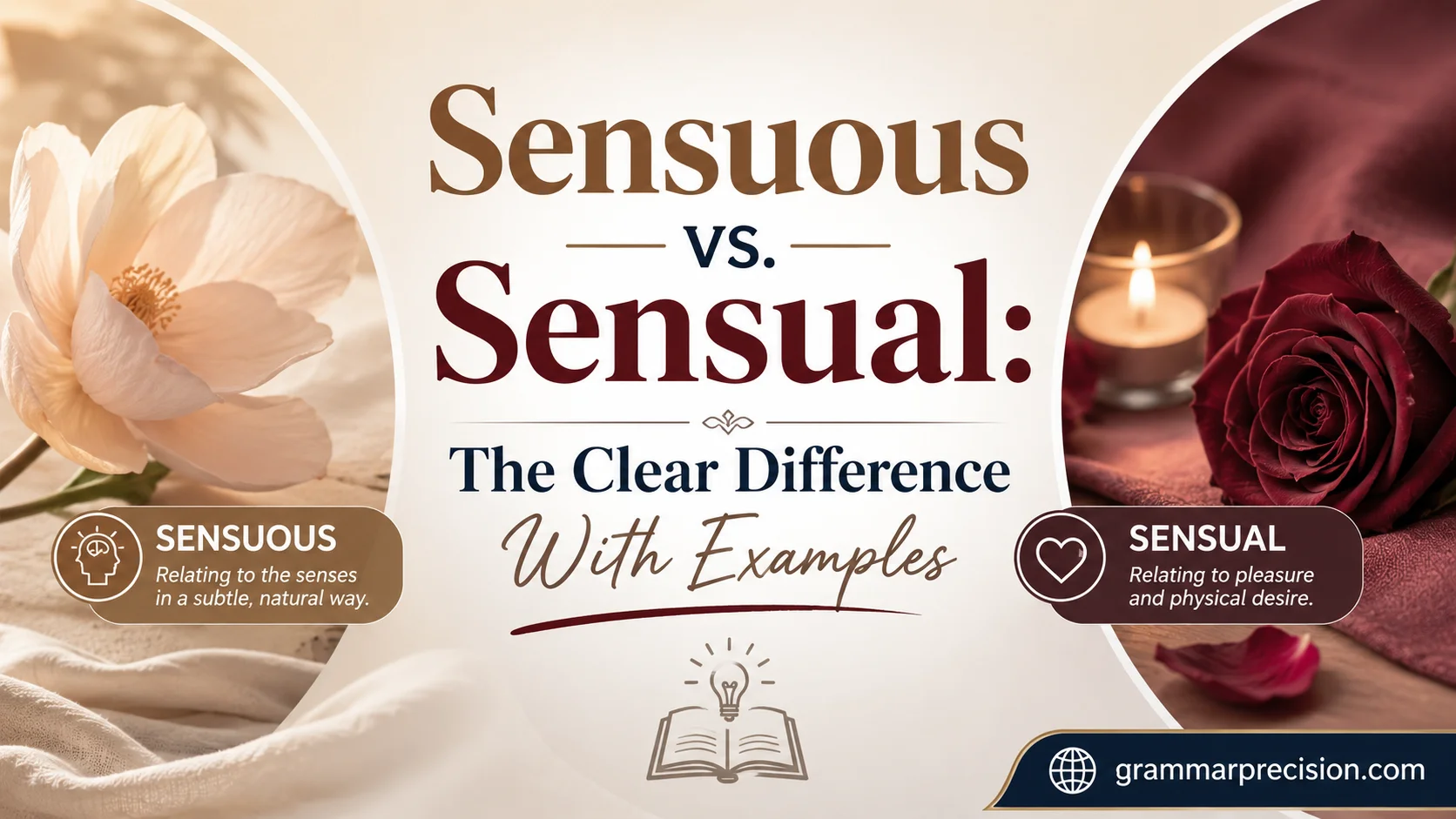
Sensuous vs. Sensual can confuse writers because both words relate to the senses. However, sensual often suggests sexual pleasure, while sensuous describes enjoyable sensory experiences without that meaning. Knowing this difference helps you choose the right word and avoid misunderstandings in everyday writing and communication.
The words sensual and sensuous share the root sens-, meaning to arouse the senses, but they developed different meanings. Sensual traditionally describes physical, carnal, or sexual pleasure, while sensuous refers to experiences involving sight, sound, touch, taste, or smell without a sexual connotation in most contexts.
As a writer, I’ve found that context makes this distinction especially important. Sensual can sometimes sound decidedly NSFW, particularly in professional communication, while sensuous usually feels more innocent and artistic. For example, you might describe sensuous music or scenery, but a sensual experience may suggest physical intimacy or sexual attraction.
Why Sensuous and Sensual Are So Easy to Confuse
The confusion starts with their shared history. Both sensuous and sensual are connected to the idea of sensation and physical feeling.
Their meanings have developed along slightly different paths. Sensuous tends to emphasize the senses themselves: seeing, hearing, tasting, smelling, or touching something pleasurable. Sensual, on the other hand, often emphasizes bodily pleasure, physical attraction, or erotic feeling.
However, the boundary isn’t a brick wall.
Modern dictionaries recognize some overlap between the two words. In certain contexts, sensual can simply mean connected with the senses or physical enjoyment. Likewise, sensuous can suggest an intense physical quality without being sexual.
That flexibility is why replacing one word with the other can subtly change the meaning of a sentence.
Compare these:
- The chef created a sensuous dessert.
- The dancer gave a sensual performance.
The first sentence focuses on sensory pleasure. The second may suggest physical allure or erotic appeal.
The easiest memory trick
Use this mental shortcut:
Sensuous = the senses.
Sensual = the body and physical attraction.
It isn’t a perfect rule for every dictionary definition, but it works remarkably well in everyday writing.
Sensuous Definition: Pleasure Through the Senses
Sensuous describes something that strongly appeals to the senses and produces physical or aesthetic pleasure.
The word can involve any of the five senses:
- Sight
- Hearing
- Smell
- Taste
- Touch
A sensuous experience doesn’t need to involve romance or sexuality. A warm loaf of freshly baked bread, the sound of rain against a window, or the scent of roses can all be sensuous.
What sensuous really means
When you call something sensuous, you’re highlighting its sensory richness.
For example:
The garden was filled with the sensuous fragrance of jasmine.
Here, sensuous emphasizes the pleasurable experience of smelling the flowers. There’s no sexual meaning.
Another example:
The orchestra created a sensuous wall of sound.
The word describes the richness and pleasure of the auditory experience.
This makes sensuous especially useful in descriptive writing. Food critics, travel writers, novelists, artists, and reviewers often use it to create vivid sensory impressions.
The five senses behind the word
A useful way to understand sensuous is to connect it directly with sensory experience.
| Sense | Sensuous example |
| Sight | A sensuous display of colors |
| Hearing | A sensuous melody |
| Smell | A sensuous floral fragrance |
| Taste | A sensuous chocolate dessert |
| Touch | A sensuous silk fabric |
Notice the pattern. The word describes how something feels to the senses, not necessarily how it makes someone feel romantically attracted.
Examples of sensuous in a sentence
- The painter used sensuous colors to give the landscape warmth.
- The restaurant served a sensuous blend of spices.
- Her voice had a sensuous musical quality.
- The velvet felt soft and sensuous against the skin.
- The garden offered a sensuous combination of fragrance and color.
- The novel contains sensuous descriptions of the countryside.
In each example, the emphasis falls on sensory richness.
Sensual Definition: Physical and Romantic Pleasure
Sensual generally describes something connected with physical pleasure, bodily enjoyment, sexual attraction, or erotic feeling.
That doesn’t mean sensual always means explicitly sexual. The word can describe a broader sense of physical pleasure. Still, it carries a stronger association with intimacy and attraction than sensuous does.
For that reason, word choice matters.
What sensual really means
Consider this sentence:
The couple shared a sensual embrace.
The word sensual suggests physical intimacy and attraction. If you replaced it with sensuous, the implication would change.
Now consider:
She wore a sensual perfume.
This could suggest that the fragrance was designed to create an alluring or seductive impression. The emphasis isn’t merely on the pleasant smell.
That’s the crucial difference. Sensuous tends to describe sensory pleasure, while sensual often describes the physical or emotional response connected with bodily pleasure and attraction.
How sensual differs from explicitly sexual language
An important nuance gets lost when people treat sensual and sexual as exact synonyms.
They aren’t identical.
Sexual directly relates to sex or sexual activity. Sensual is broader and can describe physical pleasure, attraction, intimacy, touch, or an atmosphere of seduction.
For example:
- Sensual touch → intimate, physically appealing touch
- Sexual behavior → behavior directly related to sex
- Sensual atmosphere → an environment that feels physically alluring
- Sexual relationship → a relationship involving sexual activity
So sensual can be suggestive without being explicit.
Examples of sensual in a sentence
- The room had a sensual atmosphere created by soft lighting and music.
- The perfume has a sensual fragrance.
- Their dance was graceful and sensual.
- The advertisement uses sensual imagery.
- The novel explores sensual desire.
- The silk robe gave the character an elegant, sensual appearance.
Here, sensual adds a layer of physical attraction or intimacy that sensuous may not communicate.
Sensuous vs. Sensual: The Core Difference
The fastest way to distinguish these words is to ask what kind of pleasure you’re describing.
| Feature | Sensuous | Sensual |
| Primary focus | The senses | Physical or bodily pleasure |
| Typical association | Sensory richness | Attraction or intimacy |
| Sexual meaning | Usually absent | Often possible |
| Five senses | Strong connection | Less central |
| Common contexts | Food, art, music, nature | Romance, touch, attraction |
| Tone | Descriptive, aesthetic | Intimate, alluring |
| Example | Sensuous melody | Sensual touch |
A simple test
Ask yourself:
“Am I describing how something appeals to the senses?”
If yes, sensuous is often the better choice.
“Am I describing physical attraction, intimacy, or bodily pleasure?”
If yes, sensual is usually more appropriate.
For example:
The chef prepared a sensuous meal.
The meal appeals to taste, smell, texture, and perhaps sight.
The couple shared a sensual moment.
The focus is physical intimacy.
That small distinction can prevent a surprisingly large change in meaning.
Also Read This: Knob vs Nob: Meaning Differences & Pronunciation
Sensuous vs. Sensual in Different Contexts
Context can shift the most appropriate word. Let’s look at common situations where writers encounter this pair.
Food and cooking
Sensuous is often a natural choice when describing the rich sensory experience of food.
The sensuous dessert combined dark chocolate, roasted almonds, and orange zest.
The sentence invites you to imagine taste, smell, texture, and appearance.
Sensual can also appear in food writing, especially when the writer wants to give the food an indulgent or seductive quality.
The dessert offered a sensual combination of chocolate and cream.
The second sentence feels more suggestive. It treats the food almost as an object of temptation.
Music and sound
Music can be sensuous because sound directly stimulates the senses.
The singer’s sensuous voice floated through the theater.
This describes a rich, pleasurable quality.
Sensual is also possible when the voice or music creates an atmosphere of intimacy or seduction.
The singer’s sensual voice captivated the audience.
The second version carries a stronger suggestion of allure.
Art and literature
Artists and writers frequently use sensuous to describe vivid sensory qualities.
The painter created a sensuous landscape filled with golden light.
The focus is on visual beauty.
Sensual becomes more appropriate when artwork evokes physical attraction or erotic themes.
The portrait has a distinctly sensual quality.
The reader may infer that the subject’s pose, expression, or body creates an alluring effect.
Nature and scenery
Nature is a classic setting for sensuous descriptions.
The forest offered a sensuous mixture of pine, damp earth, birdsong, and cool air.
The sentence activates several senses at once.
Calling the same forest sensual would be unusual unless the writer intentionally wanted to personify it or create an erotic mood.
Clothing and appearance
Both words can work here, but they create different impressions.
The sensuous fabric felt smooth against her skin.
This focuses on touch.
The dress gave her a sensual appearance.
This focuses more on physical attractiveness.
The distinction is subtle but powerful.
Romance and relationships
Sensual is usually the natural choice when discussing intimacy.
They shared a sensual dance.
The scene creates a sensual mood.
Using sensuous isn’t necessarily grammatically wrong in every romantic context, but it can sound more literary and sensory than intimate.
20 Sensuous vs. Sensual Sentence Examples
Seeing the words side by side makes their difference easier to remember.
| Sensuous | Sensual |
| A sensuous melody filled the room. | A sensual melody created an intimate mood. |
| The dessert had a sensuous texture. | The perfume had a sensual quality. |
| The garden was sensuous in color and scent. | The scene had a sensual atmosphere. |
| She admired the sensuous painting. | She admired the portrait’s sensual appeal. |
| The silk had a sensuous softness. | The dress created a sensual silhouette. |
| The wine offered a sensuous taste. | The advertisement used sensual imagery. |
| The novel contains sensuous descriptions of nature. | The novel explores sensual desire. |
| The singer’s voice was rich and sensuous. | The singer’s voice sounded warm and sensual. |
| The spa created a sensuous sensory experience. | The setting created a sensual mood. |
| The flowers released a sensuous fragrance. | The perfume had a sensual scent. |
The left column generally emphasizes sensory experience. The right column more often emphasizes physical allure or intimacy.
Sensuous vs. Sensual vs. Sensory
A third word often enters the discussion: sensory.
Unlike sensuous and sensual, sensory is much more neutral. It simply means related to the senses or the process of sensing.
| Word | Basic meaning | Example |
| Sensory | Related to the senses | Sensory information reaches the brain. |
| Sensuous | Pleasing or rich to the senses | The restaurant offered a sensuous dining experience. |
| Sensual | Connected with physical pleasure or attraction | The dance had a sensual quality. |
This three-way comparison is extremely useful.
You might write:
Sensory: The museum offers interactive sensory exhibits.
Sensuous: The exhibition creates a sensuous experience through light and sound.
Sensual: The portrait has a sensual quality.
The first is neutral and descriptive. The second emphasizes sensory pleasure. The third introduces physical allure.
Is “Sensual” Always Sexual?
No.
This is one of the most important points to remember.
Sensual can refer to physical pleasure without directly referring to sexual activity. A massage, luxurious fabric, intimate dance, or alluring fragrance might be described as sensual.
Still, the word often carries romantic or erotic associations.
That’s why context matters. If you’re writing for a broad audience, ask whether readers might interpret sensual more strongly than you intend.
For example:
The hotel offers a sensual experience.
This sounds intimate or seductive.
If you simply mean that guests can enjoy beautiful scents, textures, sounds, and tastes, sensuous experience may communicate your idea more precisely.
Is “Sensuous” Always About the Senses?
Yes in its core meaning, but not necessarily in a narrow literal sense.
Sensuous is strongly tied to sensory perception, yet writers often use it figuratively.
A sensuous voice, for example, isn’t something you physically touch. The description means the voice produces a rich and pleasurable sensory impression.
Likewise, a sensuous poem can use vivid language that stimulates the imagination through descriptions of color, texture, sound, fragrance, and taste.
This figurative flexibility makes sensuous especially useful in creative writing.
How to Remember the Difference Instantly
Here’s a compact memory trick:
Sensuous → senses
Sensual → physical attraction
When you’re uncertain, imagine the sentence as a photograph.
If the reader should notice color, flavor, fragrance, sound, or texture, sensuous will often fit.
If the reader should notice intimacy, physical attraction, desire, or bodily pleasure, sensual is usually the stronger choice.
You can also remember the two through contrasting examples:
- Sensuous sunset → beautiful colors and atmosphere
- Sensual glance → physical attraction
- Sensuous chocolate → taste and texture
- Sensual touch → intimacy
- Sensuous music → pleasurable sound
- Sensual dance → physical allure
A quick decision guide
Use sensuous when you mean:
- Pleasing to the senses
- Rich in sensory detail
- Beautiful or pleasurable to experience
- Related to taste, smell, sight, sound, or touch
Use sensual when you mean:
- Physically pleasurable
- Attractive in a bodily way
- Romantic or intimate
- Suggestive or erotic
When both seem possible, choose the word that gives your reader the exact emotional picture you want.
FAQs:
What is the main difference between sensual and sensuous?
Sensual usually relates to physical or sexual pleasure, while sensuous describes something that appeals strongly to the senses, such as beautiful music, rich flavors, or pleasant textures. The key difference is the sexual connotation that sensual can carry.
Is sensuous always non-sexual?
Generally, yes. Sensuous usually focuses on enjoyable sensory experiences involving sight, sound, taste, smell, or touch. Although context can influence interpretation, the word typically doesn’t suggest sexual pleasure. For example, you can describe a sunset, melody, or fabric as sensuous.
Can sensual and sensuous be used interchangeably?
They can sometimes appear interchangeably, but careful writers should consider the context. Using sensual when you mean sensuous may unintentionally suggest sexual attraction or physical intimacy. When you simply mean something that strongly appeals to the senses, sensuous is usually the safer choice.
Is sensual always related to sex?
Not necessarily, but sensual commonly has a sexual or physical meaning in modern English. It can also refer more generally to gratification of the senses. However, because readers may interpret it sexually, you should choose it carefully, especially in professional or formal writing.
Which word should I use for beautiful sensory experiences?
Use sensuous when describing something that provides a rich or pleasurable experience through the senses without implying sex. For example, sensuous music, sensuous colors, and sensuous textures are natural expressions. Use sensual when the intended meaning involves physical or sexual pleasure.
Conclusion:
Understanding sensual vs. sensuous becomes easier when you focus on their context and connotation. Sensuous usually describes something that strongly appeals to the senses, while sensual often suggests physical or sexual pleasure. Although both words share a connection with sensory experience, they aren’t always interchangeable. Choosing the right term helps your writing remain clear, precise, natural, and appropriate.