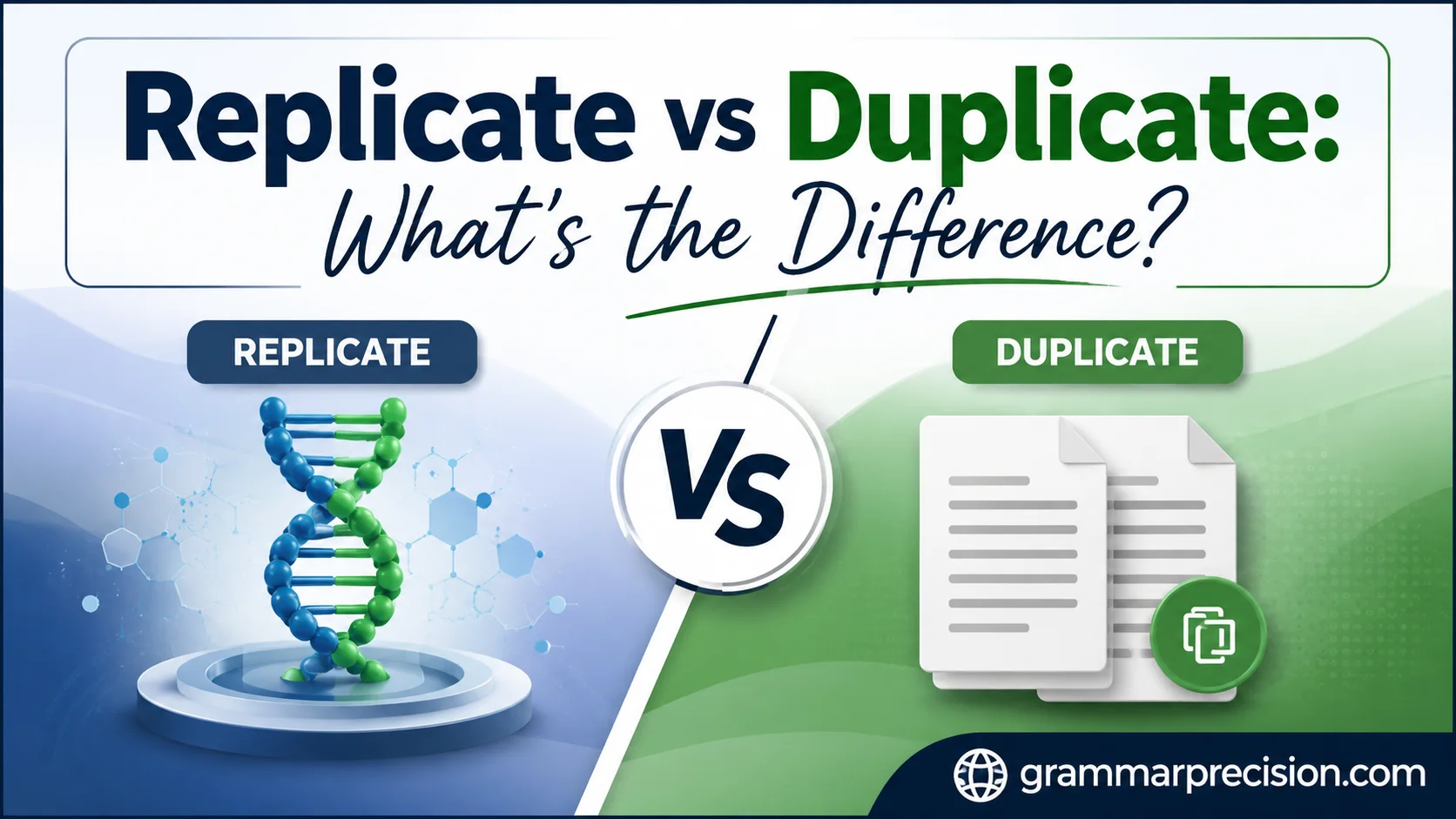
Replicate vs Duplicate can be confusing because both words describe making a copy. However, their meanings differ slightly depending on how you use them.
A duplicate is usually an exact copy of an original, while replicate means to reproduce, recreate, or construct something similar. Both can work as a noun, verb, or adjective, but the situation determines the better choice.
For example, you might duplicate a document when you need an identical copy. Scientists may replicate an experiment to achieve the same results. An artist can replicate another painting’s style without creating the exact same painting.
Replicate vs Duplicate in One Minute
The quickest way to remember the difference is this:
Replicate means to reproduce something. Duplicate means to make another copy of something.
The two words overlap because reproduction can sometimes produce an exact copy. However, replication doesn’t always require perfect sameness. A scientist might replicate an experiment to see whether another researcher can achieve similar results. The second experiment won’t be physically identical to the first because different materials, conditions, or people may be involved.
A duplicate, by contrast, generally aims at another identical or nearly identical version.
| Feature | Replicate | Duplicate |
| Basic meaning | Reproduce or recreate | Make a copy |
| Main focus | Repeating or reproducing something | Creating another version |
| Exactness | May be similar rather than identical | Often identical or nearly identical |
| Common objects | Experiments, processes, results, designs | Files, documents, keys, records |
| Common idea | “Do it again” | “Make another one” |
| Example | Replicate the experiment | Duplicate the file |
Think of it this way: replication follows a recipe, while duplication produces another serving from an existing one. The distinction isn’t absolute, but it gives you a useful mental shortcut.
What Does Replicate Mean?
Replicate means to reproduce, recreate, or repeat something so that it resembles the original or produces a similar result.
The word often carries an idea of reproduction through a process. That’s why it appears frequently in scientific, technical, academic, and business contexts.
For example:
- Scientists attempted to replicate the experiment.
- The company wants to replicate its successful marketing strategy.
- Engineers replicated the original design.
- The artist tried to replicate the texture of the painting.
- The study couldn’t replicate the earlier findings.
Notice something important in these examples. The subject isn’t always a physical object. You can replicate an experiment, result, method, strategy, effect, or experience.
Replicate as a Verb
The most common use of replicate is as a verb.
Its basic forms are:
- Replicate — present tense
- Replicated — past tense
- Replicating — present participle
- Replicates — third-person singular
For example:
The researchers replicated the original study.
Here, replicated means they performed the study again using a comparable method.
Another example:
The company successfully replicated its sales model in three new markets.
The company didn’t necessarily make three physical copies of its original business. Instead, it reproduced the same successful approach in different places.
Replicate in Science and Research
Scientific writing provides one of the clearest examples of the word’s special meaning.
When researchers replicate a study, they repeat the research using the original findings or methodology as a reference. The purpose often involves checking whether the earlier result can be reproduced.
This matters because one successful experiment doesn’t automatically establish a universal result. Repeated research can strengthen confidence in a finding.
For instance:
The second team replicated the experiment but obtained different results.
The word replicated doesn’t mean the second team created a photocopy of the first experiment. It means they repeated the experimental process to see whether a similar outcome would occur.
That’s a major clue when distinguishing replicate from duplicate.
What Does Duplicate Mean?
Duplicate means to make an exact copy or another version of something. It can function as a verb, noun, or adjective, which makes it especially flexible in everyday English.
Consider these examples:
- Please duplicate the document.
- I accidentally created a duplicate file.
- Keep a duplicate key in a safe place.
- The system detected a duplicate record.
- We need to remove these duplicates from the database.
In each case, the idea centers on another copy or instance.
Duplicate as a Verb
As a verb, duplicate means to copy something or create another version of it.
For example:
Please duplicate this spreadsheet before making changes.
The instruction is straightforward. You need another copy of the existing spreadsheet.
You could also say:
The technician duplicated the key.
That means the technician made another key with the same function and shape.
Duplicate as an Adjective
As an adjective, duplicate describes something that is an extra copy or repeats something already present.
For example:
The database contains duplicate records.
Here, duplicate describes records that repeat information already stored elsewhere.
Another example:
I found a duplicate invoice in the folder.
The invoice isn’t merely similar in a broad sense. It represents another copy of an invoice that already exists.
Duplicate as a Noun
As a noun, duplicate means a copy or an additional version.
For example:
Keep the original document and file the duplicate separately.
You can also use the plural:
The software automatically removed several duplicates.
This noun usage appears often in office work, data management, archives, and everyday situations.
The Biggest Difference Between Replicate and Duplicate
The most useful distinction comes down to what you’re reproducing and why.
Replicate often emphasizes the act of reproducing something, especially a process, result, method, or effect.
Duplicate usually emphasizes the creation of another copy, especially when the copy closely matches the original.
Consider these two sentences:
The researchers replicated the experiment.
The researchers duplicated the report.
The first sentence describes repeating a process. The second describes copying a document.
That difference becomes even clearer with results:
The researchers replicated the results.
This means they obtained comparable results by repeating the research.
But:
The researchers duplicated the results.
This can sound unnatural or misleading in many scientific contexts because results aren’t normally treated like files that you simply copy. If the intended meaning is that another study produced the same findings, replicated is the stronger choice.
Process vs Copy
A useful test is to ask yourself:
Am I repeating how something works, or am I making another copy of it?
If you’re repeating a method, process, result, or experience, replicate will often fit.
If you’re creating another document, file, object, record, or physical copy, duplicate will often sound more natural.
Of course, English doesn’t work like a rigid mathematical formula. Context can blur the boundary.
Replicate vs Duplicate in Different Fields
The best word can change depending on the subject you’re discussing. Here’s where the distinction becomes especially practical.
Replicate vs Duplicate in Science
Scientists commonly use replicate when discussing experiments, studies, findings, and biological processes.
Examples:
- The team replicated the experiment.
- Another laboratory replicated the findings.
- Researchers failed to replicate the original effect.
- The scientists replicated the testing procedure.
Duplicate has a narrower role in this setting. It can describe identical samples, copies of records, or repeated items, but it doesn’t usually replace replicate when discussing whether a research finding can be reproduced.
Replicate vs Duplicate in Technology
Technology uses both words frequently.
You might duplicate a file, folder, or record because you need another copy.
For example:
Right-click the file and select the option to duplicate it.
Meanwhile, developers might replicate a system, database environment, or technical process.
For example:
The engineers replicated the server environment for testing.
Here, replication involves recreating a functioning environment rather than simply copying one visible file.
Replicate vs Duplicate in Business
Business provides another useful contrast.
Suppose a restaurant has developed a highly successful customer-service system. Opening another location with the same system might involve replicating the business model.
You wouldn’t normally say the company “duplicated the business” unless you specifically meant that it created an additional copy or equivalent entity.
For example:
The company replicated its successful training program across all regional offices.
That sentence focuses on reproducing a successful approach.
Replicate vs Duplicate in Manufacturing
Manufacturing can use either term depending on the intended meaning.
If a factory makes another identical component, duplicate may describe the copy.
If engineers reproduce a production method or design, replicate may be more suitable.
For example:
The factory duplicated the original component.
This emphasizes another copy of the component.
The engineers replicated the original production process.
This emphasizes reproducing the method.
Replicate vs Duplicate in Data Management
Data professionals frequently use duplicate when the same record appears more than once.
For example:
The software identified 250 duplicate customer records.
Here, duplicate has a precise practical meaning: multiple records represent the same information or entity.
Replication, meanwhile, can describe maintaining copies of data across systems.
For example:
The database replicates information across multiple servers.
The goal isn’t necessarily to create accidental duplicates. Instead, the system deliberately reproduces data across locations.
What Can You Replicate?
Because replicate emphasizes reproduction, it works naturally with many abstract and concrete things.
You can replicate:
- Experiments
- Research findings
- Processes
- Methods
- Strategies
- Designs
- Systems
- Experiences
- Conditions
- Effects
- Patterns
- Successful results
For example:
The startup replicated the competitor’s distribution strategy.
The researchers couldn’t replicate the original findings.
The architect replicated several elements of the historic design.
These examples show why replicate has a broader conceptual range than simply “copy.”
Also Read This: The Media Is or The Media Are? Meaning, Grammar, and Examples
What Can You Duplicate?
Duplicate works especially well when the subject can exist as a separate copy or instance.
You can duplicate:
- Files
- Documents
- Keys
- Records
- Invoices
- Images
- Folders
- Forms
- Objects
- Database entries
- Physical products
For example:
Duplicate the form before entering the new information.
The employee accidentally duplicated the invoice.
The system found three duplicate records.
The word feels natural because each situation involves another version of an existing item.
Replicate vs Duplicate vs Copy
The word copy creates another useful comparison. In everyday English, copy is often broader and less technical than either replicate or duplicate.
| Word | Main idea | Example |
| Replicate | Reproduce something, often through a process | Replicate the experiment |
| Duplicate | Make another identical or near-identical copy | Duplicate the file |
| Copy | Make something similar or identical to an original | Copy the text |
| Reproduce | Create or produce something again | Reproduce the result |
| Imitate | Act or look like something else | Imitate the style |
These words aren’t perfect substitutes.
If you tell someone to copy the document, you’re using ordinary language. If you tell a researcher to replicate the experiment, you’re using language that highlights reproducibility. If a computer user needs another version of a file, duplicate may be the most precise choice.
Replicate vs Duplicate: Examples That Make the Difference Obvious
Sometimes a few contrasting sentences teach more than a long definition.
| Sentence | Best word | Why |
| The scientists ___ the experiment. | Replicated | They repeated a process. |
| Please ___ this document. | Duplicate | They need another copy. |
| The company ___ its successful strategy. | Replicated | It reproduced an approach. |
| The system found ___ records. | Duplicate | Records were repeated. |
| Engineers ___ the original testing environment. | Replicated | They recreated a system. |
| She ___ the key. | Duplicated | She made another physical copy. |
| The team ___ the earlier findings. | Replicated | They reproduced research results. |
| Create a ___ of the invoice. | Duplicate | The task requires another document. |
One subtle point deserves attention: duplicate can sometimes replace replicate when the context clearly involves creating an exact copy. The reverse isn’t always true.
For example, “duplicate the file” sounds completely natural. “Replicate the file” is possible in some technical contexts, but it carries a more specialized flavor and may imply reproduction across a system rather than a simple copy.
Common Errors With Replicate and Duplicate
These words cause trouble because dictionaries often give overlapping definitions. The solution isn’t memorizing two isolated meanings. Instead, pay attention to context and purpose.
Using Duplicate for Research Findings
The researchers duplicated the results.
This may be understood, but it often sounds less precise than:
The researchers replicated the results.
When discussing whether a previous finding can be reproduced, replicate is usually the better choice.
Using Replicate for Ordinary Files
Can you replicate this Word document?
This isn’t necessarily impossible, especially in technical contexts. However, everyday users would normally say:
Can you duplicate this Word document?
Or simply:
Can you copy this Word document?
Assuming Replicate Means Perfectly Identical
Replication doesn’t always mean that every detail remains exactly the same.
A replicated experiment may use different researchers or equipment while following the same basic methodology. The goal can be to determine whether the original result holds under comparable conditions.
Therefore, replication is often about reproducibility rather than perfect physical sameness.
Treating Duplicate and Replicate as Complete Synonyms
They overlap, but they carry different shades of meaning.
Compare:
The company duplicated the strategy.
The company replicated the strategy.
The second sentence more strongly suggests that the company reproduced a successful approach. The first could sound as though the strategy itself received a literal copy.
A Practical Case Study: Research vs Office Work
Imagine two people working in the same organization.
A scientist wants to test whether an earlier experiment produced reliable results. She follows the published method and runs the study again.
She replicates the experiment.
Meanwhile, an office administrator needs another copy of the scientist’s final report. He opens the original document and creates a second version.
He duplicates the report.
Both people create something again, but they aren’t performing the same action.
The scientist reproduces a process.
The administrator creates a copy.
That simple contrast captures the central difference between the two words.
A Quick Trick to Remember Replicate vs Duplicate
Use this mental shortcut:
Replicate = reproduce the action, process, result, or effect.
Duplicate = produce another copy of the thing.
Another way to remember it:
Replicate the experiment. Duplicate the document.
If you’re unsure, ask what you’re actually trying to reproduce. If it’s a method or outcome, replicate will often be the better choice. If it’s a file or object, duplicate will usually make more sense.
Mini Quiz: Replicate or Duplicate?
Test yourself with these sentences.
- The researchers wanted to ___ the original study.
- Please ___ the file before editing it.
- The company hopes to ___ its successful sales strategy.
- The database contains several ___ entries.
- Engineers successfully ___ the testing environment.
- She asked the locksmith to ___ her house key.
- The second laboratory ___ the earlier findings.
- We accidentally created a ___ invoice.
Answers
- Replicate — the researchers are repeating a study.
- Duplicate — they need another file.
- Replicate — they want to reproduce a successful strategy.
- Duplicate — the entries repeat existing information.
- Replicate — engineers are recreating an environment.
- Duplicate — they need another physical key.
- Replicate — the laboratory is reproducing research findings.
- Duplicate — the invoice is an extra copy.
If you got all eight right, you’ve already mastered the core distinction.
FAQs:
What is the difference between replicate and duplicate?
Replicate means to reproduce something closely, often to achieve the same result or follow an existing process. Duplicate means to make an exact or nearly exact copy of something. For example, scientists may replicate an experiment, while you may duplicate a document.
Is replicate the same as duplicate?
No, replicate and duplicate aren’t always the same. Replicate usually focuses on reproducing a result, process, or effect, while duplicate focuses on creating another copy of an existing item. Their meanings can overlap, but the correct word depends on the context.
When should I use replicate instead of duplicate?
Use replicate when you want to describe repeating a process, experiment, method, or result. For example, “Researchers replicated the study.” Use duplicate when you mean making a copy of a file, document, image, or object, such as “Please duplicate this report.”
Can duplicate be used as a verb and a noun?
Yes, duplicate works as both a noun and a verb. As a verb, it means to make a copy: “Please duplicate the file.” As a noun, it refers to an extra or identical copy: “I found a duplicate of the document.”
Which word is better: replicate or duplicate?
Neither word is always better because replicate and duplicate serve different purposes. Choose replicate for repeating a method or achieving a similar result, and choose duplicate when creating an identical or additional copy. Understanding the context helps you choose the right word.
Conclusion:
Understanding replicate vs duplicate becomes easier when you focus on their main meanings. Replicate usually refers to reproducing a process, result, or effect, while duplicate means creating a copy. Although the words can sometimes overlap, their usage depends on context.
Choosing the right word makes your writing clearer, more precise, and easier to understand.