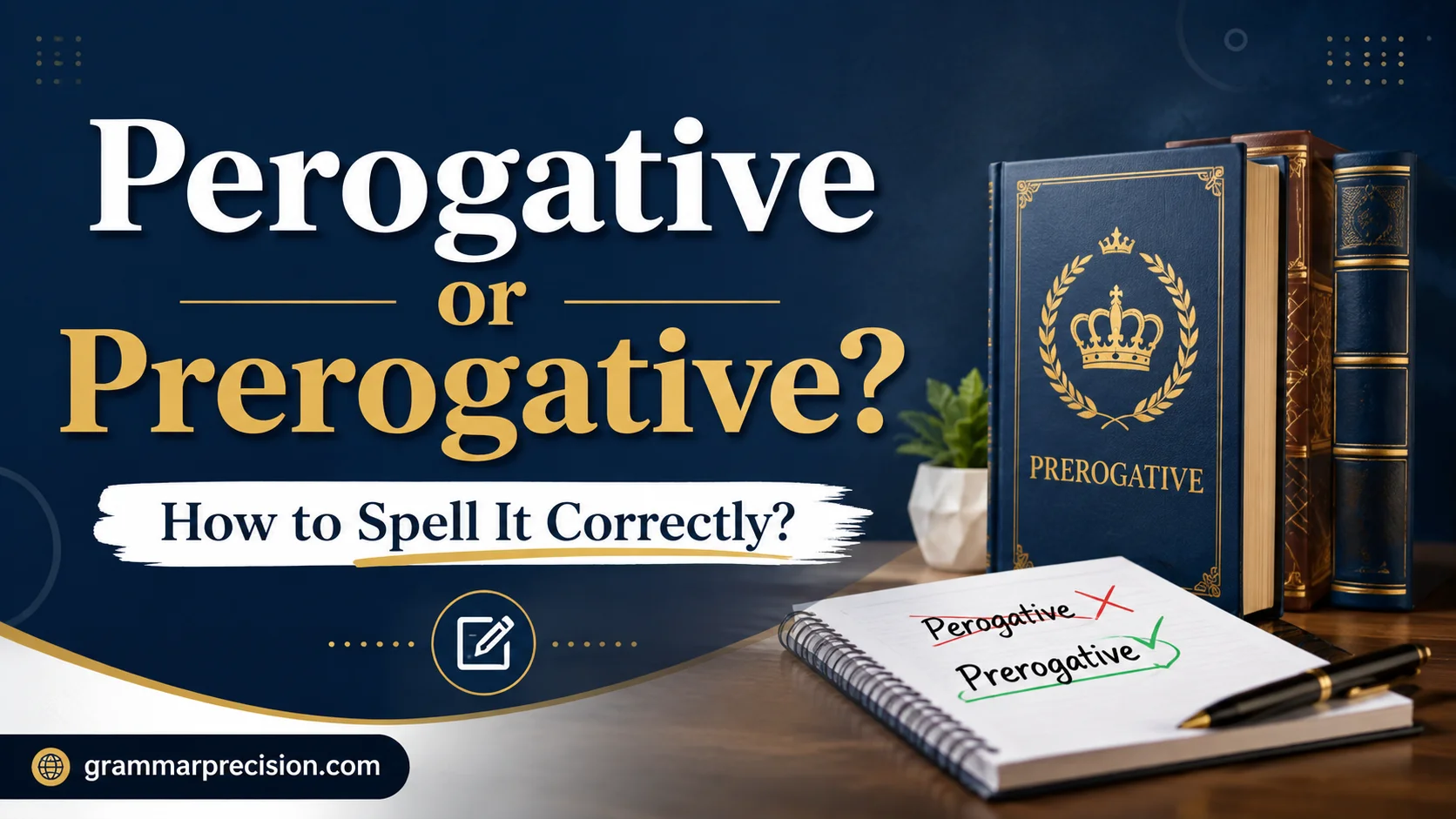
Perogative or Prerogative which spelling is correct? If you’ve ever hesitated over this word, you’re not alone. The correct spelling is prerogative, while perogative is a common spelling mistake.
The word prerogative refers to a special right, choice, or privilege that belongs to a particular person or group. It’s often used when someone has the freedom or authority to make a decision. Understanding its meaning and correct spelling can help you write with greater accuracy and confidence.
Many people write perogative because the word’s pronunciation can make the spelling confusing. However, perogative is incorrect in standard English. Once you learn the correct spelling, meaning, pronunciation, and usage of prerogative, you’ll find it much easier to use this word correctly in everyday and professional writing.
In this guide, you’ll learn the difference between perogative and prerogative, why the misspelling is so common, and how to remember the correct form. We’ll also look at clear examples, pronunciation, synonyms, and sentence usage so you can avoid this common spelling error and improve your overall English grammar and vocabulary.
Perogative or Prerogative: Which One Is Correct?
The correct spelling is prerogative.
The incorrect form is perogative.
| Spelling | Correct? | Meaning |
| prerogative | Yes | A special right, privilege, or power |
| perogative | No | Common misspelling of prerogative |
The easiest way to spot the difference is to pay attention to the r after the first p. The word begins:
P-R-E-R-O-G-A-T-I-V-E
That first r is easy to lose because normal speech can make the opening sound less distinct.
For example:
- Correct: It is your prerogative to decline the invitation.
- Incorrect: It is your perogative to decline the invitation.
The second sentence may look plausible, especially if you’ve heard the word more often than you’ve seen it written. However, standard English uses prerogative.
What Does Prerogative Mean?
A prerogative is a special right, privilege, or power that belongs to a particular person, group, office, or position.
Merriam-Webster defines the word as a right or privilege and, more specifically, as an exclusive or special right, power, or privilege. Oxford and Cambridge likewise describe it as a right, advantage, or special ability connected with a particular person or group.
In plain English, you can think of a prerogative as:
“Something you’re entitled or specially authorized to decide, have, or do.”
Consider this example:
It’s my prerogative to change my mind.
Here, the speaker means that they have the right to make that personal decision.
The word can also describe formal authority:
The director has the prerogative to approve the final budget.
In this sentence, prerogative doesn’t simply mean that the director has a preference. It suggests that the director has a particular authority connected with the position.
Prerogative Can Describe Different Kinds of Power
The meaning depends heavily on context.
A prerogative can belong to:
- An individual
- A manager
- A company director
- A government official
- A political institution
- A social group
- A monarch
- A nation
- A professional role
For instance:
Personal:
Choosing where to spend your vacation is your prerogative.
Professional:
Hiring new employees is the manager’s prerogative.
Governmental:
Certain decisions may fall within the prerogative of the executive branch.
The common thread is special entitlement or authority.
How Do You Spell Prerogative?
Spell it this way:
P-R-E-R-O-G-A-T-I-V-E
A useful way to break it apart is:
pre + rog + a + tive
Don’t treat the word as one giant block of letters. Breaking unfamiliar words into smaller pieces can make them easier to recall.
The biggest spelling trap is the first part:
PRE-R…
People often remember the opening sound but forget the second r. That produces perogative, which looks reasonable but isn’t the standard spelling.
Here’s a quick visual reminder:
P R E R O G A T I V E
↑
Keep the first R after P.
You can also connect the word with pre-, which appears in many English words and often carries the idea of “before.” The historical origin of prerogative makes that connection especially interesting.
Why Is “Perogative” Such a Common Misspelling?
English spelling and pronunciation don’t always cooperate.
That’s the heart of the problem.
When people hear prerogative, the opening sequence can sound less obvious than it looks on paper. A speaker may naturally reduce or blur an unstressed sound. If they later try to write the word from memory, the missing r can disappear.
This happens with many English words. People often spell unfamiliar vocabulary according to the sounds they think they hear.
The same basic pattern explains why someone might write:
- seperate instead of separate
- definately instead of definitely
- occured instead of occurred
- embarass instead of embarrass
Perogative belongs to the same family of spelling mistakes: the writer remembers the general sound but not the exact letter pattern.
There’s another factor, too. Prerogative isn’t an everyday word for many speakers. Words we encounter frequently in writing tend to become visually familiar. Less common words may remain dependent on pronunciation.
So the best solution isn’t simply to memorize the correction. Understand the pattern and see the word in context.
How Do You Pronounce Prerogative?
In American English, prerogative is commonly pronounced approximately:
prih-RAH-guh-tiv
Cambridge gives the US pronunciation as /prɪˈrɑː.ɡə.t̬ɪv/ and the UK pronunciation as /prɪˈrɒɡ.ə.tɪv/. The main stress falls on the second syllable.
A simple pronunciation guide is:
pri-ROG-uh-tiv
Don’t expect every letter to sound exactly as it appears. That’s one reason this word can cause spelling confusion.
Pronunciation vs. Spelling
This distinction matters:
You pronounce a word based on sound. You spell it based on letters.
Those systems overlap, but they aren’t identical in English.
For prerogative, the written r after the opening p is important even though casual speech may make the sequence difficult to hear clearly.
If you’re learning the word, practice saying it while looking at the spelling:
prerogative
prerogative
prerogative
Seeing and hearing the word together creates a stronger memory than repeating either one alone.
Examples of Prerogative in a Sentence
The best way to understand prerogative is to watch it work in different situations.
Everyday Examples
It’s your prerogative to spend your money however you choose.
Whether she accepts the offer is entirely her prerogative.
You have the prerogative to leave whenever you feel uncomfortable.
Changing your mind is your prerogative.
These examples use the word to describe personal freedom or choice.
Workplace Examples
The department head has the prerogative to approve the schedule.
Assigning the project is the manager’s prerogative.
The board reserved the prerogative to review the agreement.
Here, the word carries a stronger sense of formal authority.
Government and Legal Examples
The president exercised the prerogative to nominate a new official.
Constitutional questions can limit the exercise of executive prerogatives.
The authority claimed a prerogative to make the final decision.
The word appears especially often in formal discussions of government, constitutional power, and institutional authority. Oxford notes expressions such as royal prerogative and presidential prerogatives as established uses.
Academic and Formal Examples
Education was once considered the prerogative of wealthy families.
Leadership shouldn’t be treated as the exclusive prerogative of senior employees.
Scientific inquiry isn’t the prerogative of one profession.
These examples show another useful feature of the word. A prerogative doesn’t always refer to a physical privilege. It can describe access, authority, or an activity associated with a particular group.
What Does “It’s My Prerogative” Mean?
“It’s my prerogative” is one of the most recognizable expressions containing the word.
It means:
“I have the right to make this choice.”
For example:
I know you don’t agree with my decision, but it’s my prerogative.
The speaker isn’t necessarily claiming that the decision is morally superior. They’re emphasizing their right or freedom to make it.
This phrase can sound formal, playful, defensive, or confident depending on the situation.
Compare:
It’s my choice.
with:
It’s my prerogative.
The first is simple and conversational. The second sounds more deliberate and formal.
That’s an important point about vocabulary: correct doesn’t always mean natural in every situation. If you’re chatting with a friend, “It’s my choice” may sound more relaxed. In a formal discussion, “It’s my prerogative” may fit better.
Prerogative vs. Privilege
Prerogative and privilege overlap, but they’re not perfect substitutes.
A privilege is generally a special benefit, advantage, or right that isn’t available to everyone.
A prerogative focuses more strongly on a special right, authority, or discretion connected to a person, role, position, or group.
| Word | Main idea | Example |
| Prerogative | Special right or authority | Hiring is the director’s prerogative. |
| Privilege | Special benefit or advantage | She had the privilege of attending the ceremony. |
| Right | Entitlement or justified claim | You have the right to appeal. |
| Choice | Option between possibilities | You have a choice between two plans. |
| Authority | Power to make or enforce decisions | The manager has authority over the department. |
Think of the difference this way:
Privilege is often something you enjoy. Prerogative is often something you can decide or exercise.
The distinction isn’t absolute. In real English, the words can overlap.
Also Read This: Up To or Upto? Which Is Correct?
Prerogative vs. Right
A right can be broad and fundamental. A prerogative is usually more specific.
For example:
Employees have the right to receive their wages.
That’s an entitlement.
Now consider:
The manager has the prerogative to approve vacation requests.
That’s a special decision-making power attached to the manager’s role.
A prerogative can therefore be understood as a particular kind of right or authority, especially when it belongs to someone because of their position.
Merriam-Webster specifically includes “right or privilege” among the core meanings of prerogative.
Prerogative vs. Authority
These words are close, but their emphasis differs.
Authority means the power or right to make decisions, give orders, or control something.
Prerogative emphasizes a special right, privilege, or discretion.
Consider:
The manager has authority over the department.
This describes the manager’s general power.
Now:
Choosing the team’s schedule is the manager’s prerogative.
This identifies a particular decision that belongs to the manager.
A person can therefore have authority without every individual decision being described as a prerogative.
Is Prerogative a Formal Word?
Yes. Prerogative is generally considered a formal word. Cambridge and Oxford both label it as formal.
That doesn’t mean you can’t use it in casual conversation. You certainly can.
However, the word can sound more polished or official than simpler alternatives.
Compare:
It’s your choice.
It’s your prerogative.
The first sounds ordinary. The second has more weight.
In professional, academic, legal, political, and institutional writing, prerogative often feels perfectly natural.
In everyday conversation, use it when you want the particular meaning or tone it provides. Don’t use it simply because a longer word sounds impressive.
Common Phrases With Prerogative
Learning common word combinations can make vocabulary much easier to use naturally.
Here are several useful patterns:
- my prerogative
- your prerogative
- his prerogative
- her prerogative
- their prerogative
- the prerogative of the president
- the prerogative of the manager
- a special prerogative
- an exclusive prerogative
- executive prerogative
- royal prerogative
- presidential prerogatives
Some common sentence structures include:
It is your prerogative to make that decision.
Hiring new staff is the manager’s prerogative.
The committee exercised its prerogative to reject the proposal.
They regarded leadership as the exclusive prerogative of senior members.
Notice that prerogative frequently appears with possessives such as my, your, his, her, its, and their.
The Historical Origin of Prerogative
The history of this word is surprisingly interesting.
Prerogative ultimately comes from Latin praerogativa. In ancient Rome, the term referred to a voting group that was selected to vote first in an assembly. Because that first vote was considered significant, the word developed associations with priority, preference, and privilege.
The Latin word is connected with prae, meaning “before,” and rogare, meaning “to ask” or to ask an assembly for a decision. English later acquired the word through Anglo-French and Middle English. Merriam-Webster records its first known English use in the 15th century.
That history helps explain why the modern word refers to a special right.
The basic journey was roughly:
Voting first → priority → special status → special right or privilege
Language doesn’t always travel in a straight line. Sometimes a word carries an old idea into a completely new setting.
Common Mistakes With Prerogative
The most obvious mistake is spelling.
Mistake: Perogative
❌ It is my perogative to decide.
Correct: Prerogative
✅ It is my prerogative to decide.
Another mistake involves using prerogative when you simply mean “choice.”
The color of my notebook is my prerogative.
This isn’t grammatically impossible, but it sounds unnecessarily grand.
A more natural sentence would be:
The color of my notebook is my choice.
The stronger word works best when there’s some sense of special discretion, authority, privilege, or entitlement.
Mistake: Treating Prerogative as a Verb
Prerogative is primarily used as a noun.
You can say:
The director exercised her prerogative.
But don’t invent a verb such as:
❌ The director prerogativated the decision.
English has enough surprises without creating new ones.
How to Remember the Correct Spelling
If perogative keeps sneaking into your writing, use a simple memory technique.
Remember the Extra R
Think:
PRE + ROGATIVE
The word begins with PRE-R, not PE-R.
Write it several times:
prerogative
prerogative
prerogative
Then put it into a sentence:
It is your prerogative.
That short phrase is particularly useful because it’s one of the most common ways people encounter the word.
Use the Meaning as a Memory Hook
You can connect the word with special rights.
Think:
PREROGATIVE = SPECIAL RIGHT
When you remember the meaning, the spelling becomes easier to retrieve.
Don’t Memorize Only the First Few Letters
A common mistake is remembering:
pre… something…
Instead, learn the whole visual shape:
PREROGATIVE
The repeated r near the beginning is the detail that separates the correct spelling from the common misspelling.
A Quick Case Study: Why Context Changes the Best Word
Imagine a department manager deciding whether an employee can work remotely.
If you say:
The employee has a choice about where to work.
You’re focusing on the employee’s options.
If you say:
The manager has the authority to approve remote work.
You’re focusing on the manager’s decision-making power.
If you say:
Approving remote work is the manager’s prerogative.
You’re emphasizing that this particular decision belongs to the manager as a special part of the role.
Three words. Three shades of meaning.
That’s why vocabulary precision matters. The goal isn’t to use the fanciest word available. The goal is to choose the word that fits the exact idea.
Quick Facts About Prerogative
| Fact | Detail |
| Correct spelling | Prerogative |
| Common misspelling | Perogative |
| Part of speech | Noun |
| Typical meaning | Special right, privilege, or power |
| US pronunciation | /prɪˈrɑː.ɡə.t̬ɪv/ |
| UK pronunciation | /prɪˈrɒɡ.ə.tɪv/ |
| Register | Formal |
| Plural | Prerogatives |
| English history | Entered through Anglo-French and Middle English |
| Latin source | praerogativa |
| First known English use | 15th century |
The pronunciation and historical information above are supported by Cambridge and Merriam-Webster dictionary records.
FAQs:
Is “Perogative” a correct spelling?
No, “perogative” is not the correct spelling in standard English. The correct form is “prerogative.” The incorrect version is a common spelling mistake because of the way the word is often pronounced. Always use prerogative in formal, academic, and professional writing.
What does “prerogative” mean?
Prerogative means a special right, privilege, or authority to make a particular choice or decision. For example, “It’s your prerogative to decide.” In this sentence, the word means that the person has the right or freedom to make the decision.
How do you pronounce “prerogative”?
Prerogative is commonly pronounced as “pri-ROG-uh-tiv.” The pronunciation can make the spelling seem confusing, especially because the first part may sound different from how it looks. Learning both the pronunciation and spelling together can make the word easier to remember and use correctly.
Is “prerogative” a noun or an adjective?
Prerogative is a noun. It refers to a special right, power, privilege, or authority given to someone. For example, “Choosing the final design is the manager’s prerogative.” The word identifies something a person has the right or authority to decide or control.
What is a synonym for “prerogative”?
Common synonyms for prerogative include right, privilege, authority, power, entitlement, and discretion. The best synonym depends on the context. For example, when someone has the freedom to make a personal decision, right or choice may work better than authority.
Conclusion:
When choosing between Perogative or Prerogative, remember that prerogative is the correct spelling. Perogative is a common misspelling caused by the word’s pronunciation.
The word prerogative refers to a special right, privilege, freedom, or authority to make a decision. Although its spelling may seem tricky at first, learning its meaning and pronunciation can make it much easier to use correctly. Remember that prerogative is the standard form in English.
Now that you understand the correct spelling, meaning, pronunciation, synonyms, and usage of prerogative, you can use it confidently in your writing. Whenever you’re unsure, avoid perogative and choose prerogative instead. This simple spelling check can help you maintain clear, accurate, and professional English.