When choosing between In Every Respect vs In Every Aspect, it’s easy to feel unsure because both phrases sound similar. However, they have different meanings and work in different contexts. Understanding this small difference can make your English more accurate, natural, and clear.
The phrase “in every respect” means in every way or in all relevant points when you’re judging something as a whole. You can use it to describe a person, thing, or situation that meets a standard completely. For example, “She is an excellent teacher in every respect” means she is excellent in all ways that matter.
On the other hand, “in every aspect” focuses on every part, feature, or area of something. It’s useful when you want to examine or describe different parts of a subject separately. For instance, “The project was successful in every aspect” suggests that its planning, execution, quality, and results were all successful.
Although “in every respect” and “in every aspect” can sometimes appear interchangeable, the context usually determines which one sounds more precise. Knowing their meaning, usage, grammar, and subtle difference helps you choose the right phrase confidently. In this guide, you’ll learn their definitions, examples, common mistakes, and practical ways to use them.
In Every Respect vs In Every Aspect: What’s the Difference?
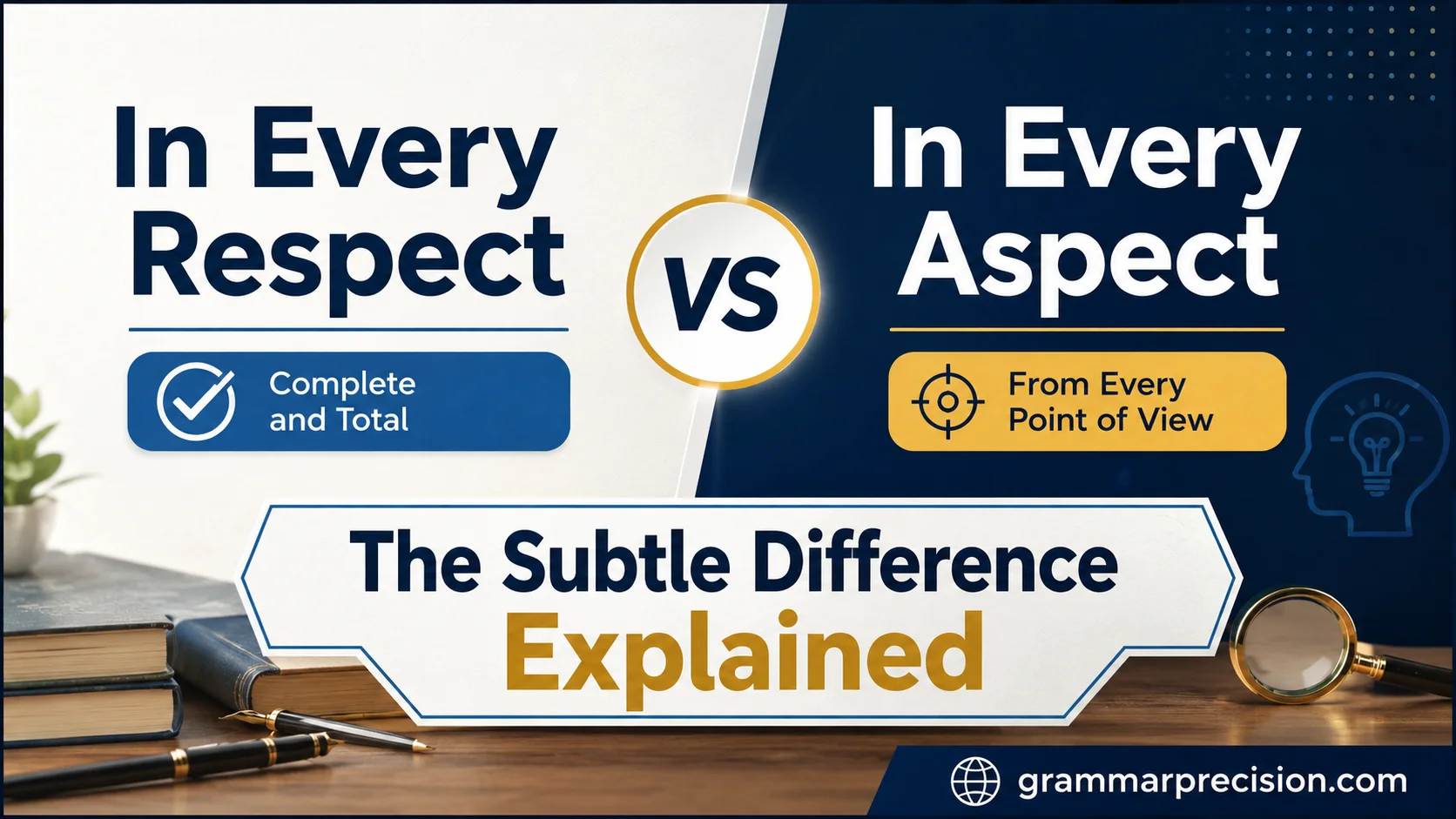
The simplest way to separate the two phrases is to think about judgment versus components.
- In every respect = in every way, regard, or dimension
- In every aspect = in every part, feature, or area
Consider these examples:
The new design is superior in every respect.
This sentence gives an overall judgment. The design is better in every relevant way, perhaps in appearance, function, quality, durability, and cost.
Now compare it with:
The report examines every aspect of the new design.
Here, aspect refers to the individual parts or areas being examined.
There’s an important nuance here. The expressions can overlap because an aspect can also be a dimension of something. Yet they don’t always create the same emphasis.
| Expression | Basic meaning | Main focus | Typical idea |
| In every respect | In every way or regard | Overall evaluation | How something compares or measures up |
| In every aspect | In every part, feature, or area | Individual components | What areas or features are involved |
A useful memory trick is simple:
Respect asks “In what way?” Aspect asks “In what part or area?”
That rule won’t solve every possible sentence, but it will guide you toward the more natural choice in most situations.
What Does “In Every Respect” Mean?
In every respect is an idiomatic expression meaning in every way, in every regard, or according to every relevant standard.
The word respect has several meanings in English. In this expression, it doesn’t mean admiration or politeness. Instead, it refers to a particular point, regard, or way of considering something.
For example:
The two proposals are different in every respect.
The writer isn’t necessarily listing every individual component of the proposals. The sentence makes a broad comparison and says that they differ in all meaningful ways.
Likewise:
She was an excellent candidate in every respect.
This suggests that she met or exceeded expectations across the board. Her qualifications, experience, communication, reliability, and other relevant qualities may all have contributed to the judgment.
When to Use “In Every Respect”
Use in every respect when you’re making a broad evaluation or comparison.
It works especially well when discussing:
- Quality
- Performance
- Character
- Standards
- Suitability
- Achievement
- Similarity or difference
- Overall superiority or inferiority
For example:
The revised proposal is better in every respect.
His second performance was stronger in every respect.
The new system is more efficient in every respect.
Their approaches are different in every respect.
Notice something about these examples. The phrase describes the overall relationship between two things rather than identifying physical or conceptual pieces.
The Tone of “In Every Respect”
This expression often sounds polished and slightly formal. You may encounter it in:
- Professional writing
- Essays
- Reviews
- Formal comparisons
- Speeches
- Literary writing
- Academic discussions
In casual conversation, in every way may sound more relaxed.
For example:
The new version is better in every way.
This sounds conversational.
The new version is better in every respect.
This sounds somewhat more formal and deliberate.
Neither is wrong. The choice depends on the tone you want.
What Does “In Every Aspect” Mean?
In every aspect means in every part, feature, area, or dimension of something.
Here, aspect refers to a particular side or component of a larger subject.
Imagine a large puzzle. Each piece represents an aspect. When you talk about every aspect, you’re considering the whole puzzle piece by piece.
For example:
We need to examine every aspect of the problem.
The problem probably has several areas that require attention. You might need to examine its causes, effects, costs, risks, and possible solutions.
Another example:
The committee considered every aspect of the proposal.
The committee may have looked at its budget, timeline, legal implications, practical requirements, and expected results.
When to Use “In Every Aspect”
Use in every aspect when you want to emphasize the different areas or features that make up a subject.
It commonly appears when discussing:
- Projects
- Plans
- Problems
- Policies
- Products
- Systems
- Designs
- Processes
- Research
- Situations
For example:
The company improved the process in every aspect.
The focus is on the various areas of the process that changed or improved.
However, there’s a useful distinction worth remembering: English speakers often prefer “every aspect of something” when they mean individual parts.
For example:
We studied every aspect of the case.
This is extremely natural.
By contrast, when making a sweeping evaluation, “in every respect” often sounds more idiomatic:
The new approach is superior in every respect.
Respect vs Aspect: What Does Each Word Really Mean?
The easiest way to understand in every respect vs in every aspect is to examine the nouns separately.
What Does “Respect” Mean in This Phrase?
In in every respect, respect means something like regard, consideration, or particular way of viewing a matter.
It isn’t referring to admiration.
Compare:
I respect my teacher.
Here, respect means admiration or esteem.
But:
The two plans are similar in every respect.
Here, respect means a particular way or point of comparison.
This older and more specialized meaning explains why the expression works naturally in broad evaluations.
What Does “Aspect” Mean?
An aspect is a particular feature, side, or element of something.
For example, a restaurant can have several aspects:
- Food quality
- Service
- Atmosphere
- Price
- Location
If you say:
The review discusses every aspect of the restaurant.
You’re emphasizing these different areas.
That’s why aspect naturally connects with verbs such as:
- Examine
- Consider
- Discuss
- Analyze
- Evaluate
- Explore
- Address
- Cover
For example:
The researchers analyzed every aspect of the experiment.
The sentence suggests a detailed examination.
The Real Difference: “Every Way” vs “Every Part”
Here’s the most useful distinction to remember:
In every respect generally emphasizes the way something is judged.
In every aspect generally emphasizes the areas or features being considered.
Think of a house.
If you say:
The house is impressive in every respect.
You’re giving an overall evaluation. The house may be attractive, spacious, well-built, comfortable, and practical.
But if you say:
The inspection covered every aspect of the house.
You’re talking about the different areas examined during the inspection.
The first sentence gives a verdict.
The second describes an investigation.
That’s the heart of the distinction.
Also Read This: Perogative or Prerogative? How to Spell It Correctly?
Same Situation, Different Phrase, Different Emphasis
Seeing the phrases side by side makes the difference much easier to grasp.
Example: A Job Candidate
The candidate impressed the panel in every respect.
This gives a broad positive judgment. The candidate performed well overall.
Now consider:
The panel considered every aspect of the candidate’s application.
This focuses on the individual areas of the application, such as education, experience, references, and skills.
The subject matter is similar. The perspective changes.
Example: A Business Plan
The business plan is stronger in every respect.
This means the plan is broadly better according to all relevant measures.
The team examined every aspect of the business plan.
This means the team looked at its individual components.
The difference is subtle but meaningful.
Example: A Product
This laptop is superior in every respect.
That’s a sweeping evaluation.
The review examines every aspect of this laptop.
That’s a detailed analysis.
The first statement sounds like a conclusion. The second sounds like the process that could lead to that conclusion.
When Both Expressions Can Work
English isn’t always divided into neat boxes. Sometimes in every respect and in every aspect can both work because the intended meaning overlaps.
Consider:
The new system is better in every respect.
The new system is better in every aspect.
Both can communicate that the system has improved across multiple dimensions.
Still, in every respect often sounds more idiomatic when the sentence expresses a broad judgment.
If you want to emphasize the specific areas in which improvement occurred, aspect becomes more useful.
For example:
The company improved the software in every aspect.
This can work when the context clearly concerns different features or areas of the software.
But a more precise construction may be:
The company improved every aspect of the software.
That version makes the component-based meaning unmistakable.
When the Expressions Shouldn’t Be Treated as Exact Synonyms
The biggest mistake is assuming that respect and aspect are interchangeable simply because the phrases sometimes overlap.
Consider:
The report examines every aspect of the accident.
Here, aspect works beautifully because the report examines different parts of the subject.
Replacing it with respect would sound unnatural:
The report examines every respect of the accident. ❌
That’s not standard English.
Now look at:
The new model is better in every respect.
The phrase expresses a broad evaluation. Replacing respect with aspect isn’t necessarily grammatically impossible, but it changes the emphasis and may sound less natural depending on context.
A good writer doesn’t ask only, “Is this grammatically possible?”
The better question is:
“Which word expresses the exact idea I want?”
In Every Respect vs In Every Aspect: Common Examples
Here are examples that show the natural patterns.
Examples With “In Every Respect”
- The revised contract is better in every respect.
- She was an outstanding leader in every respect.
- The two situations were different in every respect.
- His latest performance was stronger in every respect.
- The new method is more practical in every respect.
- The replacement is superior in every respect.
- Their approaches are almost identical in every respect.
Examples With “In Every Aspect”
- The study considers the issue in every aspect.
- The redesign improved the product in every aspect.
- The committee reviewed the proposal in every aspect.
- The course addresses the subject in every aspect.
- The project needs careful planning in every aspect.
- The team examined the problem in every aspect.
Notice that aspect often appears near words related to analysis and examination.
Common Mistakes With In Every Respect vs In Every Aspect
Treating “Respect” as a Synonym for “Admiration”
Some learners see respect and immediately think of politeness or admiration.
That’s not the meaning in:
The plan succeeded in every respect.
Here, respect means a particular regard or dimension.
Using “Aspect” for Every Broad Judgment
Because aspect means a side or feature, writers sometimes use it whenever they want to say “in every way.”
That can make a sentence less idiomatic.
If you’re delivering an overall verdict, in every respect is often the stronger choice.
Assuming One Phrase Is Always Correct
Context matters.
Neither expression automatically wins every comparison. In every respect and in every aspect can both be useful when their intended meanings overlap.
The goal isn’t to memorize a rigid rule. It’s to understand the distinction and choose deliberately.
Confusing “In Every Respect” With “With Respect To”
These expressions aren’t interchangeable.
In every respect, the plan was successful.
means the plan was successful in every way.
With respect to the budget, the plan was successful.
means regarding the budget specifically.
The second expression narrows the discussion to one particular subject.
In Every Respect vs In Every Aspect in Formal Writing
Both expressions can appear in formal writing, but they serve different purposes.
In every respect works particularly well when making a conclusion:
The revised policy is more effective in every respect.
In every aspect works well when describing comprehensive examination:
The research team evaluated every aspect of the policy.
If you’re writing an academic paper, report, review, or professional document, this distinction can make your claims more exact.
Instead of saying:
The proposal was considered in every respect.
you might choose:
The proposal was evaluated in every respect.
Or, if you mean its individual components:
The committee examined every aspect of the proposal.
The second version gives the reader a clearer picture of what happened.
A Quick Decision Test
When you’re stuck between the two phrases, ask yourself one question:
Am I talking about every way something can be judged, or every part that can be examined?
If you’re talking about every way or overall regard, choose:
In every respect
If you’re talking about every part, feature, or area, choose:
In every aspect
Here’s a compact guide:
| If you mean… | Better choice |
| In every way | In every respect |
| By every relevant standard | In every respect |
| Overall comparison | In every respect |
| Every part of a subject | In every aspect |
| Every feature | In every aspect |
| Every area of a problem | In every aspect |
| Detailed examination | In every aspect |
| Broad evaluation | In every respect |
Related Expressions You Should Know
Understanding nearby expressions can make the distinction even sharper.
In All Respects
In all respects is very close to in every respect.
The two versions are comparable in all respects.
Both expressions can mean in every way or regard.
In Every Way
This is the simpler, more conversational alternative to in every respect.
The new version is better in every way.
It’s especially useful when you want plain, direct language.
In All Aspects
In all aspects emphasizes the different areas or features of something.
The policy needs improvement in all aspects.
It can overlap with in every aspect, although the exact choice depends on context and sentence structure.
In Every Regard
In every regard is another formal alternative to in every respect.
The candidate was impressive in every regard.
It tends to sound more formal and less conversational than in every way.
A Practical Case Study
Imagine a company has launched a new smartphone.
A reviewer could write:
The new phone is better than its predecessor in every respect.
That’s an overall assessment. The reviewer believes the new model wins across the board.
The same reviewer might write:
The review examines every aspect of the new phone.
Now the focus shifts to the review itself. It may discuss the display, battery, camera, processor, design, software, price, and durability.
Finally, the reviewer could say:
The manufacturer improved every aspect of the phone’s design.
This statement specifically points toward the phone’s various design features.
The three sentences describe related ideas, but each phrase performs a different job.
That’s why precision matters.
A Simple Memory Trick
If you’re likely to forget the distinction, remember this:
Respect = every way.
Aspect = every part.
Picture a judge standing in front of a product.
If the judge says:
“It’s excellent in every respect.”
That’s a verdict.
Now picture an analyst taking the product apart and studying its individual features.
If the analyst says:
“We examined every aspect of it.”
That’s an investigation.
Verdict versus investigation is a surprisingly effective way to remember the difference.
FAQs:
Is “in every respect” grammatically correct?
Yes, “in every respect” is grammatically correct and commonly used in English. It means in every way or in all relevant ways. You can use it when describing something that is completely true based on its overall qualities, behavior, performance, or characteristics.
What does “in every aspect” mean?
“In every aspect” means in every part, area, or feature of something. It’s often used when you’re discussing the different elements of a subject. For example, “The plan was successful in every aspect” means every important part of the plan worked well.
Are “in every respect” and “in every aspect” interchangeable?
Sometimes, but not always. “In every respect” usually emphasizes overall qualities or ways, while “in every aspect” focuses more on individual parts or areas. The context matters, so choosing the phrase that matches your intended meaning makes your sentence more precise and natural.
Which is more common: “in every respect” or “in every aspect”?
“In every respect” is a well-established English expression and is often used to make an overall judgment. “In every aspect” is also correct, especially when referring to specific areas or parts of something. Neither phrase is universally better; your context and meaning should guide your choice.
Can I use “in every aspect” for a person?
Yes, you can use “in every aspect” when you’re referring to different areas of a person’s life, personality, work, or behavior. However, if you mean that someone is good or impressive in every way, “in every respect” may sound more natural and idiomatic.
Conclusion:
When comparing In Every Respect vs In Every Aspect, remember that “in every respect” means in every way, while “in every aspect” focuses on every part or area.
Both expressions are correct, but they highlight slightly different ideas. Use “in every respect” for an overall judgment and “in every aspect” when discussing specific parts, features, or areas. This simple distinction can make your writing more clear and precise.
With regular practice, choosing between these phrases becomes much easier. Pay attention to the context, decide whether you mean every way or every part, and then select the expression that fits your sentence best.