Have you ever received a text ending with a period and wondered what it really means? The “.” meaning in text can reveal subtle differences in digital communication.
Although periods follow traditional grammar and English usage rules, casual texting gives them additional emotional meaning. Depending on context, they can express seriousness, frustration, finality, or neutrality. Understanding these differences helps you interpret messages more accurately across friendships, relationships, and everyday conversations.
This guide explores common texting interpretations, real-life examples, and appropriate replies while explaining how punctuation influences tone and communication. You’ll also discover why periods matter in business communication, formal writing, meetings, and online conversations, where clarity and consistency remain essential.
Quick Answer: What Does “.” Mean in Text?
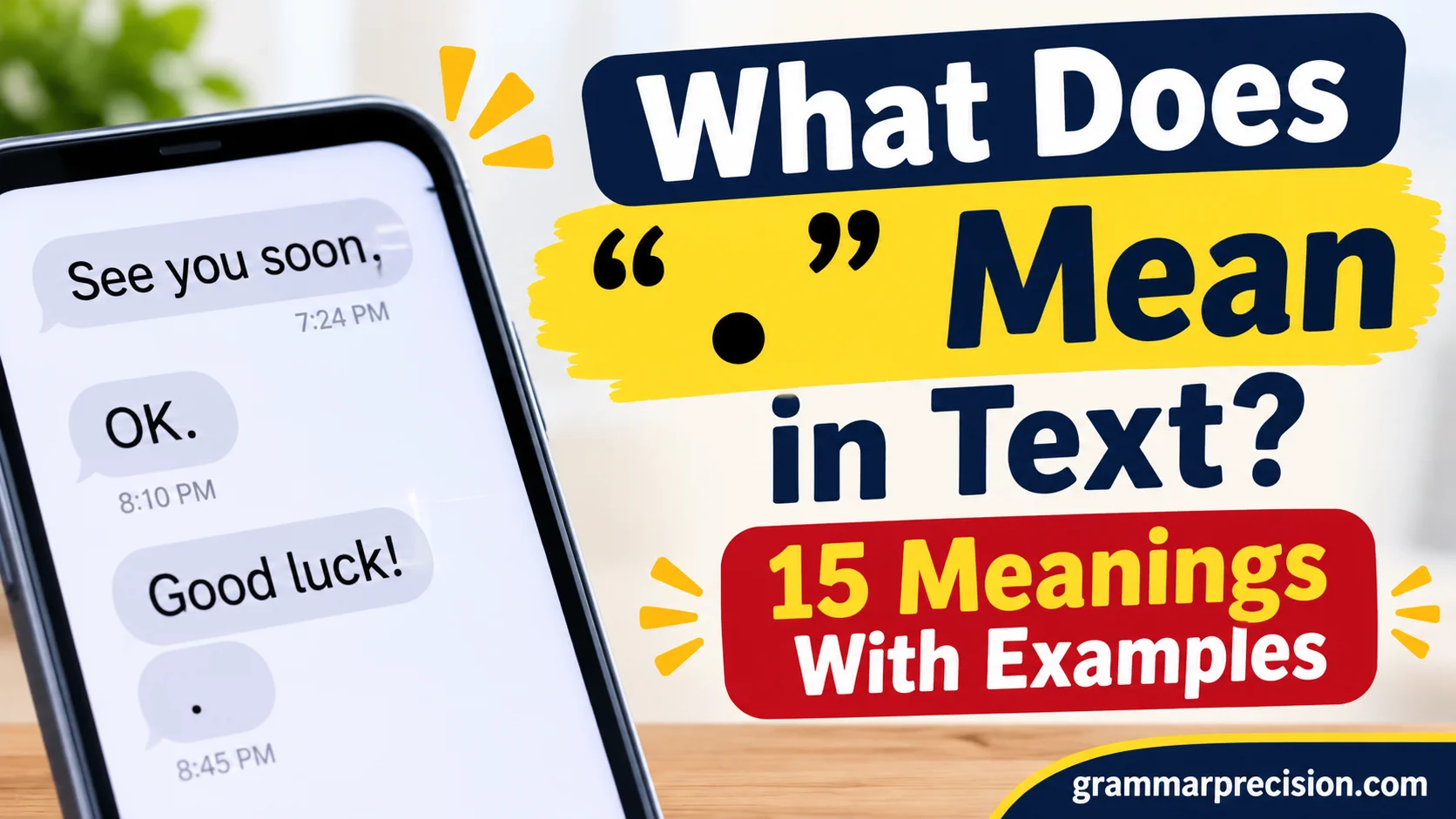
The “.” meaning in text usually refers to a period used to end a sentence. However, in casual texting, it can sometimes communicate seriousness, annoyance, frustration, emotional distance, or finality.
For example:
- “Okay” – A casual acknowledgment.
- “Okay.” – May sound serious, formal, or slightly cold.
- “Fine.” – Could express agreement, frustration, or disappointment.
- “.” – Might indicate an accidental message, an unusual response, or an attempt to get someone’s attention.
Important: A period doesn’t automatically mean someone is angry. Its meaning depends on context, personality, and communication habits.
What Does “.” Mean in Texting? (Basic Explanation)
A period is a punctuation mark that normally indicates the end of a sentence. In traditional writing, it helps readers understand where one complete thought finishes.
However, texting works differently.
When you communicate through WhatsApp, Instagram, Snapchat, or regular messages, people often skip traditional punctuation. They might send several short messages without periods or use emojis instead.
Consequently, a period can stand out when someone suddenly includes one.
Consider these examples:
| Without a period | With a period |
| Okay | Okay. |
| Sure | Sure. |
| I understand | I understand. |
| That’s fine | That’s fine. |
| See you later | See you later. |
The second versions may feel more formal or serious. Nevertheless, that difference doesn’t prove the sender has negative feelings.
Some people use proper punctuation in every message. Others rarely use it unless they want to emphasize something.
15 Possible Meanings of “.” in Text Messages
A single period can carry different meanings depending on the situation. Here are 15 common interpretations worth understanding.
A Simple Way to End a Sentence
The most straightforward meaning is grammatical. Someone might use a period because they want to finish their sentence correctly.
For example:
- “I’ll call you tomorrow.”
- “I’m going home.”
- “We can discuss this later.”
These messages don’t necessarily contain hidden emotions. The sender may simply follow standard writing rules.
An Annoyed Response
Sometimes, a period makes a short response feel irritated. This happens particularly when someone usually texts casually but suddenly changes their punctuation.
For example:
You: “Are you still upset about yesterday?”
Them: “No.”
Although the response says no, its short and direct delivery might feel unfriendly.
However, don’t assume annoyance from punctuation alone. The person could be busy or distracted.
A Serious Tone
A period can make a statement sound more serious and deliberate.
For example:
- “We need to talk.”
- “I’m not joking.”
- “This is important.”
In these situations, punctuation helps establish a firm tone. The sender might want you to pay attention rather than treat the message casually.
A Cold or Distant Reply
When someone normally sends enthusiastic messages, a sudden period can make their communication feel distant.
For instance:
Usually: “Yesss!! That sounds amazing 😊”
Today: “Okay.”
This difference might suggest a change in mood. Still, one message isn’t enough to determine someone’s feelings.
Look for repeated changes in communication before drawing conclusions.
A Sign of Disappointment
Sometimes, people use short sentences when they’re disappointed but don’t want to explain their emotions.
For example:
You: “Sorry, I can’t come tonight.”
Them: “That’s fine.”
The period might make the response feel less enthusiastic. However, the person could genuinely understand your situation.
A Conversation Shutdown
A period can communicate that someone considers a discussion finished.
For example:
You: “Can we keep arguing about this?”
Them: “No. We’re done.”
Here, the sender clearly wants to stop discussing the issue.
The words communicate finality while the punctuation reinforces the direct tone.
A Formal Communication Style
Some people naturally write complete sentences with proper punctuation.
For example:
- “Your appointment is confirmed.”
- “Please send the document today.”
- “I’ll review everything tomorrow.”
This style is common in workplace conversations and professional messages.
A period doesn’t make these messages rude. It simply reflects a more formal communication style.
An Expression of Frustration
A person might use short, punctuated messages when they feel frustrated.
For example:
You: “I forgot to bring your charger.”
Them: “Seriously.”
Depending on your relationship, this response might express disappointment or irritation.
However, the surrounding conversation matters more than the punctuation itself.
A Boundary-Setting Signal
Sometimes, people use direct statements to establish boundaries.
For example:
- “Please stop.”
- “I need some space.”
- “Don’t contact me again.”
The period can make these statements feel firm and complete.
When someone communicates a boundary, respect it instead of trying to interpret every punctuation mark.
A Sign of Finality
A period can make a message sound like a decision rather than an invitation to continue discussing something.
For example:
“I’m not changing my mind.”
The statement feels definite. The sender might want to communicate that their decision is final.
An Attempt to Sound Confident
Some people use short, direct sentences because they prefer confident communication.
For example:
- “I know.”
- “Absolutely.”
- “That’s correct.”
These messages don’t necessarily indicate anger or impatience.
In fact, the sender might simply prefer clear and straightforward language.
A Neutral Writing Habit
Not every punctuation mark carries an emotional message.
Some people learned to write complete sentences at school and continue using that habit everywhere.
They might send:
- “Good morning.”
- “How are you?”
- “See you soon.”
Even casual messages can contain proper punctuation without any hidden meaning.
A Passive-Aggressive Tone
A period can sometimes contribute to passive-aggressive communication, particularly when someone appears agreeable but sounds emotionally distant.
For example:
“Whatever.”
Depending on the conversation, this response might communicate frustration or unwillingness to continue.
However, passive aggression usually involves more than punctuation. Word choice, timing, and previous behavior also matter.
A Deliberate Dramatic Pause
A single period can occasionally create suspense or drama.
For example:
Friend: “I have something to tell you.”
You: “What?”
Friend: “You won’t believe this.”
In unusual conversations, someone might send a period to create anticipation or get your attention.
This isn’t a standard texting meaning, though. The surrounding messages should make the intention clearer.
An Accidental Message
Sometimes, a person sends a period because they accidentally tap the keyboard or send an incomplete message.
For example:
You: “Did you mean to send that?”
Them: “Sorry, accidental.”
Not every unusual message deserves a complicated interpretation. Sometimes, a period is simply a typing mistake.
12 Real Texting Examples That Show What a Period Means
Real examples make punctuation easier to understand. The following conversations show how a period can change the tone of everyday messages.
| Text message | Possible meaning | Possible tone |
| “Okay.” | Agreement | Neutral or serious |
| “Fine.” | Acceptance | Possibly annoyed |
| “Whatever.” | Disagreement or indifference | Dismissive |
| “Sure.” | Agreement | Neutral or distant |
| “Good.” | Approval | Direct |
| “Thanks.” | Gratitude | Formal or neutral |
| “No.” | Refusal | Firm |
| “I know.” | Acknowledgment | Direct |
| “I’m busy.” | Lack of availability | Informative |
| “Leave me alone.” | Request for space | Firm |
| “See you.” | Goodbye | Neutral |
| “Love you.” | Affection | Warm or ordinary |
Let’s examine a few examples more closely.
Example: “Okay.”
Conversation:
- Person A: “Let’s meet at 6 PM.”
- Person B: “Okay.”
This is a simple acknowledgment.
Now imagine Person B usually replies with emojis and enthusiastic expressions. Suddenly, “Okay.” might feel more serious than usual.
Example: “Fine.”
Conversation:
- Person A: “Would you rather stay home?”
- Person B: “Fine.”
This response could communicate agreement or disappointment.
The tone depends on whether the person genuinely accepts the suggestion.
Example: “Whatever.”
Conversation:
- Person A: “Which movie should we watch?”
- Person B: “Whatever.”
This might indicate indifference or frustration. The person could be tired of making decisions.
Example: “Thanks.”
Conversation:
- Person A: “I sent you the information.”
- Person B: “Thanks.”
Here, the period probably has no emotional significance. It’s simply a polite acknowledgment.
Key takeaway: Never judge someone’s emotions through one punctuation mark. Consider their usual texting style and the complete conversation.
What Does “.” Mean From a Girl or Guy?
The period can feel especially confusing when someone you like suddenly changes their texting style.
However, its meaning doesn’t automatically depend on gender. Girls and guys can use periods for exactly the same reasons.
What Does It Mean When a Girl Texts “.”?
When a girl sends a period, the meaning depends on your conversation and relationship.
Possible interpretations include:
- She’s annoyed: Something in the conversation might have frustrated her.
- She’s being serious: She wants you to understand an important point.
- She’s ending the conversation: She might not want to continue chatting.
- She’s using normal punctuation: She naturally writes complete sentences.
- She’s testing your response: She might be trying to get your attention.
For example:
You: “Are you coming to the party?”
Her: “Maybe.”
This doesn’t necessarily mean she’s upset. She might genuinely be unsure.
What Does It Mean When a Guy Texts “.”?
When a guy uses a period, he might be communicating something straightforward.
Possible explanations include:
- He prefers formal or grammatically correct messages.
- He’s busy and wants to respond quickly.
- He’s frustrated about something.
- He wants to end the conversation.
- He naturally prefers short messages.
Example:
You: “Did you finish your assignment?”
Him: “Yes.”
This is probably just a direct answer rather than a hidden emotional signal.
Does a Period Mean Someone Is Losing Interest?
Not necessarily.
A person who sends shorter messages might be tired, occupied, stressed, or distracted.
Instead of focusing on punctuation, consider these signs:
- They consistently avoid meaningful conversations.
- They rarely initiate communication anymore.
- They repeatedly cancel plans without explanation.
- Their interest in spending time together seems lower.
- They stop making an effort to maintain the relationship.
Even these signs need context. Honest communication is more reliable than guessing.
What Does a Period Mean in Different Relationships?
Your relationship with the sender can influence how you interpret punctuation.
The same message might sound friendly from one person and distant from another.
From Your Crush
When your crush texts “Okay.” you might immediately wonder whether they’re losing interest.
However, don’t overthink one message. They might simply communicate differently.
From Your Boyfriend or Girlfriend
A sudden change in punctuation might feel unusual if your partner normally sends affectionate messages.
If something seems wrong, ask politely instead of assuming the worst.
From Your Best Friend
Friends often use short responses without worrying about formal writing.
A period might simply mean your friend is busy or doesn’t have anything else to add.
From Your Parents
Parents sometimes use periods because they learned traditional writing rules.
A message like “Come home early.” usually communicates an instruction rather than anger.
From Your Coworker or Boss
In professional communication, periods are completely normal.
For example:
“Please submit the report before Friday.”
This is a standard workplace instruction. There’s no reason to interpret it emotionally.
How to Respond When Someone Sends a Period
Receiving a short message can leave you wondering what to say next. Fortunately, you don’t need a complicated response.
Choose something that matches the conversation.
Funny Replies
If you’re close to the person, a little humor can make things less awkward.
Try these responses:
- “Whoa, that period looks serious!”
- “Did I just receive an official statement?”
- “Someone’s punctuation game is strong today.”
- “Should I be worried about that full stop?”
- “That dot has more attitude than expected.”
Use humor carefully if the other person seems genuinely upset.
Casual Replies
When you don’t want to make things awkward, keep your response simple.
- “Alright!”
- “Got it.”
- “Sounds good.”
- “Okay, no problem.”
- “Talk to you later.”
These replies work well for ordinary conversations.
Friendly Replies
If you want to keep the conversation warm, try something more inviting.
- “Everything good?”
- “Hope your day’s going well!”
- “Let me know if you need anything.”
- “What’s happening?”
- “Are we still good?”
These responses show interest without creating unnecessary pressure.
Serious Replies
Sometimes, a direct response works best.
- “Is something bothering you?”
- “Did I say something wrong?”
- “Can we talk about this?”
- “I want to understand what you mean.”
These messages help clear up misunderstandings.
Replies When You Think They’re Upset
If the conversation feels tense, avoid responding defensively.
Instead, try:
- “You seem a little upset. Is everything okay?”
- “I didn’t mean to upset you.”
- “Let’s talk when you’re ready.”
- “I understand if you need some space.”
- “Can you tell me what’s bothering you?”
A calm response often works better than matching someone’s perceived attitude.
Period vs. Other Punctuation Marks in Texting
Periods aren’t the only punctuation marks that influence digital communication. Other symbols can also change how a message feels.
| Punctuation | Common texting impression | Example |
| Period (.) | Serious, neutral, or final | “Okay.” |
| Ellipsis (…) | Hesitation, suspense, or uncertainty | “I don’t know…” |
| Exclamation mark (!) | Excitement or emphasis | “That’s amazing!” |
| Question mark (?) | Curiosity or confusion | “Really?” |
| Multiple exclamation marks (!!) | Strong excitement | “Let’s go!!” |
| No punctuation | Casual or relaxed | “See you later” |
Period (.) vs. Ellipsis (…)
A period ends a sentence. An ellipsis uses three dots to suggest a pause, unfinished thought, or hesitation.
For example:
- “I understand.” – A complete statement.
- “I understand…” – Might suggest hesitation or uncertainty.
Period (.) vs. Exclamation Mark (!)
A period usually communicates a neutral or direct statement. An exclamation mark adds excitement, emphasis, or strong emotion.
Compare:
- “That’s great.”
- “That’s great!”
The second message sounds more enthusiastic.
Period (.) vs. Question Mark (?)
A question mark indicates a question or request for information.
For example:
- “You’re coming.” – A statement.
- “You’re coming?” – A question or request for confirmation.
Period (.) vs. No Punctuation
Messages without punctuation often feel more casual.
For example:
- “Okay” – Relaxed acknowledgment.
- “Okay.” – Potentially more formal or serious.
Neither version is automatically better. The right choice depends on your communication style.
Is Using a Period in Texting Bad Etiquette?
No. Using a period in texting isn’t bad etiquette.
Traditional grammar rules still apply to digital communication. A period helps readers recognize complete thoughts and understand written messages.
However, casual texting often follows different social expectations.
For example, someone might interpret “Thanks.” as slightly formal while another person considers it perfectly normal.
Good texting etiquette depends on several things:
- Know your audience: Friends and coworkers may expect different communication styles.
- Consider the situation: Professional messages usually benefit from proper punctuation.
- Avoid unnecessary assumptions: A period doesn’t automatically signal anger.
- Keep your tone clear: Add context when a short message could sound confusing.
- Respect boundaries: Take direct statements seriously rather than treating them as punctuation puzzles.
Ultimately, clear communication matters more than following every informal texting trend.
5 Mistakes to Avoid When Interpreting a Period
A tiny punctuation mark shouldn’t create a huge misunderstanding. Avoid these common mistakes when reading someone’s messages.
Assuming someone is angry: A period doesn’t automatically indicate frustration. The sender might simply use correct punctuation.
Ignoring the conversation’s context: The same message can mean different things depending on what happened previously.
Judging someone’s personality: Don’t label someone cold or rude because they prefer complete sentences.
Overanalyzing every message: Constantly searching for hidden meanings can create unnecessary stress.
Responding aggressively: If you’re unsure about someone’s tone, ask politely rather than starting an argument.
Remember, digital communication leaves plenty of room for misunderstanding. A little patience can prevent unnecessary drama.
FAQs About “.” Mean in Text
What Does “.” Mean in Text From a Girl?
When a girl sends a period, she might be ending a sentence, expressing seriousness, or showing frustration. However, she could simply prefer proper punctuation. Consider the conversation before interpreting her message.
What Does “.” Mean in Text From a Guy?
A guy might use a period to sound direct, formal, or serious. It can also indicate frustration or finality. However, his usual texting habits provide better clues than punctuation alone.
Does a Period Mean Someone Is Mad at You?
Not necessarily. A period can make a message feel cold or serious, but it doesn’t prove anger. Look at the person’s words, behavior, and communication patterns before making assumptions.
What Does Sending Only a Period Mean?
Sending only a period might be accidental or intentional. Someone could use it to get your attention, create suspense, or send an unusual response. Ask what they meant if you’re confused.
Why Does “Okay.” Sound Rude in Texting?
“Okay.” can sound more formal or distant than “Okay” because casual texters often skip punctuation. However, some people use periods naturally and don’t intend to sound rude.
Is a Period Passive-Aggressive in Text Messages?
Sometimes, but not always. A period might reinforce an annoyed or dismissive tone when paired with certain words. However, punctuation alone doesn’t establish passive-aggressive behavior.
What Does Three Dots (…) Mean Compared to One Period?
Three dots form an ellipsis. They often suggest hesitation, suspense, an unfinished thought, or an intentional pause. One period normally marks the end of a sentence.
Should I Use Periods When Texting Friends?
Yes, you can use periods whenever you want. Casual conversations don’t require you to follow every punctuation trend. Choose a style that feels natural and helps your friends understand you.
Does a Period Mean a Conversation Is Over?
It can, especially when someone sends a short final statement. However, a period doesn’t always end a conversation. The message’s wording and surrounding context provide better clues.
What Is the Difference Between “.” and “K.” in Texting?
A period is a punctuation mark, while “K” is an informal abbreviation for “Okay.” When someone writes “K.” the response might feel especially brief or direct. Still, the sender’s intention depends on context.
Conclusion:
Understanding the “.” meaning in text helps you recognize how a simple punctuation mark can influence digital conversations. Whether it expresses seriousness, frustration, finality, or neutrality, its interpretation depends on context, communication habits, and relationships.
Before assuming someone feels upset, consider their usual texting style and the conversation’s overall tone. Remember that punctuation doesn’t always reveal emotions. When a message seems confusing, choose clear communication over unnecessary assumptions. A simple question can prevent misunderstandings and keep your conversations friendly, comfortable, and meaningful.