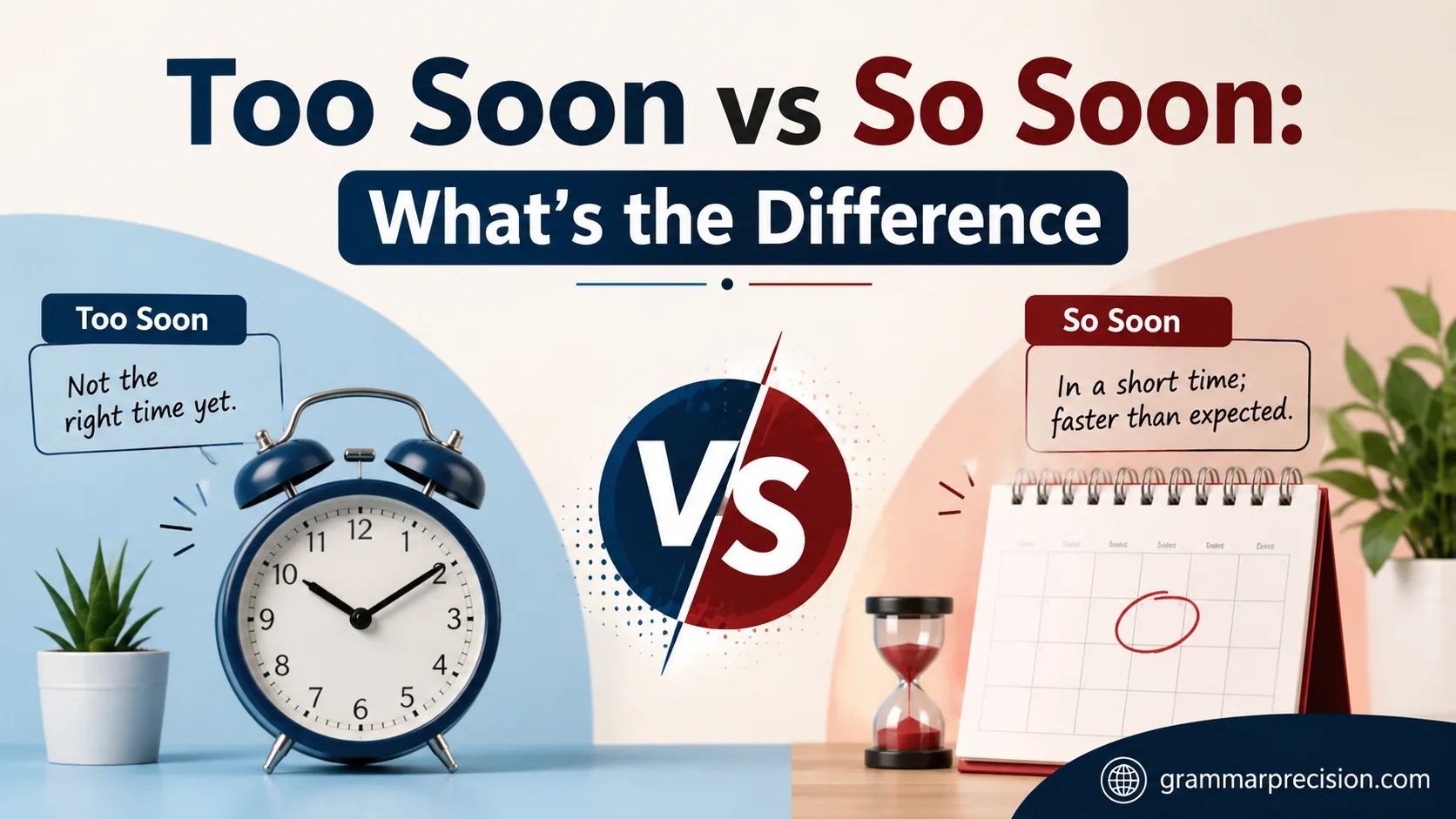
Too Soon vs So Soon can confuse writers because both expressions relate to timing, but their meanings and uses are different. Learning this simple distinction improves clarity and correctness.
In everyday English, too soon means something happens earlier than expected, appropriate, or desirable. For example, “It’s too soon to decide.” The word too shows excess, while soon refers to time. Using the correct phrase helps prevent common errors and makes your writing clearer.
The phrase so soon means something happens earlier than expected, often showing surprise, emphasis, or strong feeling. For example, “Are you leaving so soon?” Here, so emphasizes the timing. Understanding this difference helps you use both expressions naturally in casual conversations, emails, and professional writing.
Quick Answer
Although too soon and so soon both refer to time, they are not interchangeable.
- Too soon means earlier than is appropriate, desired, or acceptable. It often carries a negative meaning.
- So soon means earlier than expected and usually expresses surprise or disbelief.
Examples:
- It’s too soon to make a final decision. ✅
- You’re leaving so soon? I thought you’d stay longer. ✅
Understanding this simple distinction will help you sound more natural in everyday English.
Why Do People Confuse “Too Soon” and “So Soon”?
The confusion happens because both phrases describe events that occur earlier than expected. However, the speaker’s attitude makes all the difference.
Think of it this way:
- Too soon = There’s a problem.
- So soon = I’m surprised.
That single difference changes the entire meaning of a sentence.
For example:
- The flowers bloomed too soon because of the warm weather.
The early blooming is viewed as undesirable. - The flowers bloomed so soon!
The speaker is simply amazed by how quickly they bloomed.
Once you recognize the emotion behind each phrase, choosing the correct one becomes much easier.
Too Soon: Meaning and Usage
What Does “Too Soon” Mean?
Too soon means something happens before the right time or earlier than it should.
The word too acts as an adverb that means more than is desirable or acceptable.
Formula
Too + adjective/adverb
In this expression:
- too = excessively or more than desired
- soon = early in time
Together, they create the idea of premature timing.
Examples
- It’s too soon to celebrate the victory.
- She returned to work too soon after surgery.
- The children woke up too soon this morning.
- We announced the project too soon.
- Don’t give up too soon.
In every example, the action happened earlier than it should have.
Common Situations Where You Use “Too Soon”
You’ll often hear too soon in conversations about:
- Recovery
- Decisions
- Relationships
- Jokes
- Celebrations
- Business
- Health
- Sports
For example:
- It’s too soon to predict the election results.
- That joke was too soon after the accident.
- They invested too soon without enough research.
- The team celebrated too soon and lost the match.
Notice how each sentence suggests that waiting longer would have been better.
So Soon: Meaning and Usage
What Does “So Soon” Mean?
So soon means earlier than expected and expresses surprise, amazement, or disbelief.
Unlike too soon, it doesn’t automatically suggest that something is wrong.
Examples
- You’re leaving so soon?
- Have we already arrived so soon?
- Winter came so soon this year.
- I can’t believe the holidays are over so soon.
- She finished the marathon so soon after training.
These examples show surprise rather than criticism.
Common Situations Where You Use “So Soon”
People often use so soon when talking about:
- Unexpected departures
- Fast progress
- Sudden endings
- Seasonal changes
- Children’s growth
- Promotions
- Achievements
Examples include:
- You’re graduating so soon?
- Summer ended so soon.
- The baby started walking so soon.
- Did the meeting finish so soon?
- Time passed so soon.
The emphasis is on how unexpectedly fast something happened.
Too Soon vs So Soon: Key Differences
| Feature | Too Soon | So Soon |
| Meaning | Earlier than appropriate | Earlier than expected |
| Tone | Negative or critical | Surprised or amazed |
| Emotion | Concern, regret, warning | Surprise, admiration, curiosity |
| Suggests a problem? | Yes | Usually no |
| Common in advice | Yes | Rarely |
| Common in questions | Sometimes | Very often |
This comparison highlights the biggest difference: too soon judges the timing, while so soon reacts to it.
Examples Showing the Difference Between “Too Soon” and “So Soon”
Seeing these phrases in real sentences makes the difference much clearer. Let’s look at situations where one phrase works but the other doesn’t.
Example 1: Making a Decision
✅ It’s too soon to choose a winner.
This means there isn’t enough information yet. Making a decision now would be premature.
❌ It’s so soon to choose a winner.
This sounds unnatural because the speaker isn’t expressing surprise. They are saying the timing is inappropriate.
Example 2: Someone Leaving
✅ You’re leaving so soon?
The speaker feels surprised because they didn’t expect the person to leave yet.
✅ You’re leaving too soon.
The speaker thinks the person should stay longer.
Although both sentences talk about an early departure, the feelings behind them are different.
- So soon = “I can’t believe you’re leaving already.”
- Too soon = “I don’t think you should leave yet.”
Example 3: A Relationship
✅ They got married too soon.
This suggests that they married before they were ready.
✅ They got married so soon after meeting!
This shows surprise about how quickly it happened.
The first sentence contains judgment. The second sentence only shows reaction.
“Too Soon” vs “So Soon” in Questions
Questions often create confusion because both phrases can appear naturally.
Using “Too Soon” in Questions
When you use too soon in a question, you’re usually asking whether something is happening earlier than it should.
Examples:
- Is it too soon to talk about the future?
- Am I asking too soon?
- Is it too soon to apologize?
- Do you think we started too soon?
These questions usually involve uncertainty or concern.
Using “So Soon” in Questions
When you use so soon in a question, you are expressing surprise.
Examples:
- Are you leaving so soon?
- Did you finish so soon?
- Are they moving away so soon?
- Has the meeting ended so soon?
The speaker isn’t necessarily unhappy. They are simply surprised by the timing.
Common Mistakes With “Too Soon” and “So Soon”
Many English learners use these phrases incorrectly because they focus only on the idea of “early.” However, the feeling behind the sentence matters.
Mistake 1: Using “Too Soon” When You Mean Surprise
❌ The movie ended too soon!
(Incorrect if you only mean you were surprised.)
✅ The movie ended so soon!
However, if you mean the movie was shorter than you wanted, then too soon can work:
✅ The movie ended too soon. I wanted it to continue.
The context changes the meaning.
Mistake 2: Using “So Soon” for Warnings
❌ It’s so soon to make a final choice.
This sounds like surprise rather than advice.
✅ It’s too soon to make a final choice.
This clearly means more time is needed.
Mistake 3: Confusing “Too Soon” With “Very Soon”
Many people think too soon simply means “very soon,” but they have different meanings.
Very soon:
Means something will happen in a short amount of time.
Example:
- I’ll call you very soon.
Too soon:
Means something is happening earlier than acceptable.
Example:
- It’s too soon to call him after the argument.
The word too often introduces the idea of excess or a problem.
Also Read This: Canceled or Cancelled: The Complete Grammar Guide
Too Soon vs So Soon vs Very Soon
These three phrases look similar but serve different purposes.
| Phrase | Meaning | Example |
| Too soon | Earlier than acceptable | It’s too soon to decide. |
| So soon | Earlier than expected | You finished so soon! |
| Very soon | In a short time | I’ll arrive very soon. |
A simple trick:
- If you mean “earlier than it should happen”, choose too soon.
- If you mean “earlier than I expected”, choose so soon.
- If you mean “in a little while”, choose very soon.
How Native Speakers Use These Expressions
Native speakers often choose between too soon and so soon based on their emotional reaction.
Imagine your friend tells you they are moving to another city.
You might say:
“You’re leaving so soon?”
You feel surprised and didn’t expect the news.
But if your friend is leaving after only one week at a new job, you might say:
“You’re leaving too soon.”
You believe they should wait longer before making that decision.
The words are close, but the message changes completely.
Memory Trick: Remember the Difference Easily
Use this simple comparison:
Too soon = Too early for a reason.
So soon = So early that I’m surprised.
Think of too as a warning sign. It tells you something went beyond the acceptable limit.
Think of so as an exclamation mark. It highlights something unexpected.
Examples:
- The baby started walking so soon!
→ Surprise. - The baby started walking too soon according to the doctor.
→ Concern.
This small difference can help you choose the right phrase every time.
“Too Soon” and “So Soon” in Different Contexts
The meaning of these phrases becomes even clearer when you see how they work in different real-life situations. English speakers use them in everyday conversations, professional settings, emotional moments, and casual chats.
Let’s explore some common contexts where choosing the right phrase matters.
In Everyday Conversations
In daily conversations, so soon often appears when someone feels surprised by how quickly something happens.
Examples:
- You finished your homework so soon?
- Did you find a new apartment so soon?
- Are you going home so soon?
- The weekend ended so soon.
In each sentence, the speaker didn’t necessarily expect the event to happen that quickly.
Now look at how too soon changes the meaning:
- You finished your homework too soon.
This suggests the person may have rushed and possibly made mistakes.
- Are you going home too soon?
This suggests the speaker thinks the person should stay longer.
The difference comes down to whether the timing feels surprising or inappropriate.
Using “Too Soon” and “So Soon” at Work
Professional conversations often require careful word choices. Using the wrong phrase can make your message sound different from what you intend.
Examples With “Too Soon”
- It’s too soon to launch the product.
- We made the decision too soon without reviewing the data.
- The company expanded too soon after opening.
These examples suggest that more preparation or time was needed.
Examples With “So Soon”
- The project was completed so soon.
- You responded so soon after receiving my email.
- The team reached its goal so soon.
Here, the speaker expresses admiration or surprise.
Quick Comparison:
| Sentence | Meaning |
| The company expanded too soon. | The company expanded before it was ready. |
| The company expanded so soon. | The company expanded faster than expected. |
“Too Soon” and “So Soon” in Emotional Situations
These phrases often appear during emotional moments because timing can carry strong feelings.
“Too Soon” for Regret or Loss
People often use too soon when something ends earlier than expected or someone leaves earlier than they should have.
Examples:
- He left us too soon.
- The summer ended too soon.
- Their friendship ended too soon.
In these cases, the phrase expresses sadness or disappointment.
“So Soon” for Surprise
So soon focuses on the unexpected speed of an event.
Examples:
- I can’t believe you’re moving away so soon.
- The baby grew up so soon.
- The year passed so soon.
The speaker feels amazed by how quickly time moved.
Can “Too Soon” and “So Soon” Be Used Together?
Yes, sometimes both expressions can appear in the same conversation because they describe different reactions.
Example:
“You found a new job so soon! But isn’t it too soon to move to another city?”
Here:
- So soon shows surprise about finding a job quickly.
- Too soon shows concern about moving immediately.
Both phrases are correct because they express different ideas.
Difference Between “Too Soon” and “Too Early”
Many learners also confuse too soon with too early. These expressions are similar, but they are not always identical.
Too Early
Too early focuses on the clock, schedule, or starting time.
Examples:
- I arrived too early for the meeting.
- The store opens too early for me.
- We woke up too early today.
Too Soon
Too soon focuses on whether enough time has passed.
Examples:
- It’s too soon to judge the results.
- She started dating again too soon.
- They celebrated too soon.
Compare:
- I arrived too early for the interview.
- I arrived before the scheduled time.
- I applied for the job too soon after graduation.
- I may not have been ready yet.
The difference is small but important.
Difference Between “So Soon” and “So Quickly”
Another common confusion happens between so soon and so quickly.
Although both describe speed, they focus on different things.
So Soon
Focuses on when something happens.
Example:
- You came back so soon.
Meaning:
You returned earlier than expected.
So Quickly
Focuses on how fast something happens.
Example:
- You finished the task so quickly.
Meaning:
You completed it in a short amount of time.
Compare:
- She recovered so soon after the accident.
- The recovery happened earlier than expected.
- She recovered so quickly after the accident.
- The recovery process happened at a fast speed.
Both can sometimes describe the same event, but the focus changes.
FAQs:
Is “too soon” grammatically correct?
Yes, “too soon” is grammatically correct when something happens earlier than the appropriate, expected, or desired time. For example, “It’s too soon to make a decision.”
What does “so soon” mean?
“So soon” emphasizes that something happened earlier than expected. It often expresses surprise or emphasis, as in, “Are you leaving so soon?”
Is “to soon” correct in English?
No, “to soon” is generally incorrect when you mean a timing-related expression. The correct phrase is “too soon.” The word too means more than is appropriate or earlier than desired.
What is the difference between “too soon” and “so soon”?
“Too soon” suggests that something happens earlier than is suitable or acceptable, while “so soon” emphasizes that something happens surprisingly early. The correct choice depends on the intended meaning and context.
Can I use “too soon” in professional writing?
Yes, “too soon” works naturally in professional writing when discussing timing. For example, “It may be too soon to evaluate the results.” It is clear, grammatical, and appropriate in formal communication.
Conclusion:
Understanding Too Soon vs So Soon becomes easy once you focus on their meanings. Use too soon when something happens earlier than appropriate or desired, and use so soon to express surprise about early timing. Remember that to soon is incorrect in this context. Learning this simple distinction can improve your grammar, clarity, and confidence in everyday and professional writing.