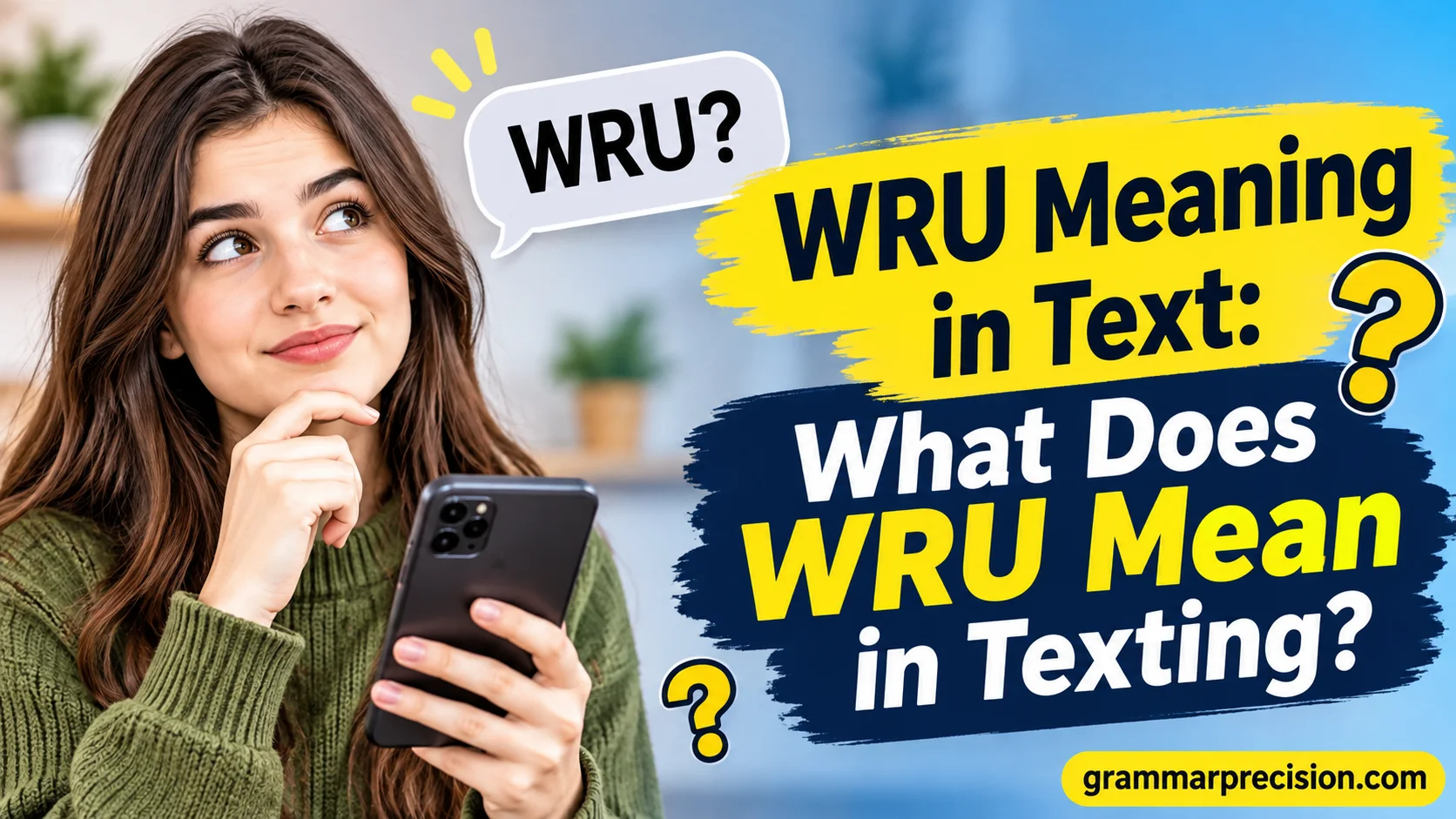
Have you ever received “WRU” and wondered what someone meant? Understanding WRU Meaning in Text helps you interpret quick messages, recognize context, and respond naturally in everyday digital conversations today.
This guide explains what WRU stands for, how people use it with friends, family, coworkers, and romantic interests, and what different situations may suggest. You’ll also find realistic examples, practical replies, and comparisons with similar abbreviations, including WYA and WYD used often in everyday messages.
You’ll learn when WRU sounds friendly, urgent, or flirty and when privacy or formal writing calls for a clearer question. Practical notes on English usage, grammar, and business communication help you choose wording that fits each conversation, whether you’re texting friends or coworkers online daily.
Quick Answer: What Does WRU Mean in Text?
WRU means “Where Are You?” It’s a casual texting abbreviation people use when asking about someone’s current location or whereabouts. Instead of typing the complete question, they shorten it to three letters to save time.
For example:
- Friend: Hey, WRU?
- You: I’m at home. What’s up?
The sender might want to meet you, check whether you’re nearby, or simply find out where you are. Your relationship and the surrounding conversation usually reveal the exact intention.
People commonly use WRU in text messages, WhatsApp chats, Snapchat conversations, and other informal digital communication. It’s short, convenient, and easy to understand once you know its meaning.
What Does WRU Stand For?
WRU stands for “Where Are You?” It’s an informal abbreviation formed from the first letters or sounds of the original question.
People use it when they want to ask about someone’s location without typing all three words. This makes conversations quicker, especially when someone needs an immediate response.
For example, imagine you’re meeting a friend at a shopping mall. Your friend hasn’t arrived yet, so you send:
“WRU? I’ve been waiting near the entrance.”
The message communicates the same question as “Where are you?” without changing its basic meaning.
The Full Form of WRU
The full form of WRU is Where Are You?
Here’s how the abbreviation connects to the original phrase:
| Letter | Meaning |
| W | Where |
| R | Are |
| U | You |
The letters R and U represent the spoken sounds of “are” and “you.” This style appears in several popular texting shortcuts, including RU (Are You?) and WYA (Where You At?).
Although WRU isn’t a traditional dictionary word, people widely recognize it in informal digital conversations.
Why People Use WRU Instead of Writing the Full Question
Texting often rewards speed and convenience. When someone wants a quick answer, typing three letters feels easier than writing an entire sentence.
However, convenience isn’t the only reason people use abbreviations. WRU also creates a relaxed conversational tone.
Here are some common reasons:
- Saving time: Three letters take less effort to type.
- Casual communication: It makes messages feel relaxed and informal.
- Quick coordination: Friends can quickly check each other’s locations.
- Mobile convenience: Short messages are easy to send while chatting on a phone.
- Digital familiarity: Many people already understand common texting shortcuts.
For instance, “WRU? We’re leaving soon” feels more casual than “Where are you? We’re leaving soon.”
Is WRU Considered Slang or an Abbreviation?
WRU is best described as an informal texting abbreviation. People sometimes call it internet slang because it belongs to casual digital communication.
However, there’s a small distinction between slang and abbreviations. Slang usually includes informal expressions with particular cultural meanings. An abbreviation shortens an existing word or phrase.
WRU primarily shortens a question rather than introducing an entirely new expression.
You can use it comfortably with friends and familiar contacts. However, writing the complete question is usually better in formal emails, professional reports, and official communication.
What Does WRU Mean in Different Conversations?
Although WRU usually asks where someone is, the situation can reveal additional meaning. A friend might want to meet you while a romantic partner may simply check your whereabouts.
Understanding the relationship between you and the sender helps you choose the right response.
WRU Meaning in Casual Text Messages
In everyday texting, WRU usually works as a straightforward location question. Someone might send it when they want to know whether you’re home, outside, or traveling.
For example:
Person A: Hey, WRU?
Person B: Just got home. Why?
Person A: Nothing much. Wanted to see if you were free.
Here, the sender simply wants to know your location and availability. There’s no complicated message hiding behind those three letters.
WRU Meaning in Conversations With Friends
Friends frequently use WRU when making plans or trying to find each other. It helps them coordinate activities without exchanging long messages.
Consider these examples:
- “WRU bro? The movie starts in 10 minutes.”
- “We’re outside the restaurant. WRU?”
- “WRU? Everyone’s waiting for you.”
- “Hey, WRU today? Let’s hang out.”
- “WRU rn? I need to tell you something.”
In these situations, WRU generally sounds friendly and direct. However, adding a short explanation makes the question feel more natural.
WRU Meaning in Romantic or Flirty Chats
When someone you like sends WRU, the message can carry a little extra interest. They might want to meet you, spend time together, or start a conversation.
For example:
Alex: WRU? Missing our conversations today.
Taylor: At home. Missing you too!
The abbreviation itself doesn’t automatically indicate romantic feelings. The surrounding words, previous conversations, and relationship provide better clues.
Someone who texts WRU might simply need information. Don’t assume every location question is a secret confession.
WRU Meaning in Professional Conversations
In workplace conversations, WRU can appear in informal messages between coworkers who already communicate casually.
For example:
Coworker: WRU? The meeting has started.
You: I’m on my way to the conference room.
However, this abbreviation isn’t suitable for every professional situation. A manager, client, or unfamiliar colleague might prefer complete sentences.
Better alternatives include:
- Where are you right now?
- Are you available for the meeting?
- Have you arrived at the office?
- Could you let me know your current location?
Remember: WRU works best when both people understand casual texting language.
15 Real-Life Examples of WRU in Texting
Examples make texting abbreviations easier to understand because you can see how people use them naturally.
Here are 15 realistic conversations showing different situations.
| Situation | Example message | Meaning |
| Meeting friends | “WRU? We’re here.” | Where are you? |
| At a restaurant | “WRU? Your food is getting cold.” | Asking your location |
| Making plans | “WRU today? Let’s meet.” | Asking where you are |
| Family chat | “WRU? Mom is looking for you.” | Checking your whereabouts |
| Romantic chat | “WRU? I want to see you.” | Asking where you are |
| Running late | “WRU? We’re already waiting.” | Checking your arrival |
| Shopping | “WRU? I’m near the entrance.” | Finding someone |
| School | “WRU? Class is starting.” | Asking your location |
| Workplace | “WRU? The team needs you.” | Checking your whereabouts |
| Group chat | “WRU guys? Join us!” | Asking where everyone is |
| Traveling | “WRU? Did you reach safely?” | Checking someone’s location |
| Party | “WRU? The party just started.” | Asking whether you’re nearby |
| Gaming | “WRU? We need backup.” | Asking where a teammate is |
| Weekend plans | “WRU tonight? Free for dinner?” | Checking location and availability |
| Emergency | “WRU? Please answer quickly.” | Urgently requesting someone’s location |
WRU When Someone Wants to Know Your Location
Sometimes the sender needs your actual location. They might be waiting outside a building or trying to find you in a crowded place.
For example:
Friend: WRU? I can’t find you anywhere.
You: I’m standing beside the main entrance.
In this situation, a direct answer prevents confusion and saves time.
WRU During Everyday Conversations
Not every WRU message involves an appointment or meeting. Sometimes someone simply wants to continue chatting.
Example:
- Person A: WRU?
- Person B: Relaxing at home.
- Person A: Nice! What are you doing later?
Here, the location question becomes a conversation starter.
WRU in Group Chats and Social Media
Group conversations often involve several people coordinating plans. Someone might use WRU to check where everyone is before starting an activity.
For example:
“WRU everyone? We’re about to leave.”
On platforms such as Instagram, Snapchat, and WhatsApp, the abbreviation can appear in direct messages or group chats.
WRU in Unexpected or Urgent Messages
An unexpected WRU message can sometimes signal urgency. The sender might need help finding someone or confirming their safety.
For example:
Sibling: WRU? Dad needs to talk to you.
You: I’m at the library. Is everything okay?
Pay attention to additional words and previous messages. They often reveal whether the sender sounds relaxed, concerned, or impatient.
How to Reply When Someone Texts You WRU
The best response depends on your relationship with the sender and how much information you want to share.
You don’t need a complicated reply. A short, natural answer usually works perfectly.
Simple and Casual Replies
If a friend or family member asks WRU, answer directly and keep the conversation moving.
Here are some easy responses:
- “I’m at home. What’s up?”
- “Just reached the office.”
- “On my way!”
- “I’m outside. Where are you?”
- “At the mall with friends.”
- “Still at work. Need something?”
- “Heading home right now.”
These responses provide useful information without making the conversation unnecessarily complicated.
Funny Replies to WRU
Sometimes a little humor makes an ordinary conversation more entertaining. If someone close to you sends WRU, try a playful response.
- “Somewhere between hungry and sleepy!”
- “On planet Earth. You?”
- “Lost in my own thoughts.”
- “Currently hiding from responsibilities.”
- “In my secret headquarters!”
- “Why? Did you miss me?”
Use these replies with people who understand your humor. A joke might confuse someone who genuinely needs your location.
Flirty Replies to WRU
If your crush or romantic partner sends WRU, you can answer playfully without making things awkward.
Try these responses:
- “Right here, waiting for your message.”
- “At home. Wish you were here!”
- “Somewhere you’d probably like to be.”
- “Thinking about you. Does that count?”
- “Why? Planning to come see me?”
- “Not too far from your heart.”
A flirty response works best when both people already share a playful connection. If you’re unsure about their intentions, start with something friendly.
Polite Replies When You Don’t Want to Share Your Location
You never have to reveal your exact location simply because someone asks. Privacy matters, especially when an unfamiliar person contacts you.
You can respond politely without sharing specific details:
- “I’m out right now. What’s going on?”
- “Somewhere nearby. Why do you ask?”
- “I’m busy at the moment.”
- “I’ll let you know when I’m available.”
- “I’d rather not share my location.”
These answers establish boundaries while keeping your communication respectful.
Is WRU Rude, Friendly, or Flirty?
The tone of WRU depends on the person sending it and the situation. The abbreviation itself isn’t inherently rude, romantic, or demanding.
However, the surrounding message can change how you interpret it.
| Context | Possible tone | Example |
| Friends | Friendly | “WRU? Let’s grab lunch.” |
| Romantic partner | Affectionate | “WRU? I miss you.” |
| Coworker | Direct | “WRU? Meeting starts now.” |
| Angry person | Impatient | “WRU? I’ve called five times!” |
| Family member | Concerned | “WRU? Are you okay?” |
How to Recognize the Sender’s Intention
Look beyond the abbreviation when interpreting someone’s message.
Consider these factors:
- Previous conversations: Have you discussed meeting or making plans?
- Relationship: Is the sender a friend, partner, relative, or stranger?
- Additional wording: Does the message include affectionate or urgent language?
- Timing: Did they send it during an expected meeting or unusual situation?
- Follow-up messages: Do they explain why they want your location?
For example, “WRU? Everyone is waiting” sounds different from “WRU, beautiful?”
The first message focuses on coordination while the second sounds more personal.
WRU vs. WYD vs. WYA: What’s the Difference?
WRU, WYD, and WYA look similar because they all contain shortened words. However, each abbreviation communicates a different question.
Understanding these differences helps you avoid confusing someone’s location with their activities.
| Abbreviation | Full Meaning | Main Purpose |
| WRU | Where Are You? | Asking someone’s location |
| WYD | What You Doing? | Asking about someone’s activity |
| WYA | Where You At? | Asking someone’s location |
| HRU | How Are You? | Asking about someone’s well-being |
| WYA RN | Where You At Right Now? | Asking someone’s current location |
| RU | Are You? | Starting a question |
WRU vs. WYA
Both WRU and WYA ask about someone’s location. The main difference involves their wording.
- WRU: Where are you?
- WYA: Where you at?
WRU uses a shortened version of a standard English question. WYA reflects a more conversational expression commonly heard in casual speech.
Example:
- Friend: “WRU?”
- You: “At home.”
Another friend might write “WYA?” to communicate almost exactly the same thing.
WRU vs. WYD
These abbreviations ask completely different questions.
WRU asks about your location while WYD asks about your current activity.
For example:
WRU: “At the gym.”
WYD: “Working out.”
You can answer both questions differently even when someone sends them together.
WRU vs. HRU
HRU stands for How Are You? It’s generally a greeting or a way to check someone’s well-being.
WRU asks where someone is physically located.
For example:
- “HRU today?” asks about someone’s condition.
- “WRU today?” asks about someone’s whereabouts.
One letter changes the question completely.
When Should You Use WRU?
WRU works well when you’re communicating with someone who understands informal texting language. It’s especially useful when you need a quick answer.
Consider using it in these situations:
- Asking friends where they are.
- Finding someone at a shopping mall.
- Coordinating plans before an event.
- Checking whether someone has arrived.
- Sending quick messages to family members.
- Communicating with teammates during online games.
When Should You Avoid Using WRU?
Although WRU works in casual conversations, it isn’t appropriate everywhere.
Avoid using it when:
- Writing formal business emails.
- Contacting unfamiliar clients.
- Communicating with professional authorities.
- Sending important official instructions.
- Writing academic assignments or reports.
Instead, write the complete question, “Where are you?”
It sounds clearer and more respectful in situations where informal abbreviations might appear unprofessional.
FAQs About WRU
Does WRU Mean Where Are You?
Yes. WRU commonly stands for “Where Are You?” People use it in informal text messages to ask someone’s location or whereabouts.
Is WRU the Same as WYA?
They have nearly identical meanings. Both abbreviations ask where someone is, although their wording differs slightly.
Can WRU Have Different Meanings?
In everyday texting, its established meaning is “Where Are You?” However, unusual situations or specialized communities might use the same letters differently. Always consider the surrounding conversation.
Is WRU Appropriate for Work Messages?
It depends on your workplace culture. Close coworkers might understand it in casual team chats. However, complete sentences work better in formal communication.
How Do You Pronounce WRU?
WRU represents the spoken question “Where are you?” Most people simply read the abbreviation as its full phrase rather than pronouncing each letter separately.
What Does WRU Mean From a Guy?
When a guy sends WRU, he’s usually asking about your location. He might want to meet you, check your availability, or continue a conversation. It doesn’t automatically mean he’s flirting.
What Does WRU Mean From a Girl?
When a girl texts WRU, she generally wants to know where you are. Depending on your relationship, she might be making plans, checking on you, or starting a conversation.
What Does WRU RN Mean?
WRU RN means “Where Are You Right Now?” The letters RN stand for “Right Now.” This version emphasizes that the sender wants your current location.
Is WRU Still Used in Modern Texting?
Yes. WRU remains understandable in informal digital communication. People may choose newer expressions or simply type the complete question, but the abbreviation still serves its original purpose.
Should You Reply to WRU Immediately?
Not necessarily. Reply whenever you’re comfortable and available. If someone needs urgent information, responding sooner can help. However, you don’t owe anyone an immediate answer or your exact location.
Conclusion:
Understanding WRU Meaning in Text helps you recognize what someone asks and respond with confidence. Whether you’re chatting with friends, family, or someone special, context matters. A simple abbreviation can communicate curiosity, urgency, or interest depending on your conversation.
Now that you know its meaning, examples, and possible replies, you can use WRU naturally in everyday texting. Remember to consider the relationship, tone, and situation before responding. When clarity matters, especially in professional communication, choosing complete words always makes your message easier to understand.