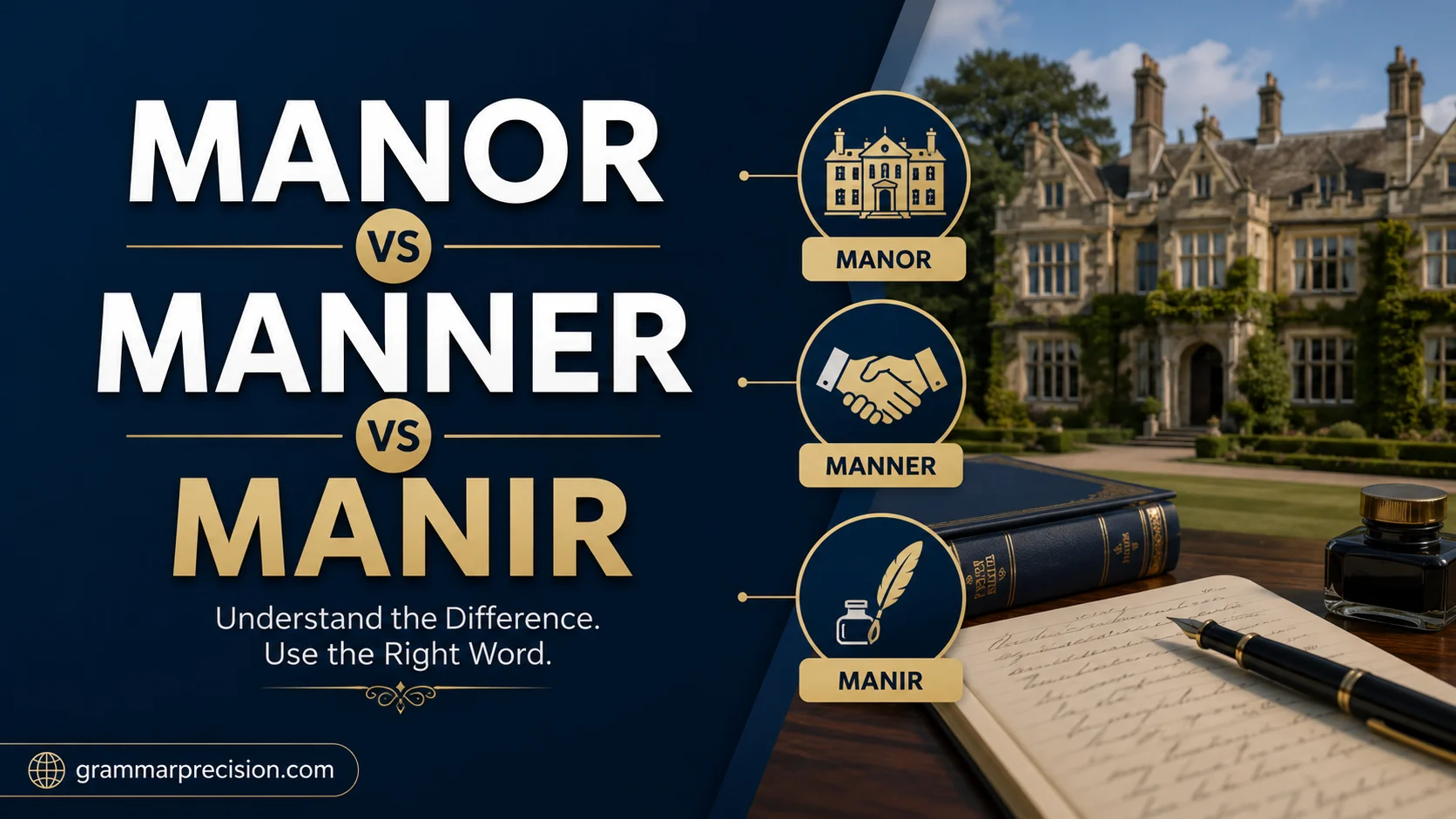
Manor vs Manner vs Manir explains three confusing terms with different meanings and uses. This guide helps readers understand correct spelling, usage, and context to avoid common writing mistakes easily.
Manner describes a way of doing things and shows someone’s behavior, style, or method in daily situations. It relates to conduct, etiquette, and interaction with others. Understanding its meaning, spelling, and usage improves clear communication and professional writing in essays, emails, and articles while preventing confusion between similar sounding words through simple real-life examples today.
Manor refers to a large house or estate connected with historical land ownership and the feudal system. A manir is only a typo and incorrect spelling in English. Learning these differences helps you choose the correct term confidently and create polished sentences for professional content. These words may sound alike, but their meanings are separate.
Manor vs Manner vs Manir: Quick Comparison Table
Before exploring each word in detail, this simple comparison will help you understand the basic difference.
| Word | Correct Spelling? | Meaning | Part of Speech | Example |
| Manor | Yes | A large country house, estate, or historical residence | Noun | The family owns an ancient manor in the countryside. |
| Manner | Yes | A way of doing something, behavior, or style | Noun | She answered the question in a respectful manner. |
| Manir | No (usually incorrect) | Common misspelling of manner | Incorrect form | He showed good manir. ❌ |
The easiest way to remember the difference is:
- Manor = A place
- Manner = A way or behavior
- Manir = A spelling mistake
Although manor and manner sound similar, they describe completely different ideas.
What Does Manor Mean?
The word manor refers to a large house or estate, especially one connected with history, land ownership, or wealthy families.
A manor is more than just a big home. Traditionally, it included the main residence, surrounding land, farms, and sometimes villages controlled by a landowner.
For centuries, manors played an important role in European society, especially during the medieval period.
Manor Definition and Origin
The word manor comes from Old French “manoir,” meaning a dwelling or residence. It entered English after the Norman influence on England in the Middle Ages.
Historically, a manor was the center of a landowner’s property. The person who controlled the manor often managed agricultural activities, collected payments, and provided protection to people living on the estate.
A traditional manor usually included:
- A large main house
- Farmland
- Gardens
- Worker housing
- Storage buildings
- Sometimes a church or village
A manor was not simply a luxurious home. It represented social status, wealth, and land ownership.
Manor Meaning in Modern English
Today, people still use manor to describe large historic houses or impressive country estates.
For example:
- The couple visited an old manor during their vacation.
- The movie was filmed at a beautiful English manor.
- The manor has been preserved for future generations.
Modern usage often appears in:
- Travel writing
- Historical books
- Architecture discussions
- Real estate descriptions
- Fiction and fantasy stories
Examples of Manor in Sentences
Here are some examples to make the meaning clearer:
- The royal family stayed at a beautiful manor during their countryside trip.
- The old manor has stood on the hill for more than 300 years.
- Tourists often visit the historic manor to learn about local history.
- The author described a mysterious manor hidden deep in the forest.
Notice that manor always refers to a physical location.
You can visit a manor, own a manor, renovate a manor, or live in a manor.
You cannot use manor to describe someone’s personality or actions.
What Does Manner Mean?
The word manner has a completely different meaning from manor. It describes how something happens, how someone behaves, or the way an action is performed.
It is one of the most common words in everyday English.
Different Meanings of Manner
The word manner has several meanings depending on the context.
Manner as a Way of Doing Something
In this sense, manner means a method, style, or approach.
Examples:
- He completed the task in a professional manner.
- The machine operates in a similar manner.
- She explained the topic in a simple manner.
Here, manner answers the question:
“How was something done?”
For example:
“She spoke in a friendly manner.”
This means:
“She spoke in a friendly way.”
Manner as Behavior or Attitude
Manner can also describe how someone behaves toward others.
Examples:
- Good manners can make a strong first impression.
- His rude manner upset the guests.
- Children should learn basic manners.
In this context, manners usually refers to polite social behavior.
Common examples include:
- Saying “please”
- Saying “thank you”
- Listening when others speak
- Showing respect
Good manners help people communicate better and build positive relationships.
Common Expressions Using Manner
English speakers frequently use the word manner in everyday phrases.
In a Similar Manner
Meaning: In the same way.
Example:
“The two machines work in a similar manner.”
In This Manner
Meaning: In this way.
Example:
“Complete the form in this manner to avoid errors.”
Good Manners
Meaning: Polite behavior.
Example:
“Parents often teach their children good manners.”
Bad Manners
Meaning: Rude or disrespectful behavior.
Example:
“Interrupting people constantly is considered bad manners.”
Is Manir a Correct English Word?
No, manir is not considered a standard English word.
In most cases, people write manir when they actually mean manner. This mistake usually happens because the pronunciation of “manner” can make people unsure about the spelling.
English spelling can sometimes feel tricky because words do not always sound exactly how they look.
For example:
- Manner → pronounced like “MAN-er”
- Manor → pronounced similarly in many accents
- Manir → incorrect spelling
Why Do People Spell Manner as Manir?
Several reasons can cause this mistake:
Pronunciation Confusion
When people hear a word instead of reading it, they may guess the spelling incorrectly.
Influence From Other Languages
Some languages use “i” sounds where English uses “a” or “e,” which can influence spelling choices.
Lack of Reading Exposure
People who rarely see the written form of a word may rely only on pronunciation.
However, formal writing requires correct spelling. Using manir in an essay, email, or article can make the writing appear careless.
Manor vs Manner: Key Differences You Should Remember
Although manor and manner look almost identical, their meanings are completely different.
| Feature | Manor | Manner |
| Meaning | A large house or estate | A way, method, or behavior |
| Type | Physical place | Action or attitude |
| Part of Speech | Noun | Noun |
| Related Words | Estate, mansion, residence | Method, style, behavior |
| Example | They visited a historic manor. | She acted in a polite manner. |
A helpful memory trick:
Manor has “one n” because it is one location.
Manner has “two n’s” because it describes how things are done.
This simple connection can help you avoid mistakes.
Also Read This: In the Books vs. On the Books: The Complete Guide
Common Mistakes With Manor and Manner
Many writers confuse these words because they sound alike. Let’s look at some common errors.
Mistake One: Using Manor for Behavior
Incorrect:
He spoke in a polite manor.
Correct:
He spoke in a polite manner.
Why?
The sentence describes how he spoke, not a building.
Mistake Two: Using Manner for a Building
Incorrect:
They stayed at a beautiful manner.
Correct:
They stayed at a beautiful manor.
Why?
The sentence refers to a house or estate.
Mistake Three: Writing Manir Instead of Manner
Incorrect:
She has excellent manir.
Correct:
She has excellent manners.
Why?
The correct spelling is manner.
Easy Memory Tricks for Manor vs Manner vs Manir
Learning confusing words becomes easier when you connect them with simple ideas.
Memory Trick One: Manor Means Mansion
Both words begin with “M.”
Think:
Manor = Mansion
A mansion is a large house, just like a manor.
Example:
“The wealthy family lived in a grand manor.”
Memory Trick Two: Manner Means Method
Both words begin with “M.”
Think:
Manner = Method
A method explains how something happens.
Example:
“He completed the project in an organized manner.”
Memory Trick Three: Manir Means Mistake
Remember:
Manir is not the standard spelling.
Whenever you see “manir,” replace it with manner unless you are referring to a different language or name.
Manor vs Manner Examples in Everyday Writing
Seeing these words in context makes the difference easier to understand.
| Sentence | Correct Word | Explanation |
| The old ___ was built in the 1700s. | Manor | Refers to a historic building |
| She behaved in a respectful ___. | Manner | Refers to behavior |
| The workers repaired the ancient ___. | Manor | Refers to a property |
| He answered the question in a calm ___. | Manner | Refers to style |
| Good ___ are important in society. | Manners | Refers to polite behavior |
Why English Has Similar Words Like Manor and Manner
English contains thousands of confusing word pairs because the language developed from many sources.
English borrowed words from:
- Latin
- French
- Germanic languages
- Greek
- Norse languages
Because of this mixture, many words share similar spellings but have unrelated meanings.
The words manor and manner have historical connections through French and Latin influences. However, modern English uses them differently.
This is why spelling alone is not enough. You also need to understand the context.
Case Study: How One Letter Changes Meaning
Consider this sentence:
“The guest behaved in a strange manor.”
A reader might imagine a strange building because manor means a place.
However, the writer probably meant:
“The guest behaved in a strange manner.”
The second sentence makes sense because it describes behavior.
This example shows why choosing the right word matters. A single letter can completely change the image in the reader’s mind.
How to Improve Your Vocabulary and Avoid Similar Mistakes
Confusing words are easier to remember when you practice them regularly.
Try these strategies:
- Read English articles daily.
- Write your own example sentences.
- Learn words in context instead of memorizing definitions.
- Use dictionaries when uncertain.
- Pay attention to spelling patterns.
A vocabulary mistake is often not caused by a lack of intelligence. It usually happens because English contains many unusual patterns.
The solution is exposure and practice.
FAQs:
What is the difference between Manor and Manner?
Manor refers to a large house, estate, or historic residence, often linked with the feudal system and land ownership. Manner describes a way of doing something, a person’s behavior, or a method of action. Although they sound similar, they have completely different meanings and uses in English.
Is Manir a correct English word?
No, manir is not a correct English word. It is usually a typo or misspelling of either manor or manner. Using the correct spelling is important because incorrect words can create confusion and affect the clarity of your writing.
How can I remember the difference between Manor and Manner?
You can remember that Manor contains “or,” which can remind you of a property or estate. Manner contains “ner,” which connects better with behavior, attitude, and the way someone acts. These simple memory tricks make it easier to use both words correctly.
What does Manner mean in everyday communication?
Manner refers to the way someone behaves, speaks, or completes an action. It includes conduct, etiquette, style, and approach. For example, a doctor’s bedside manner describes how they interact with patients. Good manners help create respectful and effective communication in different situations.
Why is it important to understand Manor and Manner?
Understanding the difference between Manor and Manner helps you avoid writing mistakes and improves your professional writing. Correct word usage makes your essays, emails, articles, and social media posts more clear, polished, and easier for readers to understand.
Conclusion:
Manor, Manner, and Manir may look or sound similar, but they have different meanings and purposes. Manor relates to a historic estate, while Manner explains behavior or a method. Manir is simply an incorrect spelling. Learning these differences improves writing clarity, prevents confusion, and helps you communicate more confidently in English.