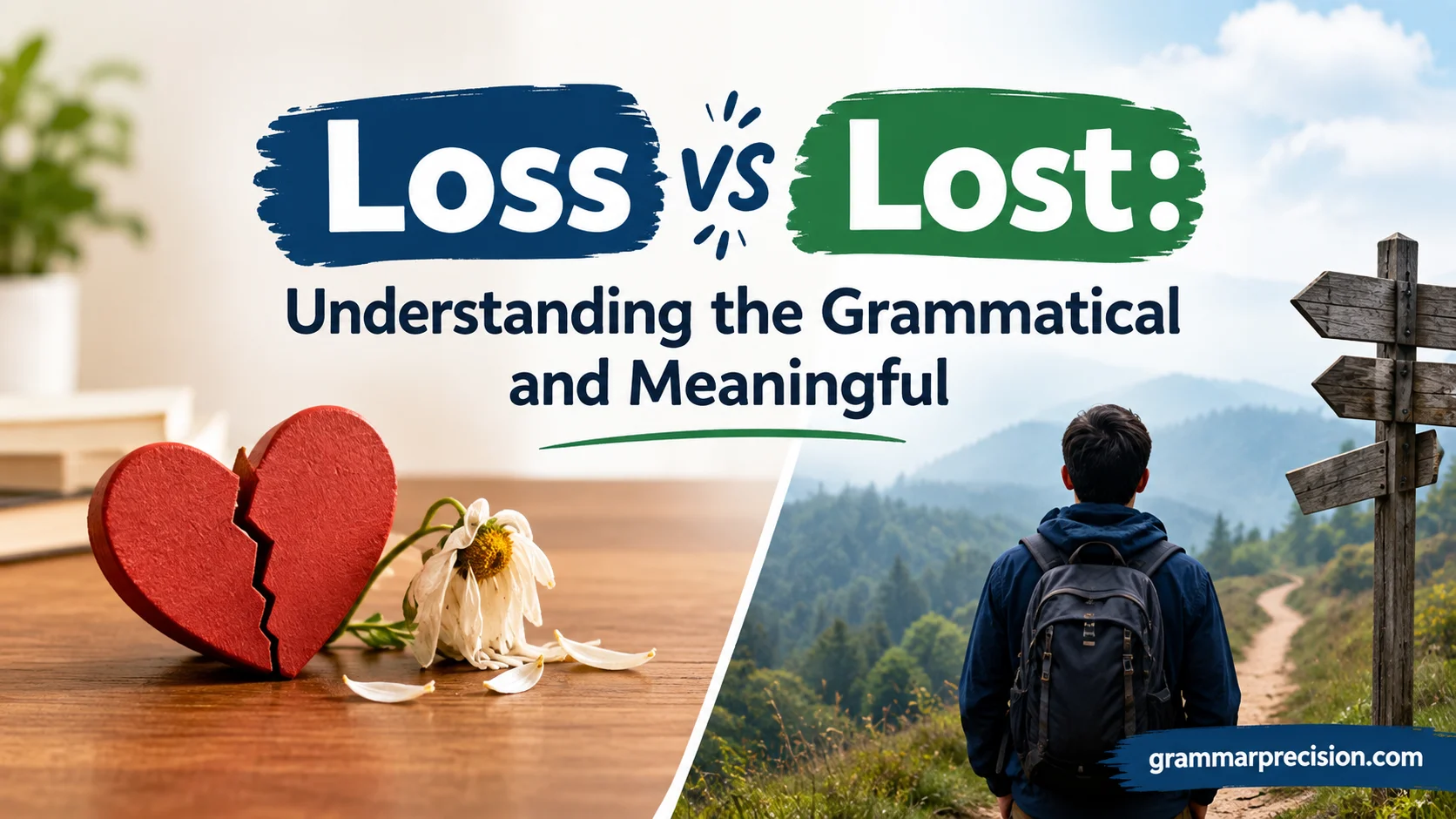
Understanding Loss vs Lost is important for anyone who wants to improve English grammar and communication skills. These commonly confused words have different meanings and uses. Learning the correct difference helps you write clearly, speak confidently, and avoid common mistakes in everyday conversations and professional writing.
Many English learners struggle with word choice, grammar accuracy, and sentence structure when using similar words. Loss is a noun that refers to something missing or gone, while lost is usually a verb or adjective. Knowing this distinction improves writing skills, enhances language confidence, and supports better communication in academic, business, and personal situations.
The difference between Loss vs Lost may seem small, but it plays a major role in effective communication. Using the correct term helps readers understand your message without confusion. Language experts, teachers, and professional writers emphasize proper grammar because it improves readability, builds credibility, and demonstrates a stronger command of English. Accurate usage also creates a more professional and trustworthy impression.
Learning grammar rules through practical examples is one of the best ways to master English. When you understand Loss vs Lost, you can avoid frequent errors and communicate with greater precision. Strong knowledge of English vocabulary, grammar rules, language learning techniques, and context-based usage supports long-term improvement. This knowledge helps students, professionals, and content creators produce clear, accurate, and high-quality content.
Loss vs. Lost: What’s the Difference?
The main difference between loss and lost is grammatical function.
Loss names the experience, result, amount, or consequence of losing something. It works as a noun.
Lost is the simple past and past participle form of lose. It can also work as an adjective when it describes something missing, misplaced, or someone who feels confused.
| Word | Part of Speech | Main Meaning | Example |
| Lose | Verb | To no longer have, keep, or win | Don’t lose your keys. |
| Lost | Verb | Past form of lose | I lost my keys. |
| Lost | Adjective | Missing or unable to find a way | The child looked lost. |
| Loss | Noun | The result or experience of losing | The loss was difficult. |
| Losing | Verb/Gerund | The ongoing act of losing | He is losing confidence. |
A useful way to remember the relationship is:
Lose → Lost → Loss
Think of lose as the action, lost as the completed action or resulting state, and loss as the thing or experience that the action creates.
Cambridge Grammar also distinguishes the words by grammatical role, identifying loss as a noun and lost as an adjective in relevant constructions.
Loss Meaning and Usage
Loss is a noun that refers to the fact, experience, or result of losing something or someone.
It can describe physical things, money, opportunities, relationships, confidence, time, or even life. That broad meaning explains why loss appears in many different kinds of writing.
Consider these examples:
- The company suffered a major loss.
- His death was a terrible loss to the family.
- The team accepted the loss gracefully.
- The accident resulted in a significant loss of property.
- Data loss can cause serious problems.
Notice something important: loss doesn’t describe the action directly. Instead, it names the consequence, situation, or experience.
Loss as a Noun
Because loss is a noun, it can appear after articles, adjectives, possessives, and prepositions.
For example:
- a loss
- the loss
- a serious loss
- financial loss
- her loss
- loss of control
- after the loss
This gives you a quick grammar test. If the sentence needs a noun, loss may be the right choice.
Compare:
She lost her job.
Here, lost describes what she did.
Her job loss was unexpected.
Here, loss names the event.
The meaning remains closely connected, but the grammar changes.
Lost Meaning and Usage
Lost has several important functions. First, it is the simple past form of lose.
For example:
- I lost my phone yesterday.
- They lost the match.
- She lost her passport.
- We lost contact with them.
- He lost his temper.
In each sentence, lost describes an action that happened in the past.
Lost is also the past participle of lose. That means it can appear with helping verbs in structures such as the present perfect and past perfect.
- She has lost her keys.
- They had lost hope.
- We have lost enough time already.
The word lost can also function as an adjective.
- The lost child was found.
- I felt lost in the new city.
- He seemed lost without his usual routine.
- The lost opportunity never returned.
In these examples, lost describes a condition rather than directly naming an action.
Where “Lose” Fits Into the Picture
Understanding lose makes the Loss vs. Lost difference much clearer.
Lose is the base verb. It can mean to misplace something, fail to win, become deprived of something, decrease something, or fail to maintain something.
Examples include:
- Don’t lose your wallet.
- We might lose the game.
- She wants to lose weight.
- Don’t lose hope.
- Try not to lose focus.
Its past form is lost:
lose → lost
So:
I lose my keys sometimes.
becomes:
I lost my keys yesterday.
However, loss isn’t another tense of lose. It’s a noun.
I lost my keys.
The loss of my keys caused a problem.
That distinction is one of the most important points in this entire topic.
Loss vs. Lost: Grammar Breakdown
Grammar provides the fastest way to choose between these words.
Loss as a Noun
A noun can act as a subject or object. Loss can do both.
As a subject:
The loss was unexpected.
As an object:
The company reported a major loss.
After a preposition:
They struggled after the loss.
In a noun phrase:
It was a significant financial loss.
Common patterns include:
- a loss
- the loss of
- suffer a loss
- experience a loss
- prevent loss
- financial loss
- personal loss
- data loss
- loss of control
The phrase loss of is especially common because it lets the noun describe what has disappeared or been taken away.
Lost as a Verb
When lost is the past tense of lose, it normally works as the main verb.
She lost her wallet.
The basic structure is:
Subject + lost + object
Examples:
- I lost my ticket.
- He lost his job.
- They lost the game.
- We lost our connection.
- She lost her confidence.
Here, lost tells us what happened.
Lost as an Adjective
Lost can also describe a person, object, or situation.
The lost dog eventually returned home.
Here, lost describes the dog.
I feel lost without a clear plan.
Here, lost describes an emotional or mental state.
This distinction matters because the same word can perform different grammatical jobs.
Loss vs. Lost by Meaning
The words become easier to distinguish when you examine the situations in which people use them.
When Something Is Missing
Use lost when describing the action or state.
I lost my glasses.
Use loss when naming the resulting situation.
The loss of my glasses was inconvenient.
The first sentence focuses on the event. The second focuses on the experience or result.
When Someone Dies
Loss commonly refers to death, especially in formal or emotional language.
The family suffered a heartbreaking loss.
You can also use lost as a verb:
She lost her father at a young age.
These sentences aren’t interchangeable because their structures differ.
When Money Is Gone
Both words frequently appear in financial contexts.
The company lost $2 million.
Here, lost is the verb.
The company suffered a loss of $2 million.
Here, loss is the noun.
Business writing often uses losses as the plural noun:
The company reported substantial losses.
Dictionary.com similarly distinguishes lose as a verb from loss as a noun and notes that both can describe tangible and intangible things.
When an Opportunity Disappears
You can say:
We lost the opportunity.
Or:
It was a major loss of opportunity.
The first focuses on the action. The second turns the idea into a noun phrase.
When Someone Feels Confused
Here, lost often works as an adjective.
I feel lost without clear instructions.
You wouldn’t normally say:
I feel loss.
Instead, you might say:
I feel a sense of loss.
That tiny change creates a completely different grammatical structure.
Also Read This: In the Evening or On the Evening?
Loss vs. Lost in Real Sentences
Context often provides the strongest clue.
| Situation | Correct Example | Why |
| Misplacing something | I lost my phone. | Past action |
| Result of misplacing it | The loss was frustrating. | Noun |
| Sports defeat | We lost the game. | Past action |
| Sports result | It was a painful loss. | Noun |
| Emotional state | She felt lost. | Adjective |
| Financial result | The company suffered a loss. | Noun |
| Financial action | The company lost money. | Verb |
| Missing person/object | The lost child was found. | Adjective |
This table reveals a useful pattern: lost often tells what happened or describes a state, while loss names the event or result.
Common Collocations With Loss and Lost
Collocations are word combinations that commonly occur together. Learning them can make your English sound more natural.
Common Expressions With Loss
- financial loss
- personal loss
- heavy loss
- major loss
- significant loss
- loss of control
- loss of confidence
- loss of interest
- loss of income
- loss of life
- loss of memory
- weight loss
- data loss
- at a loss
For example:
The company suffered a financial loss.
She experienced a loss of confidence after the criticism.
Common Expressions With Lost
- lost opportunity
- lost time
- lost interest
- lost confidence
- lost control
- lost hope
- lost connection
- lost cause
- lost track
- lost in thought
- lost for words
- get lost
- feel lost
For example:
We lost track of time while talking.
He was lost in thought during the meeting.
Loss vs. Lost vs. Lose vs. Losing
Many mistakes happen because learners focus on spelling rather than grammatical function.
| Word | Function | Typical Meaning | Example |
| Lose | Verb | Present/base action | Don’t lose your keys. |
| Lost | Verb | Past action | I lost my keys. |
| Lost | Adjective | Missing/confused | I feel lost. |
| Loss | Noun | Result or experience | The loss hurt. |
| Losing | Verb/Gerund | Ongoing action | He is losing patience. |
Think of the sentence:
She lost her job.
Now transform it:
Her job loss was difficult.
Then:
She is losing confidence.
And finally:
She doesn’t want to lose hope.
The underlying idea stays connected. The grammatical form changes.
Loss vs. Lost vs. Loose: Don’t Mix These Up
There’s another word that causes trouble: loose.
Although lose, lost, and loss belong to the same word family, loose has a different meaning.
Lose means to no longer have something or to fail to win.
Don’t lose your keys.
Lost is the past form of lose or an adjective.
I lost my keys.
Loss is a noun.
The loss of my keys was frustrating.
Loose is an adjective meaning not tight or securely fixed.
My shirt is loose.
A simple comparison helps:
| Word | Meaning |
| Lose | No longer have or fail to win |
| Lost | Past form of lose; missing or confused |
| Loss | Result or experience of losing |
| Loose | Not tight or firmly attached |
Don’t let the similar spelling fool you. Loose belongs to a different semantic lane.
The Most Common Errors English Learners Make
Mistake: “I Loss My Phone”
Incorrect:
I loss my phone yesterday.
Correct:
I lost my phone yesterday.
Why? The sentence describes a completed past action. Therefore, you need the past form of lose: lost.
Mistake: “It Was a Big Lost”
Incorrect:
It was a big lost.
Correct:
It was a big loss.
The sentence needs a noun after the article a. Therefore, loss fits.
Mistake: “The Company Lost Was Huge”
Incorrect:
The company lost was huge.
Correct:
The company’s loss was huge.
The intended meaning concerns the financial result. Loss works as the noun.
Mistake: Confusing Loss With Lose
Incorrect:
I don’t want to loss my job.
Correct:
I don’t want to lose my job.
After want to, you need the base form of the verb. That means lose, not loss.
How to Choose the Correct Word Instantly
When you’re unsure, don’t guess based on spelling. Use this four-step test.
First, identify the job of the word.
If you need a noun, consider loss.
If you need a verb, consider lose, lost, or losing.
Second, check the time.
If the action happened in the past, lost may be correct.
She lost her wallet.
Third, ask whether you’re describing a state.
If you’re describing someone who cannot find their way or feels confused, lost may work as an adjective.
He looked lost.
Finally, look at the surrounding grammar.
Articles such as a and the often point toward a noun:
a loss
After to, you normally need the base verb:
to lose
After is/was or another linking verb, lost may function as an adjective:
She was lost.
This quick check can prevent most common errors.
Mini Case Studies: Same Idea, Different Word
Seeing related sentences side by side makes the distinction much easier.
Case Study: A Lost Job
She lost her job last month.
Here, lost describes the completed action.
Her job loss affected her finances.
Here, loss names the event and its consequence.
She is losing confidence.
Here, losing describes an ongoing change.
She doesn’t want to lose hope.
Here, lose is the base verb after to.
One situation. Four grammatical forms.
Case Study: A Sports Match
Our team lost the final.
The word lost describes the action.
The final was a painful loss.
The noun loss describes the result.
The team could lose again next week.
The base verb refers to a possible future event.
The team is losing confidence.
The -ing form describes an ongoing process.
This is why memorizing isolated definitions isn’t enough. Grammar determines which form belongs in the sentence.
A Practical Memory Trick for Loss vs. Lost
Here’s a compact rule worth remembering:
Lose = do. Lost = did or is. Loss = thing/result.
For example:
- I lose things. → present/base action
- I lost something. → completed action
- I am lost. → state
- The loss was frustrating. → result or experience
Another helpful clue is the t in lost. The word contains the visual marker of its past-tense form.
If you’re writing about something that happened yesterday, last week, or earlier, lost may be the form you need.
If you’re naming the event itself, choose loss.
Loss vs. Lost Practice Quiz
Choose the correct word for each sentence.
- I ______ my wallet on the bus yesterday.
- The company suffered a serious financial ______.
- Don’t ______ your passport while traveling.
- She felt completely ______ after moving to a new city.
- The team ______ the championship game.
- His sudden departure was a great ______.
- We don’t want to ______ this opportunity.
- The ______ of data caused major problems.
- He has ______ interest in the project.
- The child became ______ in the crowded mall.
Answer Key
- lost
- loss
- lose
- lost
- lost
- loss
- lose
- loss
- lost
- lost
The trick isn’t memorizing the answers. Look at the grammatical role first. That habit will serve you far beyond this particular word pair.
FAQs:
What is the main difference between Loss and Lost?
Loss is a noun that refers to something that has been lost, while lost is a verb or adjective used to describe something that is missing or someone who cannot find their way.
Is Loss a noun or a verb?
Loss is always a noun. It represents the act, result, or experience of losing something valuable, important, or meaningful.
Can Lost be used as an adjective?
Yes, lost can be used as an adjective. For example, in the sentence “I found a lost wallet,” the word lost describes the wallet.
Why do people confuse Loss and Lost?
People often confuse these words because they come from the same root word and have similar spellings. However, they serve different grammatical functions and are used in different contexts.
How can I remember when to use Loss and Lost?
A simple trick is to remember that loss names the result of losing something, while lost describes the action or condition of something being missing. Regular practice and reading examples can help reinforce the correct usage.
Conclusion:
Understanding Loss vs Lost helps you use English more accurately and confidently. These two words have different grammatical functions, and knowing when to use each one improves communication skills, writing quality, and overall language fluency.
When learning grammar, it is important to focus on real-world usage, context clues, and sentence structure. Loss refers to the act or result of losing something, while lost describes something that has already gone missing or a person who cannot find their way. Mastering this distinction strengthens vocabulary knowledge and reduces common writing mistakes.
By practicing Loss vs Lost regularly, you can build stronger English grammar skills and communicate more effectively in everyday situations. Whether you are a student, professional, or language learner, understanding these commonly confused words will improve clarity, increase confidence, and help you create more accurate and professional content.