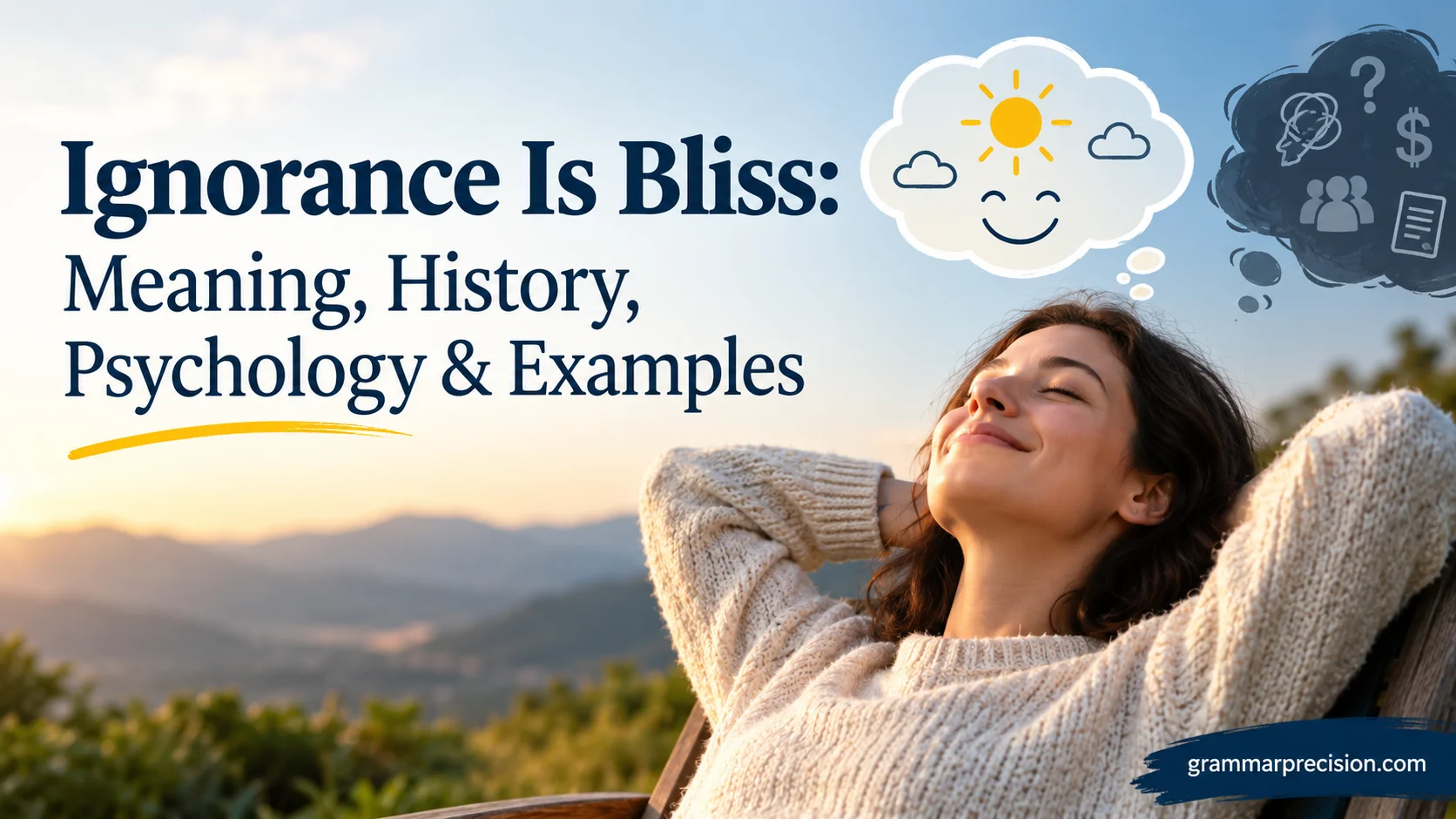
Have you ever felt happier simply because you didn’t know something? That familiar feeling captures the meaning of “ignorance is bliss,” a timeless English idiom about knowledge, comfort, and emotional peace.
But this expression carries more nuance than its five words suggest. In this guide, you’ll explore its meaning, origin, psychology, examples, English usage, and modern interpretations. You’ll also see how the phrase works in everyday conversations, relationships, workplaces, meetings, and digital communication.
Beyond its literary history, ignorance is bliss can reveal how people manage information, uncertainty, and stress. The article examines its connection with business communication, scheduling, time management, online booking, broadcasting, calendar planning, and project management when information becomes excessive or distracting.
You’ll also learn how grammar, formal writing, and consistency affect natural usage. Finally, a brief look at US and UK style preferences helps clarify how regional English conventions can shape tone and word choice. Whether you’re an English learner, writer, or curious reader, this guide makes the expression easy to understand and use confidently.
What Does “Ignorance Is Bliss” Mean?
Ignorance is bliss means that not knowing certain facts can sometimes make you happier or more comfortable. When information could cause stress, disappointment, fear, or unnecessary worry, remaining unaware may feel easier.
Cambridge Dictionary defines the expression as an idiom used to emphasize that it can sometimes be better not to know all the facts about a situation. Dictionary.com similarly explains it as the idea that not knowing something is often more comfortable than knowing it.
In simple terms, the phrase means:
Sometimes, knowing less means worrying less.
Imagine ordering a meal without knowing every tiny imperfection behind the scenes. You enjoy it because you don’t know about them. Later, learning every minor detail might make the experience feel less pleasant.
That doesn’t make ignorance good. It shows why knowledge and happiness don’t always move together.
Is “Ignorance Is Bliss” Positive or Negative?
The expression can sound positive, negative, humorous, or ironic depending on context.
For example, someone might say:
- “I haven’t checked the weather for our trip. Ignorance is bliss.”
- “She never read the negative comments, so ignorance was bliss.”
- “Ignoring the warning signs wasn’t bliss for long.”
The first example is humorous. The second describes emotional protection. The third challenges the idiom.
That flexibility makes ignorance is bliss useful in modern English.
Why Does “Ignorance Is Bliss” Sound Contradictory?
The phrase contains a deliberate tension. Ignorance normally suggests a lack of knowledge, while bliss suggests extreme happiness or deep contentment.
Putting them together creates a paradox: how can not knowing something produce happiness?
The answer lies in information’s emotional cost. Knowledge can reveal risks, responsibilities, disappointments, and uncomfortable truths. Before discovering them, you may feel perfectly calm.
Think of knowledge as opening a door. Sometimes the room contains something wonderful. Sometimes it contains a problem you now have to solve.
That doesn’t make the door bad. It means information can create obligations that didn’t exist emotionally before you knew about them.
The Origin of “Ignorance Is Bliss”
The phrase ignorance is bliss comes from Thomas Gray’s 18th-century poem Ode on a Distant Prospect of Eton College. Gray wrote the poem in 1742, and it was first printed anonymously in 1747.
The famous closing lines read:
“No more; where Ignorance is Bliss,
’Tis Folly to be wise.”
The Thomas Gray Archive preserves these lines in the poem’s original text and notes that the poem was written at Stoke in August 1742. The printed version appeared in London in 1747.
Thomas Gray and the Original Idea
Gray’s original idea deserves closer attention because modern usage can oversimplify it.
The poem reflects on youth, innocence, suffering, and adulthood. Gray contrasts carefree children with the hardships that await them as they mature.
Earlier in the poem, he describes poverty, age, pain, remorse, and other forms of human suffering. Then he asks why people should know their fate when such knowledge could destroy their present happiness.
So Gray wasn’t simply saying, “Being stupid is good.”
His point was more subtle. There can be happiness in remaining innocent of future troubles. Once people understand the difficulties ahead, that knowledge can change how they experience the present.
Did Gray Invent the Idea?
Not exactly. Similar ideas existed long before Gray. The Thomas Gray Archive notes several earlier parallels involving writers such as Sophocles, Terence, Montaigne, and others.
Gray didn’t invent the underlying thought. He gave English its most memorable formulation.
In that sense, the phrase became more influential than the older philosophical idea itself.
What Does “Ignorance Is Bliss” Mean Psychologically?
The psychology behind ignorance is bliss becomes clearer when you consider how people respond to uncertainty and unpleasant information.
Information can help you make better decisions, but it can also create emotional pressure. Once you know about a problem, you may feel responsible for responding to it.
For example, imagine that you haven’t heard a strange noise from your car. You drive peacefully. Once a mechanic tells you the noise could signal an expensive repair, your mental experience changes immediately.
The mechanical problem existed before the conversation. Your awareness of it changed your emotional state.
Information Can Create Anxiety
People often feel more anxious when they receive uncertain or threatening information. The mind starts asking questions:
- What happens next?
- How serious is this?
- Can I fix it?
- What if things get worse?
- What should I do now?
Ignorance can temporarily prevent that chain reaction.
However, temporary relief isn’t the same as a good long-term strategy. Avoiding important information can eventually increase risk.
Information Overload Can Reduce Peace
Modern life makes the expression surprisingly relevant. Notifications, headlines, messages, alerts, reviews, opinions, statistics, and social updates arrive constantly.
You can know something about almost everything.
That doesn’t mean you need to know everything.
A person who checks every update and researches every minor concern may experience more mental noise than someone who sets reasonable boundaries.
In this context, ignorance is bliss can describe selective attention rather than total unawareness.
Emotional Protection and Information Avoidance
People sometimes avoid information because they aren’t emotionally ready to process it. Someone might delay reading performance feedback, checking a difficult message, or opening an upsetting report.
That reaction can provide short-term comfort.
Yet avoidance becomes problematic when it prevents necessary action. There’s a meaningful difference between choosing not to consume unnecessary information and refusing to face important facts.
“Ignorance Is Bliss” Examples in Everyday Life
The expression works best when a situation contains information that could reduce someone’s comfort.
Relationships
Imagine someone hears a partner’s harmless criticism secondhand and becomes upset. Another person might say, “Maybe ignorance is bliss in this case.”
The speaker doesn’t necessarily endorse secrecy. They simply mean that learning the detail created pain without providing a useful solution.
Workplace Situations
Suppose an employee discovers that a presentation contained a tiny formatting mistake after the meeting. Nobody noticed, and the client remained satisfied.
The employee might laugh and say, “Ignorance is bliss.”
The mistake existed, but knowing about it after the fact doesn’t necessarily improve anything.
Social Media
Social media provides endless opportunities for this expression.
You post a photograph and receive plenty of positive reactions. Then you spend an hour searching for every negative comment. Suddenly, your entire perception changes.
In that situation, knowing every opinion isn’t necessarily valuable.
Travel
Someone may enjoy a long flight without researching every possible turbulence statistic. Another traveler may spend hours reading frightening stories before departure.
More information doesn’t guarantee a better experience.
Shopping
You buy a product, love it, and use it happily. Later, you discover a newer model with additional features.
Was your original product suddenly bad? Not necessarily.
Knowing every alternative can create dissatisfaction.
A Quick “Ignorance Is Bliss” Case Study
Consider two employees preparing for a major presentation.
Employee A spends the entire morning reading every negative prediction about the meeting. By presentation time, they feel overwhelmed.
Employee B checks only the information needed to prepare. They review the agenda, verify the data, and ignore unrelated speculation.
Neither employee has perfect knowledge. Yet Employee B may feel calmer by avoiding unnecessary information.
The lesson isn’t that Employee B should remain uninformed. Instead, it shows the difference between useful knowledge and distracting knowledge.
Good judgment often means knowing what deserves your attention.
When Is Ignorance Actually Bliss?
There are situations where not knowing every detail can protect your peace without creating meaningful harm.
For example:
- You don’t need to read every stranger’s opinion about your work.
- You don’t need to research every possible minor problem before relaxing.
- You don’t need to compare every available product after making a sound purchase.
- You don’t need to monitor every social-media reaction.
- You don’t need to know every harmless detail about a surprise.
In these cases, selective ignorance can function like a mental filter.
Healthy Ignorance vs. Harmful Ignorance
The distinction matters.
| Healthy selective ignorance | Harmful ignorance |
| Ignoring unnecessary criticism | Ignoring serious warnings |
| Avoiding information overload | Avoiding important facts |
| Protecting personal boundaries | Refusing necessary responsibility |
| Skipping harmless spoilers | Ignoring a serious problem |
| Limiting distracting updates | Avoiding essential financial information |
The key question is simple: Does not knowing protect your peace, or prevent wise action?
Also Read This: SRS Meaning: The Complete Guide & Examples
When Ignorance Is Not Bliss
The expression becomes dangerous when people use it to justify avoiding information that affects safety, health, finances, relationships, or major responsibilities.
Suppose someone ignores a warning light because they don’t want to worry about their car. The lack of knowledge might feel pleasant for a day, but the underlying mechanical problem hasn’t disappeared.
The same principle applies to finances. Ignoring bills doesn’t make debt disappear. Avoiding a contract doesn’t remove its terms. Refusing to read important instructions doesn’t eliminate responsibility.
Here, knowledge may feel uncomfortable, but it gives you a chance to respond.
Ignorance vs. Willful Ignorance
Ordinary ignorance means lacking knowledge about something. Willful ignorance goes further. It involves deliberately avoiding information that a person could reasonably discover.
That distinction changes the meaning considerably.
Someone who doesn’t know about a distant event may simply lack information. Someone who refuses to learn about a problem because knowing would require action is behaving differently.
Therefore, saying “ignorance is bliss” doesn’t always excuse avoidance.
Sometimes the phrase describes innocent unawareness. At other times, it exposes a person’s attempt to escape uncomfortable reality.
“Ignorance Is Bliss” vs. “Knowledge Is Power”
These expressions appear to contradict each other, but they answer different questions.
| Expression | Main idea | Best understood as |
| Ignorance is bliss | Not knowing can sometimes preserve peace | Emotional perspective |
| Knowledge is power | Information can improve your ability to act | Practical perspective |
| What you don’t know can’t hurt you | Unknown information may not affect you immediately | Casual proverb |
| Blissful ignorance | Someone remains happily unaware | Descriptive phrase |
| Out of sight, out of mind | Distance can reduce mental attention | Everyday saying |
The real tension isn’t knowledge versus ignorance.
It’s useful knowledge versus unnecessary information.
Knowing how to repair a problem can empower you. Knowing every unpleasant opinion about that problem may accomplish nothing.
Similar Expressions to “Ignorance Is Bliss”
Several English expressions share part of the same idea.
“What You Don’t Know Can’t Hurt You”
This saying emphasizes the possibility that unknown information won’t cause immediate distress or harm. It often sounds more casual and less reflective than ignorance is bliss.
“Blissful Ignorance”
This phrase describes a person who remains happily unaware of something.
For example:
“He lived in blissful ignorance of the surprise party.”
It focuses more directly on the person’s state of awareness.
“Out of Sight, Out of Mind”
This expression suggests that something becomes easier to forget when it isn’t visible or immediately present.
It overlaps with ignorance is bliss, but the emphasis is different. One concerns knowledge; the other concerns attention and absence.
How to Use “Ignorance Is Bliss” Correctly
You can use the expression as a complete thought or place it inside a longer sentence.
Natural Example Sentences
- Ignorance is bliss when you don’t need to know every minor detail.
- I didn’t read the comments because ignorance is bliss.
- Sometimes, ignorance really is bliss.
- She joked that ignorance was bliss after hearing the news.
- For that particular situation, ignorance is bliss.
The phrase works well in casual conversation, essays, commentary, storytelling, and informal writing.
For highly formal writing, a direct explanation may be clearer:
“Limited information may reduce unnecessary anxiety.”
Is “Ignorance Is Bliss” Formal?
The expression is widely understood, but it carries an idiomatic and conversational flavor. You can use it in many forms of writing when the tone permits figurative language.
In highly formal or technical contexts, a direct statement may communicate the idea more precisely.
For example:
“Limited information may reduce unnecessary anxiety.”
That version explains the concept without relying on an idiom.
Common Misunderstandings About “Ignorance Is Bliss”
One common mistake is interpreting the phrase as a universal argument against education or knowledge.
That isn’t what the original poem establishes.
Another mistake is treating ignorance as identical to stupidity. The phrase usually concerns lack of awareness, not a person’s intelligence.
A third misunderstanding involves assuming the expression always praises ignorance. In real conversations, people often use it ironically.
For example, someone might say:
“Ignorance is bliss—until the bill arrives.”
Here, the speaker recognizes that avoiding information provided temporary comfort rather than a permanent solution.
Why the Phrase Still Works Today
The staying power of ignorance is bliss comes from its psychological familiarity. People still face Gray’s basic tension: knowing can illuminate life while also making it heavier.
Modern technology has intensified that tension. You can receive instant updates about distant events, monitor other people’s reactions, compare countless products, and investigate almost any question within seconds.
More information doesn’t automatically produce more peace.
The challenge is learning which information deserves your attention.
In that sense, the old idiom has acquired a modern lesson: being informed matters, but being overwhelmed doesn’t.
FAQs About “Ignorance Is Bliss”
Is “Ignorance Is Bliss” an Idiom?
Yes. Ignorance is bliss is an English idiom and saying. It means that not knowing certain facts can sometimes make a person happier or less worried.
Who Said “Ignorance Is Bliss” First?
The familiar wording comes from English poet Thomas Gray. He used it in Ode on a Distant Prospect of Eton College, written in 1742 and published in print in 1747.
What Is the Simple Meaning of “Ignorance Is Bliss”?
In simple terms, it means you may feel happier when you don’t know about something unpleasant or worrying.
Is “Ignorance Is Bliss” Always True?
No. The phrase describes a situation, not a universal rule. Avoiding unnecessary information can reduce stress, but ignoring important facts can create larger problems.
What Is the Difference Between Ignorance and Blissful Ignorance?
Ignorance simply means a lack of knowledge. Blissful ignorance emphasizes being happily unaware of something, often because discovering it could cause worry or discomfort.
Conclusion:
Ignorance is bliss remains one of English’s most memorable expressions because it captures a genuine human dilemma. Information can empower you, but it can also burden you. Thomas Gray’s original poem focused on the innocence of youth and the painful knowledge that comes with maturity.
Today, the phrase applies to everything from relationships and workplaces to social media and everyday decisions. The wisest interpretation isn’t that ignorance beats knowledge. Instead, it suggests something subtler: not every piece of information deserves your attention. Sometimes peace comes from knowing more. Sometimes it comes from knowing when enough is enough.