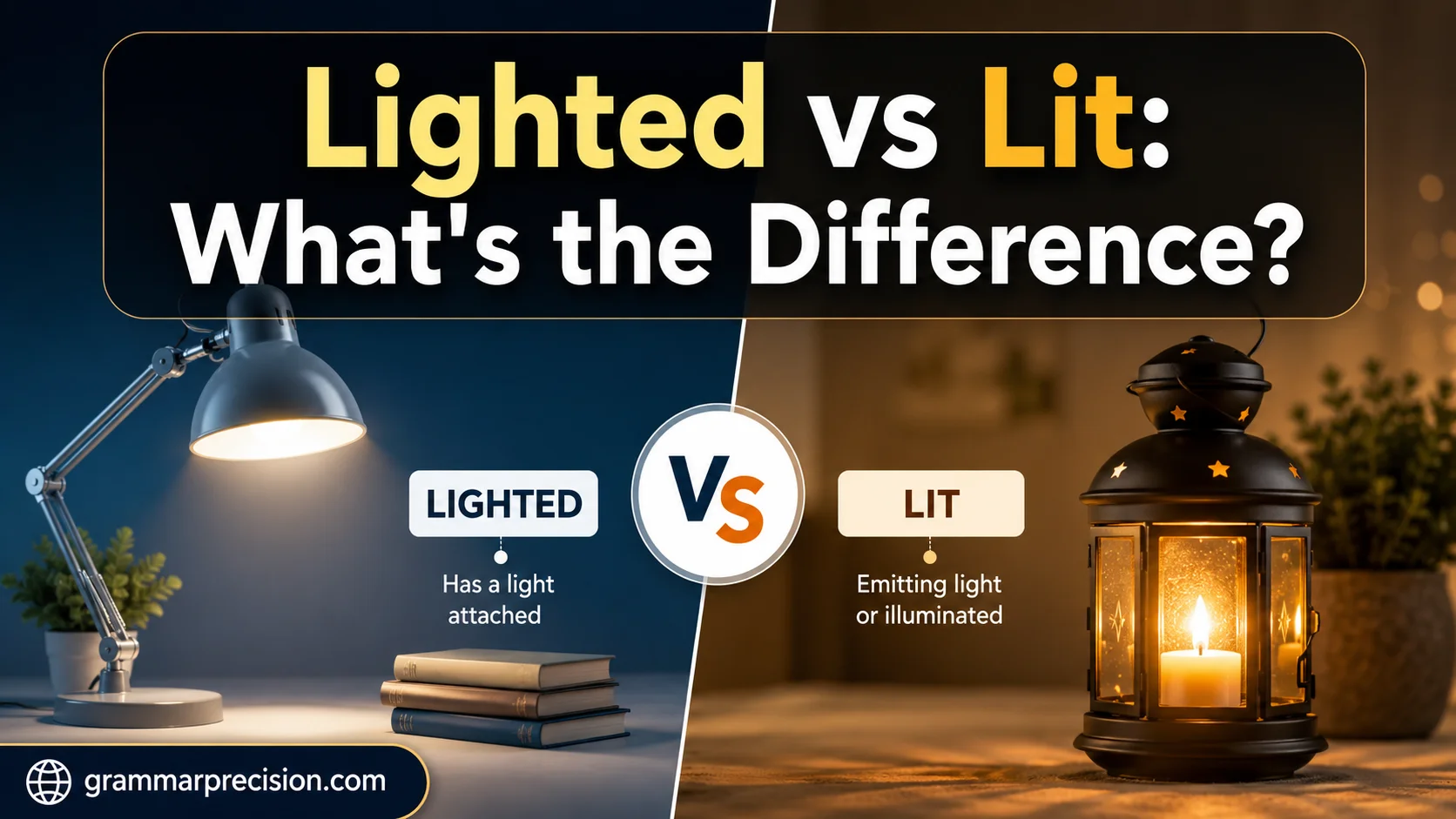
Lighted vs Lit can confuse writers, but both forms are correct. Lit commonly works as a verb, while lighted often functions as an adjective in everyday English writing usage.
Both lighted and lit are past tense and past participle forms of the verb to light. They have long histories in English, and both remain correct across the English-speaking world. However, lit is more common as a verb form, while lighted often describes something already illuminated, such as a lighted grill, in modern English.
In modern writing, your choice can depend on context and preference. Lit is generally favored outside the U.S., while lighted appears more often in American English. Both forms are hundreds of years old, so neither is exclusively British or American. The simple answer is to choose the form that sounds natural in your sentence for you.
Lighted vs Lit in One Minute
Before digging into the finer points, here’s the quick version:
| Word | Basic role | Common use | Example |
| Lit | Past tense and past participle | Everyday English | She lit the candle. |
| Lighted | Past tense, past participle, and adjective | Descriptive or established phrases | A lighted candle stood nearby. |
| Lit | Adjective | Describing something illuminated | The hallway was lit by lamps. |
| Lighted | Adjective | Often placed before a noun | They followed a lighted path. |
Modern dictionaries recognize both lit and lighted as forms of the verb light. Merriam-Webster lists the verb as “lit or lighted,” while Cambridge gives lit as the past tense and past participle and also recognizes lighted.
That means you don’t need to treat lighted as a mistake.
The more useful question is this: Which form sounds natural in your particular sentence?
What Does “Lit” Mean?
Lit is the most familiar past form of light in everyday English. You use it when someone ignites something, causes something to burn, or illuminates an area.
For example:
- She lit a candle.
- He lit the fireplace.
- They lit the lantern.
- The moon lit the path.
- Someone lit the match.
In these sentences, lit clearly describes an action that happened in the past.
The verb pattern looks like this:
light → lit → lit
The first form is the base verb. The second is the simple past. The third is the past participle.
For example:
She lights the candle every evening.
She lit the candle yesterday.
She has lit the candle already.
This irregular pattern is similar to other familiar English verbs such as sing → sang → sung and write → wrote → written. English doesn’t always follow one neat formula, which is why verb forms can occasionally feel like a box of mismatched socks.
Lit as a Past-Tense Verb
When the action happened in the past, lit is often the most natural choice.
- James lit the grill before dinner.
- Maria lit a match.
- The campers lit a fire.
- He lit the lamp when the room became dark.
In ordinary conversation, these sentences sound smooth and familiar.
Lit as a Past Participle
Lit can also follow helping verbs such as has, have, had, or was.
- She has lit the candles.
- They had lit the fire before sunset.
- The room was lit by several lamps.
- The stage was brightly lit.
Here, lit doesn’t simply tell you that an action happened. It can also describe the resulting condition.
Lit as an Adjective
Lit can function as an adjective meaning illuminated or provided with light.
Consider these examples:
- We entered a lit hallway.
- The street was brightly lit.
- They walked along a lit path.
- The room was softly lit.
This use is especially common when describing places, spaces, and visual settings.
What Does “Lighted” Mean?
Lighted is also a legitimate form of the verb light. It can work as a past-tense verb, a past participle, or an adjective.
For example:
- She lighted the candle.
- He lighted the fireplace.
- The workers lighted the torches.
- A lighted candle sat on the table.
Merriam-Webster specifically gives lighted or lit as forms of the verb.
However, there’s an important usage point.
Although lighted is grammatically correct, lit is generally the more natural choice for many everyday past-tense actions.
Compare:
- She lit the candle.
- She lighted the candle.
Both are grammatically possible. The first usually sounds more natural in ordinary American English.
Lighted as an Adjective
Where lighted becomes especially useful is in descriptive phrases before nouns.
For example:
- a lighted candle
- a lighted match
- a lighted fuse
- a lighted sign
- a lighted path
Cambridge specifically gives examples such as “a lighted candle/match” and “a lighted fuse.”
So, don’t assume that lit has completely replaced lighted. It hasn’t.
The Key Difference Between Lighted and Lit
The biggest practical difference isn’t grammatical correctness. Both forms can be correct.
The real distinction comes from usage and naturalness.
Lit tends to be the first choice when you’re talking about an action or describing something that has been illuminated.
Lighted often appears in established descriptive phrases, especially when it comes directly before a noun.
Consider these examples:
| Sentence | Naturalness | Explanation |
| She lit the candle. | Very natural | Common past-tense use |
| She lighted the candle. | Correct | Less common in everyday speech |
| The candle was lit. | Very natural | Common participle |
| A lighted candle sat nearby. | Natural | Established descriptive pattern |
| The room was lit by candles. | Very natural | Common passive construction |
| A lighted sign hung above the door. | Natural | Descriptive adjective |
Think of it this way: lit is often the workhorse, while lighted has some favorite jobs of its own.
Lighted vs Lit Examples by Situation
Context makes this comparison much easier.
Candles
For an action, lit is usually the natural choice:
- She lit three candles.
- He lit a candle during the ceremony.
- We lit the candles before dinner.
As an adjective, however, lighted can sound perfectly natural:
- A lighted candle stood beside the window.
- She carried a lighted candle upstairs.
You can also say lit candle. The difference isn’t about correctness. It’s about the particular construction and the rhythm of the sentence.
Fires and Fireplaces
Both forms can describe a fire:
- Dad lit the fireplace.
- Dad lighted the fireplace.
- The fireplace was lit before the guests arrived.
- A lighted fireplace warmed the room.
Again, lit usually feels more conversational when describing the action.
Cigarettes and Matches
With cigarettes and matches, lit is especially common:
- He lit a cigarette.
- She lit a match.
- The match wouldn’t stay lit.
- He used a lit match to start the fire.
These are straightforward action-and-result constructions.
Rooms and Buildings
When talking about illumination, lit is extremely useful:
- The room was brightly lit.
- The hallway was poorly lit.
- The building was lit with blue lights.
- The stage was dramatically lit.
You can also use lighted in some descriptive contexts:
- a lighted room
- a lighted building
- a lighted hallway
Yet these often compete with more natural expressions such as well-lit room or brightly lit hallway.
Roads, Streets, and Paths
Both words can work:
- We walked along a lit street.
- We followed a lighted path.
- The road was brightly lit.
- They stayed on the lighted trail.
The choice often depends on the noun and the phrase you want to build.
Signs and Displays
Lighted is particularly comfortable in descriptive noun phrases:
- a lighted sign
- a lighted display
- a lighted advertisement
You can also describe the result with lit:
- The sign was lit all night.
- The display was brightly lit.
That small shift in structure can make one form sound much smoother than the other.
Why “Lit” Sounds More Natural in Some Sentences
Language isn’t governed only by grammar rules. Usage patterns matter too.
Native speakers repeatedly encounter certain combinations. Over time, those combinations become familiar. That’s why “lit the candle” usually feels more effortless than “lighted the candle”, even though both can be grammatically defensible.
Merriam-Webster’s examples include everyday constructions such as “we lit the kindling”, which reflects this common usage.
This doesn’t mean lighted is old-fashioned or incorrect. It simply means that lit has become the default choice in many ordinary situations.
A Simple Comparison
Action: She lit the candle.
Description: A lighted candle sat on the table.
That’s not an unbreakable rule. It’s a useful pattern.
Also Read This: Blatant vs Flagrant: Which Word Should You Use?
Why “Lighted” Still Matters
If lit is so common, why keep lighted around?
Because English uses it naturally in several established constructions.
Cambridge defines lighted as an adjective meaning burning or starting to burn and gives examples involving candles, matches, and fuses.
You’ll encounter phrases such as:
- lighted candle
- lighted match
- lighted fuse
- lighted sign
- lighted path
- lighted display
In these expressions, lighted can function smoothly as a descriptive modifier.
There’s also a useful stylistic advantage. Lighted has two clear syllables, while lit is extremely compact. Depending on the sentence, writers may prefer one for rhythm, emphasis, or clarity.
Lighted vs Lit in American English
In American English, lit is a very common form of the past tense and past participle of light. Cambridge lists lit as the past tense and past participle while also recognizing lighted.
For everyday writing, these are natural:
- She lit the candle.
- He lit the grill.
- They lit a fire.
- The room was lit by candles.
However, American English also uses lighted in descriptive phrases:
- a lighted candle
- a lighted sign
- a lighted fuse
So the American-English rule isn’t “always use lit.”
A better rule is:
Use the form that fits the construction naturally.
Lighted vs Lit in British English
British English also recognizes both forms, although usage can vary by context and speaker.
The important point is that regional variation doesn’t turn one form into a universal grammatical error.
If you’re writing for an international audience, lit is generally a safe and widely understood choice for ordinary past-tense uses.
For descriptive phrases, though, lighted remains perfectly understandable and can be idiomatic.
In other words, don’t turn a usage preference into a grammar emergency.
Common Phrases You Should Know
Some combinations occur so often that memorizing them can save you considerable hesitation.
| Phrase | Meaning |
| lit candle | A candle that has been ignited |
| lighted candle | A candle that is burning |
| well-lit room | A room with plenty of illumination |
| lighted sign | A sign provided with illumination |
| lit fireplace | A fireplace containing a burning fire |
| lighted path | A path illuminated by lights |
| brightly lit street | A street strongly illuminated |
| dimly lit room | A room with weak lighting |
Notice something interesting: “well-lit,” “brightly lit,” and “dimly lit” are especially common combinations.
The past participle lit works naturally after adverbs such as well, brightly, and dimly.
Examples:
- a well-lit office
- a brightly lit stage
- a dimly lit restaurant
- a poorly lit hallway
When the compound adjective comes before a noun, the hyphen helps show that the words work together as one modifier.
Lighted vs Lit in Formal Writing
For formal writing, the best choice depends on what you’re saying rather than how formal the document is.
In academic, business, and professional writing, lit is completely acceptable:
- The laboratory was lit by overhead fixtures.
- Researchers lit the samples using a controlled flame.
- The exhibition hall was well-lit.
There’s no need to replace lit with lighted simply to sound sophisticated.
At the same time, don’t “correct” an established phrase such as lighted candle just because lit is more common elsewhere.
Good writing isn’t about choosing the fanciest word. It’s about choosing the clearest and most natural word.
Lighted vs Lit: Common Mistakes
Several mistakes appear again and again.
Mistake: Assuming “Lighted” Is Wrong
It’s not.
Lighted is a legitimate form of the verb light. Major dictionaries recognize it.
Mistake: Using “Light” for a Past Action
Don’t write:
She light the candle yesterday.
Use:
She lit the candle yesterday.
Or, where appropriate:
She lighted the candle yesterday.
Mistake: Thinking “Lit” Is Only Slang
Modern English also uses lit in slang, especially to describe something exciting or lively.
For example:
The concert was lit.
That meaning is separate from the traditional verb form.
Context tells you which meaning applies.
Mistake: Treating “Lit” and “Lighted” as Completely Interchangeable
They overlap, but they don’t always sound equally natural.
Compare:
She lit the candle.
with:
She lighted the candle.
Both can work. The first is usually more natural in ordinary conversation.
Now compare:
a lighted candle
with:
a lit candle
Both are possible, but lighted candle is an established descriptive construction.
A Quick Decision Tree for Lighted vs Lit
When you’re stuck, use this simple process:
Are you talking about the past form of “light”?
↓
Yes
↓
Is it an ordinary action?
↓
Choose “lit”
↓
Are you describing a noun?
↙ ↘
Yes No
↓ ↓
Check the phrase “Lit” is often
for natural usage the natural choice
↓
“Lighted” may work well
in established descriptions
This isn’t a rigid grammar law. It’s a practical shortcut.
If you’re writing “She ___ the candle,” choose lit.
If you’re writing “a ___ candle,” both lit and lighted may work, depending on the intended style and context.
Lighted vs Lit: A Mini Case Study
Imagine you’re describing a quiet dinner scene.
Version A
Sarah lit the candles as the guests arrived. The dining room was softly lit by their warm glow.
This version sounds natural and conversational. Lit handles both the past action and the resulting illumination.
Version B
Sarah lighted the candles as the guests arrived. A lighted candle stood beside every plate.
This version is also grammatical. However, the repeated lighted gives the prose a slightly different rhythm.
The Lesson
Neither paragraph contains a basic grammar error. The difference comes from style, collocation, and context.
That distinction matters because grammar isn’t always a binary game of right versus wrong. Sometimes two forms are valid while one is simply more idiomatic in a particular setting.
20 Example Sentences With Lighted and Lit
Examples With “Lit”
- She lit the candle before dinner.
- He lit the fireplace at dusk.
- They lit a campfire near the lake.
- Maria lit a match.
- The candles were lit at sunset.
- The room was softly lit.
- The street was brightly lit.
- His face lit up when he heard the news.
- The stage was lit with blue lights.
- The lantern lit the narrow path.
Examples With “Lighted”
- A lighted candle stood beside the bed.
- They followed a lighted path.
- A lighted sign marked the entrance.
- She carried a lighted lantern.
- The lighted fuse burned quickly.
- A lighted match fell onto the ground.
- The lighted display attracted visitors.
- We sat beside a lighted fireplace.
- A lighted sign guided travelers toward the hotel.
- The building had a lighted entrance.
The pattern becomes clearer after seeing these examples side by side: lit dominates many action and participle constructions, while lighted remains useful in descriptive phrases.
Lighted vs Lit: Quick Reference Table
| Question | Best practical answer |
| Is lit correct? | Yes |
| Is lighted correct? | Yes |
| Is lit a past form of light? | Yes |
| Is lighted a past form of light? | Yes |
| Which is usually more natural for an ordinary past action? | Lit |
| Can lighted work as an adjective? | Yes |
| Can lit work as an adjective? | Yes |
| Is well-lit common? | Yes |
| Is lighted candle correct? | Yes |
| Is lit candle correct? | Yes |
Lighted vs Lit: The Easiest Rule to Remember
If you want one practical rule, remember this:
Use “lit” as your default past form of “light.” Keep “lighted” when it naturally fits a descriptive phrase or established expression.
For example:
Natural everyday action:
She lit the candle.
Natural descriptive phrase:
A lighted candle rested on the table.
Natural compound adjective:
We entered a well-lit room.
Once you recognize these patterns, the choice becomes much less mysterious.
FAQs:
Is “Lighted” or “Lit” Correct?
Both lighted and lit are correct past tense and past participle forms of the verb to light. However, lit is more common when describing an action, while lighted often works as an adjective.
Is “Lit” More Common Than “Lighted”?
Yes, lit is generally more common as a verb, especially when describing an action. For example, “She lit the candle” sounds natural. Lighted is also correct, particularly when it describes something that has been illuminated.
Is “Lighted” More Common in American English?
Lighted appears more often in American English than in some other varieties of English. However, it isn’t exclusively American. Lit is widely understood and commonly used throughout the English-speaking world.
Can “Lighted” Be Used as an Adjective?
Yes. Lighted can function as an adjective when it describes something that has been illuminated. For example, “We walked along a lighted street.” This use is different from the action-focused use of lit.
Should I Use “Lit” or “Lighted” in Writing?
Choose based on context, grammar, and your preferred style. When you’re describing an action, lit is often the more natural choice. When describing an illuminated object or place, lighted may fit better. Both forms are grammatically acceptable.
Conclusion:
Lighted vs Lit is not a matter of one form being correct and the other incorrect. Lit is usually the more natural choice for an action, while lighted often works as an adjective. Both forms have a long history in the English language and remain acceptable today.
When in doubt, consider the context and choose the form that sounds most natural.